
Autonomous Sprayer Robot Market Report 2026
Global Outlook – By Type (Self-Propelled, Tractor-Mounted, Drone-Based), By Technology (Global Positioning System (GPS) Or Global Navigation Satellite System (GNSS), Computer Vision, Artificial Intelligence And Machine Learning, Sensors), By Application (Agriculture, Horticulture, Greenhouse, Forestry, Other Applications), By End-User (Large Farms, Small And Medium Farms, Research Institutes, Other End Users) – Market Size, Trends, Strategies, and Forecast to 2030
Autonomous Sprayer Robot Market Overview
• Autonomous Sprayer Robot market size has reached to $1.5 billion in 2025 • Expected to grow to $3.68 billion in 2030 at a compound annual growth rate (CAGR) of 19.7% • Growth Driver: Rising Food Production Demand Driving Growth In The Market Due To Increasing Efficiency And Higher Crop Yields • Market Trend: Next-Generation Technologies For Efficient Crop Spraying • North America was the largest region in 2025 and Asia-Pacific is the fastest growing region.What Is Covered Under Autonomous Sprayer Robot Market?
An autonomous sprayer robot is a self-operating agricultural machine designed to apply pesticides, herbicides, fertilizers, or water to crops without the need for manual intervention. These robots move precisely along crop rows, detect plant health, and adjust spraying patterns and quantities based on real-time data. An autonomous sprayer robot reduces labor requirements, minimizes chemical waste, and enhances efficiency by ensuring uniform application. The main types of autonomous sprayer robots are self-propelled, tractor-mounted, and drone-based. Self-propelled robots are equipped with their own engine and mobility system, enabling independent movement across fields. They utilize technologies such as global positioning system (GPS) or global navigation satellite system (GNSS), computer vision, artificial intelligence and machine learning, and sensors. These robots are applied in agriculture, horticulture, greenhouses, forestry, and other fields, serving end-users including large farms, small and medium farms, research institutes, and others.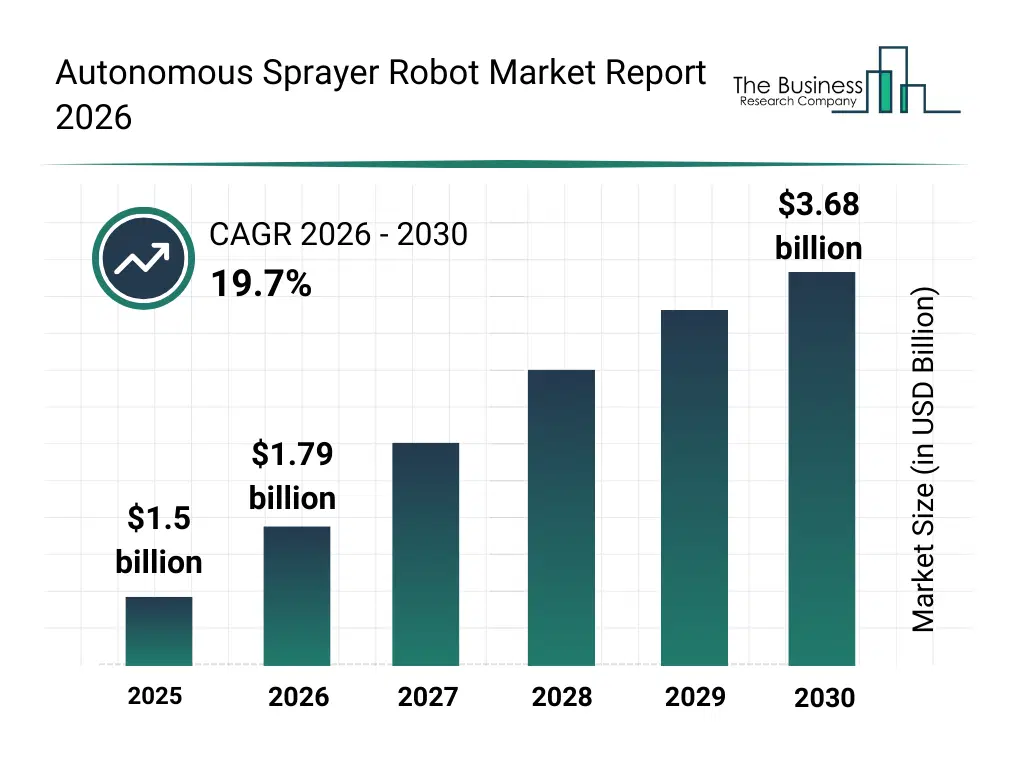
What Is The Autonomous Sprayer Robot Market Size and Share 2026?
The autonomous sprayer robot market size has grown rapidly in recent years. It will grow from $1.5 billion in 2025 to $1.79 billion in 2026 at a compound annual growth rate (CAGR) of 19.8%. The growth in the historic period can be attributed to increasing labor shortages in agriculture, rising dependence on chemical-based crop protection, early adoption of gps-guided sprayers, growing need for uniform chemical application, escalating operational inefficiencies in manual spraying.What Is The Autonomous Sprayer Robot Market Growth Forecast?
The autonomous sprayer robot market size is expected to see rapid growth in the next few years. It will grow to $3.68 billion in 2030 at a compound annual growth rate (CAGR) of 19.7%. The growth in the forecast period can be attributed to growing use of AI-enabled variable rate spraying, increasing shift toward sustainable pesticide usage, rising adoption of drone-based spraying, expanding government incentives for precision agriculture, increasing integration of real-time crop health monitoring. Major trends in the forecast period include adoption of autonomous sprayers for precision chemical application, integration of real-time computer vision for targeted spraying, growing use of drone-based sprayers for hard-to-reach areas, expansion of multi-crop spraying robots for diverse farm needs, rise in demand for low-volume high-efficiency spraying technologies.
Global Autonomous Sprayer Robot Market Segmentation
1) By Type: Self-Propelled, Tractor-Mounted, Drone-Based 2) By Technology: Global Positioning System (GPS) Or Global Navigation Satellite System (GNSS), Computer Vision, Artificial Intelligence And Machine Learning, Sensors 3) By Application: Agriculture, Horticulture, Greenhouse, Forestry, Other Applications 4) By End-User: Large Farms, Small And Medium Farms, Research Institutes, Other End Users Subsegments: 1) By Self-Propelled: Wheeled, Tracked 2) By Tractor-Mounted: Boom Sprayer, Spot Sprayer 3) By Drone-Based: Multi-Rotor, Fixed-WingWhat Is Driver Of The Autonomous Sprayer Robot Market?
The rising demand for food production is expected to propel the growth of the autonomous sprayer robot market going forward. Food production refers to the process of growing, processing, and preparing food from raw ingredients for human consumption. Increasing food production is necessary to meet the growing demand caused by the rising global population. Autonomous sprayer robots help food production by efficiently applying fertilizers and pesticides, reducing crop damage, saving labor, and increasing overall yield. For instance, in April 2025, according to Department for Environment, Food & Rural Affairs, a UK-based government agency, production in the UK accounted for 58% of domestic consumption in 2023 (based on unprocessed value at farmgate), followed by the EU at 24% and the rest of the world at 18%. Therefore, the rising demand for food production is driving the growth of the autonomous sprayer robot industry.Key Players In The Global Autonomous Sprayer Robot Market
Major companies operating in the autonomous sprayer robot market are Deere & Company, CNH Industrial N.V., Kubota Corporation, Saga Robotics AS, Solinftec, Yanmar Holdings Co. Ltd., Carbon Robotics Inc., Blue White Robotics Ltd., LJ Tech, Burro Inc., Hylio AgTech LLC, MQ Autonomous Agritech, Ecorobotix SA, Iron Ox Inc., XAG Co. Ltd., AgXeed B.V., FarmDroid ApS, Naïo Technologies SAS, SwarmFarm Robotics Pty Ltd, Verdant Robotics Inc.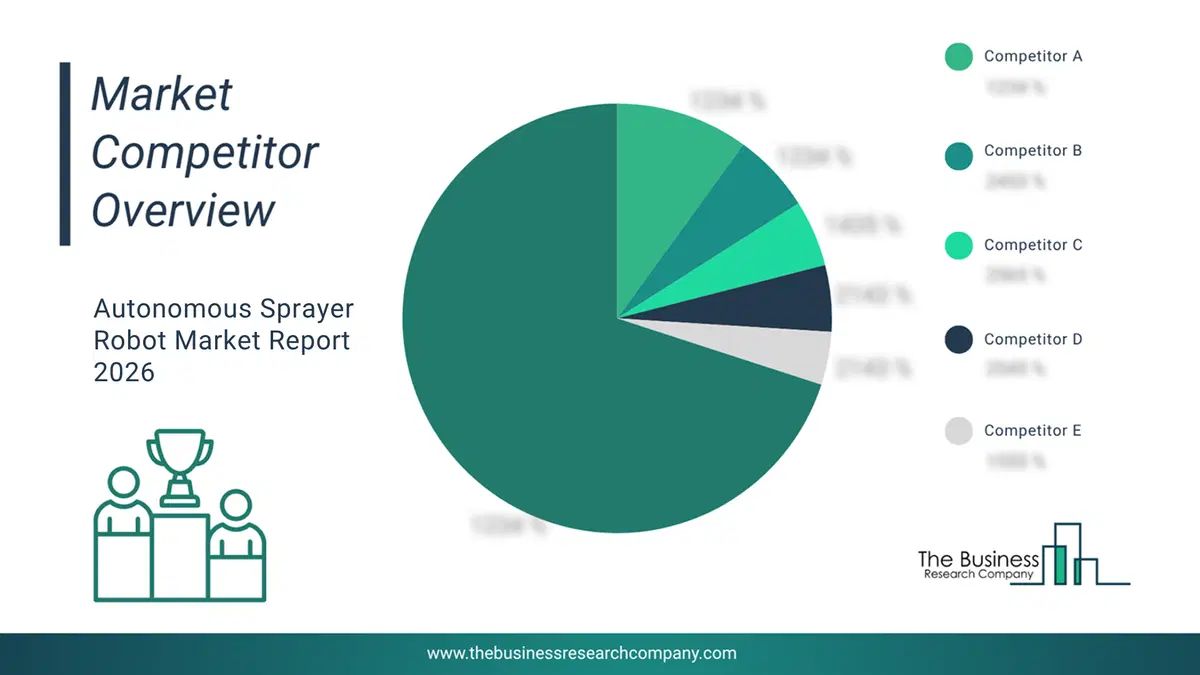
This chart is for illustrative purposes; the full report includes a detailed competitor analysis and comprehensive overview of the top 10 companies in the market.
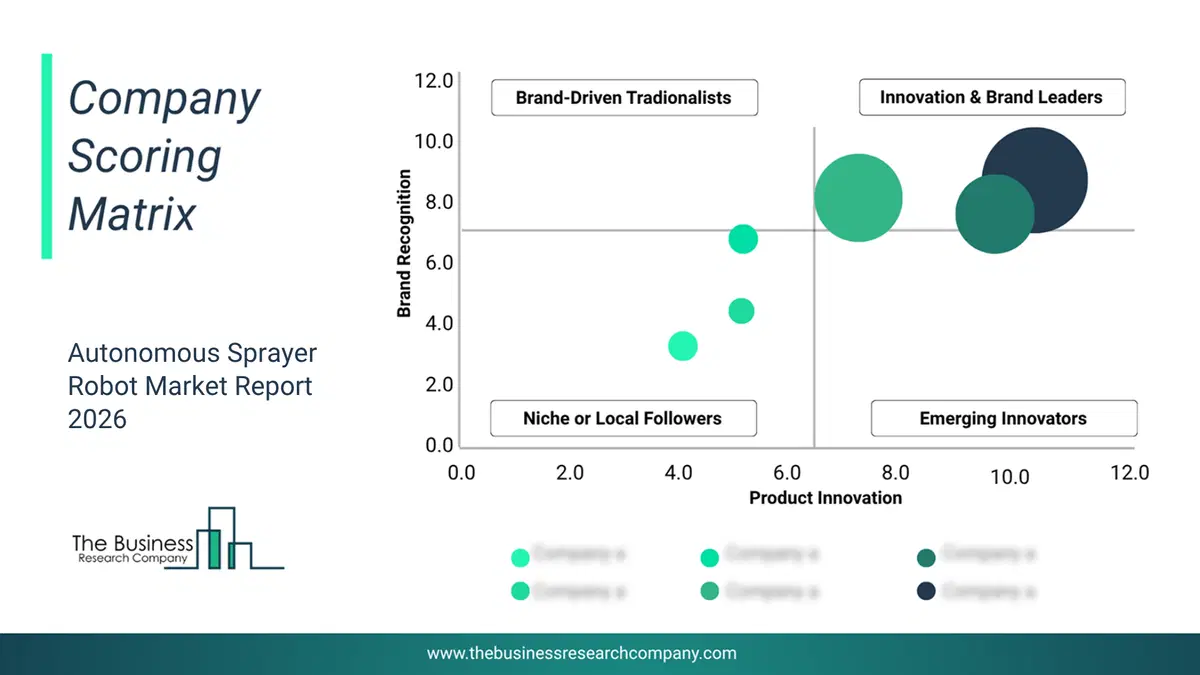
This chart maps companies by product innovation and brand strength, with bubble size indicating relative revenue, helping identify market leaders, challengers, and niche players. This is an illustrative chart; the full report provides a complete and accurate competitive analysis.
Global Autonomous Sprayer Robot Market Trends and Insights
Major companies operating in the autonomous sprayer robot market are focusing on developing technological advancements such as autonomous electric robot sprayers to enhance precision agriculture, improve operational efficiency, and reduce labor and chemical usage. An autonomous electric robot sprayer refers to a self-operating, electrically powered agricultural machine designed to apply fertilizers, pesticides, or herbicides to crops with minimal human intervention, using sensors, GPS, and AI for precise navigation and spraying. For instance, in November 2024, Merlo S.p.A., an Italy-based manufacturing company, launched a Cingo M600A-e designed for precision crop spraying. It is designed for specialized crops such as vineyards, offering precise, GPS-guided spraying with automatic obstacle detection. Its lightweight design reduces soil compaction while enabling continuous 24-hour operation, increasing productivity and sustainability. The robot’s adaptable platform supports future tool attachments, making it a versatile solution for efficient and eco-friendly crop management.What Are Latest Mergers And Acquisitions In The Autonomous Sprayer Robot Market? Deere & Company Acquires GUSS Automation LLC To Advance Autonomous Sprayer Robot Innovation And Precision Agriculture Integration
In August 2025, Deere & Company, a US-based manufacturing company, acquired GUSS Automation LLC for an undisclosed amount. With this acquisition, Deere & Company aims to expand GUSS's commercial reach, accelerate innovation in autonomous spraying, and fully integrate precision agriculture technologies to enhance efficiency and productivity for high-value crop growers. GUSS Automation LLC is a US-based manufacturing company that offers autonomous sprayer robots.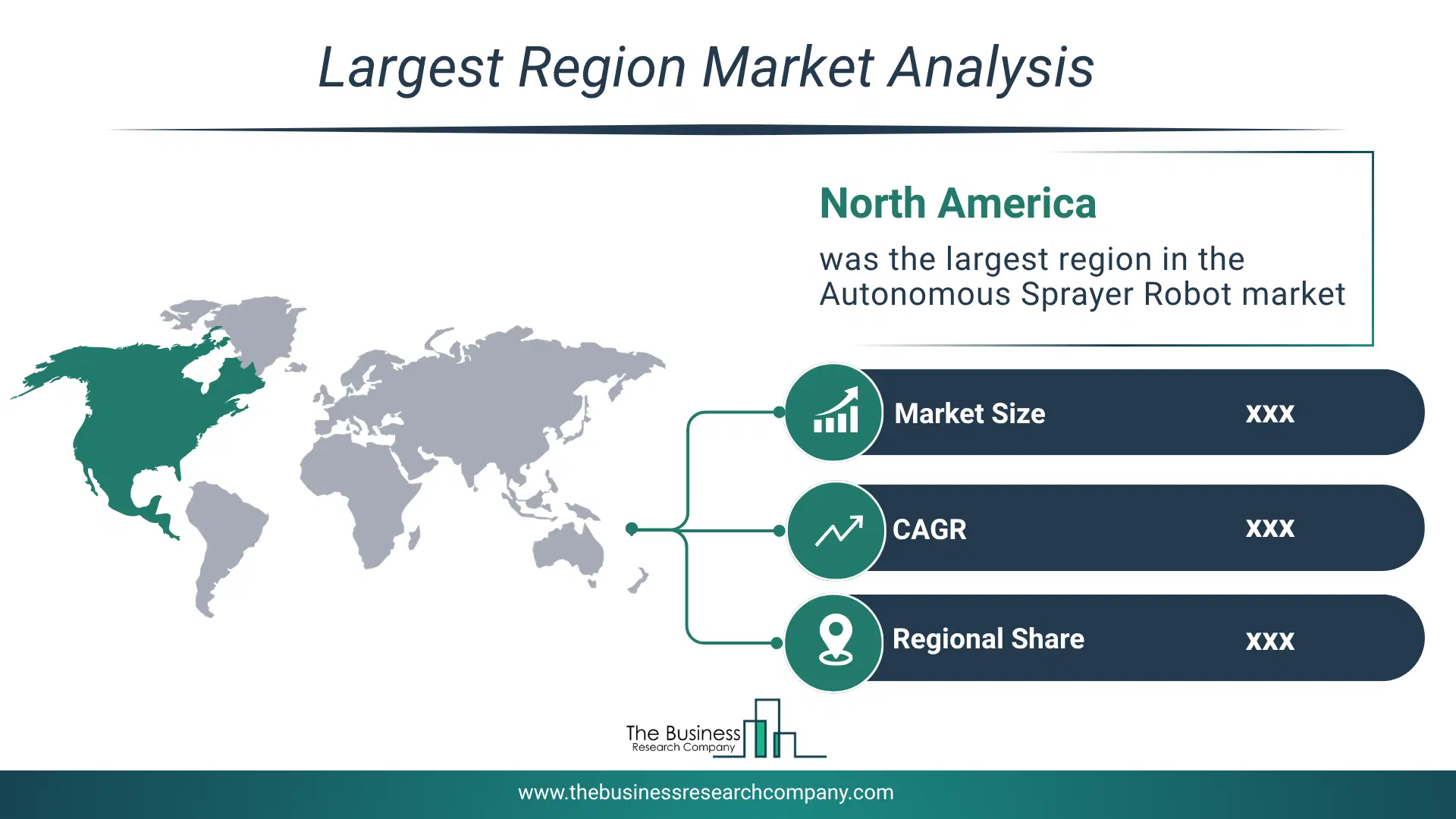
Regional Outlook
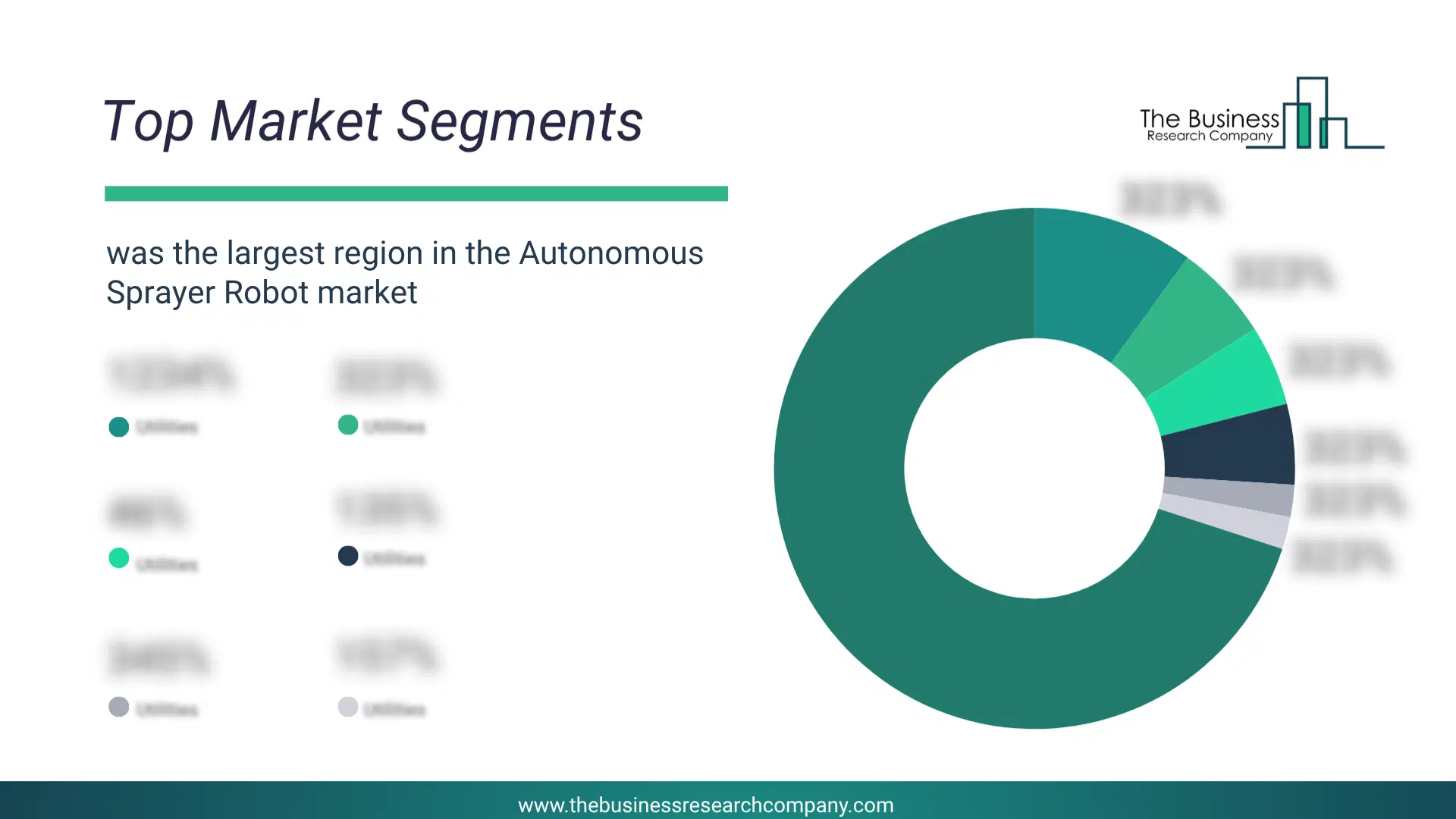
North America was the largest region in the autonomous sprayer robot market in 2025. Asia-Pacific is expected to be the fastest-growing region in the forecast period. The regions covered in this market report are Asia-Pacific, South East Asia, Western Europe, Eastern Europe, North America, South America, Middle East, Africa. The countries covered in this market report are Australia, Brazil, China, France, Germany, India, Indonesia, Japan, Taiwan, Russia, South Korea, UK, USA, Canada, Italy, SpainWhat Defines the Autonomous Sprayer Robot Market?
The autonomous sprayer robot market includes revenues earned by entities by providing services such as precision crop spraying, field monitoring, and automated navigation. Only goods and services traded between entities or sold to end consumers are included. The autonomous sprayer robot market consists of sales of fertilizer spraying systems, smart navigation robots, and drone sprayers. Values in this market are ‘factory gate’ values; that is, the value of goods sold by the manufacturers or creators of the goods, whether to other entities (including downstream manufacturers, wholesalers, distributors, and retailers) or directly to end customers. The value of goods in this market includes related services sold by the creators of the goods.How is Market Value Defined and Measured?
The market value is defined as the revenues that enterprises gain from the sale of goods and/or services within the specified market and geography through sales, grants, or donations in terms of the currency (in USD unless otherwise specified). The revenues for a specified geography are consumption values that are revenues generated by organizations in the specified geography within the market, irrespective of where they are produced. It does not include revenues from resales along the supply chain, either further along the supply chain or as part of other products.
This chart presents market attractiveness based on a quantitative evaluation of growth, competition, strategic alignment, and risk, offering a clear view of opportunity areas for decision-making. This chart is for illustrative purposes; the full report contains the complete analysis.

This chart highlights the Total Addressable Market (TAM) by estimating the maximum revenue opportunity using an assumption-driven approach, supporting strategic planning and opportunity sizing across markets. The chart is illustrative; the full report provides a more comprehensive analysis.
What Key Data and Analysis Are Included in the Autonomous Sprayer Robot Market Report 2026?
The autonomous sprayer robot market research report is one of a series of new reports from The Business Research Company that provides market statistics, including industry global market size, regional shares, competitors with the market share, detailed market segments, market trends and opportunities, and any further data you may need to thrive in the autonomous sprayer robot industry. The market research report delivers a complete perspective of everything you need, with an in-depth analysis of the current and future state of the industry.Autonomous Sprayer Robot Market Report Forecast Analysis
| Report Attribute | Details |
|---|---|
| Market Size Value In 2026 | $1.79 billion |
| Revenue Forecast In 2030 | $3.68 billion |
| Growth Rate | CAGR of 19.7% from 2026 to 2030 |
| Base Year For Estimation | 2025 |
| Actual Estimates/Historical Data | 2020-2025 |
| Forecast Period | 2026 - 2030 |
| Market Representation | Revenue in USD Billion and CAGR from 2026 to 2030 |
| Segments Covered | Type, Technology, Application, End-User |
| Regional Scope | Asia-Pacific, Western Europe, Eastern Europe, North America, South America, Middle East, Africa |
| Country Scope | The countries covered in the report are Australia, Brazil, China, France, Germany, India, Indonesia, Japan, Taiwan, Russia, South Korea, UK, USA, Canada, Italy, Spain |
| Key Companies Profiled | Deere & Company, CNH Industrial N.V., Kubota Corporation, Saga Robotics AS, Solinftec, Yanmar Holdings Co. Ltd., Carbon Robotics Inc., Blue White Robotics Ltd., LJ Tech, Burro Inc., Hylio AgTech LLC, MQ Autonomous Agritech, Ecorobotix SA, Iron Ox Inc., XAG Co. Ltd., AgXeed B.V., FarmDroid ApS, Naïo Technologies SAS, SwarmFarm Robotics Pty Ltd, Verdant Robotics Inc. |
| Customization Scope | Request for Customization |
| Pricing And Purchase Options | Explore Purchase Options |