
Contact Us
  Search
The Business Research Company Logo
Global Autonomous Surgical Robotics Market Report 2026
Published :September 2026
Pages :250
Format :PDF
Delivery Time :2-3 Business Days
Why 2-3 days? We update the report with the latest data and news before delivery. Let us know if you need us to expedite.
Report Price :$4,490.00

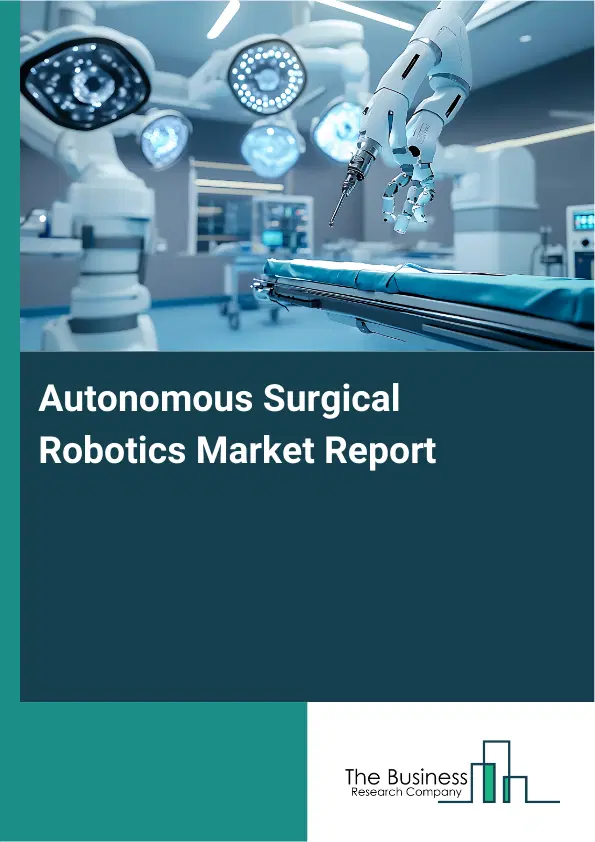
Autonomous Surgical Robotics Market Report 2026

Global Outlook – By Type (Interventional Surgical Robots, Assisted Surgical Robots, Minimally Invasive Surgical Robots, Other Types), By Application (Urology Surgery, Orthopedic Surgery, Cardiology Surgery, Neurology Surgery, Other Applications), By End-Users (Hospitals, Ambulatory Surgery Centers, Other End-Users) – Market Size, Trends, Strategies, and Forecast to 2030

Autonomous Surgical Robotics Market Overview

• Autonomous Surgical Robotics market size has reached to $2.61 billion in 2025 • Expected to grow to $5.64 billion in 2030 at a compound annual growth rate (CAGR) of 16.6% • Growth Driver: Rising Demand For Minimally Invasive Surgeries Fueling The Growth Of The Market Due To Shorter Recovery Time And Lower Complication Risks • Market Trend: AI-Driven Robotic Systems Improve Orthopedic Surgical Outcomes • North America was the largest region in 2025 and Asia-Pacific is the fastest growing region.

Market Gains By 2030 – Top Opportunities By Segment

Hospitals
Segmentation By End User
+ $1741.83 Million
Minimally Invasive Surgical Robots
Segmentation By Type
+ $1226.43 Million
Orthopedic Surgery
Segmentation By Application
+ $905.54 Million

Market Gain identifies the most promising market opportunities by highlighting the segments or products expected to generate the highest incremental revenue growth over the next five years.

The key promising market opportunities in the autonomous surgical robotics market include: • Hospitals (Segmentation By End User) → Expected gain of $1741.83 MillionMinimally Invasive Surgical Robots (Segmentation By Type) → Expected gain of $1226.43 MillionOrthopedic Surgery (Segmentation By Application) → Expected gain of $905.54 Million

What Is Covered Under Autonomous Surgical Robotics Market?

Autonomous surgical robotics refers to advanced robotic systems capable of performing surgical tasks with minimal or no human intervention by using artificial intelligence and real-time data. These systems aim to enhance surgical precision, reduce human error, and improve patient outcomes by automating complex procedures. The main types of autonomous surgical robotics are interventional surgical robots, assisted surgical robots, minimally invasive surgical robots, and others. Interventional surgical robots are advanced robotic systems designed to assist in minimally invasive procedures by precisely navigating instruments through small incisions or natural orifices, often under image guidance. These robots are applied across a wide range of surgical specialties, including urology surgery, orthopedic surgery, cardiology surgery, neurology surgery, and others, serving end users such as hospitals, ambulatory surgery centers, and others.
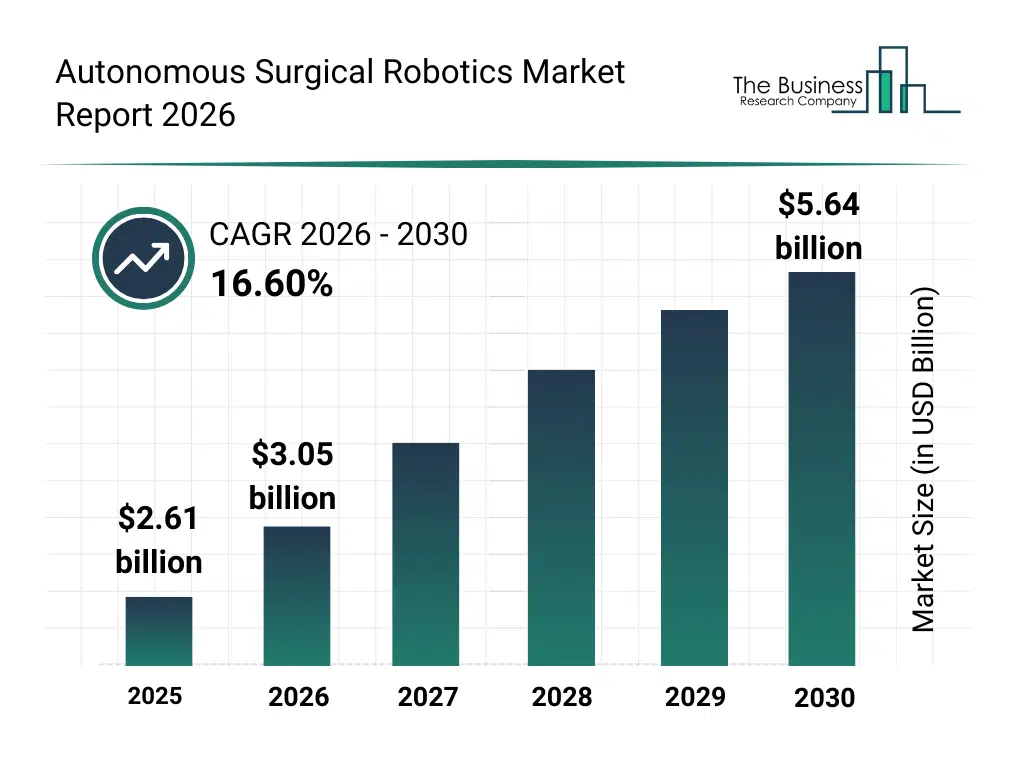
Autonomous Surgical Robotics market report bar graph

What Is The Autonomous Surgical Robotics Market Size and Share 2026?

The autonomous surgical robotics market size has grown rapidly in recent years. It will grow from $2.61 billion in 2025 to $3.05 billion in 2026 at a compound annual growth rate (CAGR) of 16.9%. The growth in the historic period can be attributed to high dependence on manual surgical procedures, early adoption of basic robotic-assisted surgery, limited ai capabilities in operating rooms, rising need for complex surgeries, growing hospital infrastructure in developed regions.

What Is The Autonomous Surgical Robotics Market Growth Forecast?

The autonomous surgical robotics market size is expected to see rapid growth in the next few years. It will grow to $5.64 billion in 2030 at a compound annual growth rate (CAGR) of 16.6%. The growth in the forecast period can be attributed to advancement in autonomous surgical robotics, integration of ai and machine learning algorithms, expansion of robotic surgery applications across specialties, increased investments in smart operating rooms, rising healthcare expenditure in emerging economies. Major trends in the forecast period include increasing adoption of minimally invasive surgical procedures, rising demand for precision and accuracy in surgeries, integration of real-time data analytics in surgical procedures, expansion of robotic surgery in emerging markets, focus on reducing human error and improving patient outcomes.
Research Expert

Book your 30 minutes free consultation with our research experts

Major Segmentation Breakdown Chart Of The Autonomous Surgical Robotics Market.

Global Autonomous Surgical Robotics Market Segmentation

1) By Type: Interventional Surgical Robots, Assisted Surgical Robots, Minimally Invasive Surgical Robots, Other Types 2) By Application: Urology Surgery, Orthopedic Surgery, Cardiology Surgery, Neurology Surgery, Other Applications 3) By End-Users: Hospitals, Ambulatory Surgery Centers, Other End-Users Subsegments: 1) By Interventional Surgical Robots: Catheter-Based Interventional Robots, Endovascular Robots, Interventional Radiology Robots, Percutaneous Robots 2) By Assisted Surgical Robots: Robotic Arm Systems, Robotic Navigation Systems, Robotic Visualization Platforms, Robotic Positioning Systems 3) By Minimally Invasive Surgical Robots: Laparoscopic Robots, Thoracoscopic Robots, Robotic Endoscopes, Single-Port Surgical Robots 4) By Other Types: Orthopedic Surgical Robots, Neurosurgical Robots, Dental Surgical Robots, Microsurgical Robots, Autonomous Surgical Robots The top segments in the autonomous surgical robotics market will be: • Hospitals will reach $3569.45 Million by 2030.Minimally Invasive Surgical Robots will reach $2404.53 Million by 2030.Orthopedic Surgery will reach $1751.12 Million by 2030.Assisted Surgical Robots will reach $1461.58 Million by 2030.Urology Surgery will reach $1182.59 Million by 2030.

What Is The Driver Of The Autonomous Surgical Robotics Market?

The rising demand for minimally invasive surgeries is expected to propel the growth of the autonomous surgical robotics market. Minimally invasive procedures refer to medical interventions performed through small incisions or openings, reducing patient trauma and recovery time. The demand for minimally invasive surgical procedures is increasing due to their ability to offer shorter recovery times, reduced risks of complications, less pain, and smaller scars, making them more appealing to patients seeking quicker and safer treatment options. Autonomous surgical robotics enhances minimally invasive surgeries by providing precise and consistent robotic assistance, reducing the need for large incisions. They improve surgical accuracy and patient outcomes while minimizing recovery time and surgeon fatigue. For instance, in June 2024, according to the American Society of Plastic Surgeons, a US-based non-profit organization, minimally invasive procedures grew by 7% in 2023, compared to 2022. Therefore, the rising demand for minimally invasive surgeries is driving the growth of the autonomous surgical robotics industry.
Infographic Chart Showing Key Market Drivers Analysis And Restraints For Autonomous Surgical Robotics Market

Infographic Chart Showing Key Market Drivers Analysis And Restraints For Autonomous Surgical Robotics Market

The chart presents an impact analysis of key drivers and restraints, quantifying their relative influence on the market's growth rate and helping assess the balance between growth enablers and limiting factors. This chart offers a high-level perspective; the full report contains more detailed insights.

Download the sample report for a detailed analysis Download Sample

How Will The Drivers Impact Growth In The Global Autonomous Surgical Robotics Market?

Expansion Of Smart Operating Rooms (High) – During the forecast period, the expansion of smart operating rooms is expected to driver the growth in the autonomous surgical robotics market. As healthcare systems increasingly adopt digitally integrated surgical environments that combine robotics, advanced imaging technologies, artificial intelligence, and real-time data connectivity, hospitals and surgical centers are transforming conventional operating theaters into intelligent surgical ecosystems capable of supporting highly precise and automated procedures. The rising development of smart operating room infrastructure is projected to expand the deployment of robotic-assisted surgical platforms across hospitals and ambulatory surgery centers, leading to heightened demand for integrated robotic technologies that enable enhanced surgical visualization, automated instrument control, and seamless data-driven surgical workflows. A broader expansion of smart operating room ecosystems increases the use of AI-enabled surgical planning, connected surgical devices, and intelligent operating room management systems, driving sustained demand for advanced autonomous surgical robotics solutions. The expansion of smart operating rooms growth contribution during the forecast period in 2025 is 2.5%. • Increasing Investments And Need For Digital Surgery Technologies (High) – During the forecast period, the increasing investments and need for digital surgery technologies are expected to propel growth in the autonomous surgical robotics market. As healthcare systems accelerate the digital transformation of surgical care, hospitals and medical institutions are increasingly investing in robotic-assisted systems, AI-enabled surgical platforms, and advanced digital operating room infrastructure designed to enhance surgical precision, improve patient safety, and optimize procedural efficiency. The growing investment in digital surgery technologies is projected to expand the deployment of robotic-assisted surgical systems across hospitals and specialized surgical centers, leading to heightened demand for intelligent robotic platforms that support real-time surgical guidance, automated instrument control, and data-driven clinical decision-making. A broader adoption of digital surgery ecosystems increases the use of AI-powered surgical planning, integrated imaging technologies, and connected surgical devices, driving sustained demand for advanced autonomous surgical robotics solutions. The increasing investments and need for digital surgery technologies growth contribution during the forecast period in 2025 is 2.0%. • Growing Adoption Of Robotic-Assisted Surgery (Medium) – During the forecast period, the growing adoption of robotic-assisted surgery is expected to driver the autonomous surgical robotics market. As healthcare providers increasingly emphasize surgical approaches that improve precision, enhance visualization, and reduce patient recovery times, hospitals and surgical centers are expanding the use of robotic platforms across a broad range of clinical specialties including urology, gynecology, orthopedics, cardiothoracic surgery, and general surgery. The rising adoption of robotic-assisted surgical systems is projected to increase the number of robot-supported procedures performed globally, leading to heightened demand for advanced robotic platforms capable of enabling precise instrument control, improved surgical dexterity, and minimally invasive procedural techniques. A broader integration of robotic-assisted surgery within healthcare systems increases the use of AI-supported surgical planning, high-definition visualization systems, and automated surgical workflows, driving sustained demand for advanced autonomous surgical robotics solutions. The growing adoption of robotic-assisted surgery growth contribution during the forecast period in 2025 is 1.5%. • Rising Chronic Disease Burden (Medium) – During the forecast period, the rising chronic disease burden is expected to propel growth in the autonomous surgical robotics market. As the prevalence of long-term health conditions such as cardiovascular diseases, cancer, diabetes, and musculoskeletal disorders continues to increase across global populations, healthcare providers are experiencing greater demand for surgical interventions required to treat and manage these complex conditions. The growing burden of chronic diseases is projected to expand the number of surgical procedures performed across hospitals and specialized care facilities, leading to heightened demand for robotic-assisted surgical systems that enhance surgical precision, support minimally invasive techniques, and improve patient recovery outcomes. A broader rise in chronic disease prevalence increases the reliance on advanced surgical technologies, including AI-supported robotic platforms and precision-guided surgical systems, driving sustained demand for autonomous surgical robotics solutions. The rising chronic disease burden growth contribution during the forecast period in 2025 is 1.0%.

How Will The Restraints Impact Growth In The Global Autonomous Surgical Robotics Market?

Lack Of Trained Surgeons In Robotic Surgery (High) – During the forecast period, the lack of trained surgeons in robotic surgery is restricting the growth of the autonomous surgical robotics market. Limited availability of surgeons with specialized training in robotic-assisted procedures and increasing operational complexities associated with robotic surgical platforms are placing greater constraints on the adoption of advanced autonomous surgical technologies, particularly among hospitals and healthcare systems that lack dedicated robotic surgery training programs. From a clinical and operational perspective, developing proficiency in robotic surgery requires extensive training, simulator-based learning, procedural mentorship, and continuous skill development. These workforce limitations, coupled with steep learning curves associated with robotic platforms, limited integration of robotic training within traditional surgical education, and competing priorities in healthcare workforce development, intensify institutional caution around implementing comprehensive robotic surgical systems that require consistently trained and specialized surgical workforce. Growth affected by the lack of trained surgeons in robotic surgery during the forecast period in 2025 is -2.5%. • High Maintenance And Service Costs (High) – During the forecast period, high maintenance and service costs are restricting the growth of the autonomous surgical robotics market. Ongoing operational expenses and increasing financial pressures across healthcare institutions are placing greater scrutiny on investments in robotic surgical technologies. From a financial and operational perspective, allocating resources for robotic surgery platforms, including routine maintenance, service contracts, specialized instrument replacements, software upgrades, and technical support, requires careful prioritization against other critical healthcare investments, often leading to delayed procurement decisions or restricted use of robotic systems within surgical departments. These financial pressures, coupled with uncertainty around long-term return on investment, budget limitations in healthcare systems, and competing priorities for medical technology upgrades and infrastructure improvements, intensify institutional caution around deploying comprehensive robotic surgical platforms that require sustained operational and financial commitment. Growth affected by the high maintenance and service costs during the forecast period in 2025 is -1.5%. • Impact Of Trade War And Tariff (Medium) – During the forecast period, the impact of trade wars and tariffs is restricting the growth of the autonomous surgical robotics market. Rising geopolitical tensions and new tariffs on medical devices are increasing cost pressures across the global medtech industry, which in turn constrains the manufacturing and distribution of robotic surgical technologies. From a financial and operational perspective, tariffs on imported components, electronic modules, and precision parts used in robotic surgical systems increase production costs and complicate global supply chains. These additional costs often require manufacturers to adjust sourcing strategies, delay production expansion, or increase device prices for healthcare providers. These trade barriers, coupled with uncertainty around evolving international trade policies and reliance on globally distributed suppliers, intensify industry caution around scaling production and deploying advanced robotic surgical platforms. Growth affected by the impact of trade wars and tariffs during the forecast period in 2025 is -0.3%.

Key Players In The Global Autonomous Surgical Robotics Market

Major companies operating in the autonomous surgical robotics market are Johnson & Johnson, Medtronic plc, Stryker Corporation, Intuitive Surgical Inc., Zimmer Biomet Holdings Inc., Smith & Nephew plc, Globus Medical Inc., Renishaw plc, Memic Innovative Surgery Ltd., CMR Surgical Ltd., Noah Medical Inc., THINK Surgical Inc., Medical Microinstruments S.p.A., Distalmotion SA, Moon Surgical SAS, Activ Surgical Inc., Curexo Inc., Virtual Incision Corporation, Andromeda Surgical Inc, Beijing Tuodao Medical Technology Co. Ltd.
Top 10 Competitor Market Share Analysis Pie Chart For The Autonomous Surgical Robotics Market.

This chart is for illustrative purposes; the full report includes a detailed competitor analysis and comprehensive overview of the top 10 companies in the market.

Bubble Chart Of Company Scoring Matrix By Innovation, Brand And Revenue For The Autonomous Surgical Roboticsmarket

This chart maps companies by product innovation and brand strength, with bubble size indicating relative revenue, helping identify market leaders, challengers, and niche players. This is an illustrative chart; the full report provides a complete and accurate competitive analysis.

What Is The Market Share Of The Competitors In The Autonomous Surgical Robotics Market?

The market is fragmented, with the top 10 players accounting for 53.11% of total market revenue.
• Intuitive Surgical Inc. – 10.43%
• Stryker Corporation – 8.81%
• Medtronic plc – 6.69%
• Johnson & Johnson – 6.27%
• Zimmer Biomet Holdings Inc. – 6.12%
• Smith & Nephew plc – 5.15%
• Globus Medical Inc. – 4.09%
• Siemens Healthineers AG – 2.38%
• CMR Surgical Ltd. – 2.1%
• THINK Surgical Inc. – 1.06%

What Are Latest Mergers And Acquisitions In The Autonomous Surgical Robotics Market?

In March 2025, NVIDIA Corporation, a US-based technology company, partnered with GE HealthCare Technologies Inc. to advance the development of autonomous diagnostic imaging with physical AI. This partnership aims to develop AI-powered autonomous imaging systems, such as X-ray and ultrasound, that can automate tasks like patient positioning and image acquisition to improve diagnostic efficiency and accessibility worldwide. GE HealthCare Technologies Inc. is a US-based medical technology company specializing in imaging and surgical robotics for autonomous systems.
Pie Chart Showing Regional Market Share And Geographic Distribution For Autonomous Surgical Robotics Market.

Regional Outlook

North America was the largest region in the autonomous surgical robotics market in 2025. Asia-Pacific is expected to be the fastest-growing region in the forecast period. The regions covered in this market report are Asia-Pacific, South East Asia, Western Europe, Eastern Europe, North America, South America, Middle East, Africa. The countries covered in this market report are Australia, Brazil, China, France, Germany, India, Indonesia, Japan, Taiwan, Russia, South Korea, UK, USA, Canada, Italy, Spain
Need data for a specific geography? Request Regional Data

What Will Be The Regional Market Share In The Global Autonomous Surgical Robotics Market In 2030?

The market size for regions in the global autonomous surgical robotics market by 2025 will be:
• North America – $978.75 Million
• Asia Pacific – $662.51 Million
• Western Europe – $624.25 Million
• South America – $118.78 Million
• Eastern Europe – $96.05 Million
• Middle East – $79.17 Million
• Africa – $48.81 Million

What Defines the Autonomous Surgical Robotics Market?

The autonomous surgical robotics market consists of revenues earned by entities by providing services such as preoperative planning and simulation, intraoperative navigation and guidance, postoperative monitoring and data analysis, training and remote surgical assistance, and sterilization and maintenance services. The market value includes the value of related goods sold by the service provider or included within the service offering. The autonomous surgical robotics market also includes sales of robotic surgical systems, surgical robotic arms, surgical navigation systems, haptic feedback devices, and robotic surgery accessories. Values in this market are ‘factory gate’ values; that is, the value of goods sold by the manufacturers or creators of the goods, whether to other entities (including downstream manufacturers, wholesalers, distributors, and retailers) or directly to end customers. The value of goods in this market includes related services sold by the creators of the goods.

How is Market Value Defined and Measured?

The market value is defined as the revenues that enterprises gain from the sale of goods and/or services within the specified market and geography through sales, grants, or donations in terms of the currency (in USD unless otherwise specified). The revenues for a specified geography are consumption values that are revenues generated by organizations in the specified geography within the market, irrespective of where they are produced. It does not include revenues from resales along the supply chain, either further along the supply chain or as part of other products.
Market Attractiveness Scoring And Analysis Chart Evaluating Growth, Competition, Risk Factors For The Autonomous Surgical Robotics Market.

This chart presents market attractiveness based on a quantitative evaluation of growth, competition, strategic alignment, and risk, offering a clear view of opportunity areas for decision-making. This chart is for illustrative purposes; the full report contains the complete analysis.

Total Addressable Market Analysis Chart Displaying Revenue Potential And Market Size For The Autonomous Surgical Robotics Market.

This chart highlights the Total Addressable Market (TAM) by estimating the maximum revenue opportunity using an assumption-driven approach, supporting strategic planning and opportunity sizing across markets. The chart is illustrative; the full report provides a more comprehensive analysis.

Access full TAM calculations and growth projections in our report Get Report

What Key Data and Analysis Are Included in the Autonomous Surgical Robotics Market Report 2026?

The autonomous surgical robotics market research report is one of a series of new reports from The Business Research Company that provides market statistics, including industry global market size, regional shares, competitors with the market share, detailed market segments, market trends and opportunities, and any further data you may need to thrive in the autonomous surgical robotics industry. The market research report delivers a complete perspective of everything you need, with an in-depth analysis of the current and future state of the industry.

Autonomous Surgical Robotics Market Report Forecast Analysis

Report Attribute Details
Market Size Value In 2026$3.05 billion
Revenue Forecast In 2030$5.64 billion
Growth RateCAGR of 16.9% from 2026 to 2030
Base Year For Estimation2025
Actual Estimates/Historical Data2020-2025
Forecast Period2026 - 2030 - 2035
Market RepresentationRevenue in USD Billion and CAGR from 2026 to 2030
Segments CoveredType, Application, End-Users
Regional ScopeAsia-Pacific, Western Europe, Eastern Europe, North America, South America, Middle East, Africa
Country ScopeThe countries covered in the report are Australia, Brazil, China, France, Germany, India, Indonesia, Japan, Taiwan, Russia, South Korea, UK, USA, Canada, Italy, Spain.
Key Companies ProfiledJohnson & Johnson, Medtronic plc, Stryker Corporation, Intuitive Surgical Inc., Zimmer Biomet Holdings Inc., Smith & Nephew plc, Globus Medical Inc., Renishaw plc, Memic Innovative Surgery Ltd., CMR Surgical Ltd., Noah Medical Inc., THINK Surgical Inc., Medical Microinstruments S.p.A., Distalmotion SA, Moon Surgical SAS, Activ Surgical Inc., Curexo Inc., Virtual Incision Corporation, Andromeda Surgical Inc, Beijing Tuodao Medical Technology Co. Ltd.
Customization ScopeRequest for Customization
Pricing And Purchase OptionsExplore Purchase Options
Chat with us