
Autonomous Train Components Market Report 2026
Global Outlook – By Component (Radio Detection And Ranging (RADAR) Modules, Optical Sensor And Cameras, Odometers, Antennas, Light Detection And Ranging (LiDAR) Module, Infrared Cameras, Other Components), By Train Type (Long Distance Train, Suburban, Tram, Monorail, Subway), By Grade (Grades Of Automation (GoA)A1 + Grades Of Automation (GoA)A2, Grades Of Automation (GoA)A3, Grades Of Automation (GoA)A4) – Market Size, Trends, Strategies, and Forecast to 2030
Autonomous Train Components Market Overview
• Autonomous Train Components market size has reached to $6.51 billion in 2025 • Expected to grow to $12.41 billion in 2030 at a compound annual growth rate (CAGR) of 13.8% • Growth Driver: Electrification Of Trains Boosting Growth In The Autonomous Train Component Market • Market Trend: Integration Of Advanced Technologies In The Autonomous Train Components Market • Asia-Pacific was the largest region and fastest growing region.What Is Covered Under Autonomous Train Components Market?
Autonomous train components refer to technological elements integrated into trains that allow them to operate autonomously or semi-autonomously without the need for direct human involvement. These components promote safety, efficiency, and dependability in rail transportation by decreasing human error, optimizing train performance, and enabling advanced features such as autonomous braking, accident avoidance, and adaptive cruise control. The main components of the autonomous train components are radio detection and ranging (RADAR) modules, optical sensors and cameras, odometers, antennas, light detection and ranging (lidar) modules, infrared cameras, and others. The radio detection and ranging (RADAR) module is a sensing device that uses radio waves to detect and locate objects by analyzing the time it takes to reflect. They are used in various types of trains, including long-distance trains, suburban, trams, monorail, and subways, with various grades available, such as grades of automation (GoA)A1 + grades of automation (GoA)A2, grades of automation (GoA)A3, and grades of automation (GoA)A4.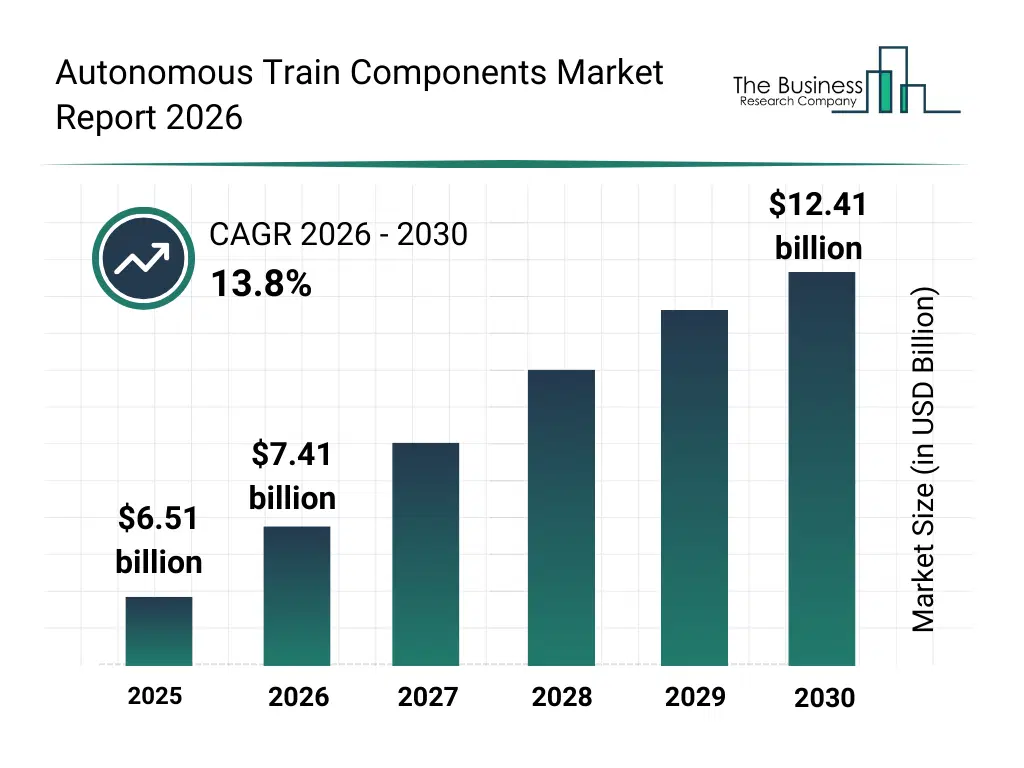
What Is The Autonomous Train Components Market Size and Share 2026?
The autonomous train components market size has grown rapidly in recent years. It will grow from $6.51 billion in 2025 to $7.41 billion in 2026 at a compound annual growth rate (CAGR) of 14.0%. The growth in the historic period can be attributed to urban rail expansion, signaling automation, reduction of human error focus, early autonomous train deployments, rail safety regulations.What Is The Autonomous Train Components Market Growth Forecast?
The autonomous train components market size is expected to see rapid growth in the next few years. It will grow to $12.41 billion in 2030 at a compound annual growth rate (CAGR) of 13.8%. The growth in the forecast period can be attributed to smart rail infrastructure investments, AI-based train control, autonomous metro projects, predictive maintenance adoption, digital rail signaling. Major trends in the forecast period include adoption of goa4 automation, integration of lidar and radar systems, expansion of driverless metro projects, growth of sensor-rich train platforms, demand for fail-safe control systems.

Global Autonomous Train Components Market Segmentation
1) By Component: Radio Detection And Ranging (RADAR) Modules, Optical Sensor And Cameras, Odometers, Antennas, Light Detection And Ranging (LiDAR) Module, Infrared Cameras, Other Components 2) By Train Type: Long Distance Train, Suburban, Tram, Monorail, Subway 3) By Grade: Grades Of Automation (GoA)A1 + Grades Of Automation (GoA)A2, Grades Of Automation (GoA)A3, Grades Of Automation (GoA)A4 Subsegments: 1) By Radio Detection And Ranging (RADAR) Modules: Short-range RADAR, Long-range RADAR 2) By Optical Sensors And Cameras: Standard Cameras, 3D Imaging Cameras 3) By Odometers: Mechanical Odometers, Electronic Odometers 4) By Antennas: GPS Antennas, Communication Antennas 5) By Light Detection And Ranging (LiDAR) Module: 2D LiDAR, 3D LiDAR 6) By Infrared Cameras: Thermal Imaging Cameras, Near-Infrared Cameras 7) By Other Components: Control Units, Communication ModulesWhat Is The Driver Of The Autonomous Train Components Market?
The growing electrification of railways is expected to propel the growth of the autonomous train components market going forward. Electrification of railways involves converting diesel-powered train systems to operate using electricity, typically through overhead lines or third rails, offering benefits like reduced emissions and increased efficiency. The electrification of railways is growing due to its benefits, such as increased energy efficiency, reduced emissions, improved performance, alignment with global sustainability efforts, and modernization in transportation. Autonomous train component systems maximize the benefits of train electrification by optimizing energy usage, enhancing safety, and improving overall operational efficiency. They also use a variety of technologies to control acceleration and braking and maintain appropriate spacing between trains, thereby reducing crashes, over speeding, and other safety issues on electrified railways. For instance, in November 2024, according to the Office of Rail and Road (ORR), a UK-based independent safety and economic regulator, the total route‑length in Great Britain open for traffic was 15,849 km, of which 6,130 km was electrified that is 39% electrified. Therefore, the growing electrification of railways is driving the growth of the autonomous train components industry.Key Players In The Global Autonomous Train Components Market
Major companies operating in the autonomous train components market report include Siemens AG, ZF Friedrichshafen AG, Mitsubishi Heavy Industries Ltd, Thales Group, Alstom SA, Kawasaki Heavy Industries, CRRC Corporation Limited, Wabtec Corporation, Bombardier Transportation, Construcciones y Auxiliar de Ferrocarriles, Ansaldo STS, CASCO Signal Ltd., Otiv BV, 4AI Systems Pty Ltd, Ingeteam Corporation SA, Electric & Hybrid Rail Technology, Infotrans Engineers Private Limited, Bahnen der Stadt Monheim GmbH, Navya SA, EasyMile SAS, Local Motors Inc., Yutong Bus Co. Ltd.
This chart is for illustrative purposes; the full report includes a detailed competitor analysis and comprehensive overview of the top 10 companies in the market.

This chart maps companies by product innovation and brand strength, with bubble size indicating relative revenue, helping identify market leaders, challengers, and niche players. This is an illustrative chart; the full report provides a complete and accurate competitive analysis.
Global Autonomous Train Components Market Trends and Insights
Major companies operating in the autonomous train component market are focusing on integrating advanced technologies, such as train control and supervision systems, to gain a competitive edge in the market. This system is designed for the operation and supervision of trains in rail-based transportation systems. For instance, in February 2023, Bharat Electronics Limited, an India-based government-owned aerospace and defense electronics company, in partnership with Delhi Metro Rail Corporation (DMRC), jointly launched the Indigenous-Automatic Train Supervision (i-ATS) system. This indigenously developed train control and supervision system is designed to enhance the overall efficiency and safety of train operations. The i-ATS system is elevating operational standards and safety across the railway network. i-ATS can be used to operate various rail-based systems, notably Indian railways. This technology has been built with the ability to work with different signaling vendors' systems with appropriate alterations.What Are Latest Mergers And Acquisitions In The Autonomous Train Components Market?
In November 2023, Siemens Mobility, a Germany-based technology company, acquired HMH s.r.o. for an undisclosed amount. This acquisition aims to strengthen Siemens' position in the Eastern European rail market by enhancing its train protection portfolio. HMH s.r.o. is a Slovak Republic-based technology company, manufactures the MIREL train protection system.
Regional Outlook
Asia-Pacific was the largest region in the autonomous train components market in 2025. It is expected to be the fastest-growing region in the forecast period. The regions covered in this market report include Asia-Pacific, South East Asia, Western Europe, Eastern Europe, North America, South America, Middle East, Africa. The countries covered in this market report include Australia, Brazil, China, France, Germany, India, Indonesia, Japan, Taiwan, Russia, South Korea, UK, USA, Canada, Italy, SpainWhat Defines the Autonomous Train Components Market?
The autonomous train components market consists of sales of GPS (Global Positioning System) modules, control computers, actuators, maintenance monitoring systems, and power management systems. Values in this market are ‘factory gate’ values, that is the value of goods sold by the manufacturers or creators of the goods, whether to other entities (including downstream manufacturers, wholesalers, distributors and retailers) or directly to end customers. The value of goods in this market includes related services sold by the creators of the goods.How is Market Value Defined and Measured?
The market value is defined as the revenues that enterprises gain from the sale of goods and/or services within the specified market and geography through sales, grants, or donations in terms of the currency (in USD unless otherwise specified). The revenues for a specified geography are consumption values that are revenues generated by organizations in the specified geography within the market, irrespective of where they are produced. It does not include revenues from resales along the supply chain, either further along the supply chain or as part of other products.
This chart presents market attractiveness based on a quantitative evaluation of growth, competition, strategic alignment, and risk, offering a clear view of opportunity areas for decision-making. This chart is for illustrative purposes; the full report contains the complete analysis.

This chart highlights the Total Addressable Market (TAM) by estimating the maximum revenue opportunity using an assumption-driven approach, supporting strategic planning and opportunity sizing across markets. The chart is illustrative; the full report provides a more comprehensive analysis.
What Key Data and Analysis Are Included in the Autonomous Train Components Market Report 2026?
The autonomous train components market research report is one of a series of new reports from The Business Research Company that provides market statistics, including industry global market size, regional shares, competitors with the market share, detailed market segments, market trends and opportunities, and any further data you may need to thrive in the autonomous train components industry. The market research report delivers a complete perspective of everything you need, with an in-depth analysis of the current and future state of the industry.Autonomous Train Components Market Report Forecast Analysis
| Report Attribute | Details |
|---|---|
| Market Size Value In 2026 | $7.41 billion |
| Revenue Forecast In 2030 | $12.41 billion |
| Growth Rate | CAGR of 14.0% from 2026 to 2030 |
| Base Year For Estimation | 2025 |
| Actual Estimates/Historical Data | 2020-2025 |
| Forecast Period | 2026 - 2030 - 2030 |
| Market Representation | Revenue in USD Billion and CAGR from 2026 to 2030 |
| Segments Covered | Component, Train Type, Grade |
| Regional Scope | Asia-Pacific, Western Europe, Eastern Europe, North America, South America, Middle East, Africa |
| Country Scope | The countries covered in the report are Australia, Brazil, China, France, Germany, India, Indonesia, Japan, Taiwan, Russia, South Korea, UK, USA, Canada, Italy, Spain. |
| Key Companies Profiled | Siemens AG, ZF Friedrichshafen AG, Mitsubishi Heavy Industries Ltd, Thales Group, Alstom SA, Kawasaki Heavy Industries, CRRC Corporation Limited, Wabtec Corporation, Bombardier Transportation, Construcciones y Auxiliar de Ferrocarriles, Ansaldo STS, CASCO Signal Ltd., Otiv BV, 4AI Systems Pty Ltd, Ingeteam Corporation SA, Electric & Hybrid Rail Technology, Infotrans Engineers Private Limited, Bahnen der Stadt Monheim GmbH, Navya SA, EasyMile SAS, Local Motors Inc., Yutong Bus Co. Ltd. |
| Customization Scope | Request for Customization |
| Pricing And Purchase Options | Explore Purchase Options |