
Autonomous Train Technology Market Report 2026
Global Outlook – By Component (Camera, Accelerometer, Odometer, Tachometer, Radio Set, Other Components), By Grade Of Automation (Grade Of Automation 1 (GOA –, Grade Of Automation 2 (GOA, Grade Of Automation 3 (GOA, Grade Of Automation 4 (GOA,), By Technology (Communication-Based Train Control (CBTC), European Railway Traffic Management System (ERTMS), Automatic Train Control (ATC), Positive Train Control (PTC)), By Application (Passenger Train, Freight Train) – Market Size, Trends, Strategies, and Forecast to 2030
Autonomous Train Technology Market Overview
• Autonomous Train Technology market size has reached to $4.56 billion in 2025 • Expected to grow to $5.66 billion in 2030 at a compound annual growth rate (CAGR) of 4.3% • Growth Driver: Railway Expenditure Boosting Growth In The Autonomous Train Technology Market • Market Trend: Adoption Of Aeva's 4D LiDAR Technology Revolutionizing Autonomous Train Operations • Asia-Pacific was the largest region and fastest growing region.What Is Covered Under Autonomous Train Technology Market?
Autonomous train technology refers to the use of advanced systems, sensors, and algorithms to enable trains to operate without direct human intervention. This technology offers several potential benefits, including improved safety, increased operational efficiency, reduced energy consumption, and an enhanced passenger experience and reliability in railway operations. The main types of autonomous train technology components are cameras, accelerometers, odometers, tachometers, radio sets, and others. A camera refers to an optical instrument used to capture still images or record videos by recording light onto a photosensitive surface. It is classified into various types of grades of automation, such as grade of automation 1 (GOA 1), grade of automation 2 (GOA 2), grade of automation 3 (GOA 3), and grade of automation 4 (GOA 4), and includes several technologies, including communication-based train control (CBTC), European railway traffic management system (ERTMS), automatic train control (ATC), and positive train control (PTC). It is used in various applications, including passenger trains and freight trains.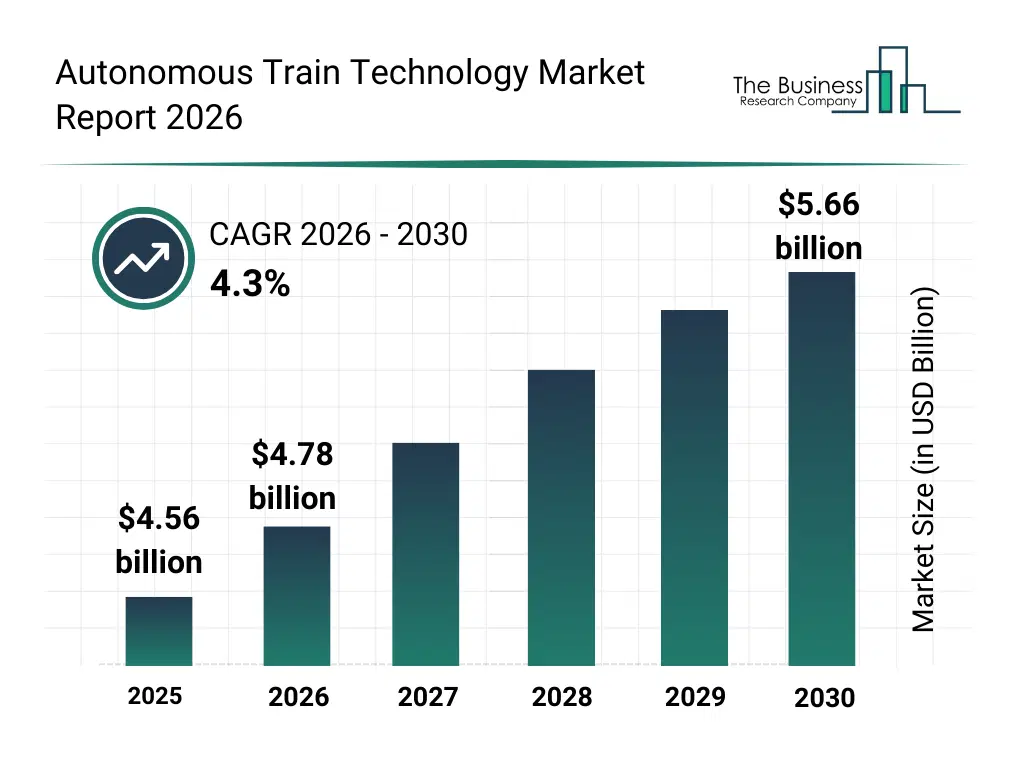
What Is The Autonomous Train Technology Market Size and Share 2026?
The autonomous train technology market size has grown steadily in recent years. It will grow from $4.56 billion in 2025 to $4.78 billion in 2026 at a compound annual growth rate (CAGR) of 4.8%. The growth in the historic period can be attributed to urban rail network expansion, demand for operational safety, adoption of automatic train control, reduction of human error, public transport modernization.What Is The Autonomous Train Technology Market Growth Forecast?
The autonomous train technology market size is expected to see steady growth in the next few years. It will grow to $5.66 billion in 2030 at a compound annual growth rate (CAGR) of 4.3%. The growth in the forecast period can be attributed to government investments in smart rail, AI-based traffic management, demand for energy-efficient rail systems, growth of autonomous metros, digital rail infrastructure. Major trends in the forecast period include expansion of driverless metro projects, integration of cbtc and ertms systems, adoption of AI-based train control, growth of sensor fusion technologies, focus on operational safety and reliability.
Global Autonomous Train Technology Market Segmentation
1) By Component: Camera, Accelerometer, Odometer, Tachometer, Radio Set, Other Components 2) By Grade Of Automation: Grade Of Automation 1 (GOA 1), Grade Of Automation 2 (GOA 2), Grade Of Automation 3 (GOA 3), Grade Of Automation 4 (GOA 4) 3) By Technology: Communication-Based Train Control (CBTC), European Railway Traffic Management System (ERTMS), Automatic Train Control (ATC), Positive Train Control (PTC) 4) By Application: Passenger Train, Freight Train Subsegments: 1) By Camera: 2D Cameras, 3D Cameras, Thermal Cameras 2) By Accelerometer: MEMS (Micro-Electro-Mechanical Systems) Accelerometers, Piezoelectric Accelerometers, Capacitive Accelerometers 3) By Odometer: Optical Odometers, Electromagnetic Odometers, Rotary Odometers 4) By Tachometer: Digital Tachometers, Optical Tachometers 5) By Radio Set: VHF (Very High Frequency) Radio, UHF (Ultra High Frequency) Radio, LTE Or 5G Radio, Satellite Radio 6) By Other Components: GPS Systems, LiDAR Sensors, Control Systems (including software), Power Supply And Battery Management Systems, Actuators And Motors, Communication Systems (Wi-Fi, Ethernet), Proximity Sensors And Infrared SensorsWhat Is The Driver Of The Autonomous Train Technology Market?
The increase in expenditure on railways is expected to fuel the growth of the autonomous train technology market going forward. Expenditure on railways refers to the amount of money spent by governments or private entities on various aspects of railway infrastructure, operations, and development. These railway expenditures arise because of increasing demand for public transportation, improved operational efficiency and competitiveness, and meeting the growing demands of modern transportation. Railway expenditure utilizes autonomous train technology to enhance infrastructure, integrate autonomous systems, and promote growth, which will consequently improve efficiency, safety, and sustainability in rail transportation systems. For instance, in November 2023, according to the Office of Rail and Road (ORR), a UK-based non-ministerial government department, the operational expenditure for the UK rail industry from April 2022 to March 2023 amounted to approximately $31.5 billion (£25.4 billion), with a 1.0% increase compared to the previous year. The breakdown of this expenditure includes $15.4 billion (£12.4 billion) attributed to Network Rail, $14.5 billion (£11.7 billion) for franchised train operators, and $1.6 billion (£1.3 billion) from other segments of the rail industry. Therefore, an increase in expenditure on railways is driving the growth of the autonomous train technology industry.Key Players In The Global Autonomous Train Technology Market
Major companies operating in the autonomous train technology market report include China Railway Corporation, Hitachi Ltd, Siemens AG, Deutsche Bahn AG, General Electric Company, Mitsubishi Electric Corporation, ABB Group, Toshiba Corporation, Thales Group, Alstom SA, CSX Transportation, Kawasaki Heavy Industries, Japan Railways Group, WSP Global Inc, Huawei Technologies Co. Ltd, Wabtec Corporation, Tech Mahindra Ltd, MTR Corporation, Stadler Rail, CAF Signalling S.A.U, Hyundai Rotem, Itron Inc, PT Kereta Api Indonesia (Persero), Kyosan Electric Manufacturing Ltd, Mermec Corporation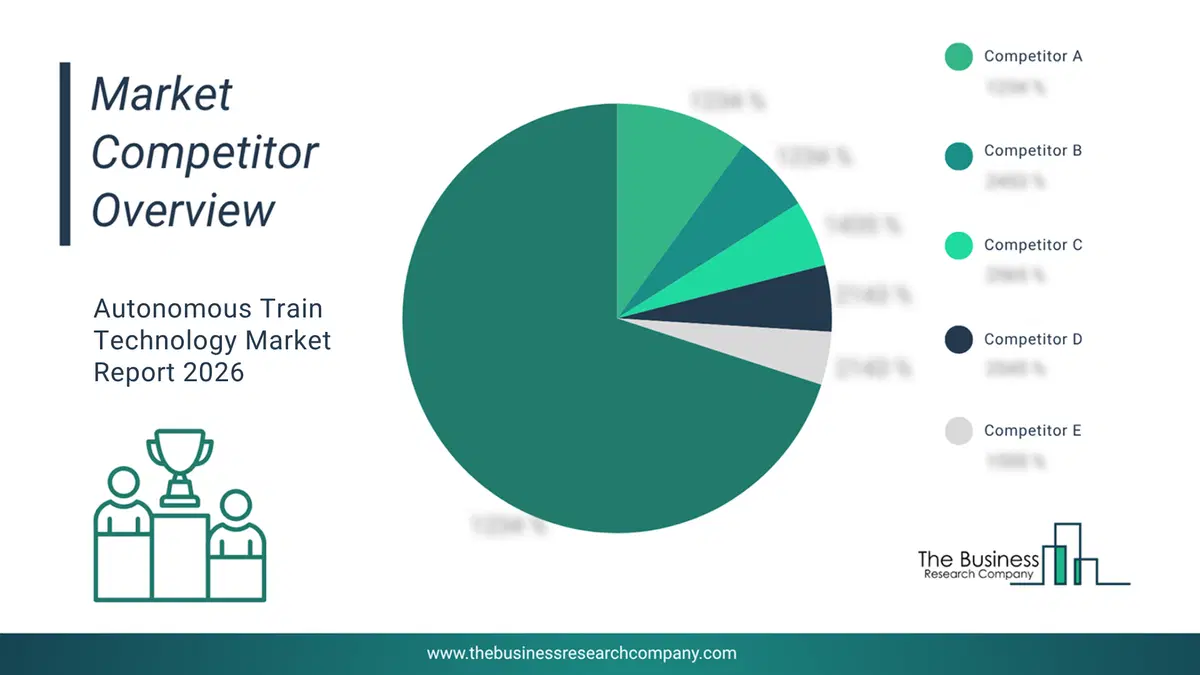
This chart is for illustrative purposes; the full report includes a detailed competitor analysis and comprehensive overview of the top 10 companies in the market.
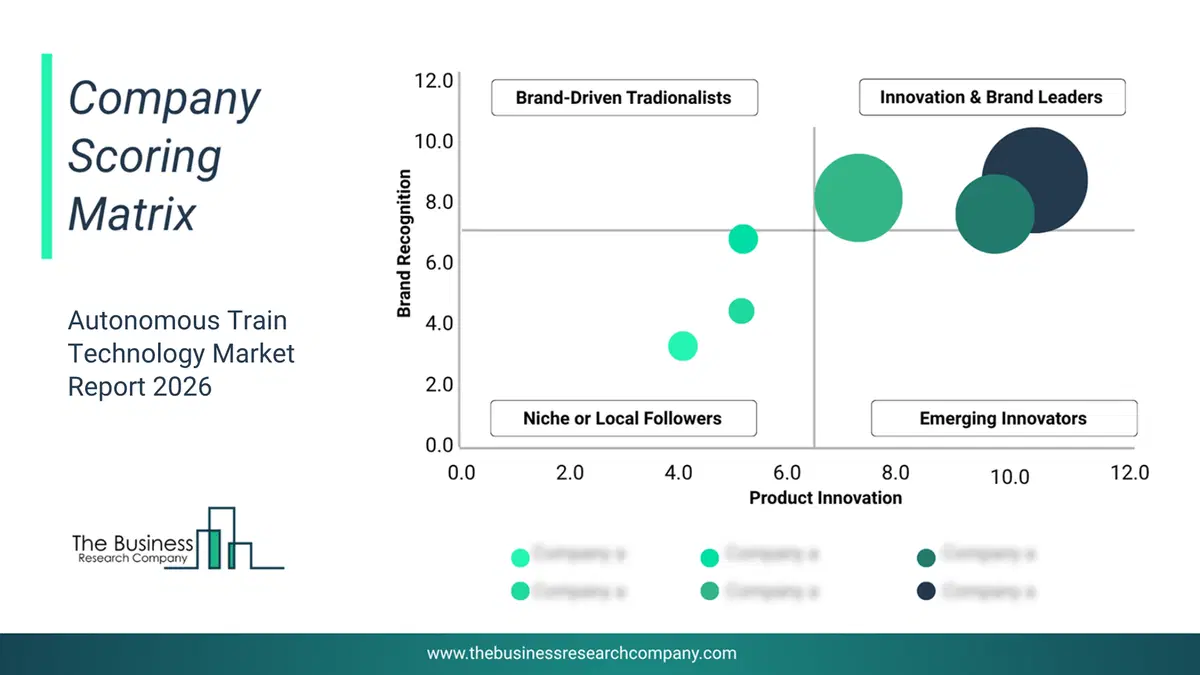
This chart maps companies by product innovation and brand strength, with bubble size indicating relative revenue, helping identify market leaders, challengers, and niche players. This is an illustrative chart; the full report provides a complete and accurate competitive analysis.
Global Autonomous Train Technology Market Trends and Insights
Major companies operating in the autonomous train technology market are focusing on the adoption of innovative technological solutions, such as Aeva's 4D LiDAR technology, to maintain a competitive edge and ensure regulatory compliance in automatic train operation solutions. 4D LiDar technology revolutionizes autonomous systems by providing advanced perception capabilities that enhance safety, efficiency, and reliability in various industries. For instance, in August 2023, Railergy, a Germany-based top-tier provider of railway automation solutions, adopted Aeva's 4D LiDAR technology to power autonomous train technology and enhance safety in their automatic train operation solution. This innovative technology enables the automation of trains for various applications, including shunting, main line, and last-mile operations in areas such as seaports, freight, and mining. Additionally, this technology provides instant velocity data and high-resolution sensing capabilities, allowing for the real-time detection of obstacles and ensuring safe autonomous locomotive passage.What Are Latest Mergers And Acquisitions In The Autonomous Train Technology Market?
In May 2024, Hitachi Rail Ltd., a Japan-based transportation and infrastructure company, acquired Thales Group’s Ground Transportation Systems (GTS) business for an undisclosed amount. The acquisition aims to strengthen Hitachi Rail's global presence and capabilities in sustainable mobility solutions by enhancing its advanced digital signaling and systems integration. Thales Group is a France-based technology company that specializes in advanced signaling and control systems, which are critical for the development and operation of autonomous and automated train technologies.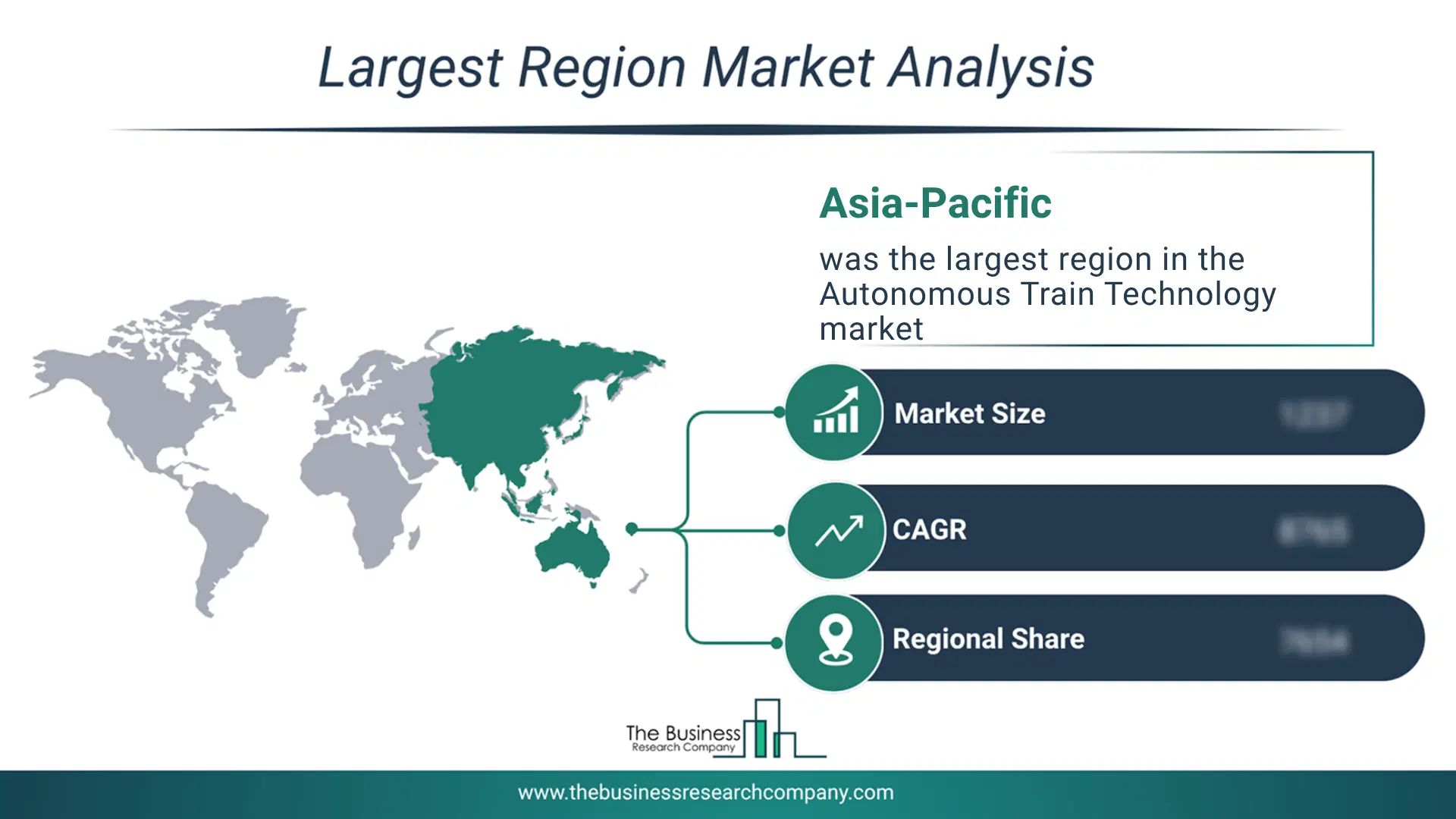
Regional Outlook
Asia-Pacific was the largest region in the autonomous train technology market in 2025. It is expected to be the fastest-growing region in the forecast period. The regions covered in this market report include Asia-Pacific, South East Asia, Western Europe, Eastern Europe, North America, South America, Middle East, Africa. The countries covered in this market report include Australia, Brazil, China, France, Germany, India, Indonesia, Japan, Taiwan, Russia, South Korea, UK, USA, Canada, Italy, SpainWhat Defines the Autonomous Train Technology Market?
The autonomous train technology market consists of revenues earned by entities by providing services such as autonomous operation, route optimization, automated maintenance, remote monitoring and control, predictive maintenance, communication, and connectivity. The market value includes the value of related goods sold by the service provider or included within the service offering. The autonomous train technology market also includes the sale of sensors, control systems, communication systems, onboard computers, navigation systems, actuators, and redundant and fail-safe systems. Values in this market are ‘factory gate’ values, that is, the value of goods sold by the manufacturers or creators of the goods, whether to other entities (including downstream manufacturers, wholesalers, distributors, and retailers) or directly to end customers. The value of goods in this market includes related services sold by the creators of the goods.How is Market Value Defined and Measured?
The market value is defined as the revenues that enterprises gain from the sale of goods and/or services within the specified market and geography through sales, grants, or donations in terms of the currency (in USD unless otherwise specified). The revenues for a specified geography are consumption values that are revenues generated by organizations in the specified geography within the market, irrespective of where they are produced. It does not include revenues from resales along the supply chain, either further along the supply chain or as part of other products.
This chart presents market attractiveness based on a quantitative evaluation of growth, competition, strategic alignment, and risk, offering a clear view of opportunity areas for decision-making. This chart is for illustrative purposes; the full report contains the complete analysis.

This chart highlights the Total Addressable Market (TAM) by estimating the maximum revenue opportunity using an assumption-driven approach, supporting strategic planning and opportunity sizing across markets. The chart is illustrative; the full report provides a more comprehensive analysis.
What Key Data and Analysis Are Included in the Autonomous Train Technology Market Report 2026?
The autonomous train technology market research report is one of a series of new reports from The Business Research Company that provides market statistics, including industry global market size, regional shares, competitors with the market share, detailed market segments, market trends and opportunities, and any further data you may need to thrive in the autonomous train technology industry. The market research report delivers a complete perspective of everything you need, with an in-depth analysis of the current and future state of the industry.Autonomous Train Technology Market Report Forecast Analysis
| Report Attribute | Details |
|---|---|
| Market Size Value In 2026 | $4.78 billion |
| Revenue Forecast In 2030 | $5.66 billion |
| Growth Rate | CAGR of 4.8% from 2026 to 2030 |
| Base Year For Estimation | 2025 |
| Actual Estimates/Historical Data | 2020-2025 |
| Forecast Period | 2026 - 2030 - 2030 |
| Market Representation | Revenue in USD Billion and CAGR from 2026 to 2030 |
| Segments Covered | Component, Grade Of Automation, Technology, Application |
| Regional Scope | Asia-Pacific, Western Europe, Eastern Europe, North America, South America, Middle East, Africa |
| Country Scope | The countries covered in the report are Australia, Brazil, China, France, Germany, India, Indonesia, Japan, Taiwan, Russia, South Korea, UK, USA, Canada, Italy, Spain. |
| Key Companies Profiled | China Railway Corporation, Hitachi Ltd, Siemens AG, Deutsche Bahn AG, General Electric Company, Mitsubishi Electric Corporation, ABB Group, Toshiba Corporation, Thales Group, Alstom SA, CSX Transportation, Kawasaki Heavy Industries, Japan Railways Group, WSP Global Inc, Huawei Technologies Co. Ltd, Wabtec Corporation, Tech Mahindra Ltd, MTR Corporation, Stadler Rail, CAF Signalling S.A.U, Hyundai Rotem, Itron Inc, PT Kereta Api Indonesia (Persero), Kyosan Electric Manufacturing Ltd, Mermec Corporation |
| Customization Scope | Request for Customization |
| Pricing And Purchase Options | Explore Purchase Options |