
Aviation Infrastructure Market Report 2026
Global Outlook – By Airport Type (Commercial Airport, Military Airport, General Aviation Airport), By Infrastructure Type (Terminal, Control Tower, Taxiway And Runway, Apron, Hangar, Other Infrastructure Types), By Size (Small Airports (Less Than 1 Million Passengers Per Year), Medium Airports (1-5 Million Passengers Per Year), Large Airports (Over 5 Million Passengers Per Year)), By Location (Urban, Suburban, Rural) – Market Size, Trends, Strategies, and Forecast to 2030
Aviation Infrastructure Market Overview
• Aviation Infrastructure market size has reached to $865.87 billion in 2025 • Expected to grow to $1144.32 billion in 2030 at a compound annual growth rate (CAGR) of 5.7% • Growth Driver: Rising Demand For Air Cargo Transportation Fueling The Growth Of The Market Due To Expansion Of E-Commerce And Need For Faster Logistics • Market Trend: Innovative 5G-A Smart Airport Integration Enhances Aviation Infrastructure Efficiency • Asia-Pacific was the largest region and fastest growing region.What Is Covered Under Aviation Infrastructure Market?
Aviation infrastructure refers to the physical and organizational facilities required for the operation of aircraft and the management of air travel, including airports, runways, air traffic control systems, and maintenance facilities. It plays a crucial role in ensuring safe, efficient, and reliable air transportation for passengers and cargo. The main types of airports in aviation infrastructure are commercial airports, military airports, and general aviation airports. A commercial airport is a public facility designed primarily for handling scheduled passenger and cargo flights operated by commercial airlines. It includes essential infrastructure types such as terminals, control towers, taxiways and runways, aprons, hangars, and others to accommodate different airport sizes, ranging from small airports (less than 1 million passengers per year) to medium airports (1-5 million passengers per year) to large airports (over 5 million passengers per year). These airports are typically located in urban, suburban, or rural areas.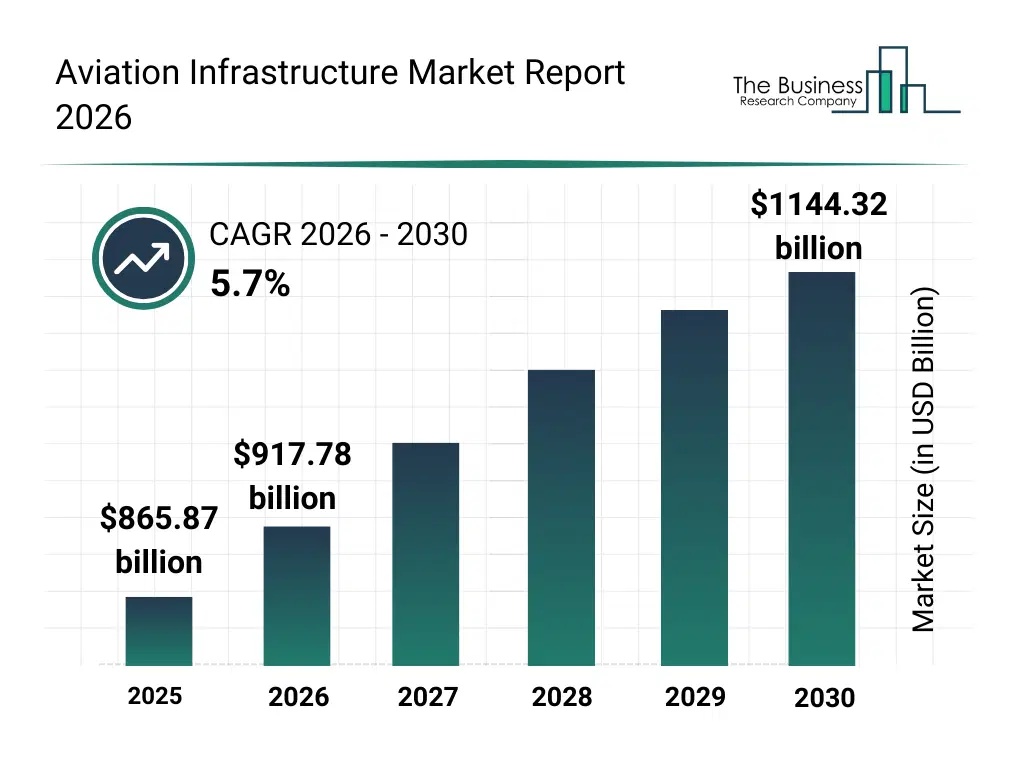
What Is The Aviation Infrastructure Market Size and Share 2026?
The aviation infrastructure market size has grown strongly in recent years. It will grow from $865.87 billion in 2025 to $917.78 billion in 2026 at a compound annual growth rate (CAGR) of 6.0%. The growth in the historic period can be attributed to increasing expansion of commercial air travel, early modernization of airport facilities, rising construction of runways and terminals, growth of global air cargo activities, development of specialized aviation safety systems.What Is The Aviation Infrastructure Market Growth Forecast?
The aviation infrastructure market size is expected to see strong growth in the next few years. It will grow to $1144.32 billion in 2030 at a compound annual growth rate (CAGR) of 5.7%. The growth in the forecast period can be attributed to growing investment in smart airport technologies, rising demand for sustainable aviation infrastructure, expansion of automated ground operations, increasing focus on resilient airport design, strong growth in digital air traffic management systems. Major trends in the forecast period include rising need for efficient airport facility upgrades, growth in digital infrastructure enhancements, expansion of advanced airside and landside systems, rising deployment of real-time operational monitoring, increasing investment in sustainable airport design.
Global Aviation Infrastructure Market Segmentation
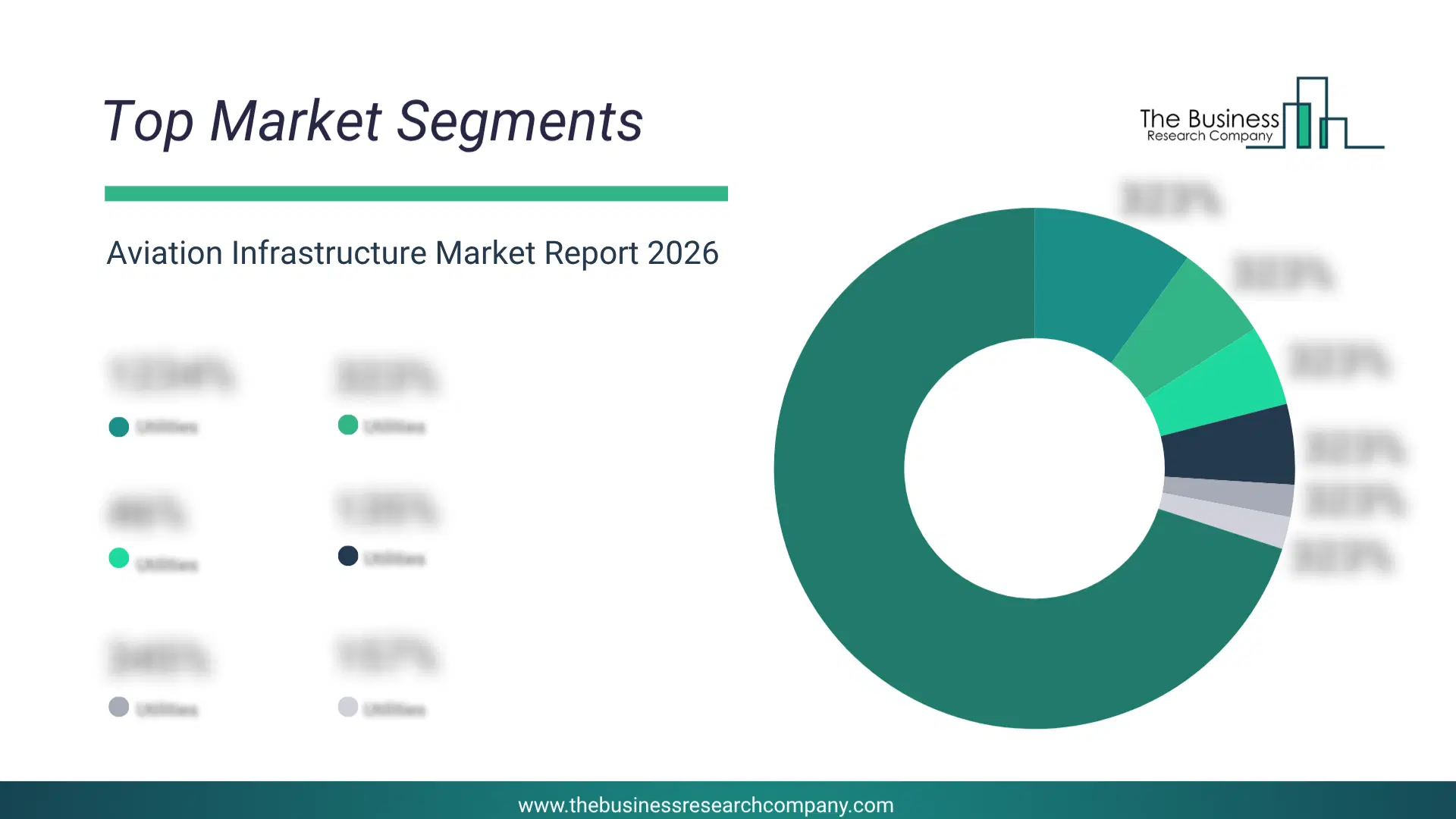
1) By Airport Type: Commercial Airport, Military Airport, General Aviation Airport 2) By Infrastructure Type: Terminal, Control Tower, Taxiway And Runway, Apron, Hangar, Other Infrastructure Types 3) By Size: Small Airports (Less Than 1 Million Passengers Per Year), Medium Airports (1-5 Million Passengers Per Year), Large Airports (Over 5 Million Passengers Per Year) 4) By Location: Urban, Suburban, Rural Subsegments: 1) By Commercial Airport: Domestic Terminals, International Terminals, Cargo Terminals, Maintenance Hangars, Runways And Taxiways, Passenger Lounges 2) By Military Airport: Airbase Facilities, Aircraft Maintenance Units, Munitions Storage, Command And Control Centers, Runways And Hangars 3) By General Aviation Airport: Private Jet Terminals (FBOs), Aircraft Hangars, Flight Schools, Charter Services, Maintenance And Repair Operations (MRO) FacilitiesWhat Is The Driver Of The Aviation Infrastructure Market?
The rise in demand for air cargo transportation is expected to propel the growth of the aviation infrastructure market going forward. Air cargo transportation is the movement of goods and freight by aircraft, offering fast and efficient delivery for time-sensitive and high-value products. The demand for air cargo transportation is rising due to increased global trade, which requires faster and more reliable shipping solutions to connect international markets efficiently. Aviation infrastructure facilitates air cargo transportation by providing the necessary runways, cargo terminals, and logistical support systems to ensure efficient handling, storage, and movement of goods. For instance, in December 2023, according to the International Air Transport Association (IATA), a Canada-based airline trade association, air cargo capacity increased 13.6% from 2022 to 49.8 billion available cargo ton-kilometers (ACTKs) in 2023. Therefore, the rising demand for air cargo transportation is driving growth in the aviation infrastructure industry.Key Players In The Global Aviation Infrastructure Market
Major companies operating in the aviation infrastructure market are Siemens AG, Raytheon Technologies Corporation, Honeywell International Inc., Bechtel Corporation, Safran S.A., Thales Group, Skanska AB, Turner Construction Company, Jacobs Engineering Group, Balfour Beatty plc, Ferrovial S.A., Groupe ADP, Vinci Airports, Fraport AG, HDR Inc., Arup Group, Royal Schiphol Group, Changi Airports International, HOK Group Inc., Fluor Corporation, TAV Airports Holding, Dubai Aviation Engineering Projects (DAEP), Flughafen Zürich AG, Perkins and Will, Copenhagen Airports A/S, Foster + Partners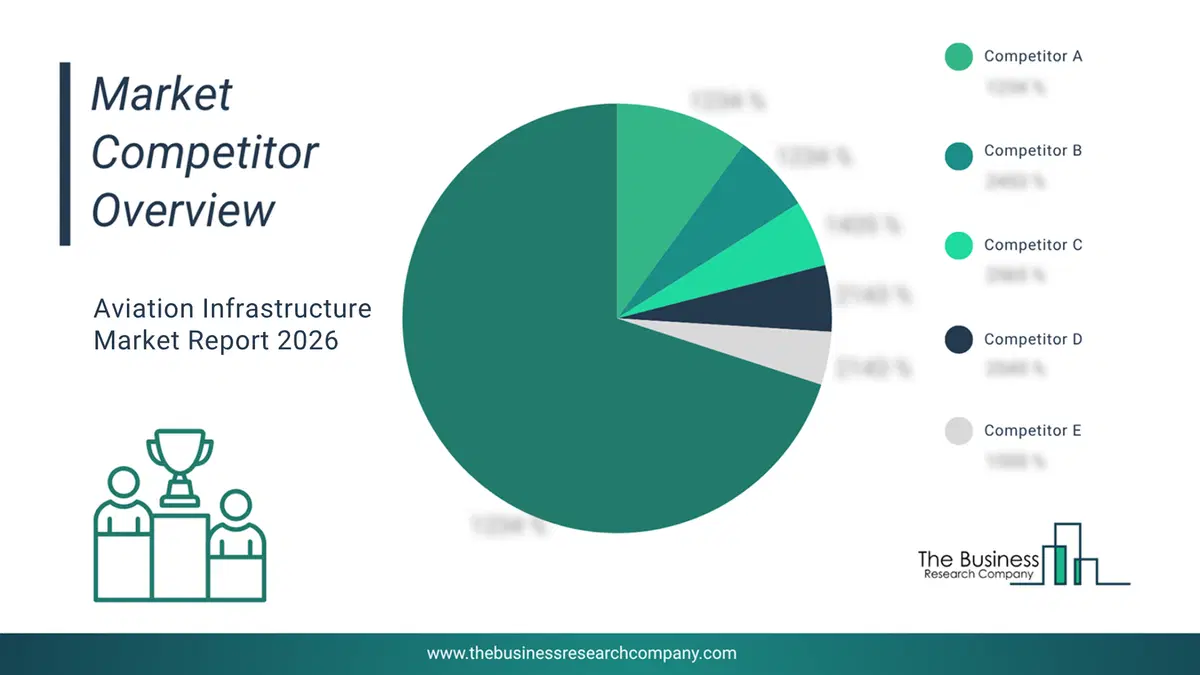
This chart is for illustrative purposes; the full report includes a detailed competitor analysis and comprehensive overview of the top 10 companies in the market.
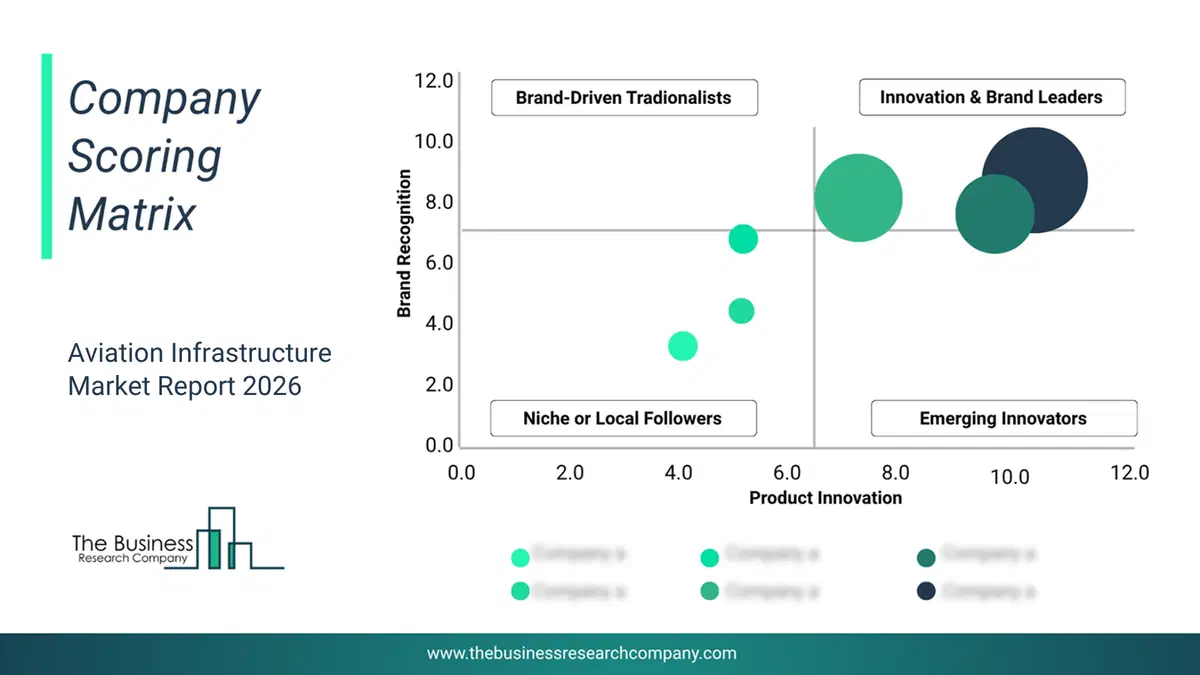
This chart maps companies by product innovation and brand strength, with bubble size indicating relative revenue, helping identify market leaders, challengers, and niche players. This is an illustrative chart; the full report provides a complete and accurate competitive analysis.
Global Aviation Infrastructure Market Trends and Insights
Major companies operating in the aviation infrastructure market are focusing on adopting innovative solutions, such as smart airport construction, to enhance operational efficiency and passenger experience. Smart airport construction refers to the integration of advanced technologies such as 5G, IoT, and AI into airport infrastructure to enable intelligent monitoring, predictive maintenance, and streamlined operations. For instance, in March 2024, Baoshan Yunrui Airport, a China-based mid-sized airport, launched the world’s first 5G-Advanced (5G-A) smart airport integrated sensing base station, marking the first global application of 5G-A technology in airport construction. This cutting-edge system combines ultra-high-speed 5G-A connectivity with advanced sensing capabilities to support real-time data transmission, precise aircraft positioning, and comprehensive environmental monitoring. A standout feature is its integration of communication, sensing, and edge computing into a single base station, enabling smart coordination across airport operations, including baggage handling, runway management, and emergency response.What Are Latest Mergers And Acquisitions In The Aviation Infrastructure Market?
In December 2024, Adani Defence Systems & Technologies Ltd., an India-based defense and aerospace company, acquired Air Works India Engineering Private Limited for $47 million. Through this acquisition, Adani aims to strengthen its aerospace and defense capabilities by expanding India’s domestic aircraft maintenance, repair, and overhaul services, supporting the country’s self-reliance goals, and meeting the growing demand from the rapidly expanding aviation sector. Air Works India Engineering Private Limited is an India-based aircraft maintenance company that provides aviation infrastructure and MRO services.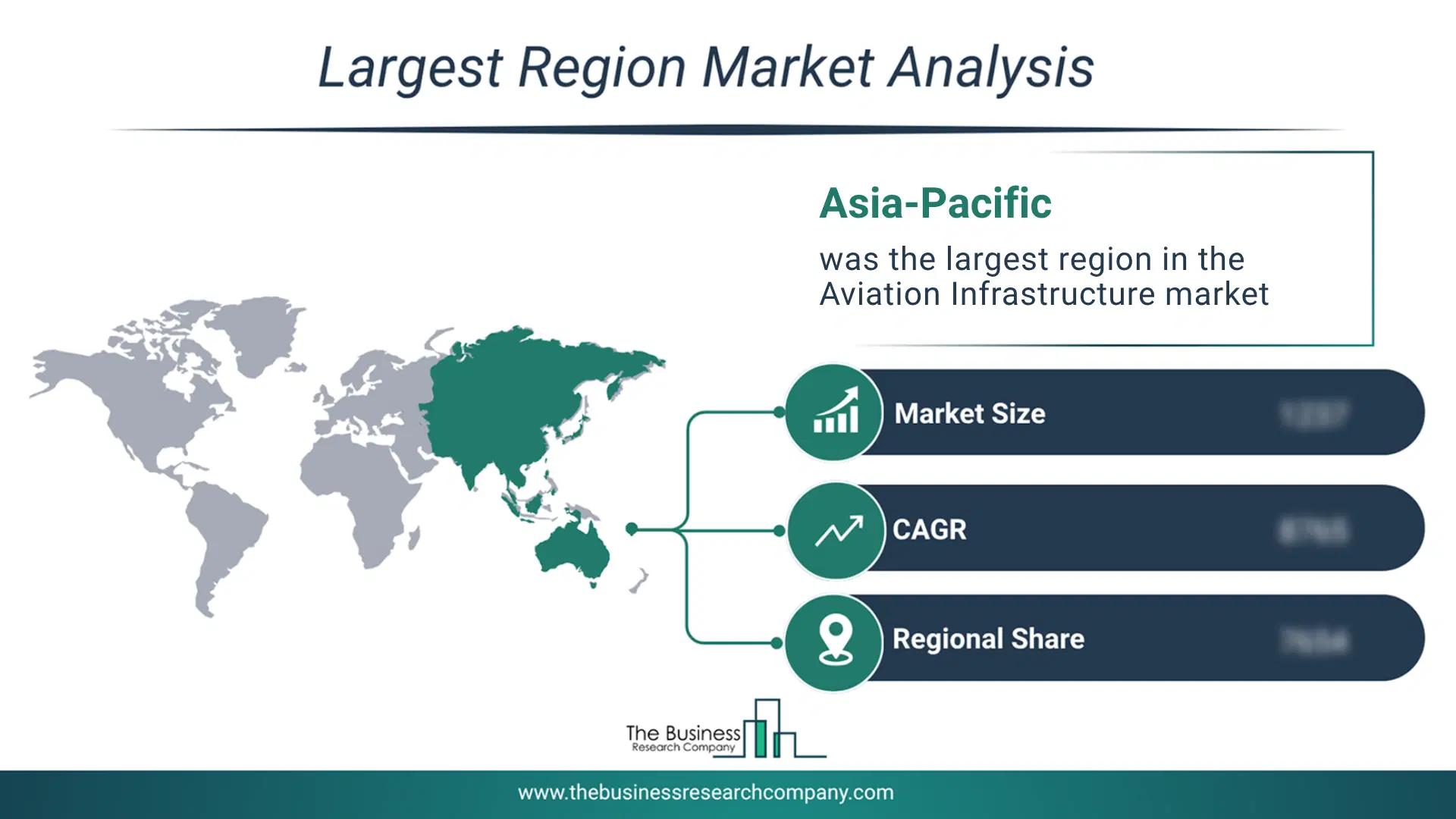
Regional Insights
Asia-Pacific was the largest region in the aviation infrastructure market in 2025. Asia-Pacific is expected to be the fastest-growing region in the forecast period. The regions covered in this market report are Asia-Pacific, South East Asia, Western Europe, Eastern Europe, North America, South America, Middle East, Africa. The countries covered in this market report are Australia, Brazil, China, France, Germany, India, Indonesia, Japan, Taiwan, Russia, South Korea, UK, USA, Canada, Italy, Spain.What Defines the Aviation Infrastructure Market?
The aviation infrastructure market includes revenues earned by entities by providing services, such as airport construction and maintenance, runway development, terminal management, fueling services, ground handling, and airport security. The market value includes the value of related goods sold by the service provider or included within the service offering. Only goods and services traded between entities or sold to end consumers are included.How is Market Value Defined and Measured?
The market value is defined as the revenues that enterprises gain from the sale of goods and/or services within the specified market and geography through sales, grants, or donations in terms of the currency (in USD unless otherwise specified). The revenues for a specified geography are consumption values that are revenues generated by organizations in the specified geography within the market, irrespective of where they are produced. It does not include revenues from resales along the supply chain, either further along the supply chain or as part of other products.
This chart presents market attractiveness based on a quantitative evaluation of growth, competition, strategic alignment, and risk, offering a clear view of opportunity areas for decision-making. This chart is for illustrative purposes; the full report contains the complete analysis.

This chart highlights the Total Addressable Market (TAM) by estimating the maximum revenue opportunity using an assumption-driven approach, supporting strategic planning and opportunity sizing across markets. The chart is illustrative; the full report provides a more comprehensive analysis.
What Key Data and Analysis Are Included in theAviation Infrastructure Market Report 2026?
The aviation infrastructure market research report is one of a series of new reports from The Business Research Company that provides market statistics, including industry global market size, regional shares, competitors with the market share, detailed market segments, market trends and opportunities, and any further data you may need to thrive in the aviation infrastructure industry. The market research report delivers a complete perspective of everything you need, with an in-depth analysis of the current and future state of the industry.Aviation Infrastructure Market Report Forecast Analysis
| Report Attribute | Details |
|---|---|
| Market Size Value In 2026 | $917.78 billion |
| Revenue Forecast In 2030 | $1144.32 billion |
| Growth Rate | CAGR of 6.0% from 2026 to 2030 |
| Base Year For Estimation | 2025 |
| Actual Estimates/Historical Data | 2020-2025 |
| Forecast Period | 2026 - 2030 |
| Market Representation | Revenue in USD Billion and CAGR from 2026 to 2030 |
| Segments Covered | Airport Type, Infrastructure Type, Size, Location |
| Regional Scope | Asia-Pacific, Western Europe, Eastern Europe, North America, South America, Middle East, Africa |
| Country Scope | The countries covered in this market report are Australia, Brazil, China, France, Germany, India, Indonesia, Japan, Taiwan, Russia, South Korea, UK, USA, Canada, Italy, Spain |
| Key Companies Profiled | Siemens AG, Raytheon Technologies Corporation, Honeywell International Inc., Bechtel Corporation, Safran S.A., Thales Group, Skanska AB, Turner Construction Company, Jacobs Engineering Group, Balfour Beatty plc, Ferrovial S.A., Groupe ADP, Vinci Airports, Fraport AG, HDR Inc., Arup Group, Royal Schiphol Group, Changi Airports International, HOK Group Inc., Fluor Corporation, TAV Airports Holding, Dubai Aviation Engineering Projects (DAEP), Flughafen Zürich AG, Perkins and Will, Copenhagen Airports A/S, Foster + Partners |
| Customization Scope | Request for Customization |
| Pricing And Purchase Options | Explore Purchase Options |