
Avionics Radiation Dosimetry Market Report 2026
Global Outlook – By Product Type (Active Dosimeters, Passive Dosimeters, Personal Dosimeters, Area Monitors, Other Product Types), By Technology (Semiconductor-Based, Thermoluminescent, Optically Stimulated Luminescence, Other Technologies), By Application (Commercial Aviation, Military Aviation, Spacecraft, Others Application), By End-User (Airlines, Defense Organizations, Space Agencies, Research Institutes, Other End-Users) – Market Size, Trends, Strategies, and Forecast to 2030
Avionics Radiation Dosimetry Market Overview
• Avionics Radiation Dosimetry market size has reached to $1.3 billion in 2025 • Expected to grow to $2.04 billion in 2030 at a compound annual growth rate (CAGR) of 9.4% • Growth Driver: Rapid Expansion Of Commercial Aviation Driving The Growth Of The Market Due To Rising Global Air Travel Demand • North America was the largest region in 2025 and Asia-Pacific is the fastest growing region.What Is Covered Under Avionics Radiation Dosimetry Market?
Avionics radiation dosimetry refers to the measurement and assessment of ionizing radiation exposure within the avionics environment, particularly in aircraft these systems are designed to detect, quantify, and monitor the levels of cosmic and other forms of radiation encountered during flight. The primary purpose of avionics radiation dosimetry is to evaluate the radiation dose absorbed by electronic systems and sometimes the crew, helping to predict and mitigate potential radiation-induced effects on avionics reliability, system performance, and human health. The main product types of avionics radiation dosimetry are active dosimeters, passive dosimeters, personal dosimeters, area monitors, and others. Active dosimeters refer to real-time monitoring devices that measure and record radiation exposure continuously, providing immediate feedback to users for safety and compliance purposes. These dosimeters utilize technologies such as semiconductor-based, thermoluminescent, optically stimulated luminescence, and others, and are applied in commercial aviation, military aviation, spacecraft, and other environments. The key end-users include airlines, defense organizations, space agencies, research institutes, and others.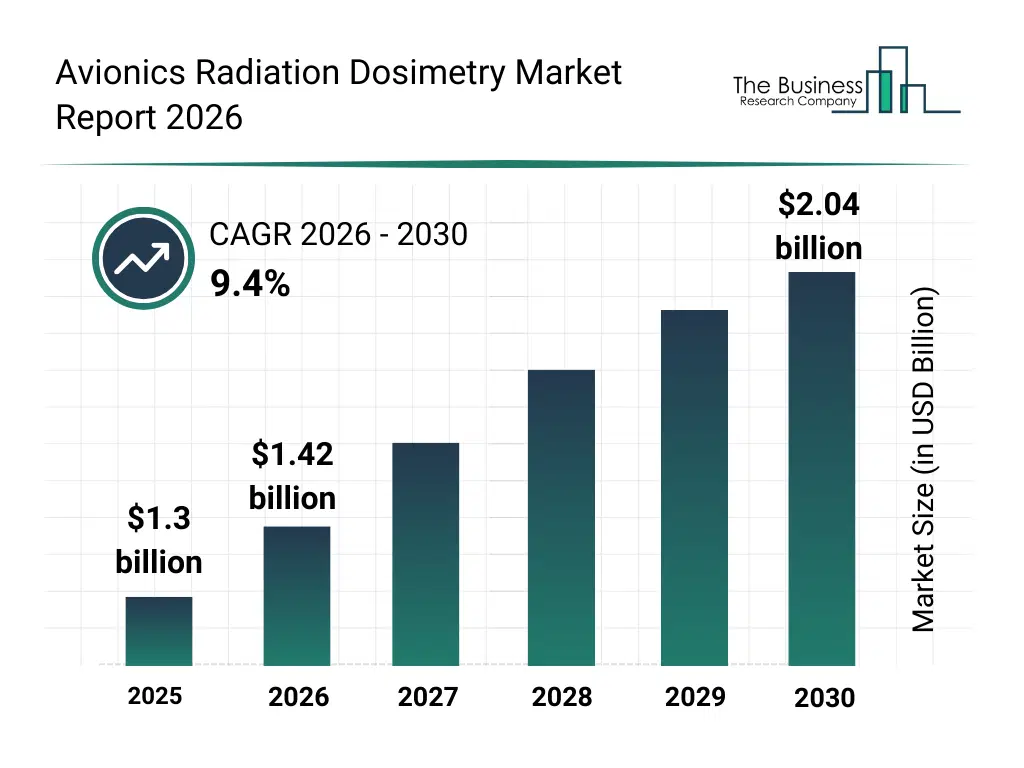
What Is The Avionics Radiation Dosimetry Market Size and Share 2026?
The avionics radiation dosimetry market size has grown strongly in recent years. It will grow from $1.3 billion in 2025 to $1.42 billion in 2026 at a compound annual growth rate (CAGR) of 9.7%. The growth in the historic period can be attributed to increased long-haul commercial flights, growth in avionics electronics usage, heightened awareness of cosmic radiation exposure, adoption of radiation dosimetry software, regulatory requirements for flight safety monitoring.What Is The Avionics Radiation Dosimetry Market Growth Forecast?
The avionics radiation dosimetry market size is expected to see strong growth in the next few years. It will grow to $2.04 billion in 2030 at a compound annual growth rate (CAGR) of 9.4%. The growth in the forecast period can be attributed to development of advanced real-time dosimeters, expansion of radiation monitoring services, integration with predictive avionics analytics, growth in space tourism and commercial spaceflight, adoption of automated radiation risk assessment platforms. Major trends in the forecast period include growth in high-altitude and long-duration radiation monitoring solutions, rising adoption of integrated avionics radiation safety modules, expansion of crew radiation exposure tracking programs, increased use of permanent radiation dose monitoring for aircraft systems, development of advanced neutron dosimetry technologies for aerospace environments.
Global Avionics Radiation Dosimetry Market Segmentation
1) By Product Type: Active Dosimeters, Passive Dosimeters, Personal Dosimeters, Area Monitors, Other Product Types 2) By Technology: Semiconductor-Based, Thermoluminescent, Optically Stimulated Luminescence, Other Technologies 3) By Application: Commercial Aviation, Military Aviation, Spacecraft, Others Application 4) By End-User: Airlines, Defense Organizations, Space Agencies, Research Institutes, Other End-Users Subsegments: 1) By Active Dosimeters: Electronic Personal Dosimeters (EPD), Real-Time Dosimeters, Pocket Dosimeters, Dose Rate Monitors 2) By Passive Dosimeters: Thermoluminescent Dosimeters (TLD), Optically Stimulated Luminescence (OSL) Dosimeters, Film Badges, Nuclear Track Detectors 3) By Personal Dosimeters: Wearable Dosimeters, Smart Or Connected Dosimeters, Badge Dosimeters, Ring Dosimeters 4) By Area Monitors: Fixed Radiation Monitors, Portable Area Monitors, Environmental Radiation Monitors, Gamma Or Neutron Monitors 5) By Other Product Types: Survey Meters, Spectrometry Devices, Radiation Mapping Systems, Ion Chamber DetectorsWhat Is Driver Of The Avionics Radiation Dosimetry Market?
The rise in space exploration is expected to propel the growth of the avionics radiation dosimetry market going forward. Space exploration is the investigation and study of outer space through the use of astronomy, robotic spacecraft, and human spaceflight to expand our understanding of the universe. Space exploration is increasing mainly due to advancements in technology that make space missions more feasible and cost-effective. Avionics radiation dosimetry in space exploration is used to monitor and measure radiation exposure to spacecraft electronics and crew, ensuring their safety and the reliability of onboard systems. For instance, in July 2024, according to the UK Space Agency, a UK-based government body responsible for the civil space program, in 2023, 175 new UK organizations were recognized for engaging in space-related activities, reflecting an 11% growth compared to 2022. Therefore, the rise in space exploration is driving the growth of the avionics radiation dosimetry industry.Key Players In The Global Avionics Radiation Dosimetry Market
Major companies operating in the avionics radiation dosimetry market are Thermo Fisher Scientific Inc., Fuji Electric Co. Ltd., Teledyne Technologies Incorporated, HORIBA Ltd., Fluke Biomedical, Ludlum Measurements Inc., PTW Freiburg GmbH, RaySafe Technologies Ltd., ATOMTEX Group, Berkeley Nucleonics Corporation, Kromek Group plc, IBA Dosimetry GmbH, PCE Instruments Inc., Polimaster Ltd., ACMAS Technologies Private Limited, Radiation Solutions Inc., SE International Inc., MegiQ B.V., Sper Scientific Industries Inc., ADVACAM s.r.o.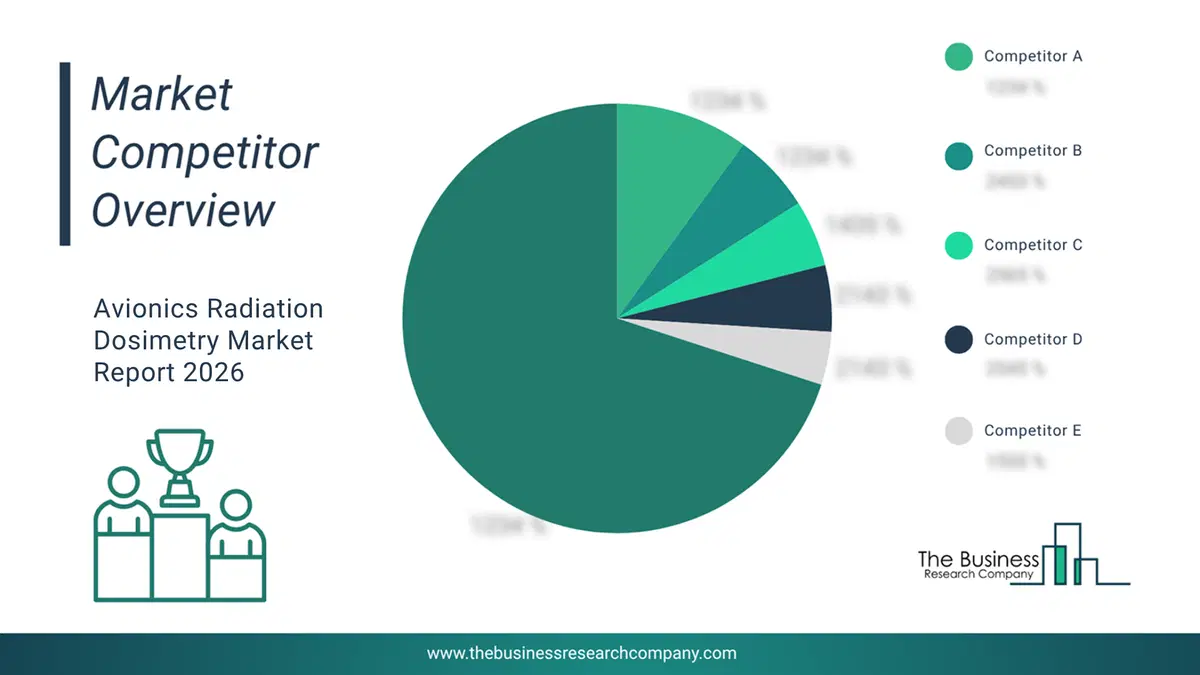
This chart is for illustrative purposes; the full report includes a detailed competitor analysis and comprehensive overview of the top 10 companies in the market.
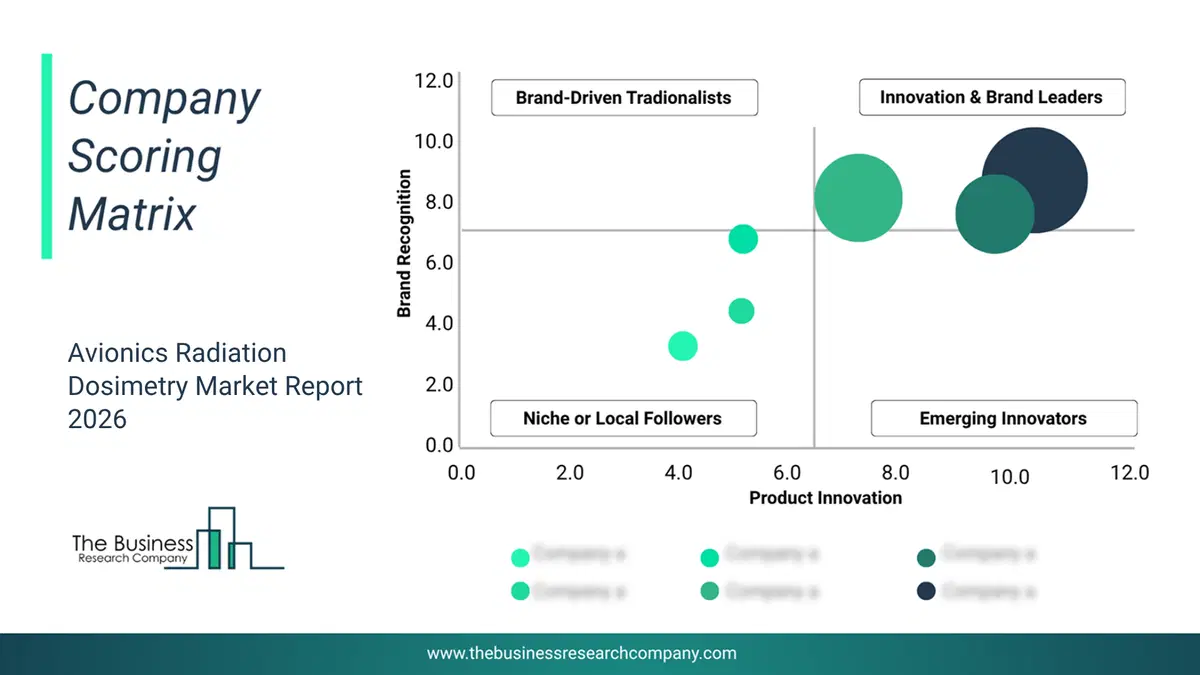
This chart maps companies by product innovation and brand strength, with bubble size indicating relative revenue, helping identify market leaders, challengers, and niche players. This is an illustrative chart; the full report provides a complete and accurate competitive analysis.
What Are Latest Mergers And Acquisitions In The Avionics Radiation Dosimetry Market? Advacam And Vector Space Biosciences Partnership To Advance Space-Based Biotechnology And Radiation Monitoring
In October 2024, Advacam, a Czech-based company specializing in advanced radiation imaging and detection solutions, partnered with Vector Space Biosciences to develop AI models and CubeSat payloads for the space industry. With this partnership, Advacam and Vector Space Biosciences aim to combine advanced radiation measurement and AI-driven data analysis to enhance space-based biotechnology and pharmaceutical research, enabling the development of radiation-hardened medical devices and the discovery of new drug insights from space-generated data. Vector Space Biosciences is a US-based company specializing in space biosciences and artificial intelligence.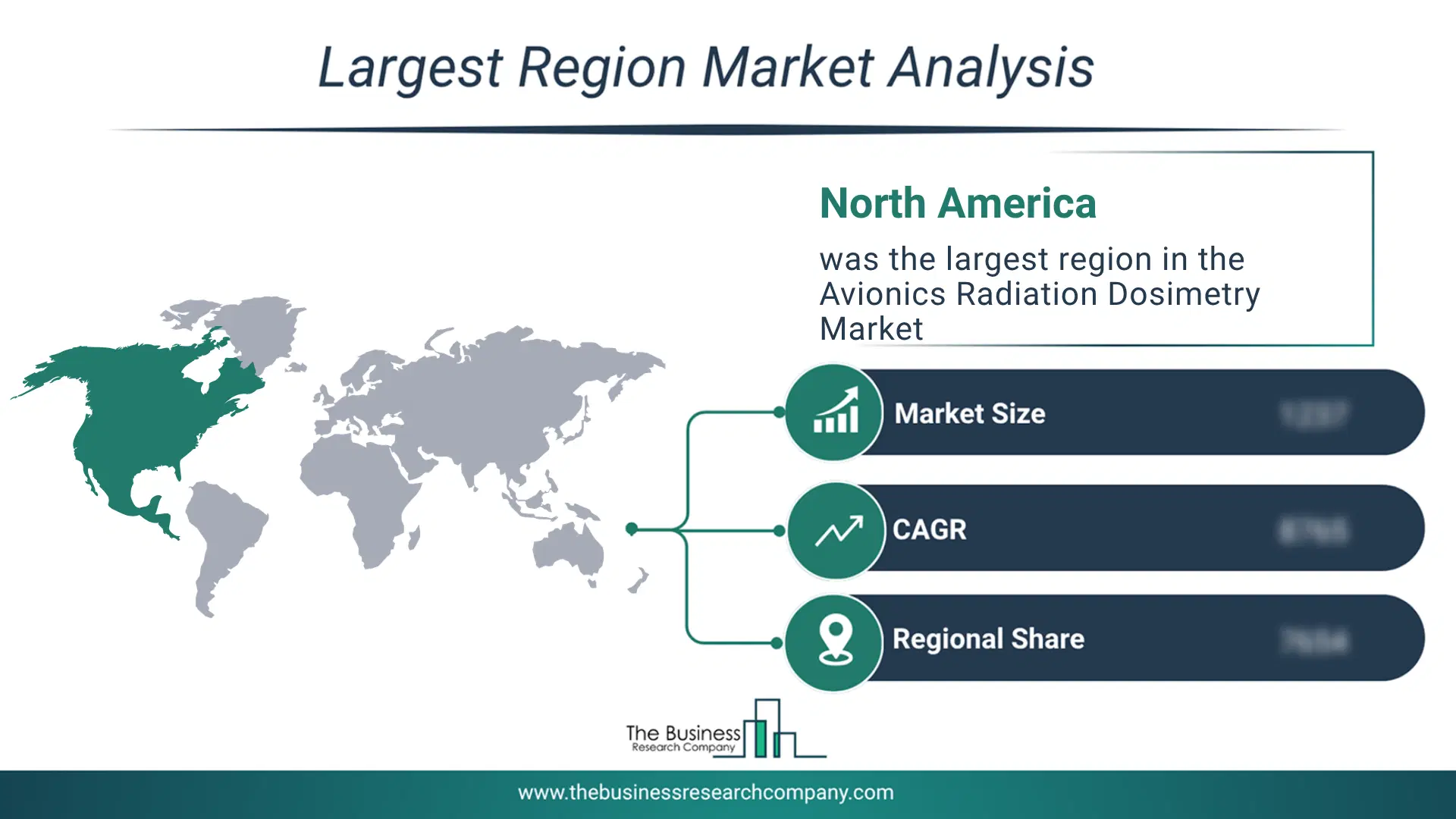
Regional Insights
North America was the largest region in the avionics radiation dosimetry market in 2025. Asia-Pacific is expected to be the fastest-growing region in the forecast period. The regions covered in this market report are Asia-Pacific, South East Asia, Western Europe, Eastern Europe, North America, South America, Middle East, Africa. The countries covered in this market report are Australia, Brazil, China, France, Germany, India, Indonesia, Japan, Taiwan, Russia, South Korea, UK, USA, Canada, Italy, SpainWhat Defines the Avionics Radiation Dosimetry Market?
The avionics radiation dosimetry market consists of revenues earned by entities by providing services such as radiation dose assessment, permanent radiation dose monitoring service, issuance of monthly radiation dose reports, radiation modeling and simulation, training, and qualification courses. The market value includes the value of related goods sold by the service provider or included within the service offering. The avionics radiation dosimetry market also includes sales of products including personal emergency radiation detectors, total ionizing dose measurement modules, AVIDOS aviation dosimetry software, neutron dosimeters using CR-39 solid state nuclear track detectors, in light nova extremity dosimeter. Values in this market are ‘factory gate’ values, that is, the value of goods sold by the manufacturers or creators of the goods, whether to other entities (including downstream manufacturers, wholesalers, distributors, and retailers) or directly to end customers. The value of goods in this market includes related services sold by the creators of the goods.How is Market Value Defined and Measured?
The market value is defined as the revenues that enterprises gain from the sale of goods and/or services within the specified market and geography through sales, grants, or donations in terms of the currency (in USD unless otherwise specified). The revenues for a specified geography are consumption values that are revenues generated by organizations in the specified geography within the market, irrespective of where they are produced. It does not include revenues from resales along the supply chain, either further along the supply chain or as part of other products.
This chart presents market attractiveness based on a quantitative evaluation of growth, competition, strategic alignment, and risk, offering a clear view of opportunity areas for decision-making. This chart is for illustrative purposes; the full report contains the complete analysis.

This chart highlights the Total Addressable Market (TAM) by estimating the maximum revenue opportunity using an assumption-driven approach, supporting strategic planning and opportunity sizing across markets. The chart is illustrative; the full report provides a more comprehensive analysis.
What Key Data and Analysis Are Included in the Avionics Radiation Dosimetry Market Report 2026?
The avionics radiation dosimetry market research report is one of a series of new reports from The Business Research Company that provides market statistics, including industry global market size, regional shares, competitors with the market share, detailed market segments, market trends and opportunities, and any further data you may need to thrive in the avionics radiation dosimetry industry. The market research report delivers a complete perspective of everything you need, with an in-depth analysis of the current and future state of the industry.Avionics Radiation Dosimetry Market Report Forecast Analysis
| Report Attribute | Details |
|---|---|
| Market Size Value In 2026 | $1.42 billion |
| Revenue Forecast In 2030 | $2.04 billion |
| Growth Rate | CAGR of 9.4% from 2026 to 2030 |
| Base Year For Estimation | 2025 |
| Actual Estimates/Historical Data | 2020-2025 |
| Forecast Period | 2026 - 2030 |
| Market Representation | Revenue in USD Billion and CAGR from 2026 to 2030 |
| Segments Covered | Product Type, Technology, Application, End-User |
| Regional Scope | Asia-Pacific, Western Europe, Eastern Europe, North America, South America, Middle East, Africa |
| Country Scope | The countries covered in the avionics radiation dosimetry market report are Australia, Brazil, China, France, Germany, India, Indonesia, Japan, Taiwan, Russia, South Korea, UK, USA, Canada, Italy, Spain |
| Key Companies Profiled | Thermo Fisher Scientific Inc., Fuji Electric Co. Ltd., Teledyne Technologies Incorporated, HORIBA Ltd., Fluke Biomedical, Ludlum Measurements Inc., PTW Freiburg GmbH, RaySafe Technologies Ltd., ATOMTEX Group, Berkeley Nucleonics Corporation, Kromek Group plc, IBA Dosimetry GmbH, PCE Instruments Inc., Polimaster Ltd., ACMAS Technologies Private Limited, Radiation Solutions Inc., SE International Inc., MegiQ B.V., Sper Scientific Industries Inc., ADVACAM s.r.o. |
| Customization Scope | Request for Customization |
| Pricing And Purchase Options | Explore Purchase Options |