
B2B Payments Market Report 2026
Global Outlook – By Payment Type (Domestic Payments, Cross-Border Payments), By Payment Mode (Bank Transfer, Cards, Other Payment Modes), By Enterprise Size (Large Enterprises, Medium-Sized Enterprises, Small-Sized Enterprises), By Industry Vertical (Manufacturing, IT And Telecom, Metals And Mining, Energy And Utilities, Banking, Financial Services And Insurance, Government Sector, Other Industry Vertical) – Market Size, Trends, Strategies, and Forecast to 2030
B2B Payments Market Overview
• B2B Payments market size has reached to $1340.09 billion in 2025 • Expected to grow to $2188.83 billion in 2030 at a compound annual growth rate (CAGR) of 10.3% • Growth Driver: Rising E-Commerce Industry Propels Growth In The B2B Payment Market • Market Trend: B2B Payments Market Embraces Seamless Payment Assistances • Asia-Pacific was the largest region in 2025.Market Gains By 2030 – Top Opportunities By Segment
Market Gain identifies the most promising market opportunities by highlighting the segments or products expected to generate the highest incremental revenue growth over the next five years.
What Is Covered Under B2B Payments Market?
B2B payments refer to a payment that occurs between two organizations or businesses, from a buyer to a supplier, for the supply of goods and services. The payment is a one-time or recurring transaction that depends on the contractual agreement of the buyer and supplier. It is used for transacting payments between two businesses. The main payment types for B2B payments are domestic payments and cross-border payments. Domestic payments refer to payments made within a country where the bank has issued the client's credit or debit card and the merchant account is registered in the same country. The major payment modes are bank transfer, cards, and others used by large enterprises, medium-sized enterprises, and small-sized enterprises operating in various verticals such as manufacturing, IT and telecom, metals and mining, energy and utilities, BFSI, government sector, and others.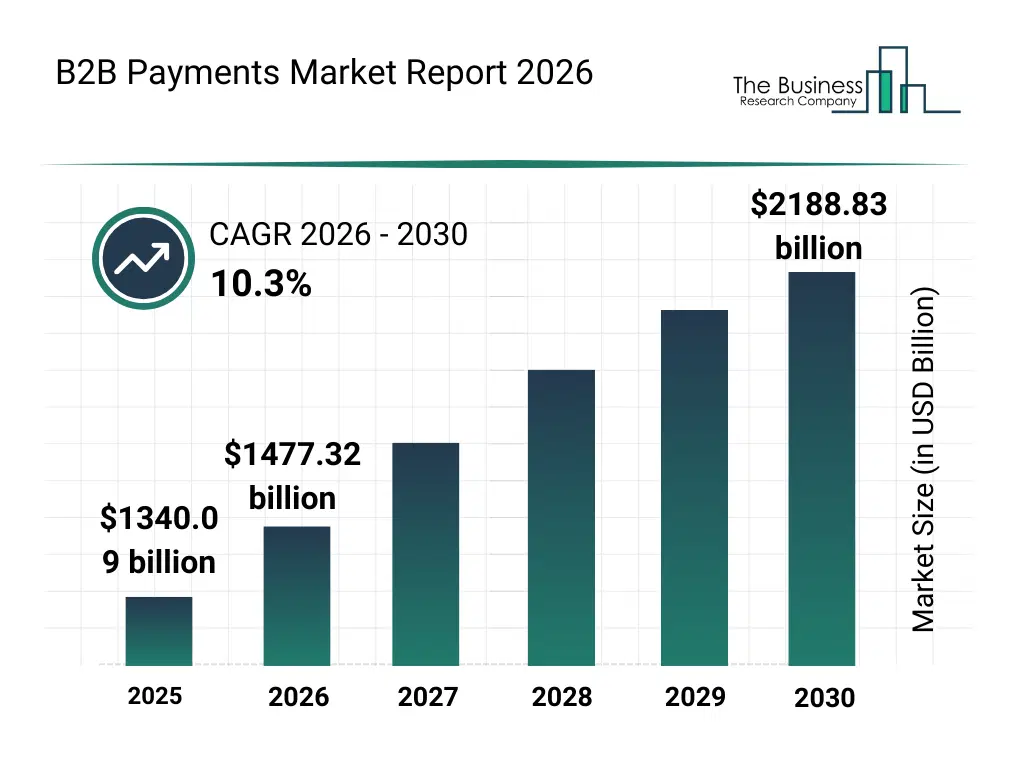
What Is The B2B Payments Market Size and Share 2026?
The b2b payments market size has grown rapidly in recent years. It will grow from $1340.09 billion in 2025 to $1477.32 billion in 2026 at a compound annual growth rate (CAGR) of 10.2%. The growth in the historic period can be attributed to expansion of global trade transactions, increasing reliance on electronic fund transfers, growth of enterprise resource planning systems, rising demand for faster settlement cycles, adoption of digital invoicing practices.What Is The B2B Payments Market Growth Forecast?
The b2b payments market size is expected to see rapid growth in the next few years. It will grow to $2188.83 billion in 2030 at a compound annual growth rate (CAGR) of 10.3%. The growth in the forecast period can be attributed to increasing demand for instant cross-border payments, rising adoption of api-based payment platforms, expansion of embedded finance solutions, growing focus on payment security and compliance, increasing use of ai-driven fraud detection. Major trends in the forecast period include increasing adoption of real-time payment processing platforms, rising use of automated invoice and reconciliation systems, expansion of cross-border payment solutions, growing integration of blockchain-based payment security, enhanced focus on cash flow optimization.
Global B2B Payments Market Segmentation
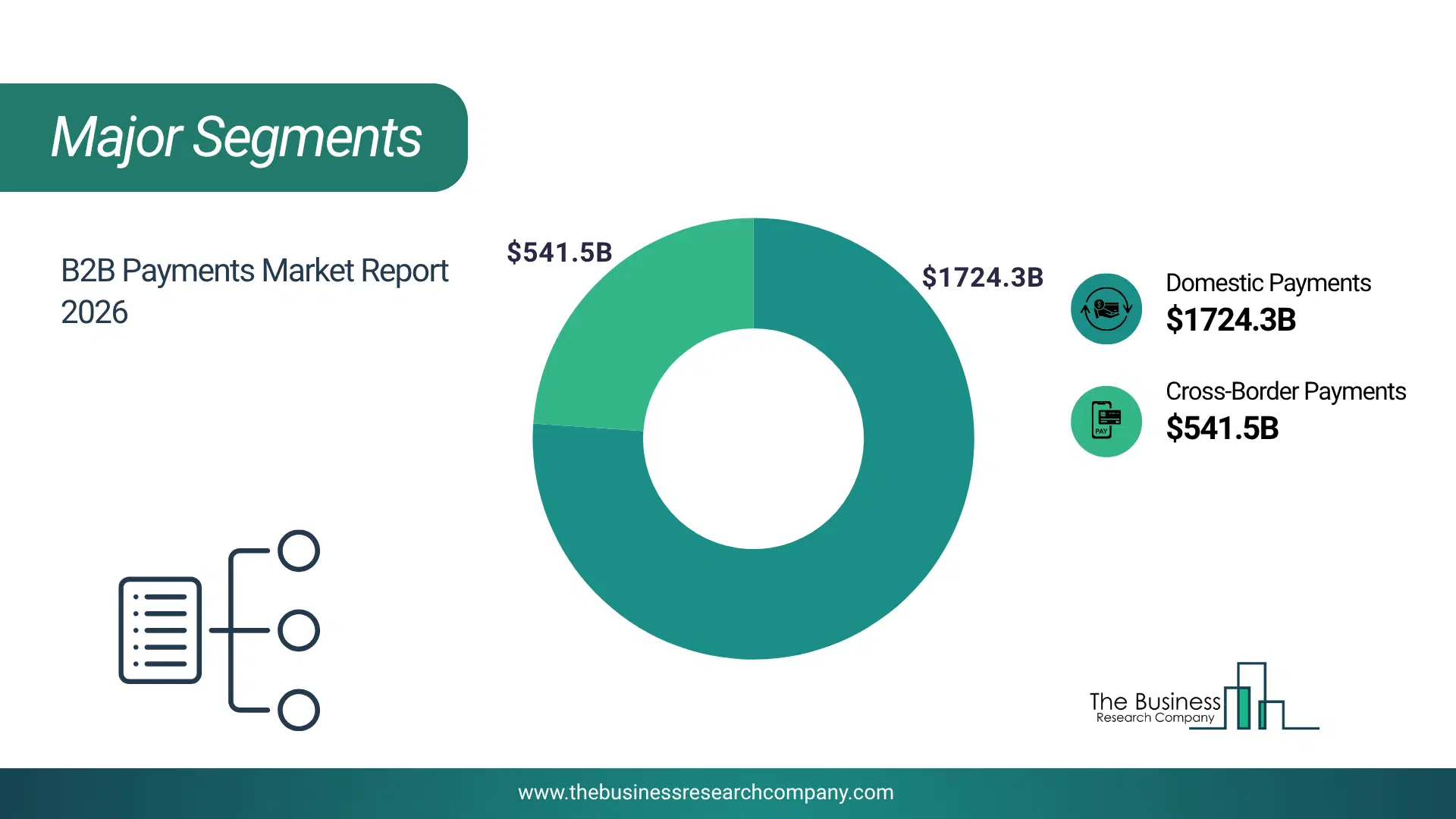
1) By Payment Type: Domestic Payments, Cross-Border Payments 2) By Payment Mode: Bank Transfer, Cards, Other Payment Modes 3) By Enterprise Size: Large Enterprises, Medium-Sized Enterprises, Small-Sized Enterprises 4) By Industry Vertical: Manufacturing, IT And Telecom, Metals And Mining, Energy And Utilities, Banking, Financial Services And Insurance, Government Sector, Other Industry Vertical Subsegments: 1) By Domestic Payments: ACH Transfers, Wire Transfers, Credit And Debit Card Payments, E-checks And Electronic Invoicing 2) By Cross-Border Payments: International Wire Transfers, Foreign Exchange Services, Payment Processing Platforms For Global Transactions, Remittance Services The top segments in the b2b payments market will be: • Domestic Payments will reach $1724.26 billion by 2030. • Cross-Border Payments will reach $541.42 billion by 2030.What Is The Driver Of The B2B Payments Market?
The rising e-commerce industry is expected to propel the growth of the B2B payments market going forward. E-commerce involves buying and selling goods or services over the Internet or online platforms, enabling transactions, payments, and interactions between businesses and consumers in a digital environment. B2B payments in e-commerce streamline transaction processes, ensuring secure and efficient financial transactions between businesses, fostering trust, and enabling the seamless exchange of goods and services in the digital marketplace. For instance, in November 2023, according to the US Census Bureau, a US-based Department of Commerce, in the third quarter of 2023, U.S. retail e-commerce sales reached an estimated $271.7 billion, marking a 0.9% (±0.4%) increase from the preceding quarter. Compared to the third quarter of 2022, e-commerce sales saw a rise of 7.8% (±1.2%), while total retail sales increased by 2.0% (±0.4%) during the same period. E-commerce sales constituted 14.9% of total sales in the third quarter of 2023. Therefore, the rising e-commerce industry is driving the growth of the B2B payments industry.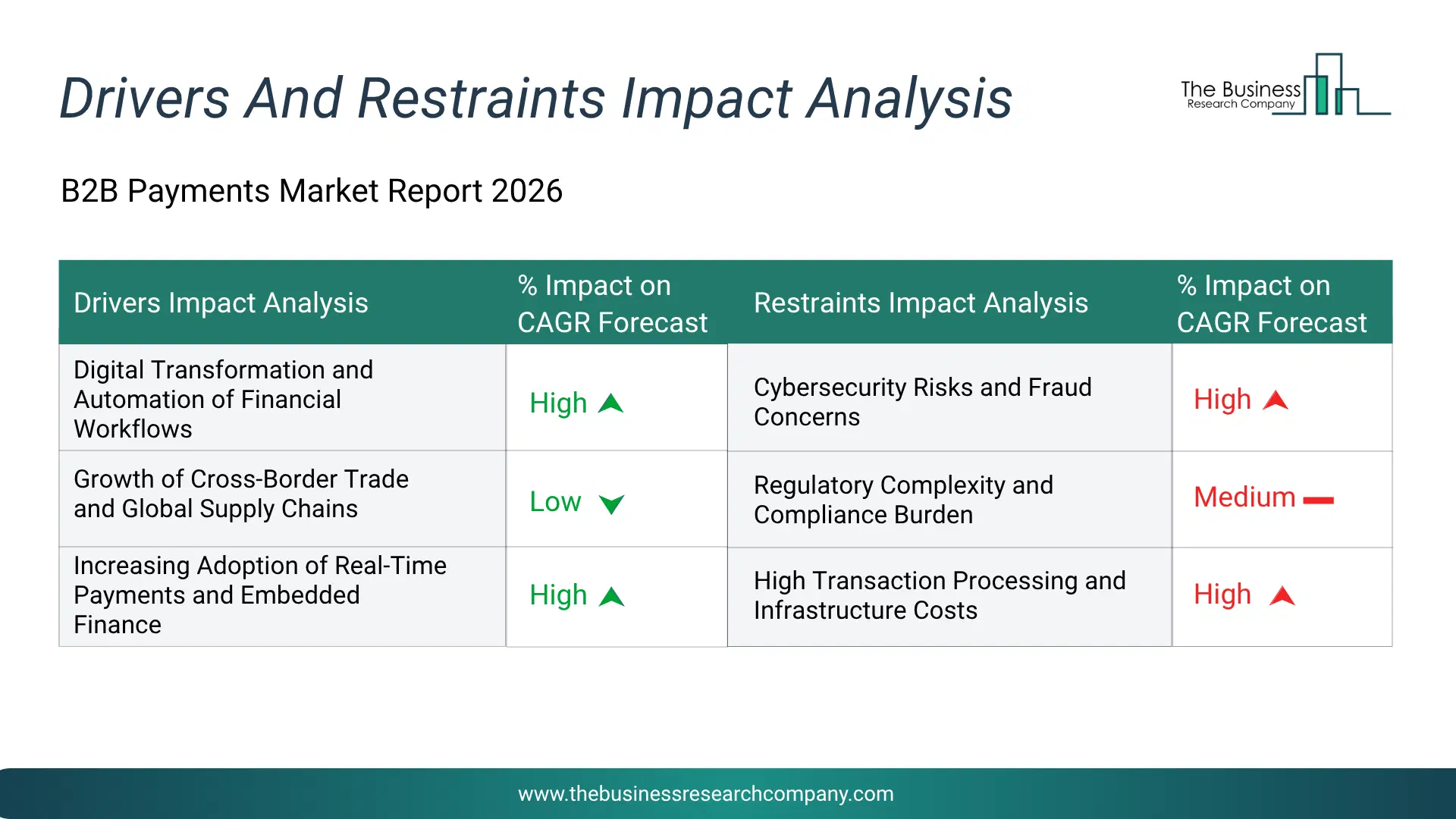
Infographic Chart Showing Key Market Drivers Analysis And Restraints For B2B Payments Market
The chart presents an impact analysis of key drivers and restraints, quantifying their relative influence on the market's growth rate and helping assess the balance between growth enablers and limiting factors. This chart offers a high-level perspective; the full report contains more detailed insights.
How Will The Drivers Impact Growth In The Global B2B Payments Market?
• Digital Transformation and Automation of Financial Workflows (High) – During the forecast period, the digital transformation and automation of financial workflows is expected to become a key growth driver for the b2b payments market by 2030. The rapid digital transformation of enterprises across industries is significantly driving the adoption of b2b payment solutions. Organizations are increasingly automating accounts payable (ap), accounts receivable (ar), invoicing, reconciliation, and treasury operations to enhance efficiency, reduce errors, and improve transparency. Cloud -based platforms, erp integrations, api -enabled payment gateways, and real -time processing systems are streamlining financial workflows and minimizing manual intervention. Businesses are prioritizing digital payment ecosystems to accelerate transaction cycles, improve working capital management, and enhance supplier relationships. This structural shift from paper -based and manual processes to digital and automated b2b payment systems is a major long -term growth driver for the market. • Growth of Cross-Border Trade and Global Supply Chains (Low) – During the forecast period, the growth of cross-border trade and global supply chains is expected to emerge as a major factor driving the expansion of the b2b payments market by 2030. The expansion of international trade and increasingly complex global supply chains is fueling demand for secure, transparent, and efficient cross-border b2b payment solutions. Businesses engaged in global sourcing and distribution require multi-currency payment capabilities, foreign exchange management, regulatory compliance support, and real-time transaction tracking. Fintech innovations such as blockchain-based settlements, real-time gross settlement (rtgs) systems, and digital trade finance platforms are improving transaction speed and reducing settlement risks. As cross-border commerce grows, companies are investing in advanced b2b payment platforms to ensure seamless global financial operations. • Increasing Adoption of Real-Time Payments and Embedded Finance (High) – During the forecast period, the increasing adoption of real-time payments and embedded finance is expected to act as a key growth catalyst for the b2b payments market by 2030. The growing adoption of real-time payment infrastructure and embedded finance solutions is transforming b2b transactions. Businesses increasingly expect instant fund transfers, automated reconciliation, and integrated financing options within digital platforms. Embedded payment solutions within e-commerce, procurement, and supply chain management platforms are improving transaction efficiency and user experience. Real-time payments reduce liquidity constraints, enhance cash flow visibility, and enable faster settlement cycles between buyers and suppliers. This technological shift toward seamless, integrated, and real-time b2b payment ecosystems is a strong growth accelerator for the market.How Will The Restraints Impact Growth In The Global B2B Payments Market?
• Cybersecurity Risks and Fraud Concerns (High) – During the forecast period, the b2b payment systems are increasingly targeted by cyber threats, including phishing attacks, payment fraud, ransomware, and business email compromise (bec) scams. As transaction volumes and digital adoption grow, ensuring robust security, encryption, and fraud detection mechanisms becomes critical. Security breaches can lead to financial losses, reputational damage, and regulatory penalties. The growing complexity of cyber risks acts as a restraint, requiring continuous investment in security infrastructure and compliance frameworks, which may increase operational costs for payment providers and enterprises. • Regulatory Complexity and Compliance Burden (Medium) – During the forecast period, the b2b payment providers must comply with evolving financial regulations, anti-money laundering (aml) policies, know-your-customer (kyc) requirements, data protection laws, and cross-border financial standards. Regulatory differences across jurisdictions add complexity to global payment operations and may slow market expansion. Compliance costs, licensing requirements, and reporting obligations can be particularly challenging for smaller fintech firms. These regulatory hurdles act as a restraint on market growth, especially in highly regulated financial environments. • High Transaction Processing and Infrastructure Costs (High) – During the forecast period, the high transaction processing and infrastructure costs act as a restraint for the b2b payments market by increasing the overall cost of operating digital payment platforms. Payment providers need to invest heavily in secure payment gateways, cloud infrastructure, settlement systems, and real-time transaction processing capabilities. Additionally, costs associated with maintaining interoperability across multiple banking networks and payment rails further add to operational expenses. These high costs can reduce profit margins for service providers and make pricing less competitive for end users, particularly small and medium-sized enterprises.Key Players In The Global B2B Payments Market
Major companies operating in the b2b payments market are JPMorgan Chase & Co., Bank of America Corporation, Citigroup Inc., American Express Company, Visa Inc., Mastercard Inc., PayPal Holdings Inc., Stripe Inc., Fiserv Inc., Global Payments Inc., Worldpay Inc., Adyen N.V., Bill.com Inc., Payoneer Global Inc., Bottomline Technologies Inc., Flywire Corporation, Paystand Inc., AvidXchange Inc., Tipalti Inc., Airwallex, WePay Inc., Billtrust Holdings Inc., ACI Worldwide Inc., Capital One Financial Corporation, Block Inc., Square Inc., Ant Group Co., Wise Payments Limited, TransferWise Ltd.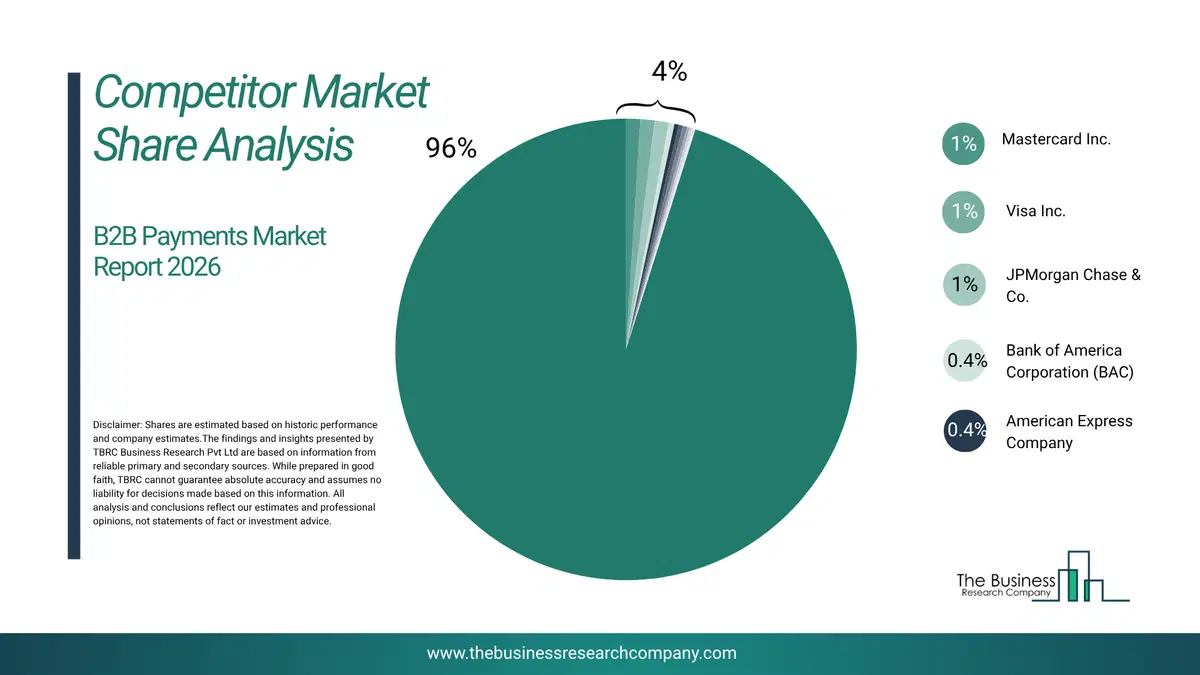
This chart is for illustrative purposes; the full report includes a detailed competitor analysis and comprehensive overview of the top 10 companies in the market.
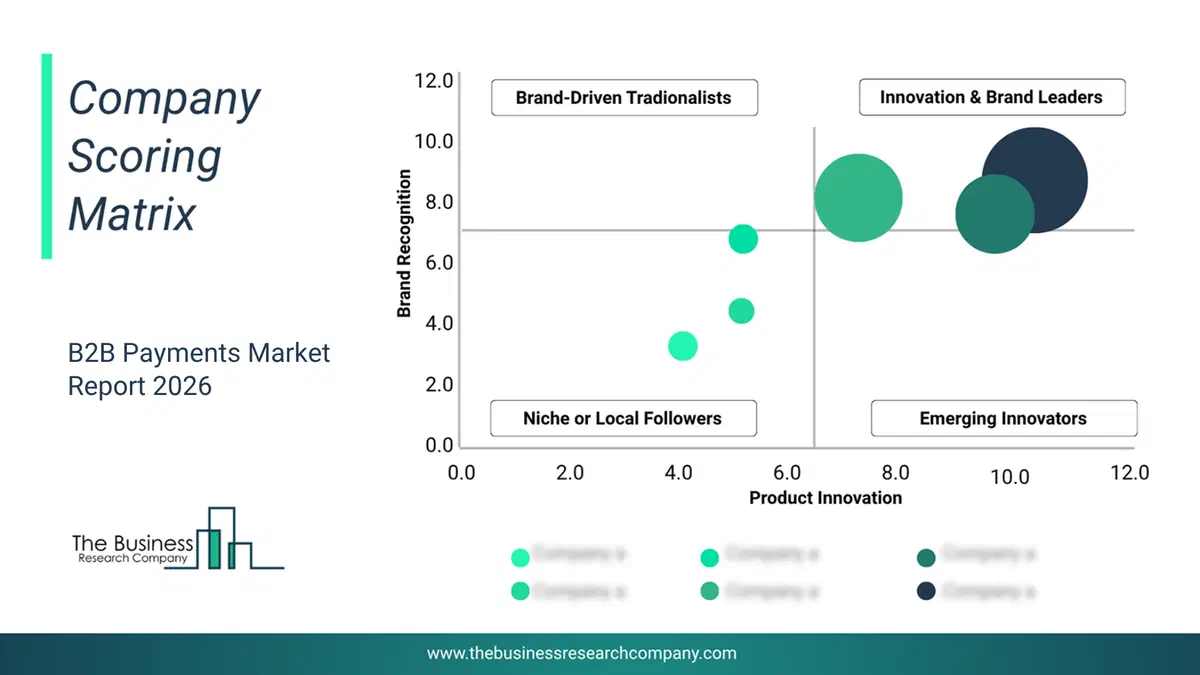
This chart maps companies by product innovation and brand strength, with bubble size indicating relative revenue, helping identify market leaders, challengers, and niche players. This is an illustrative chart; the full report provides a complete and accurate competitive analysis.
Global B2B Payments Market Trends and Insights
Major companies operating in the B2B payments market are increasing their focus on introducing innovative solutions, such as seamless payment assistance, to gain a competitive edge in the market. A seamless payment experience refers to a transaction process that is frictionless and user-friendly, where customers can make payments easily and efficiently without encountering disruptions or obstacles. For instance, in December 2023, Alternative Payments, a UK-based company, launched Collections Assist, a product designed to revolutionize accounts receivable collections for service companies. The new product allows businesses to send overdue invoices to collections in just two clicks, saving time and reducing manual efforts. The platform enables businesses to offer their customers a seamless payment experience with Alternative Payments' B2B checkout, which features the company's branding and design elements.What Are Latest Mergers And Acquisitions In The B2B Payments Market?
In June 2025, Xero Ltd, a New Zealand–based accounting‑software company, acquired Melio Payments Inc. for an $2.5 billion. With this acquisition, Xero aimed to integrate a fast‑growing B2B payments engine directly into its accounting platform thereby offering SMBs a seamless end‑to‑end financial workflow combining bookkeeping, accounts payable/receivable, and payment processing. Melio Payments Inc is a US‑based B2B payments platform that specializes in providing bill‑pay, accounts‑payable & receivable automation, and payment transfer services tailored for small and mid‑sized businesses.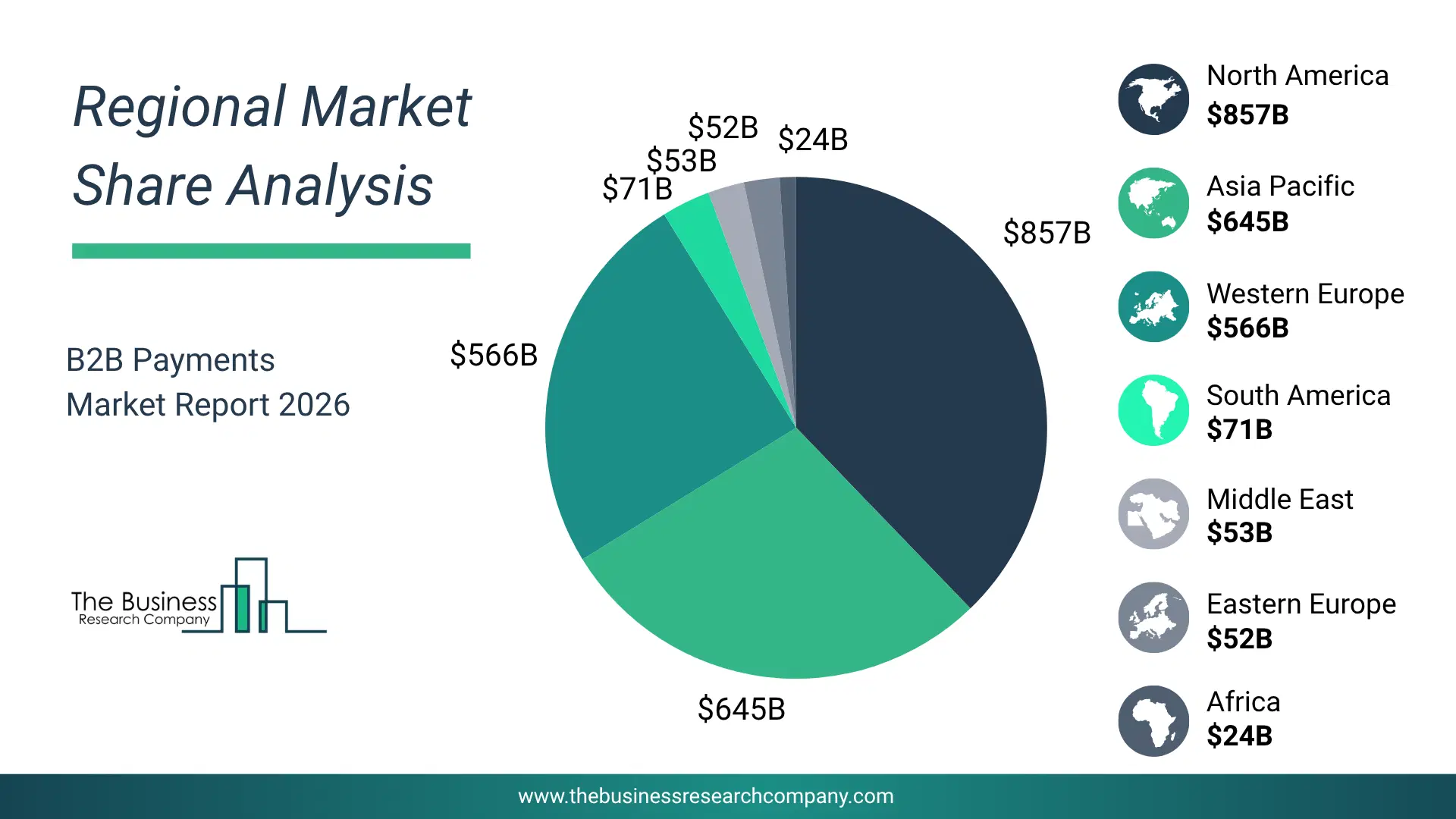
Regional Outlook
Asia-Pacific was the largest region in the B2B payments market in 2025. The regions covered in this market report are Asia-Pacific, South East Asia, Western Europe, Eastern Europe, North America, South America, Middle East, Africa. The countries covered in this market report are Australia, Brazil, China, France, Germany, India, Indonesia, Japan, Taiwan, Russia, South Korea, UK, USA, Canada, Italy, Spain.What Defines the B2B Payments Market?
The B2B payments market includes revenues earned by entities by providing transaction processing services such as payment gateways, cash payments, payment security, bookkeeping & taxes, and record cash flow. The market value includes the value of related goods sold by the service provider or included within the service offering. Only goods and services traded between entities or sold to end consumers are included.How is Market Value Defined and Measured?
The market value is defined as the revenues that enterprises gain from the sale of goods and/or services within the specified market and geography through sales, grants, or donations in terms of the currency (in USD unless otherwise specified). The revenues for a specified geography are consumption values that are revenues generated by organizations in the specified geography within the market, irrespective of where they are produced. It does not include revenues from resales along the supply chain, either further along the supply chain or as part of other products.
This chart presents market attractiveness based on a quantitative evaluation of growth, competition, strategic alignment, and risk, offering a clear view of opportunity areas for decision-making. This chart is for illustrative purposes; the full report contains the complete analysis.

This chart highlights the Total Addressable Market (TAM) by estimating the maximum revenue opportunity using an assumption-driven approach, supporting strategic planning and opportunity sizing across markets. The chart is illustrative; the full report provides a more comprehensive analysis.
What Key Data and Analysis Are Included in the B2B Payments Market Report 2026?
The b2b payments market research report is one of a series of new reports from The Business Research Company that provides market statistics, including Market Report 2026?global market size, regional shares, competitors with the market share, detailed market segments, market trends and opportunities, and any further data you may need to thrive in the b2b payments Market Report 2026? The market research report delivers a complete perspective of everything you need, with an in-depth analysis of the current and future state of the Market Report 2026?B2B Payments Market Report Forecast Analysis
| Report Attribute | Details |
|---|---|
| Market Size Value In 2026 | $1477.32 billion |
| Revenue Forecast In 2030 | $2188.83 billion |
| Growth Rate | CAGR of 10.3% from 2026 to 2030 |
| Base Year For Estimation | 2025 |
| Actual Estimates/Historical Data | 2020-2025 |
| Forecast Period | 2026 - 2030 |
| Market Representation | Revenue in USD Billion and CAGR from 2026 to 2030 |
| Segments Covered | Payment Type, Payment Mode, Enterprise Size, Industry Vertical |
| Regional Scope | Asia-Pacific, Western Europe, Eastern Europe, North America, South America, Middle East, Africa |
| Country Scope | The countries covered in the report are Australia, Brazil, China, France, Germany, India, ... |
| Key Companies Profiled | JPMorgan Chase & Co., Bank of America Corporation, Citigroup Inc., American Express Company, Visa Inc., Mastercard Inc., PayPal Holdings Inc., Stripe Inc., Fiserv Inc., Global Payments Inc., Worldpay Inc., Adyen N.V., Bill.com Inc., Payoneer Global Inc., Bottomline Technologies Inc., Flywire Corporation, Paystand Inc., AvidXchange Inc., Tipalti Inc., Airwallex, WePay Inc., Billtrust Holdings Inc., ACI Worldwide Inc., Capital One Financial Corporation, Block Inc., Square Inc., Ant Group Co., Wise Payments Limited, TransferWise Ltd. |
| Customization Scope | Request for Customization |
| Pricing And Purchase Options | Explore Purchase Options |