
Baggage Handling System Market Report 2026
Global Outlook – By Type (Destination Coded Vehicle (DCV); Conveyor), By Technology (Radio-Frequency Identification (RFID); Barcode), By Mode (Airport; Railway; Marine), By Application (Check-In Systems; Security Screening Systems; Sorting Systems; Transfer Systems; Arrival And Reclaim Systems) – Market Size, Trends, Strategies, and Forecast to 2030
Baggage Handling System Market Overview
• Baggage Handling System market size has reached to $11.13 billion in 2025 • Expected to grow to $16.07 billion in 2030 at a compound annual growth rate (CAGR) of 7.5% • Growth Driver: Growth In Tourism Industry Boosting Baggage Handling System Market • Market Trend: Digital Predictive Maintenance Enhancing Airport Operational Reliability • Asia-Pacific was the largest region in 2025 and North America is the fastest growing region.Market Gains By 2030 – Top Opportunities By Segment
Market Gain identifies the most promising market opportunities by highlighting the segments or products expected to generate the highest incremental revenue growth over the next five years.
What Is Covered Under Baggage Handling System Market?
A baggage handling system (BHS) is an automated system used in airports to transport efficiently checked luggage from check-in counters to the aircraft, optimizing efficiency, minimizing mishandling, and ensuring prompt and accurate delivery to and from the aircraft. The purpose of a baggage handling system is to streamline the check-in and baggage retrieval process, improve passenger experience, and ensure that luggage reaches the correct destination efficiently. The main types in baggage handling system are destination coded vehicle (DCV) and conveyor. A destination coded vehicle (DCV) refers to an automated vehicle used in airport baggage handling systems to transport luggage to specific destinations within the airport, such as different sorting areas or directly to the correct aircraft. The various technologies included radio-frequency identification (RFID) and barcode to deploy in airport, railway, and marine modes for check-in systems, security screening systems, sorting systems, transfer systems, and arrival and reclaim system applications.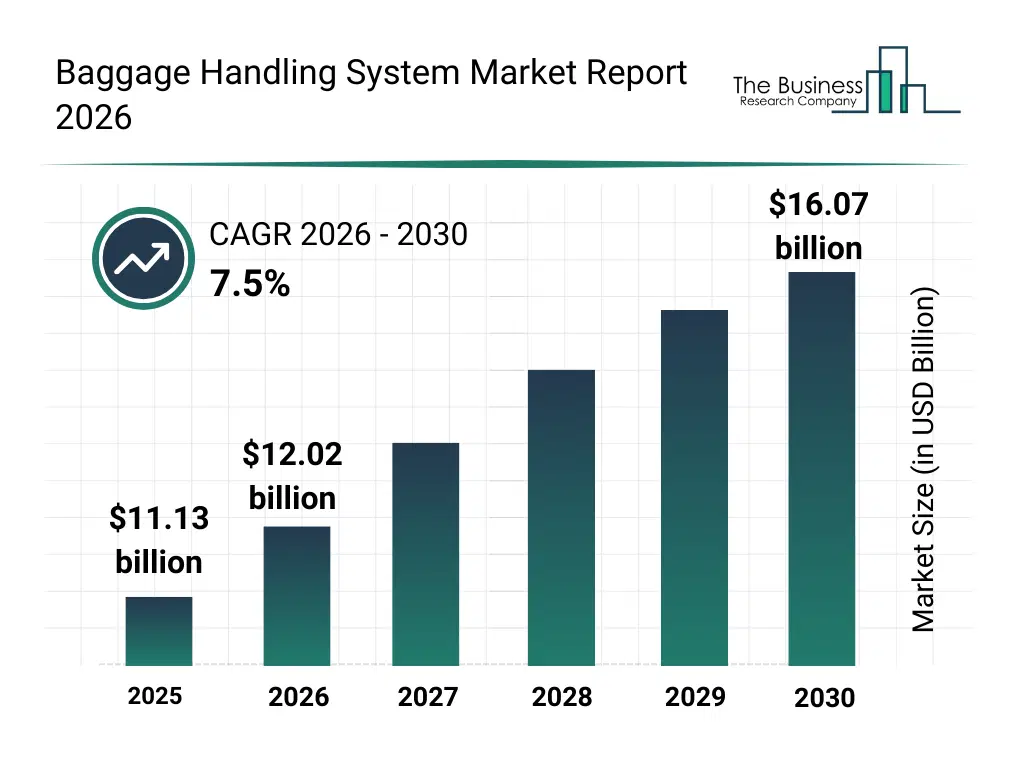
What Is The Baggage Handling System Market Size and Share 2026?
The baggage handling system market size has grown strongly in recent years. It will grow from $11.13 billion in 2025 to $12.02 billion in 2026 at a compound annual growth rate (CAGR) of 8.1%. The growth in the historic period can be attributed to expansion of global air passenger traffic, modernization of airport infrastructure, rising baggage volume per passenger, adoption of conveyor-based handling systems, increased airport capacity investments.What Is The Baggage Handling System Market Growth Forecast?
The baggage handling system market size is expected to see strong growth in the next few years. It will grow to $16.07 billion in 2030 at a compound annual growth rate (CAGR) of 7.5%. The growth in the forecast period can be attributed to increasing investments in smart airport projects, rising focus on contactless passenger processing, expansion of multimodal transport hubs, growing adoption of predictive maintenance systems, increasing demand for scalable baggage solutions. Major trends in the forecast period include increasing deployment of fully automated baggage systems, rising adoption of rfid-based baggage tracking, growing integration of ai-driven sorting technologies, expansion of high-speed conveyor systems, enhanced focus on baggage handling accuracy.
Global Baggage Handling System Market Segmentation
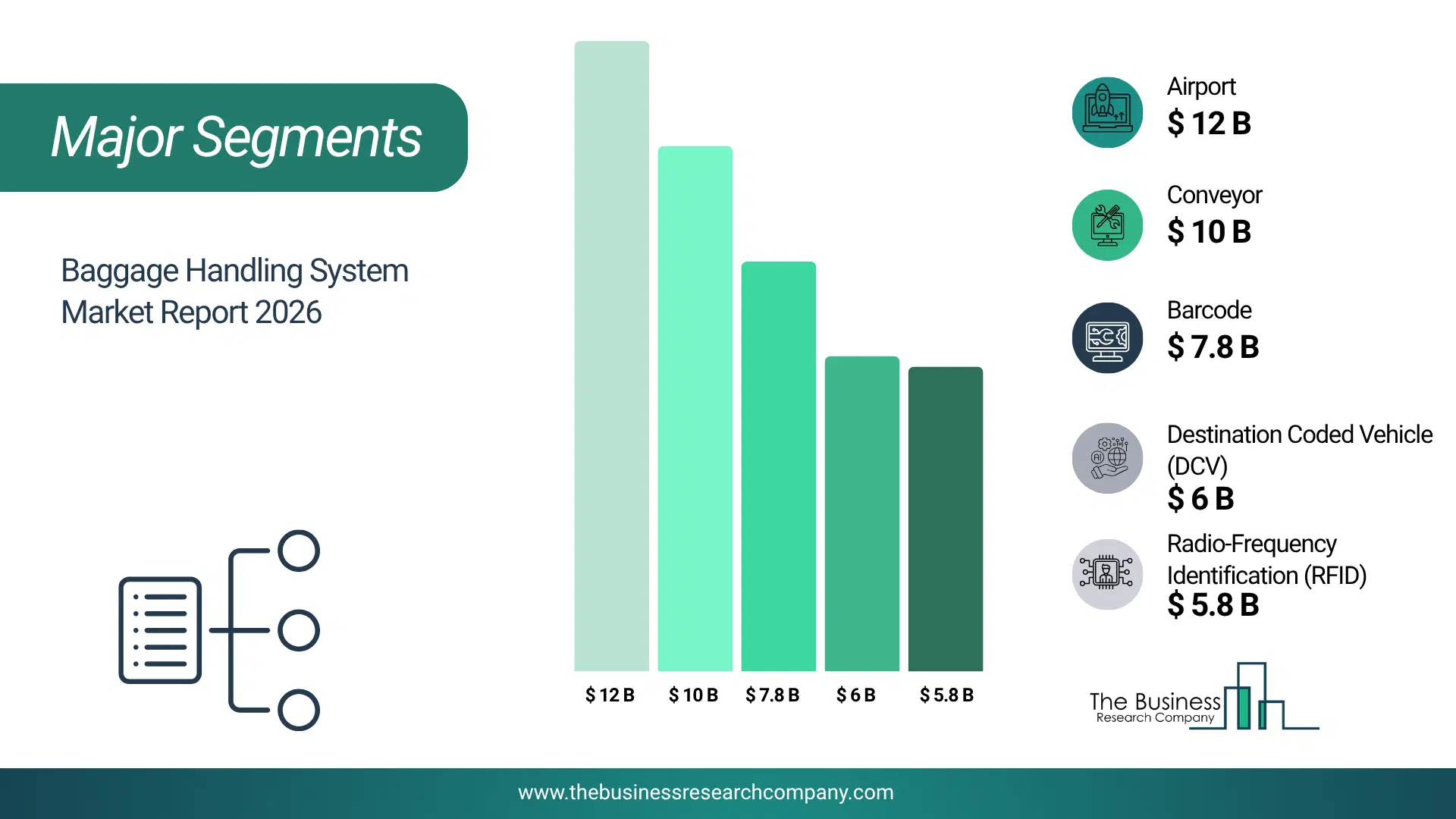
1) By Type: Destination Coded Vehicle (DCV), Conveyor 2) By Technology: Radio-Frequency Identification (RFID), Barcode 3) By Mode: Airport, Railway, Marine 4) By Application: Check-In Systems, Security Screening Systems, Sorting Systems, Transfer Systems, Arrival And Reclaim Systems Subsegments: 1) By Destination Coded Vehicle (DCV): Automated DCV System, Semi-Automated DCV System 2) By Conveyor: Belt Conveyor, Gravity Roller Conveyor, Powered Roller Conveyor, Spiral Conveyor, Tilt Tray Conveyor The top segments in the baggage handling system market will be: • Airport will reach $12058.77 Million by 2030. • Conveyor will reach $10001.39 Million by 2030. • Barcode will reach $7850.8 Million by 2030. • Destination Coded Vehicle (DCV) will reach $6075.19 Million by 2030. • Radio-Frequency Identification (RFID) will reach $5858.71 Million by 2030.What Is The Driver Of The Baggage Handling System Market?
The expansion of the tourism industry is expected to propel the growth of the baggage handling system market going forward. The tourism industry encompasses businesses and services that cater to travelers and tourists, including transportation, accommodations, attractions, and hospitality. The expansion of the tourism industry is fueled by enhanced infrastructure, economic growth, rising disposable incomes, globalization, and more accessible travel information. Baggage handling systems support tourism by efficiently and systematically managing luggage, ensuring a smooth travel experience for tourists, and improving satisfaction and operational effectiveness for travel service providers. For instance, in February 2024, according to United Nations World Tourism Organization (UNWTO), a Spain-based specialized agency of the United Nations, a global estimate recorded 1,286 million international tourists in 2023, an increase of 34% over 2022. Therefore, expanding the tourism industry is driving the baggage handling system industry.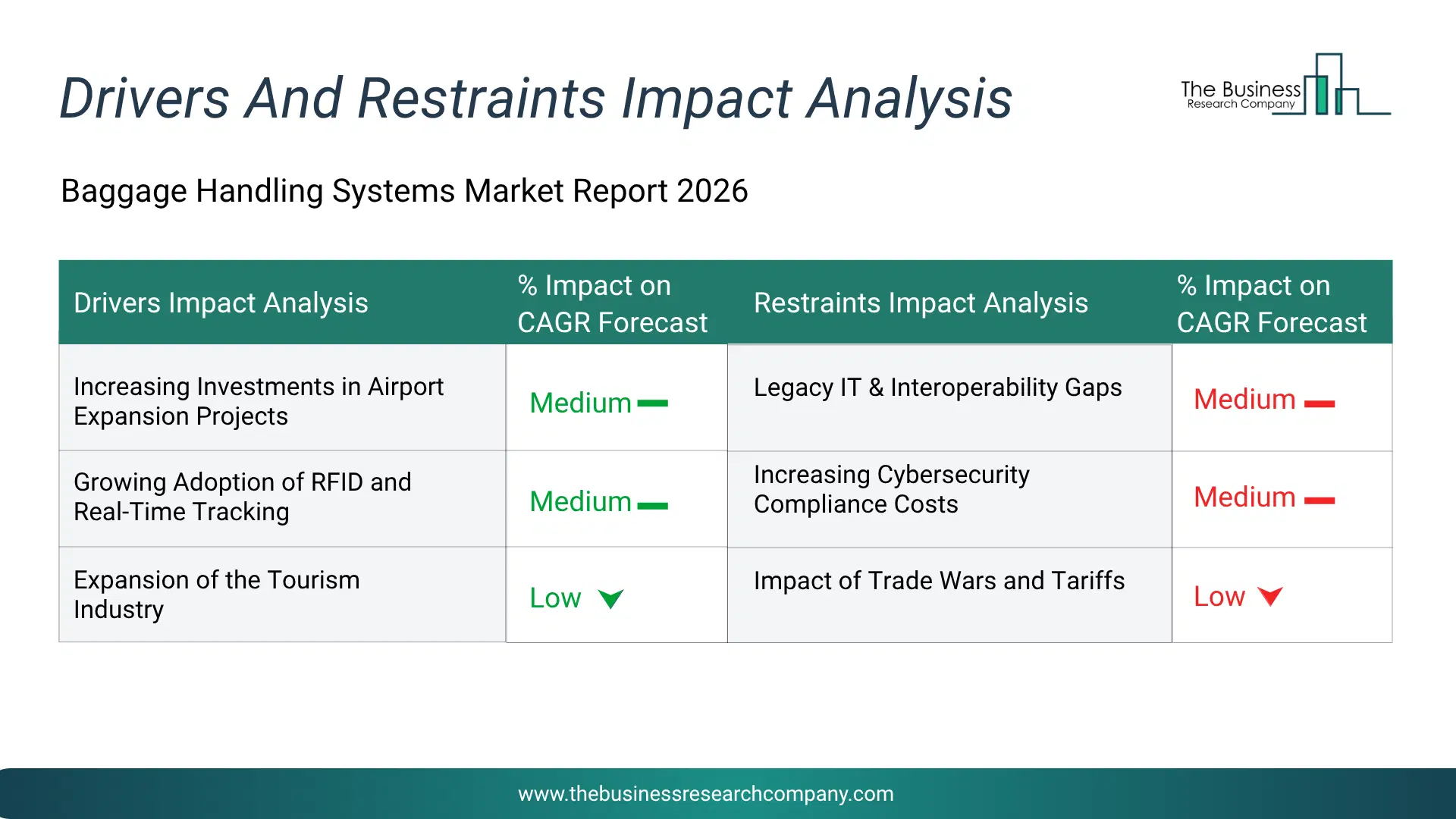
Infographic Chart Showing Key Market Drivers Analysis And Restraints For Baggage Handling System Market
The chart presents an impact analysis of key drivers and restraints, quantifying their relative influence on the market's growth rate and helping assess the balance between growth enablers and limiting factors. This chart offers a high-level perspective; the full report contains more detailed insights.
How Will The Drivers Impact Growth In The Global Baggage Handling Systems Market?
• Increasing Investments in Airport Expansion Projects (Medium) – During the forecast period, the increasing investments in airport expansion projects will become a key driver of growth in the baggage handling system market by 2030. as airports worldwide execute large-scale development programs to add terminals, increase gate capacity and expand passenger processing areas, these projects require upgraded baggage systems that can handle higher passenger volumes with greater accuracy and efficiency. forecasts from airports council international (aci world) show that global air travel is expected to reach about 9.8 billion passengers in 2025, reflecting sustained annual increases that place rising pressure on airport infrastructure and necessitate advanced baggage processing capabilities. as airports expand their operational footprints and integrate new capacity between 2025 and 2030, they accelerate the installation of high-capacity conveyors, automated sortation units and real-time tracking technologies to support larger throughput and reduce processing delays. as operators scale facilities to accommodate future travel growth, they directly expand the role of high-performance baggage systems, linking infrastructure development with operational efficiency enhancements. therefore, the increasing investments in airport expansion projects is anticipated to contributing to a 1.5% annual growth in the market. • Growing Adoption of RFID and Real-Time Tracking (Medium) – During the forecast period, the growing adoption of rfid and real time tracking will propel the growth of the baggage handling system market by 2030. as airports and airlines integrate advanced digital identification tools between 2025 and 2030, they enhance the accuracy and visibility of baggage movement throughout each stage of the journey. global aviation authorities emphasize the industry-wide shift toward standardized rfid-enabled tracking, which supports automated sorting, reduces human error and strengthens operational reliability across large and complex airport networks. as baggage volumes rise and passenger itineraries become more interconnected, airports depend on real-time tracking systems to monitor flows, detect disruptions instantly and sustain service quality. the continued expansion of digital tracking requirements reinforces the need for high-performing, technology-enabled baggage systems that ensure efficiency, transparency and traveler confidence. consequently, the growing adoption of rfid and real time tracking is projected to contributing to a 1.3% annual growth in the market. • Expansion of the Tourism Industry (Low) – During the forecast period, the expansion of the tourism industry will will propel the growth of the baggage handling system market. as international travel increases between 2025 and 2030 and global tourism activity strengthens across regions, rising passenger movements create sustained pressure on airport infrastructure and require more efficient handling of growing baggage volumes. industry projections from global tourism authorities indicate a continued upward trajectory in leisure and cross-border travel through the decade, reflecting a broader resurgence of mobility and international connectivity. as airports accommodate higher tourist traffic and experience greater variability in seasonal flows, they must adopt more advanced and reliable baggage systems to maintain service quality, reduce congestion and support smooth passenger journeys. the consistent rise in tourism-driven travel demand reinforces the need for scalable, automated and technology-enabled baggage solutions that can handle expanding volumes efficiently. therefore, this expansion of the tourism industry is projected to supporting to a 1.0% annual growth in the market. • Growing E-Commerce and Cargo Volumes (Low) – During the forecast period, the growing e-commerce and cargo volumes will propel the growth of baggage handling and related aviation processing systems. As global retailers and logistics operators accelerate their reliance on air transport to meet faster delivery expectations, the continuous rise in air freight traffic increases aircraft movements and places greater pressure on airport handling operations. Analyst indicators show that air cargo activity continues to grow year on year, with international markets recording notable increases in demand that reflect the ongoing expansion of cross-border e-commerce networks. As airports process larger amounts of cargo alongside passenger baggage, operators must enhance sorting, handling and tracking infrastructure to maintain throughput efficiency and operational reliability. According to the International Air Transport Association, global air cargo demand rose by 11.3% in 2024, demonstrating the scale of freight growth that compels airports to strengthen integrated baggage and cargo handling capabilities. The growing e-commerce and cargo volumes growth contribution during the forecast period in 2025 is 0.5%.How Will The Restraints Impact Growth In The Global Baggage Handling Systems Market?
• Legacy IT & Interoperability Gaps (Medium) – During the forecast period, legacy it and interoperability gaps are restricting the growth of the baggage handling system market during the forecast period. many airports continue to rely on outdated infrastructure and fragmented software environments that cannot connect seamlessly with modern sorting, scanning and real-time tracking technologies. these limitations slow digital upgrades, increase implementation risks and require operators to use manual workarounds that reduce the reliability of baggage operations. transitioning from legacy systems often demands extensive restructuring and operational downtime, which forces airports with limited budgets or resources to postpone modernization efforts. as a result, airports delay the adoption of next-generation baggage systems in the face of growing integration complexity, thereby restricting the growth of the baggage handling system market. growth affected by legacy it and interoperability gaps across regions during the forecast period in 2025 is -1.6% • Increasing Cybersecurity Compliance Costs (Medium) – During the forecast period, increasing cybersecurity compliance costs are restricting the growth of the baggage handling system market during the forecast period. as airports transition toward more digitally integrated baggage systems that rely on interconnected networks, cloud-based platforms and continuous data exchange, they must comply with increasingly stringent global aviation cybersecurity standards. these requirements compel airports to invest in advanced monitoring tools, system hardening measures, incident response capabilities and specialized cybersecurity personnel, which significantly raise operational expenditures. the financial and regulatory burden of meeting these obligations slows the adoption of technology-intensive baggage solutions because each upgrade must undergo rigorous certification and satisfy evolving audit requirements. as a result, airports facing heightened cybersecurity expectations may delay or scale back digital baggage modernization initiatives, thereby restricting the growth of baggage handling system adoption. growth affected by increasing cybersecurity compliance costs across regions during the forecast period in 2025 is -1.1%. • Impact of Trade Wars and Tariffs (Low) – During the forecast period, impact of trade wars and tariffs is restricting the growth of the baggage handling system market during the forecast period. escalating geopolitical tensions and tariff increases on essential mechanical and electronic components used in baggage systems raise acquisition costs and introduce uncertainty into airport procurement plans. tariff-driven disruptions across global supply chains delay the delivery of conveyors, scanners, control modules and automation hardware, which slows planned infrastructure upgrades and forces operators to reconsider vendor agreements and sourcing models. these interruptions also prolong installation cycles for major baggage projects and limit access to specialized equipment required for high-capacity airport operations. as airports face mounting financial and operational pressures caused by prolonged trade disputes, they may defer or scale down modernization plans to reduce exposure to volatile import conditions, thereby restricting the growth of the baggage handling system market. growth affected by trade war and tariffs across regions during the forecast period in 2025 is -0.3%.Key Players In The Global Baggage Handling System Market
Major companies operating in the baggage handling system market are Siemens AG, Daifuku Co Ltd, Vanderlande Industries B V, Fives Group, SICK AG, BEUMER Group, SITA, INFORM SOFTWARE, Interroll Group, Smiths Detection Group Limited, Grenzebach Maschinenbau GmbH, Alstef Group, Cassioli Srl, ULMA Handling Systems, G&S Airport Conveyor, Logplan LLC, Honeywell International Inc., TGW Logistics Group GmbH, Brock Solutions, SATS Ltd, Amadeus IT Group SA, CIMC-TianDa Holdings, Leonardo S p A, Logan Teleflex, Civil Aviation Logistics Technology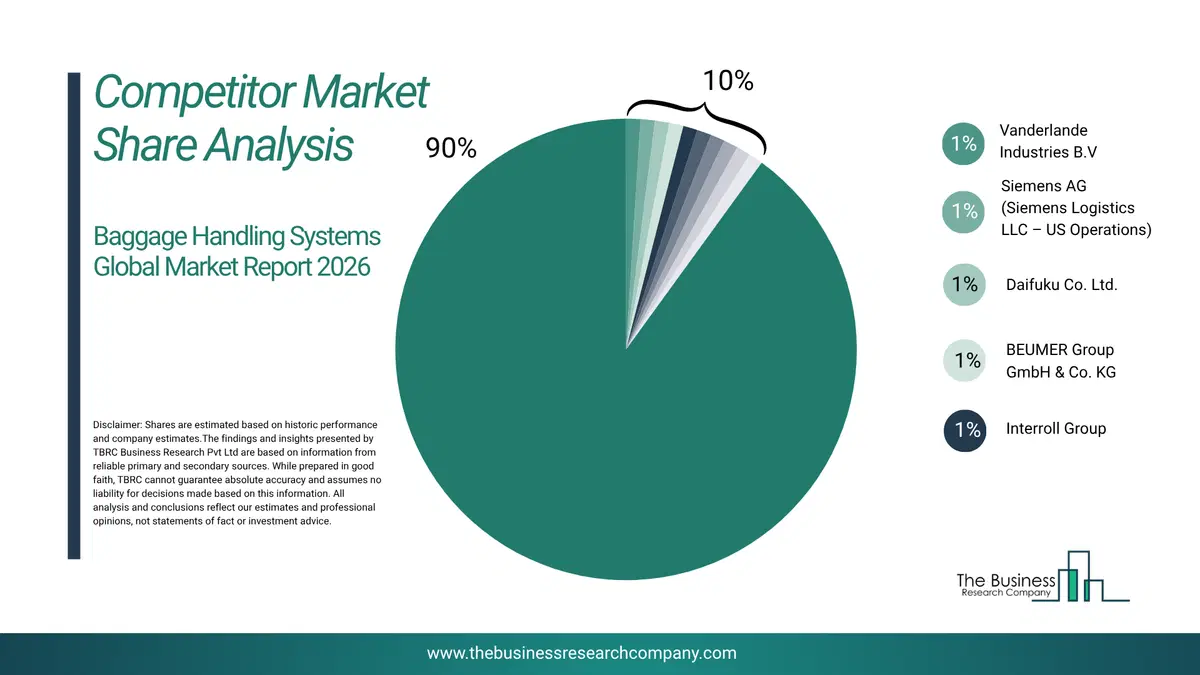
This chart is for illustrative purposes; the full report includes a detailed competitor analysis and comprehensive overview of the top 10 companies in the market.
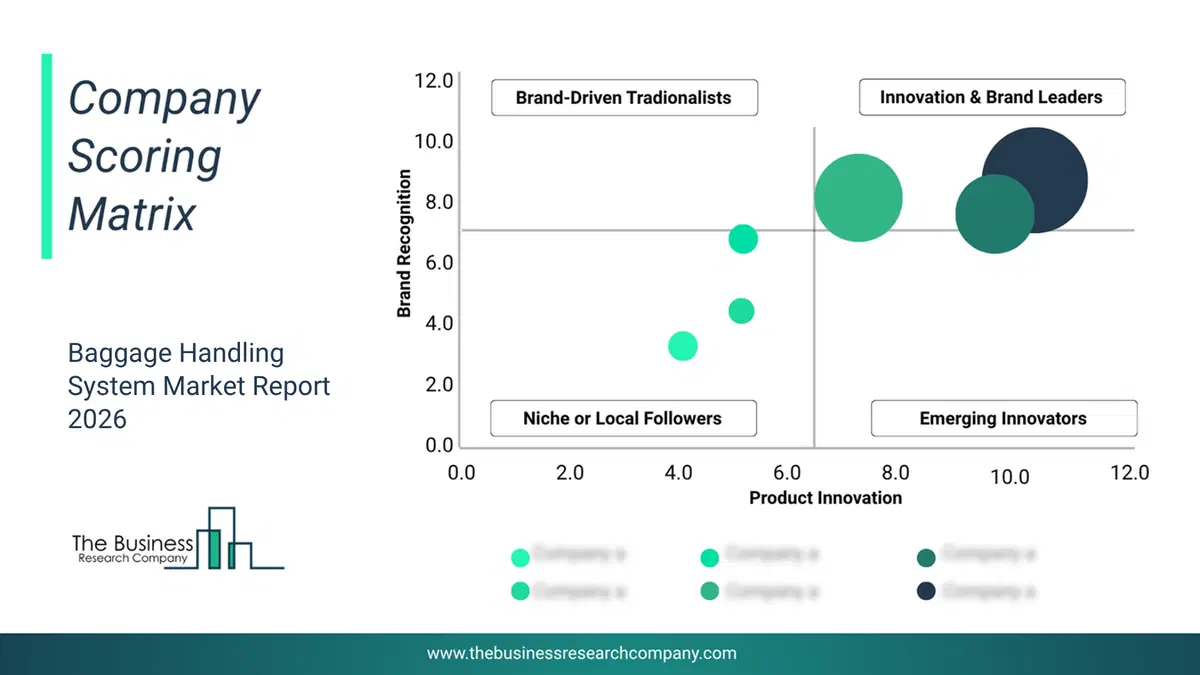
This chart maps companies by product innovation and brand strength, with bubble size indicating relative revenue, helping identify market leaders, challengers, and niche players. This is an illustrative chart; the full report provides a complete and accurate competitive analysis.
Global Baggage Handling System Market Trends and Insights
Major companies operating in the baggage handling system market are focusing on integrating digital predictive maintenance solutions such as condition monitoring platforms to enhance efficiency and system reliability. Condition monitoring platforms use real-time operational data from sensors and analytics software to continuously assess the health of baggage handling equipment, enabling capabilities such as early fault detection, performance optimisation and proactive maintenance planning. For instance, in April 2025, Siemens Logistics, a Germany-based airport logistics solutions provider, showcased SmartService 360, a digital service platform designed to improve the availability and reliability of baggage handling systems at airports, featuring real-time data collection from system components, machine-learning-based risk assessment for potential failures and a centralised dashboard for maintenance decision support. SmartService 360 improves operational uptime, reduces unplanned maintenance interventions and supports more efficient lifecycle management of baggage handling infrastructure.What Are Latest Mergers And Acquisitions In The Baggage Handling System Market?
In May 2025, Vanderlande Industries B.V., a Netherlands based logistics technology and automation company, acquired Siemens Logistics for USD 325 million (€300 million). With this acquisition, Vanderlande aimed to expand its global airport logistics footprint and strengthen its end-to-end baggage and cargo handling capabilities by integrating Siemens Logistics’ advanced airport automation technologies and digital solutions into its existing portfolio. Siemens Logistics is a Germany based logistics technology company that specializes in providing airport baggage and cargo handling systems, software platforms for airport operations, and comprehensive automation solutions.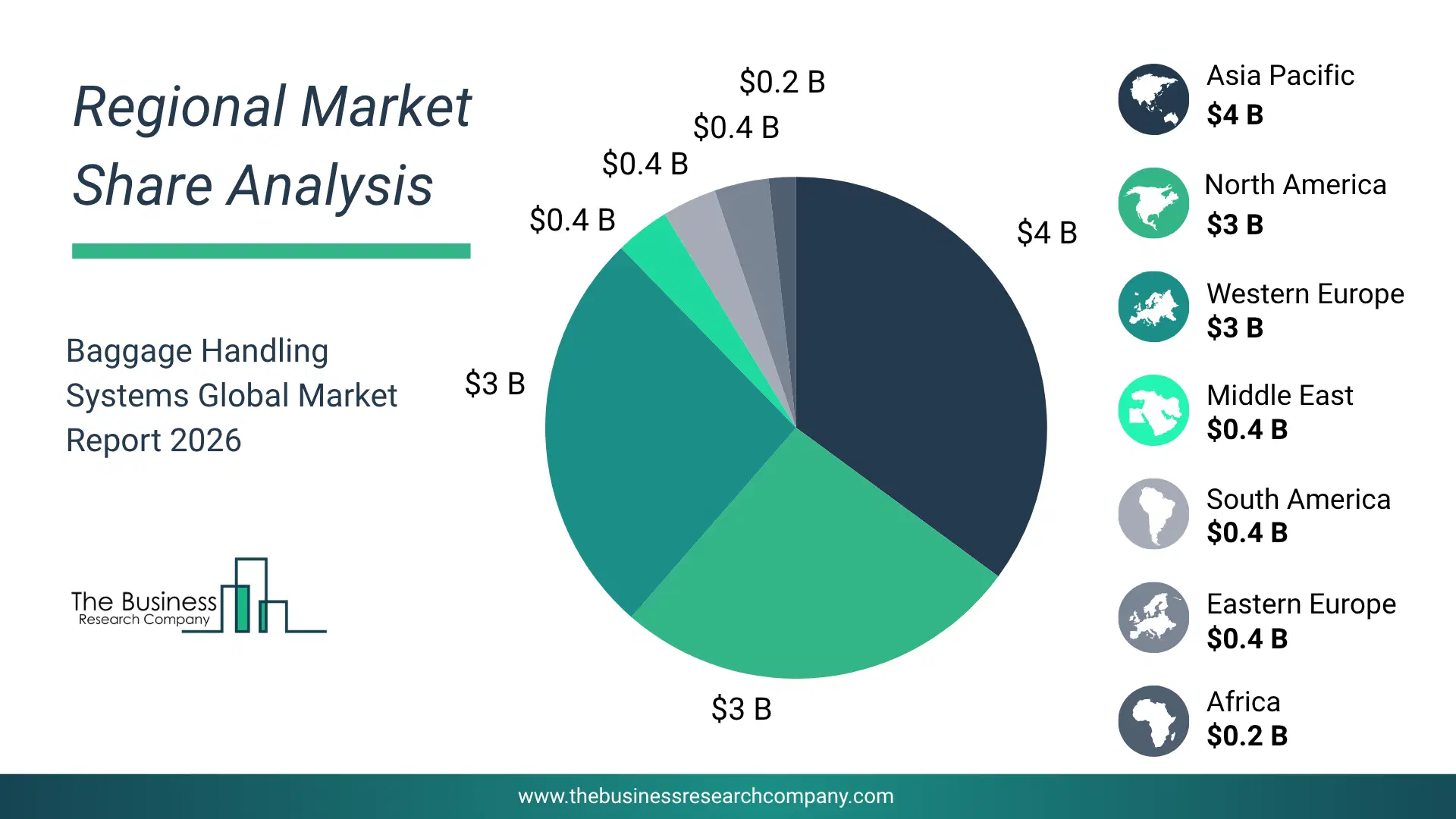
Regional Outlook
Asia-Pacific was the largest region in the baggage handling system market in 2025. North America is expected to be the fastest-growing region in the forecast period. The regions covered in this market report are Asia-Pacific, South East Asia, Western Europe, Eastern Europe, North America, South America, Middle East, Africa. The countries covered in this market report are Australia; Brazil; China; France; Germany; India; Indonesia; Japan; Taiwan; Russia; South Korea; UK; USA; Canada; Italy; Spain.What Defines the Baggage Handling System Market?
The baggage handling system market consists of revenues earned by entities by providing services such as design and consultation, installation and integration, maintenance and repair, security screening, and automation and control systems. The market value includes the value of related goods sold by the service provider or included within the service offering. The baggage handling system market also includes sales of sorters, scanners, RFID readers, automated guided vehicles (AGVs), and baggage carousels. Values in this market are ‘factory gate’ values, that is the value of goods sold by the manufacturers or creators of the goods, whether to other entities (including downstream manufacturers, wholesalers, distributors and retailers) or directly to end customers. The value of goods in this market includes related services sold by the creators of the goods.How is Market Value Defined and Measured?
The market value is defined as the revenues that enterprises gain from the sale of goods and/or services within the specified market and geography through sales, grants, or donations in terms of the currency (in USD unless otherwise specified). The revenues for a specified geography are consumption values that are revenues generated by organizations in the specified geography within the market, irrespective of where they are produced. It does not include revenues from resales along the supply chain, either further along the supply chain or as part of other products.
This chart presents market attractiveness based on a quantitative evaluation of growth, competition, strategic alignment, and risk, offering a clear view of opportunity areas for decision-making. This chart is for illustrative purposes; the full report contains the complete analysis.

This chart highlights the Total Addressable Market (TAM) by estimating the maximum revenue opportunity using an assumption-driven approach, supporting strategic planning and opportunity sizing across markets. The chart is illustrative; the full report provides a more comprehensive analysis.
What Key Data and Analysis Are Included in the Baggage Handling System Market Report 2026?
The baggage handling system market research report is one of a series of new reports from The Business Research Company that provides market statistics, including Market Report 2026?global market size, regional shares, competitors with the market share, detailed market segments, market trends and opportunities, and any further data you may need to thrive in the baggage handling system Market Report 2026? The market research report delivers a complete perspective of everything you need, with an in-depth analysis of the current and future state of the Market Report 2026?Baggage Handling System Market Report Forecast Analysis
| Report Attribute | Details |
|---|---|
| Market Size Value In 2026 | $12.02 billion |
| Revenue Forecast In 2030 | $16.07 billion |
| Growth Rate | CAGR of 8.1% from 2026 to 2030 |
| Base Year For Estimation | 2025 |
| Actual Estimates/Historical Data | 2020-2025 |
| Forecast Period | 2026 - 2030 - 2035 |
| Market Representation | Revenue in USD Billion and CAGR from 2026 to 2030 |
| Segments Covered | Type, Technology, Mode, Application |
| Regional Scope | Asia-Pacific, Western Europe, Eastern Europe, North America, South America, Middle East, Africa |
| Country Scope | The countries covered in the report are Australia, Brazil, China, France, Germany, India, Indonesia, Japan, Taiwan, Russia, South Korea, UK, USA, Canada, Italy, Spain. |
| Key Companies Profiled | Siemens AG, Daifuku Co Ltd, Vanderlande Industries B V, Fives Group, SICK AG, BEUMER Group, SITA, INFORM SOFTWARE, Interroll Group, Smiths Detection Group Limited, Grenzebach Maschinenbau GmbH, Alstef Group, Cassioli Srl, ULMA Handling Systems, G&S Airport Conveyor, Logplan LLC, Honeywell International Inc., TGW Logistics Group GmbH, Brock Solutions, SATS Ltd, Amadeus IT Group SA, CIMC-TianDa Holdings, Leonardo S p A, Logan Teleflex, Civil Aviation Logistics Technology |
| Customization Scope | Request for Customization |
| Pricing And Purchase Options | Explore Purchase Options |