

Balance Shafts Market Report 2026
Global Outlook – By Engine Type (Inline-3 Cylinder Engine, Inline-4 Cylinder Engine, Inline-5 Cylinder Engine, V6 Engine), By Manufacturing Process (Casting, Forging), By Application (Passenger Cars, Light Commercial Vehicle (LCV)) – Market Size, Trends, Strategies, and Forecast to 2030
Balance Shafts Market Overview
• Balance Shafts market size has reached to $14.71 billion in 2025 • Expected to grow to $18.69 billion in 2030 at a compound annual growth rate (CAGR) of 4.9% • Growth Driver: Growing Demand For Fuel Efficiency • North America was the largest region in 2025 and Asia-Pacific is the fastest growing region.What Is Covered Under Balance Shafts Market?
A balance shaft refers to a shaft with eccentrically attached weights that is used in internal combustion engines to lessen vibrations brought on by the pistons. It is located between the cylinder banks in the engine and is used to reduce the amount of vibration from other engine components, such as the pistons. The balance shafts are used in different types of engines, including inline-3 cylinder engines, inline-4 cylinder engines, inline-5 cylinder engines, and V6 engines. An inline-3-cylinder engine refers to a form of reciprocating piston internal combustion engine in which three cylinders are arranged in a straight line along a single crankshaft. These are manufactured through various processes, such as casting and forging, and are used for several applications, including passenger cars, light commercial vehicles (LCV), and heavy commercial vehicles (HCV).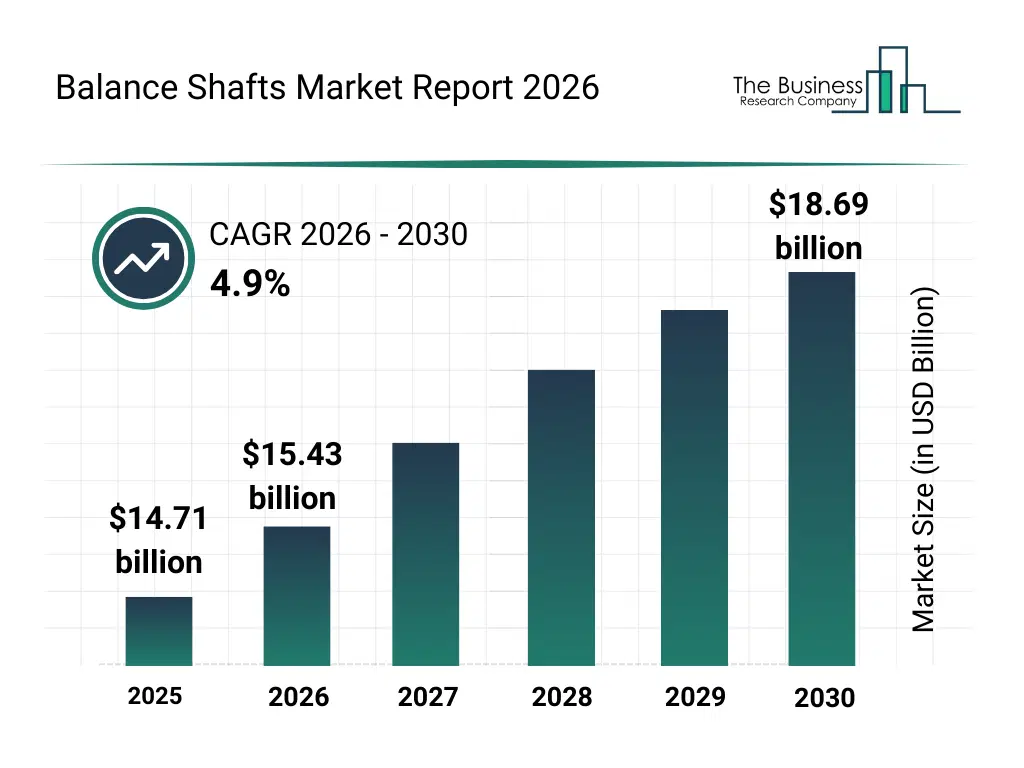
What Is The Balance Shafts Market Size and Share 2026?
The balance shafts market size has grown steadily in recent years. It will grow from $14.71 billion in 2025 to $15.43 billion in 2026 at a compound annual growth rate (CAGR) of 4.9%. The growth in the historic period can be attributed to automotive engine downsizing, rise of multi-cylinder engines, demand for smoother ride quality, growth of passenger car production, adoption of inline engines.What Is The Balance Shafts Market Growth Forecast?
The balance shafts market size is expected to see steady growth in the next few years. It will grow to $18.69 billion in 2030 at a compound annual growth rate (CAGR) of 4.9%. The growth in the forecast period can be attributed to stringent emission norms, demand for fuel-efficient vehicles, lightweight engine component adoption, electric-hybrid powertrain optimization, advanced engine balancing technologies. Major trends in the forecast period include integration of balance shafts in downsized engines, demand for nvh reduction solutions, adoption in turbocharged engines, precision forging adoption, lightweight balance shaft designs.
Global Balance Shafts Market Segmentation
1) By Engine Type: Inline-3 Cylinder Engine, Inline-4 Cylinder Engine, Inline-5 Cylinder Engine, V6 Engine 2) By Manufacturing Process: Casting, Forging 3) By Application: Passenger Cars, Light Commercial Vehicle (LCV) Subsegments: 1) By Inline-3 Cylinder Engine: Small Engine Balance Shafts, Turbocharged Inline-3 Cylinder Balance Shafts 2) By Inline-4 Cylinder Engine: Standard Inline-4 Cylinder Balance Shafts, Turbocharged Inline-4 Cylinder Balance Shafts 3) By Inline-5 Cylinder Engine: Conventional Inline-5 Cylinder Balance Shafts, Turbocharged Inline-5 Cylinder Balance Shafts 4) By V6 Engine: Conventional V6 Engine Balance Shafts, Turbocharged V6 Engine Balance ShaftsWhat Are The Drivers Of The Balance Shafts Market?
The growing demand for fuel efficiency is expected to boost the growth of the balance shaft market going forward. Fuel efficiency refers to a term used to describe how far a car can go on a given amount of fuel. It is a measure of how efficiently a vehicle or device converts chemical energy from fuel into kinetic energy or work. By reducing friction and vibration of the engine, the use of a balance shaft in a vehicle engine leads to a reduction in overall fuel consumption, which can help reduce CO2 emissions and improve fuel efficiency. For instance, in January 2024, according to a report published by Kelley Blue Book, a US-based Cox Automotive company, in 2023, a record 1.2 million car buyers in the United States chose electric vehicles, which accounted for 7.6% of the entire U.S. vehicle market, up from 5.9% in 2022. Therefore, the growing demand for fuel efficiency is driving the growth of the balance shaft industry. The growing automobile industry is expected to propel the growth of the balance shafts market going forward. The automobile industry refers to a group of businesses and institutions engaged in the creation, production, marketing, and sale of vehicles. Balance shafts are used in automobiles to reduce vibration and improve engine performance, efficiency, and durability. They can also help reduce engine noise and improve passenger comfort. For instance, in June 2023, according to reports shared by the Society of Motor Manufacturers and Traders (SMMT), a UK-based trade association, the sales of passenger cars in the UK increased by 25.8% from 140,958 units in 2022 to 177,266 units in 2023. Therefore, the growing automobile industry is driving the growth of the balance shafts industry. The increasing investments in the automotive industry are expected to propel the growth of the balance shaft market going forward. Investments in the automotive industry refer to the allocation of capital toward vehicle production, technology development, infrastructure, and related services to drive growth, innovation, and competitiveness. Increasing investments in the automotive industry are driven by rising demand for electric and autonomous vehicles, prompting manufacturers to fund advanced technologies and expand production to stay competitive. Investments in the automotive industry help balance shafts by supporting advanced engine technologies and precision manufacturing, enabling smoother, more efficient engines with reduced vibration and improved performance. For instance, in May 2025, according to the Verband der Automobilindustrie, a Germany-based German Association of the Automotive Industry, in 2023, research and development investments by German automotive companies rose by 11% year-on-year, reaching €58.4 ($63.1) billion. Therefore, the increasing investments in the automotive industry are driving the growth of the balance shaft industry.Key Players In The Global Balance Shafts Market
Major companies operating in the balance shafts market report include Linamar Corporation, American Axle & Manufacturing Holdings Inc., Schaeffler Technologies AG & Co. KG, Metaldyne Performance Group Inc., Hirschvogel Holding GmbH, SHW AG, MAT Foundry Group Ltd., Sansera Engineering Pvt. Ltd., Ningbo Jingda Hardware Manufacture Co. Ltd., Hirschvogel Group, Engine Power Components Inc., Otics Corporation, Rane Engine Valve Limited, SAC Engine Components Pvt. Ltd, TFO Corporation, Shanghai Spb Industry Co. Ltd., Hines Industries Inc., oso precision GmbH, Hunan Qilu Industrial Co. Ltd., Jinan Zhengdian Automobile Parts Co. Ltd., Kersten Maschinenbau GmbH, MFT Motoren und Fahrzeugtechnik GmbH, JL Autoparts Pvt. Ltd., Qingdao Milestone Vehicle Parts Co. Ltd, Mitec-Jebsen Automotive Systems (Dalian) Co Ltd.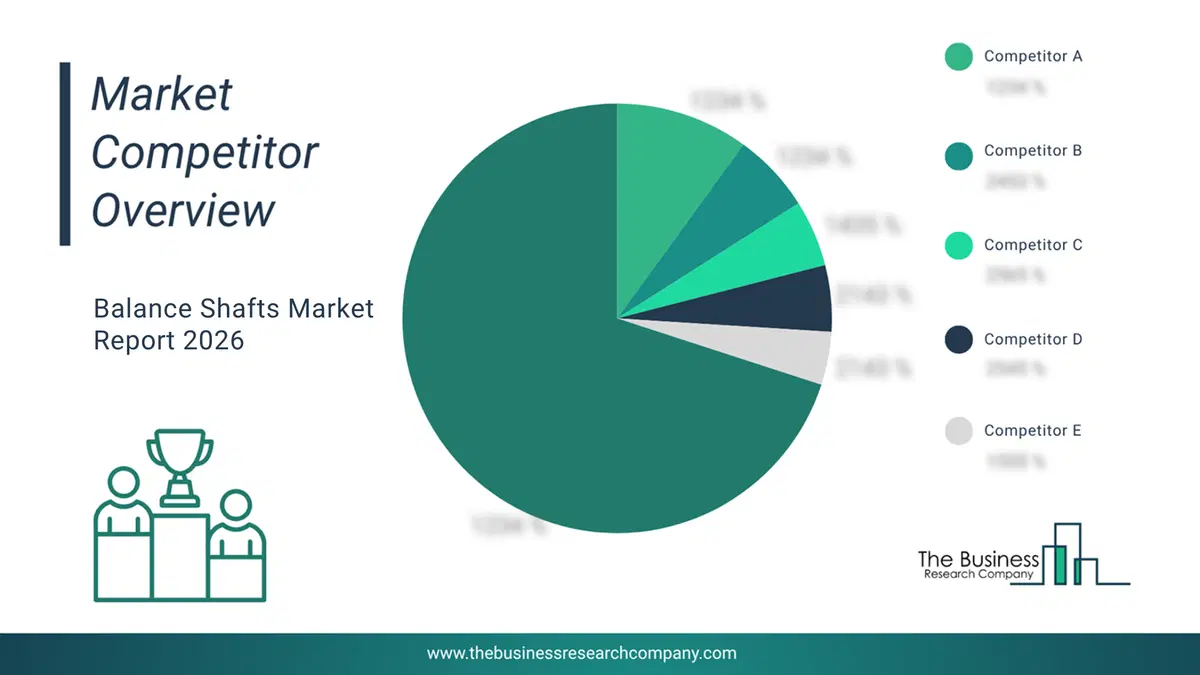
This chart is for illustrative purposes; the full report includes a detailed competitor analysis and comprehensive overview of the top 10 companies in the market.
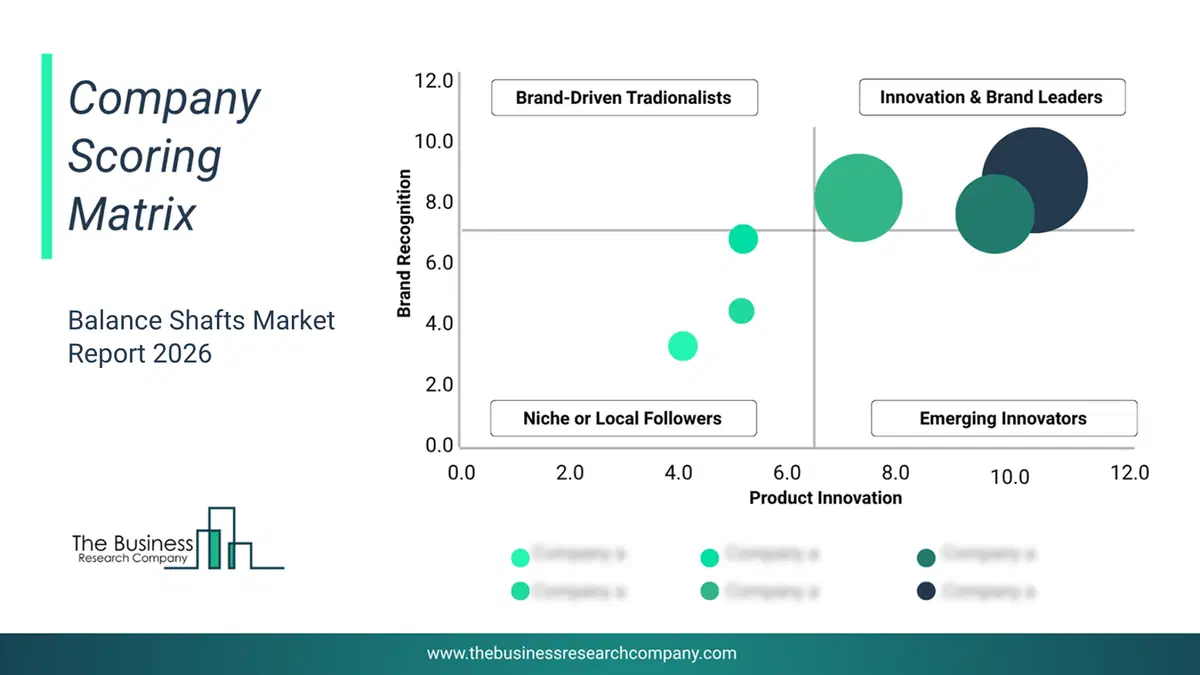
This chart maps companies by product innovation and brand strength, with bubble size indicating relative revenue, helping identify market leaders, challengers, and niche players. This is an illustrative chart; the full report provides a complete and accurate competitive analysis.

Regional Outlook
North America was the largest region in the balance shafts market in 2025. Asia-Pacific is expected to be the fastest-growing region in the forecast period. The regions covered in this market report include Asia-Pacific, South East Asia, Western Europe, Eastern Europe, North America, South America, Middle East, Africa. The countries covered in this market report include Australia, Brazil, China, France, Germany, India, Indonesia, Japan, Taiwan, Russia, South Korea, UK, USA, Canada, Italy, SpainWhat Defines the Balance Shafts Market?
The balance shaft market consists of sales of camshafts, bearing caps, crankshafts, valve tappets, and connecting rods. Values in this market are ‘factory gate’ values, that is the value of goods sold by the manufacturers or creators of the goods, whether to other entities (including downstream manufacturers, wholesalers, distributors and retailers) or directly to end customers. The value of goods in this market includes related services sold by the creators of the goods.How is Market Value Defined and Measured?
The market value is defined as the revenues that enterprises gain from the sale of goods and/or services within the specified market and geography through sales, grants, or donations in terms of the currency (in USD unless otherwise specified). The revenues for a specified geography are consumption values that are revenues generated by organizations in the specified geography within the market, irrespective of where they are produced. It does not include revenues from resales along the supply chain, either further along the supply chain or as part of other products.
This chart presents market attractiveness based on a quantitative evaluation of growth, competition, strategic alignment, and risk, offering a clear view of opportunity areas for decision-making. This chart is for illustrative purposes; the full report contains the complete analysis.

This chart highlights the Total Addressable Market (TAM) by estimating the maximum revenue opportunity using an assumption-driven approach, supporting strategic planning and opportunity sizing across markets. The chart is illustrative; the full report provides a more comprehensive analysis.
What Key Data and Analysis Are Included in the Balance Shafts Market Report 2026?
The balance shafts market research report is one of a series of new reports from The Business Research Company that provides market statistics, including industry global market size, regional shares, competitors with the market share, detailed market segments, market trends and opportunities, and any further data you may need to thrive in the balance shafts industry. The market research report delivers a complete perspective of everything you need, with an in-depth analysis of the current and future state of the industry.Balance Shafts Market Report Forecast Analysis
| Report Attribute | Details |
|---|---|
| Market Size Value In 2026 | $15.43 billion |
| Revenue Forecast In 2030 | $18.69 billion |
| Growth Rate | CAGR of 4.9% from 2026 to 2030 |
| Base Year For Estimation | 2025 |
| Actual Estimates/Historical Data | 2020-2025 |
| Forecast Period | 2026 - 2030 - 2030 |
| Market Representation | Revenue in USD Billion and CAGR from 2026 to 2030 |
| Segments Covered | Engine Type, Manufacturing Process, Application |
| Regional Scope | Asia-Pacific, Western Europe, Eastern Europe, North America, South America, Middle East, Africa |
| Country Scope | The countries covered in the report are Australia, Brazil, China, France, Germany, India, Indonesia, Japan, Taiwan, Russia, South Korea, UK, USA, Canada, Italy, Spain. |
| Key Companies Profiled | Linamar Corporation, American Axle & Manufacturing Holdings Inc., Schaeffler Technologies AG & Co. KG, Metaldyne Performance Group Inc., Hirschvogel Holding GmbH, SHW AG, MAT Foundry Group Ltd., Sansera Engineering Pvt. Ltd., Ningbo Jingda Hardware Manufacture Co. Ltd., Hirschvogel Group, Engine Power Components Inc., Otics Corporation, Rane Engine Valve Limited, SAC Engine Components Pvt. Ltd, TFO Corporation, Shanghai Spb Industry Co. Ltd., Hines Industries Inc., oso precision GmbH, Hunan Qilu Industrial Co. Ltd., Jinan Zhengdian Automobile Parts Co. Ltd., Kersten Maschinenbau GmbH, MFT Motoren und Fahrzeugtechnik GmbH, JL Autoparts Pvt. Ltd., Qingdao Milestone Vehicle Parts Co. Ltd, Mitec-Jebsen Automotive Systems (Dalian) Co Ltd. |
| Customization Scope | Request for Customization |
| Pricing And Purchase Options | Explore Purchase Options |