
Ballistic Protective Gear Market Report 2026
Global Outlook – By Type (Body Armor, Head Protection, Shields), By Material Type (Kevlar, Ultra High Molecular Weight Polyethylene (UHMWPE), Ceramics, Steel, Composite Materials), By Distribution Channel (Online Retailing, Direct Sales, Third-Party Distributors, Specialty Stores, Government Procurement), By Application Area (Combat Operations, Crowd Control, Surveillance and Protection, Transportation Security, Sports and Recreation), By End User (Military, Law Enforcement, Private Security, Civilians, Industrial Workers) – Market Size, Trends, Strategies, and Forecast to 2030
Ballistic Protective Gear Market Overview
• Ballistic Protective Gear market size has reached to $4.46 billion in 2025 • Expected to grow to $6.26 billion in 2030 at a compound annual growth rate (CAGR) of 6.9% • Growth Driver: Rising Prevalence Of Terrorism Is Fueling The Market Growth Due To Increasing Demand For Enhanced Protection In High-Risk Operations • Market Trend: Premier Body Armor Launches Lightweight High-Cut Ballistic Helmet Enhancing Mobility And Tactical Performance • North America was the largest region in 2025 and Asia-Pacific is the fastest growing region.What Is Covered Under Ballistic Protective Gear Market?
Ballistic protective gear refers to personal protective equipment specifically engineered to resist penetration and absorb the impact from ballistic threats such as bullets or explosive fragments. It is designed using advanced materials and structural technologies to provide physical protection to vital areas of the body during high-risk operations. The main types of ballistic protective gear include body armor, head protection, and shields. Body armor refers to protective clothing designed to absorb or deflect physical attacks, particularly ballistic, stab, or blunt force impacts, to safeguard the wearer's torso. These are manufactured using different material types, including Kevlar, ultra-high molecular weight polyethylene (UHMWPE), ceramics, steel, and composite materials. They are distributed through online retailing, direct sales, third-party distributors, specialty stores, and government procurement channels. They are used across multiple application areas, including combat operations, crowd control, surveillance and protection, transportation security, and sports and recreation, serving a range of end users, including military, law enforcement, private security, civilians, and industrial workers.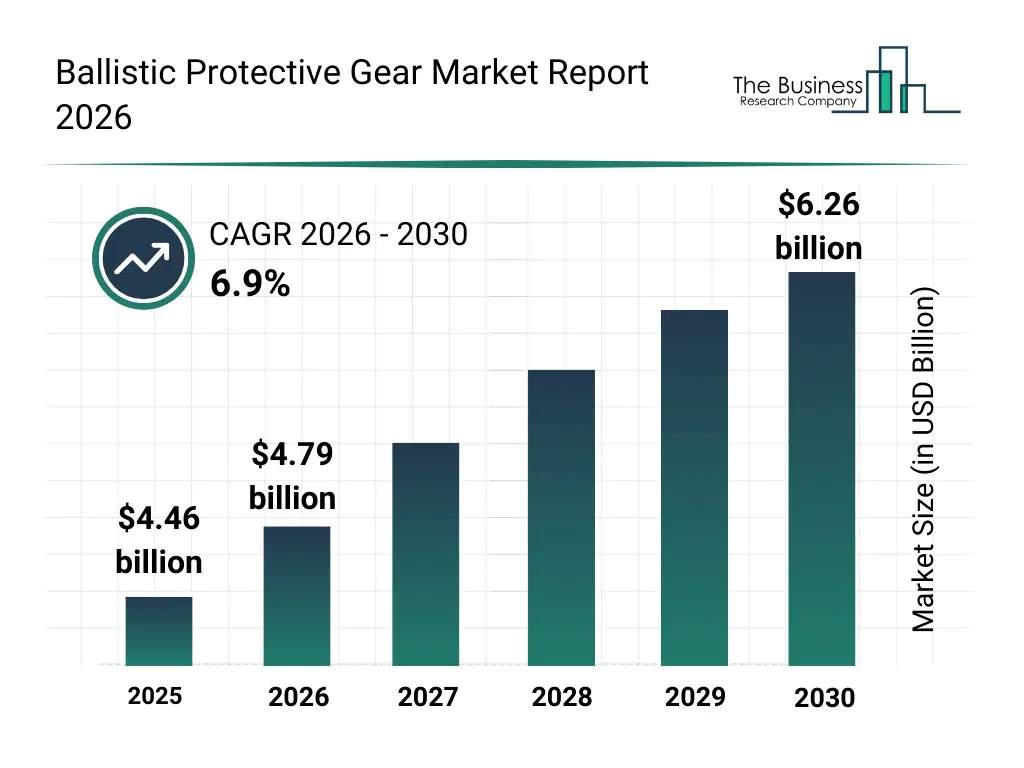
What Is The Ballistic Protective Gear Market Size and Share 2026?
The ballistic protective gear market size has grown strongly in recent years. It will grow from $4.46 billion in 2025 to $4.79 billion in 2026 at a compound annual growth rate (CAGR) of 7.4%. The growth in the historic period can be attributed to adoption of bullet-resistant vests and plate carriers in military and law enforcement, development of advanced ballistic helmets for head protection, rising use of face shields to guard against fragments and shrapnel, implementation of tactical gloves for hand protection during operations, deployment of specialized tactical boots for enhanced mobility and safety.What Is The Ballistic Protective Gear Market Growth Forecast?
The ballistic protective gear market size is expected to see strong growth in the next few years. It will grow to $6.26 billion in 2030 at a compound annual growth rate (CAGR) of 6.9%. The growth in the forecast period can be attributed to growing demand for lightweight and high-performance ballistic materials, expansion of modular and multi-threat protective gear, rising integration of smart sensors and wearable technology in ballistic equipment, focus on ergonomic and mission-specific protective designs, increasing procurement for defense, law enforcement, and high-risk security applications. Major trends in the forecast period include growth in demand for lightweight and high-strength ballistic materials, rising use of modular and customizable protective gear, increased adoption of multi-threat protective solutions, integration of communication and situational-awareness features in gear, expanding civilian and private security market for personal protection.
Global Ballistic Protective Gear Market Segmentation
1) By Type: Body Armor, Head Protection, Shields 2) By Material Type: Kevlar, Ultra High Molecular Weight Polyethylene (UHMWPE), Ceramics, Steel, Composite Materials 3) By Distribution Channel: Online Retailing, Direct Sales, Third-Party Distributors, Specialty Stores, Government Procurement 4) By Application Area: Combat Operations, Crowd Control, Surveillance and Protection, Transportation Security, Sports and Recreation 5) By End User: Military, Law Enforcement, Private Security, Civilians, Industrial Workers Subsegments: 1) By Body Armor: Soft Body Armor, Hard Body Armor, Concealable Vests, Tactical Vests, Plate Carriers 2) By Head Protection: Ballistic Helmets, Visors And Face Shields, Communication-Integrated Helmets, Modular Helmet Systems 3) By Shields: Handheld Ballistic Shields, Wheeled Ballistic Shields, Transparent Ballistic Shields, Foldable Or Collapsible ShieldsWhat Is Driver Of The Ballistic Protective Gear Market?
The rising prevalence of terrorism is expected to propel the growth of the ballistic protective gear market going forward. Terrorism refers to the unlawful use of violence or intimidation, especially against civilians, in pursuit of political, religious, or ideological objectives. The rising prevalence of terrorism is primarily due to a combination of political instability, as weak governance, power vacuums, and civil unrest create environments where extremist groups can thrive and recruit supporters. Ballistic protective gear enhances the effectiveness of counter-terrorism operations by safeguarding security personnel from gunfire, explosions, and other ballistic threats during high-risk missions, increasing their survivability, maintaining operational readiness, and enabling them to respond more confidently and efficiently in hostile environments. For instance, in February 2024, according to the report published by the Institute for Economics and Peace, an Australia-based think tank, in 2023, global deaths from terrorism rose to 8,352, a 22 % increase compared with the prior year. Therefore, the rising prevalence of terrorism drives the growth of the ballistic protective gear industry.Key Players In The Global Ballistic Protective Gear Market
Major companies operating in the ballistic protective gear market are BAE Systems plc, Safariland LLC, Point Blank Enterprises Inc., Australian Defence Apparel Pty Ltd., MKU Limited, U.S. Armor Corporation, Mehler Vario System GmbH, VestGuard UK Limited, HardShell FZE, MARS Armor Ltd., Indian Armour Systems Pvt. Ltd., Armored Republic LLC, Ningbo Dacheng Machine Tool Manufacturing Co. Ltd., Ballistic Body Armour, Premier Body Armor LLC, Anorak Hellas Ltd., MC Armor, Sarkar Tactical India Private Limited, PGD Body Armor, SMPP Limited
This chart is for illustrative purposes; the full report includes a detailed competitor analysis and comprehensive overview of the top 10 companies in the market.
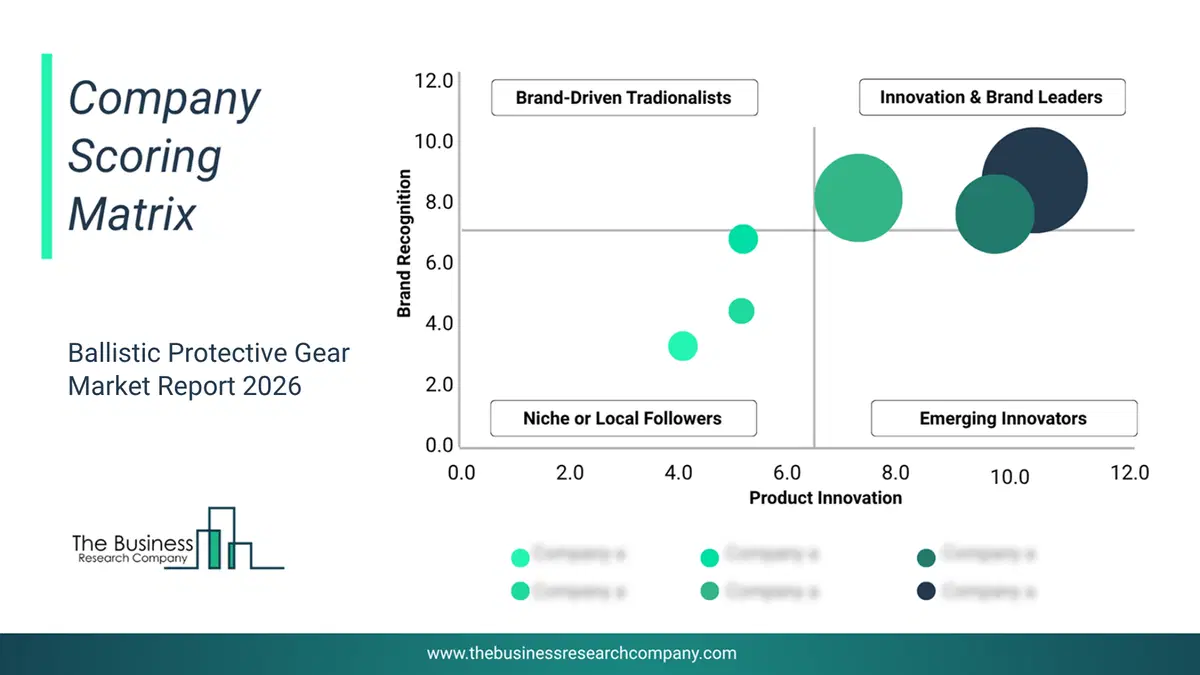
This chart maps companies by product innovation and brand strength, with bubble size indicating relative revenue, helping identify market leaders, challengers, and niche players. This is an illustrative chart; the full report provides a complete and accurate competitive analysis.
Global Ballistic Protective Gear Market Trends and Insights
Major companies operating in the ballistic protective gear market are focusing on developing innovative products, such as high-cut, lightweight ballistic helmets, to improve operational mobility, comfort, and user safety. High-cut, lightweight ballistic helmets refer to advanced protective headgear with raised ear sections made from light ballistic materials such as aramid fibers or polyethylene, designed to reduce head weight while providing ballistic protection and allowing compatibility with communication and tactical equipment to enhance mobility and situational awareness during high-risk operations. For instance, in March 2024, Premier Body Armor, LLC, a US-based ballistic protection provider, launched the Fortis Ballistic Helmet, a high-cut Level IIIA helmet weighing just 2.8 lbs. The helmet features a modular rail system for seamless integration with night vision devices, communication headsets, and tactical accessories, making it highly adaptable for diverse mission profiles. Its advanced moisture-wicking liner and adjustable suspension system ensure superior comfort and a secure fit during prolonged use. Designed to exceed global protection standards, this helmet delivers elite-level performance without the premium price tag, setting a new benchmark in protective headgear.What Are Latest Mergers And Acquisitions In The Ballistic Protective Gear Market? Double Tap Industries’ Acquisition of Caliber Armor to Strengthen Ballistic Protection Portfolio
In January 2025, Double Tap Industries LLC, a US-based provider of tactical and ballistic protective equipment, acquired Caliber Armor for an undisclosed amount. With this acquisition, Double Tap Industries aimed to expand its product portfolio and strengthen its market presence in the ballistic protective gear segment by integrating Caliber Armor’s high-performance body armor and tactical protection solutions. Caliber Armor is a US-based provider of advanced ballistic protection products, including body armor, ballistic shields, helmets, and plate carriers, serving military, law enforcement, and security markets.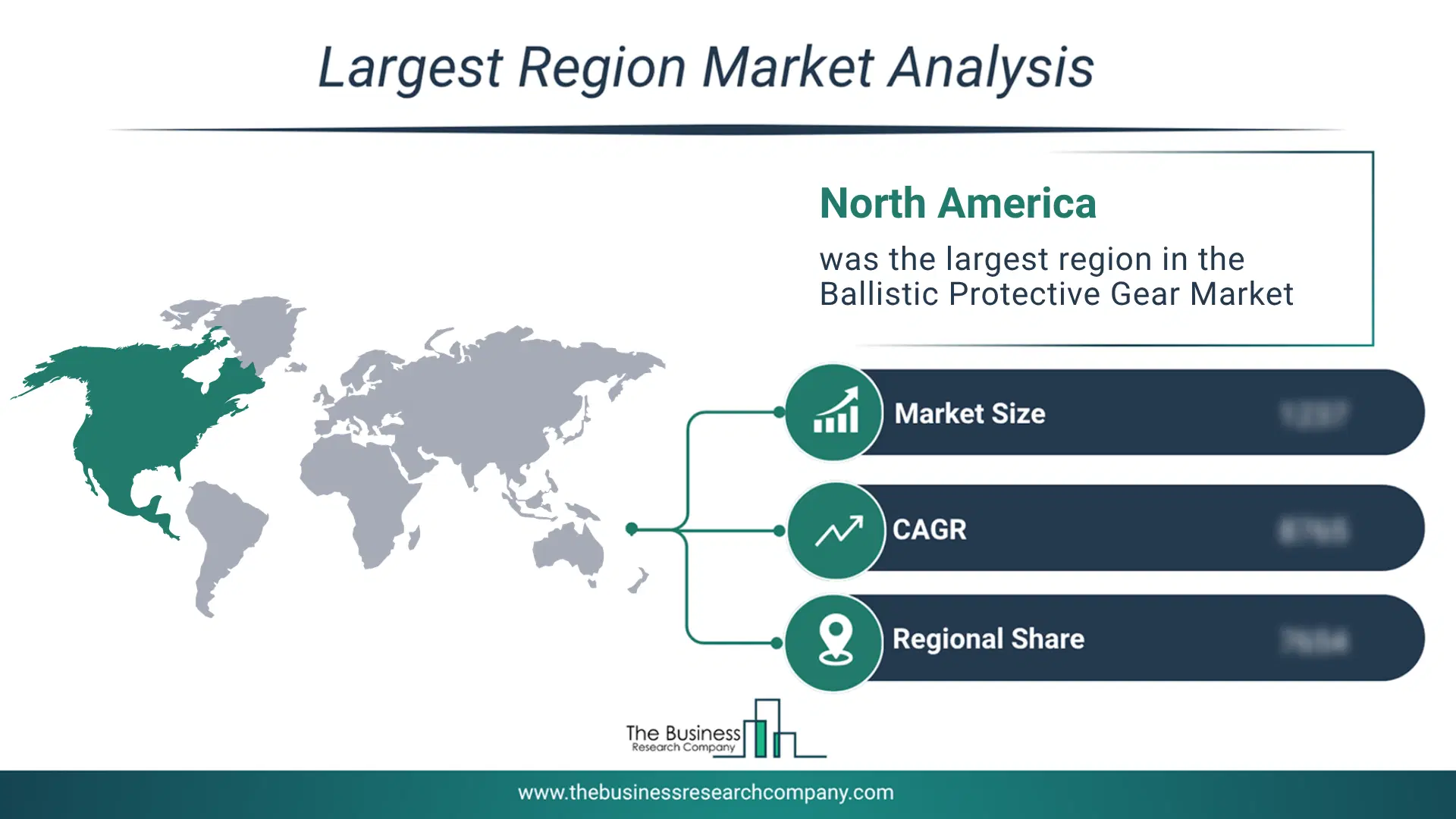
Regional Insights
North America was the largest region in the ballistic protective gear market in 2025. Asia-Pacific is expected to be the fastest-growing region in the forecast period. The regions covered in this market report are Asia-Pacific, South East Asia, Western Europe, Eastern Europe, North America, South America, Middle East, Africa. The countries covered in this market report are Australia, Brazil, China, France, Germany, India, Indonesia, Japan, Taiwan, Russia, South Korea, UK, USA, Canada, Italy, SpainWhat Defines the Ballistic Protective Gear Market?
The ballistic protective gear market consists of sales of bullet-resistant vests or plate carriers, helmets, face shields, gloves, and tactical boots. Values in this market are ‘factory gate’ values, that is, the value of goods sold by the manufacturers or creators of the goods, whether to other entities (including downstream manufacturers, wholesalers, distributors, and retailers) or directly to end customers. The value of goods in this market includes related services sold by the creators of the goods.How is Market Value Defined and Measured?
The market value is defined as the revenues that enterprises gain from the sale of goods and/or services within the specified market and geography through sales, grants, or donations in terms of the currency (in USD unless otherwise specified). The revenues for a specified geography are consumption values that are revenues generated by organizations in the specified geography within the market, irrespective of where they are produced. It does not include revenues from resales along the supply chain, either further along the supply chain or as part of other products.
This chart presents market attractiveness based on a quantitative evaluation of growth, competition, strategic alignment, and risk, offering a clear view of opportunity areas for decision-making. This chart is for illustrative purposes; the full report contains the complete analysis.

This chart highlights the Total Addressable Market (TAM) by estimating the maximum revenue opportunity using an assumption-driven approach, supporting strategic planning and opportunity sizing across markets. The chart is illustrative; the full report provides a more comprehensive analysis.
What Key Data and Analysis Are Included in the Ballistic Protective Gear Market Report 2026?
The ballistic protective gear market research report is one of a series of new reports from The Business Research Company that provides market statistics, including industry global market size, regional shares, competitors with the market share, detailed market segments, market trends and opportunities, and any further data you may need to thrive in the ballistic protective gear industry. The market research report delivers a complete perspective of everything you need, with an in-depth analysis of the current and future state of the industry.Ballistic Protective Gear Market Report Forecast Analysis
| Report Attribute | Details |
|---|---|
| Market Size Value In 2026 | $4.79 billion |
| Revenue Forecast In 2030 | $6.26 billion |
| Growth Rate | CAGR of 6.9% from 2026 to 2030 |
| Base Year For Estimation | 2025 |
| Actual Estimates/Historical Data | 2020-2025 |
| Forecast Period | 2026 - 2030 |
| Market Representation | Revenue in USD Billion and CAGR from 2026 to 2030 |
| Segments Covered | Type, Material Type, Distribution Channel, Application Area, End User |
| Regional Scope | Asia-Pacific, Western Europe, Eastern Europe, North America, South America, Middle East, Africa |
| Country Scope | The countries covered in the ballistic protective gear market report are Australia, Brazil, China, France, Germany, India, Indonesia, Japan, Taiwan, Russia, South Korea, UK, USA, Canada, Italy, Spain |
| Key Companies Profiled | BAE Systems plc, Safariland LLC, Point Blank Enterprises Inc., Australian Defence Apparel Pty Ltd., MKU Limited, U.S. Armor Corporation, Mehler Vario System GmbH, VestGuard UK Limited, HardShell FZE, MARS Armor Ltd., Indian Armour Systems Pvt. Ltd., Armored Republic LLC, Ningbo Dacheng Machine Tool Manufacturing Co. Ltd., Ballistic Body Armour, Premier Body Armor LLC, Anorak Hellas Ltd., MC Armor, Sarkar Tactical India Private Limited, PGD Body Armor, SMPP Limited |
| Customization Scope | Request for Customization |
| Pricing And Purchase Options | Explore Purchase Options |