
Bank Self-Service Machine Market Report 2026
Global Outlook – By Product Type (Automated Teller Machines (ATMs), Cash Deposit Machines (CDMs), Interactive Kiosks, Bill Payment Machines, Multi-Function Machines (MFMs)), By Technology (Traditional Technology, Contactless Technology, Artificial Intelligence (AI) Integrated Technology, Biometric Technology), By Deployment Type (On-Premises, Cloud-Based, Hybrid Deployment), By Application (Cash Withdrawal, Account Balance Inquiry, Funds Transfer, Bill Payment Services), By End-User (Retail Banking, Commercial Banking, Credit Unions, Microfinance Institutions) – Market Size, Trends, Strategies, and Forecast to 2030
Bank Self-Service Machine Market Overview
• Bank Self-Service Machine market size has reached to $3.54 billion in 2025 • Expected to grow to $5.01 billion in 2030 at a compound annual growth rate (CAGR) of 7.2% • Growth Driver: Rising Demand For Cash Transactions Driving Growth Of The Market Due To Limited Digital Access In Rural Areas • Market Trend: Innovations In Automated Self-Service Payment Solutions Transforming Bank Self-Service Machines • North America was the largest region in 2025 and Asia-Pacific is the fastest growing region.What Is Covered Under Bank Self-Service Machine Market?
Bank self-service machines refer to automated devices provided by banks that allow customers to perform various banking transactions independently, without needing to interact with bank staff. These machines are engineered to provide a seamless, secure, and efficient banking experience by enabling users to access essential banking functions anytime, thereby enhancing overall convenience and reducing reliance on traditional in-branch services. The main types of products in bank self-service machines include automated teller machines (ATMs), cash deposit machines (CDMs), interactive kiosks, bill payment machines, and multi-function machines (MFMs). An automated teller machine (ATM) is an unattended electronic machine that allows authorized users to perform banking tasks such as withdrawing cash, checking balances, depositing funds, and transferring money without needing a bank teller. It incorporates technologies like traditional technology, contactless technology, blockchain-based technology, artificial intelligence (AI) integrated technology, and biometric technology and is deployed through on-premises, cloud-based, and hybrid deployment. It finds applications in cash withdrawal, account balance inquiry, fund transfer, bill payment services, and account opening services, catering to diverse end users, including retail banking, commercial banking, investment banking, credit unions, and microfinance institutions.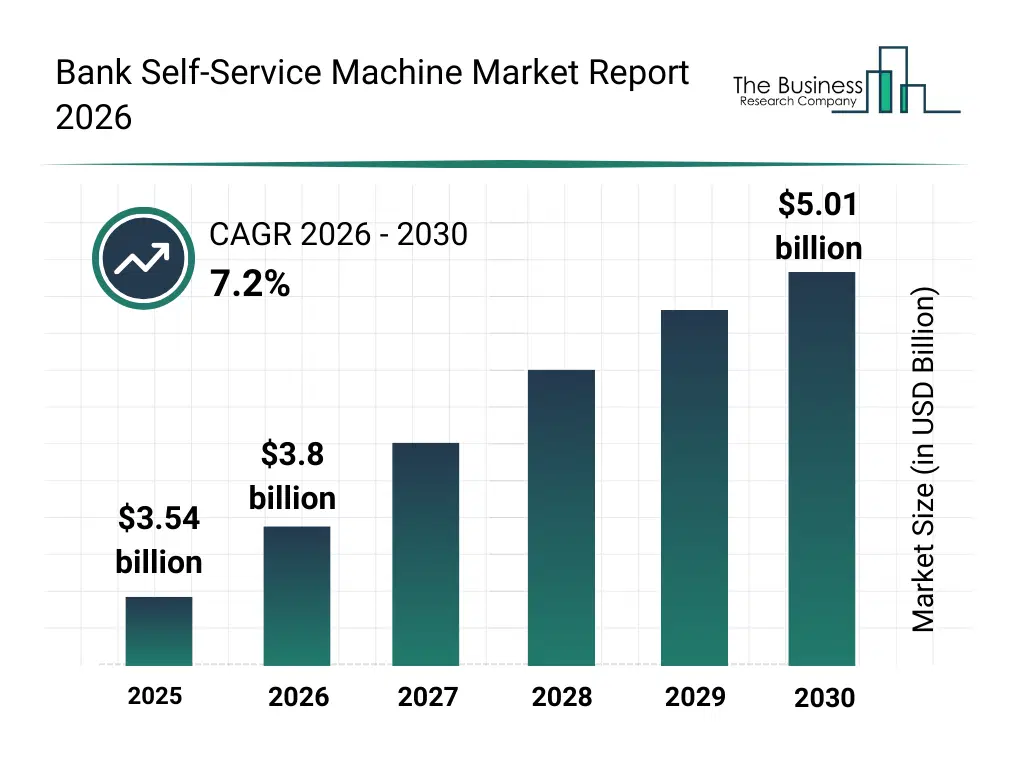
What Is The Bank Self-Service Machine Market Size and Share 2026?
The bank self-service machine market size has grown strongly in recent years. It will grow from $3.54 billion in 2025 to $3.8 billion in 2026 at a compound annual growth rate (CAGR) of 7.3%. The growth in the historic period can be attributed to expansion of atm networks, rising banking customer base, demand for faster banking services, reduction of branch operational costs, growth of urban banking infrastructure.What Is The Bank Self-Service Machine Market Growth Forecast?
The bank self-service machine market size is expected to see strong growth in the next few years. It will grow to $5.01 billion in 2030 at a compound annual growth rate (CAGR) of 7.2%. The growth in the forecast period can be attributed to increase in digital banking adoption, growth of smart banking initiatives, rising financial inclusion programs, demand for 24x7 banking access, advancements in secure transaction technologies. Major trends in the forecast period include increasing deployment of multifunction self service machines, growing adoption of contactless banking services, expansion of remote and branchless banking models, rising focus on enhanced transaction security, integration of multiple banking services in single machines.Tariff Impact On Bank Self-Service Machine Market
Tariffs have increased costs of electronic components, displays, and secure hardware used in bank self service machines. Asia pacific and north america are most affected due to electronics sourcing. Advanced multifunction machines face higher pricing pressure. However, tariffs are encouraging local manufacturing and regional assembly.
Global Bank Self-Service Machine Market Segmentation
1) By Product Type: Automated Teller Machines (ATMs), Cash Deposit Machines (CDMs), Interactive Kiosks, Bill Payment Machines, Multi-Function Machines (MFMs) 2) By Technology: Traditional Technology, Contactless Technology, Artificial Intelligence (AI) Integrated Technology, Biometric Technology 3) By Deployment Type: On-Premises, Cloud-Based, Hybrid Deployment 4) By Application: Cash Withdrawal, Account Balance Inquiry, Funds Transfer, Bill Payment Services 5) By End-User: Retail Banking, Commercial Banking, Credit Unions, Microfinance Institutions Subsegments: 1) By Automated Teller Machines (ATMs), Onsite Automated Teller Machines (ATMs), Offsite Automated Teller Machines (ATMs), Mobile Automated Teller Machines (ATMs), White Label Automated Teller Machines (ATMs) 2) By Cash Deposit Machines (CDMs), Single-Function CDMs, Multi-Function CDMs, Recyclable Cash Deposit Machines, Envelope Deposit Machines 3) By Interactive Kiosks, Self-Service Banking Kiosks, Loan Application Kiosks, Cheque Deposit Kiosks 4) By Bill Payment Machines, Utility Bill Payment Machines, Telecom Bill Payment Machines, Government Services Payment Machines 5) By Multi-Function Machines (MFMs), Cash Withdrawal And Deposit Machines, Bill Payment And Transfer Machines, Cheque Deposit And Account Update Machines, All-In-One Banking MachinesWhat Is The Driver Of The Bank Self-Service Machine Market?
The rising demand for cash transactions is expected to propel the growth of the bank self-service machine market going forward. Cash transactions refer to payments made using physical currency, such as coins or banknotes, instead of digital or electronic methods. The demand for cash transactions is rising due to limited access to digital infrastructure and unreliable internet connectivity, making physical currency a more dependable option for everyday purchases. Bank self-service machines facilitate cash transactions by enabling customers to deposit and withdraw cash quickly and securely without assistance, providing convenient 24/7 access and reducing wait times. For instance, in January 2025, according to CashEssentials, a Greece-based independent think tank, there were around 32.8 million cash withdrawals across its 1,260 ATMs and 605 branches in 2024, reflecting a 10% rise compared to 2023. Therefore, the rising demand for cash transactions is driving the growth of the bank self-service machine industry.Key Players In The Global Bank Self-Service Machine Market
Major companies operating in the bank self-service machine market are NCR Corporation, Diebold Nixdorf Incorporated, GRG Banking Equipment Co. Ltd., Hyosung TNS Inc., Nautilus Hyosung Inc., Toshiba Corporation, Fujitsu Limited, OKI Electric Industry Co. Ltd., Hitachi Ltd., Glory Ltd., Triton Systems LLC, Genmega Inc., Keba Group AG, Auriga Industries, SZZT Electronics Co. Ltd., Unisys Corporation, Nanjing Sciyon Wisdom Technology Group, KingTeller Technology Co. Ltd., Eastcompeace Technology Co. Ltd., Yihua Computer Co. Ltd., Sberbank Technology Devices, Hantle Inc.
This chart is for illustrative purposes; the full report includes a detailed competitor analysis and comprehensive overview of the top 10 companies in the market.
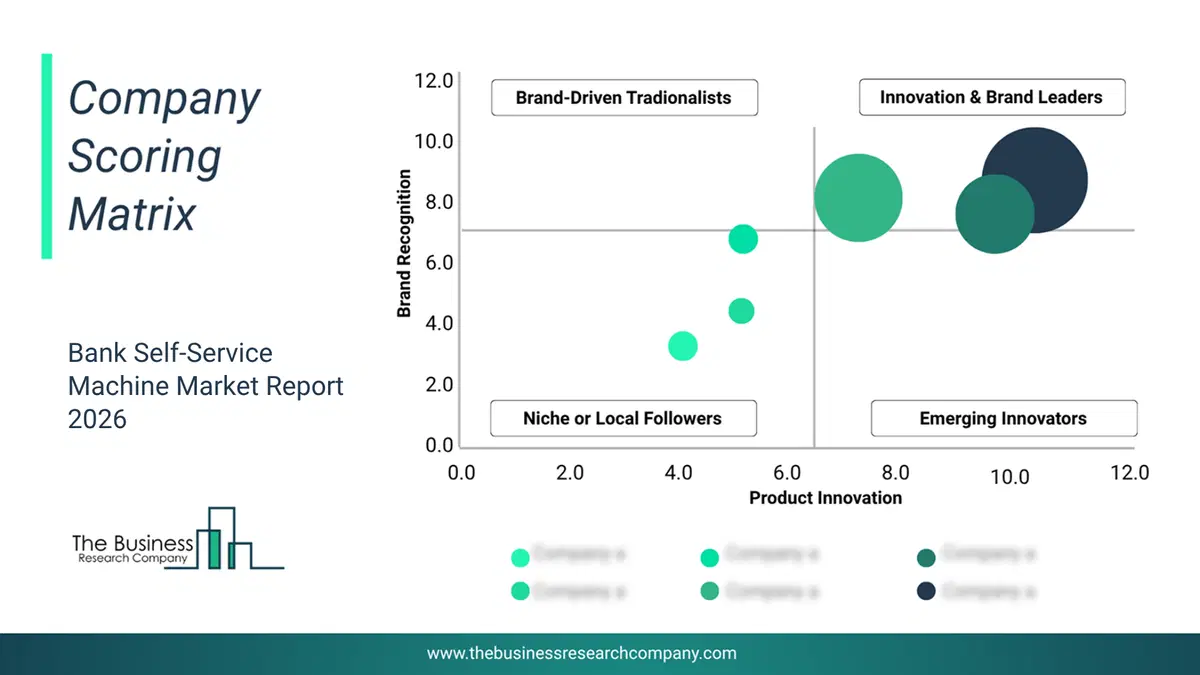
This chart maps companies by product innovation and brand strength, with bubble size indicating relative revenue, helping identify market leaders, challengers, and niche players. This is an illustrative chart; the full report provides a complete and accurate competitive analysis.
Global Bank Self-Service Machine Market Trends and Insights
Major companies operating in the bank self-service machine market are focusing on developing advanced solutions, such as automated self-service payment solutions, to enhance transaction speed, improve customer convenience, and reduce the need for in-branch staff. An automated self-service payment solution refers to a technology that allows customers to independently make payments and perform financial transactions through machines such as ATMs or kiosks without needing assistance from bank staff. For instance, in November 2024, Nayax Ltd., an Israel-based fintech company, launched an end-to-end automated self-service payment solution in El Salvador, featuring its VPOS Touch devices. These devices enable secure cashless payments at unattended machines, supporting contactless, mobile, QR, and EMV transactions. The rollout aims to modernize payment infrastructure, expand cashless commerce, and enhance customer loyalty programs across various locations such as malls, offices, universities, hospitals, and transport hubs in the country.What Are Latest Mergers And Acquisitions In The Bank Self-Service Machine Market?
In June 2025, SEDCO Holding Company, a Saudi Arabia-based asset management firm, partnered with S2M to transform self-service banking with AI. This collaboration aims to revolutionize the self-service banking landscape by introducing advanced AI-powered machines that not only enable instant card issuance but also significantly enhance customer convenience, streamline operational processes for financial institutions, and provide secure, round-the-clock banking services. S2M is a Morocco-based company specializing in developing and implementing electronic payment solutions and offering bank self-service machines as part of its payment solutions portfolio.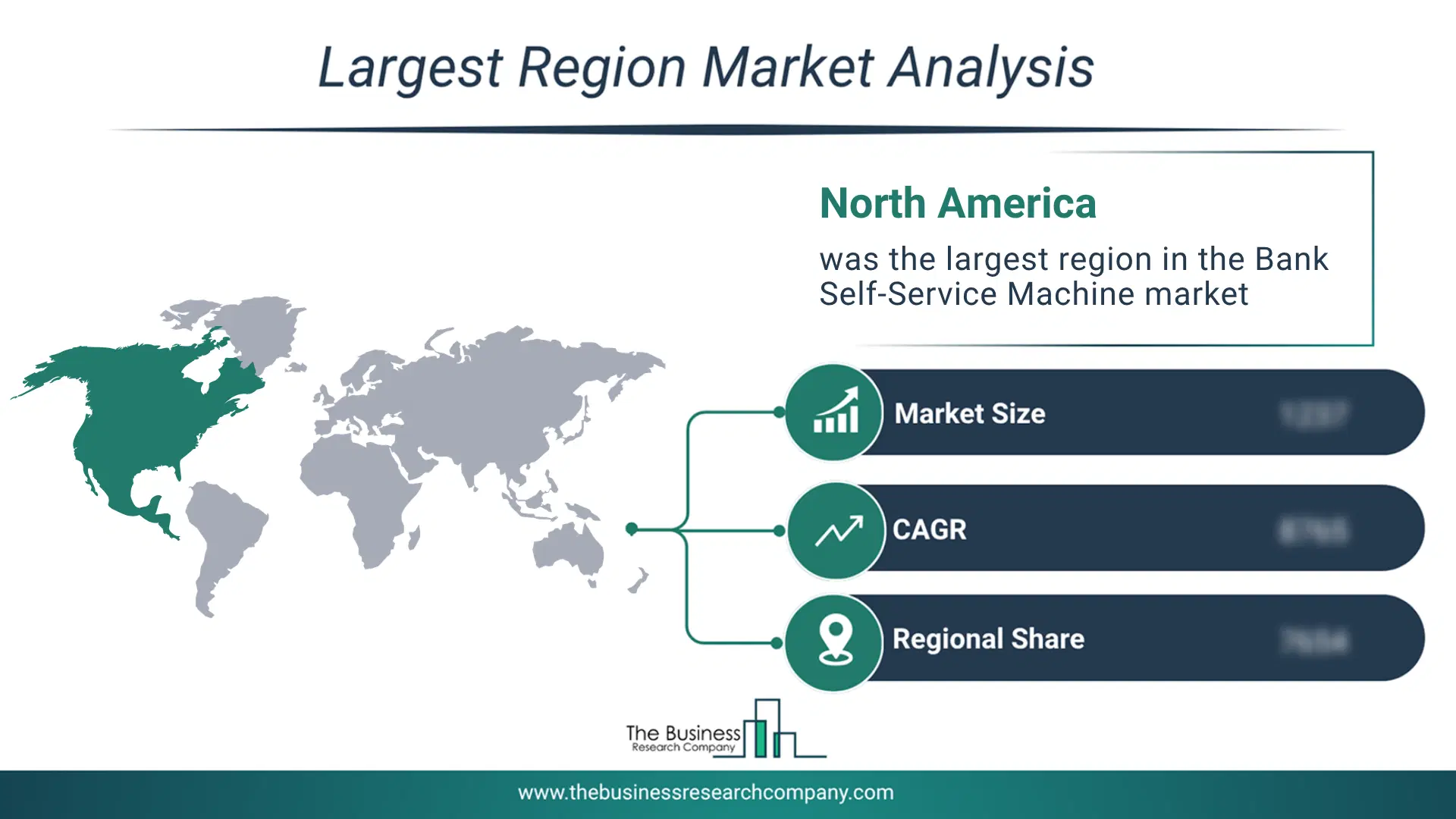
Regional Outlook
North America was the largest region in the bank self-service machine market in 2025. Asia-Pacific is expected to be the fastest-growing region in the forecast period. The regions covered in this market report are Asia-Pacific, South East Asia, Western Europe, Eastern Europe, North America, South America, Middle East, Africa The countries covered in this market report are Australia, Brazil, China, France, Germany, India, Indonesia, Japan, Taiwan, Russia, South Korea, UK, USA, Canada, Italy, Spain.What Defines the Bank Self-Service Machine Market?
The bank self-service machine market consists of sales of passbook printers, cash recycling machines, currency validators and dispensers, and biometric authentication devices. Values in this market are ‘factory gate’ values, that is, the value of goods sold by the manufacturers or creators of the goods, whether to other entities (including downstream manufacturers, wholesalers, distributors, and retailers) or directly to end customers. The value of goods in this market includes related services sold by the creators of the goods.How is Market Value Defined and Measured?
The market value is defined as the revenues that enterprises gain from the sale of goods and/or services within the specified market and geography through sales, grants, or donations in terms of the currency (in USD unless otherwise specified). The revenues for a specified geography are consumption values that are revenues generated by organizations in the specified geography within the market, irrespective of where they are produced. It does not include revenues from resales along the supply chain, either further along the supply chain or as part of other products.
This chart presents market attractiveness based on a quantitative evaluation of growth, competition, strategic alignment, and risk, offering a clear view of opportunity areas for decision-making. This chart is for illustrative purposes; the full report contains the complete analysis.

This chart highlights the Total Addressable Market (TAM) by estimating the maximum revenue opportunity using an assumption-driven approach, supporting strategic planning and opportunity sizing across markets. The chart is illustrative; the full report provides a more comprehensive analysis.
What Key Data and Analysis Are Included in the Bank Self-Service Machine Market Report 2026?
The bank self-service machine market research report is one of a series of new reports from The Business Research Company that provides market statistics, including industry global market size, regional shares, competitors with the market share, detailed market segments, market trends and opportunities, and any further data you may need to thrive in the bank self-service machine industry. The market research report delivers a complete perspective of everything you need, with an in-depth analysis of the current and future state of the industry.Bank Self Service Machine Market Report Forecast Analysis
| Report Attribute | Details |
|---|---|
| Market Size Value In 2026 | $3.8 billion |
| Revenue Forecast In 2030 | $5.01 billion |
| Base Year For Estimation | 2025 |
| Actual Estimates/Historical Data | 2020-2025 |
| Forecast Period | 2026 - 2030 |
| Market Representation | Revenue in USD Billion and CAGR from 2026 to 2030 |
| Segments Covered | Product Type, Technology, Deployment Type, Application, End-User |
| Regional Scope | Asia-Pacific, Western Europe, Eastern Europe, North America, South America, Middle East, Africa |
| Key Companies Profiled | NCR Corporation, Diebold Nixdorf Incorporated, GRG Banking Equipment Co. Ltd., Hyosung TNS Inc., Nautilus Hyosung Inc., Toshiba Corporation, Fujitsu Limited, OKI Electric Industry Co. Ltd., Hitachi Ltd., Glory Ltd., Triton Systems LLC, Genmega Inc., Keba Group AG, Auriga Industries, SZZT Electronics Co. Ltd., Unisys Corporation, Nanjing Sciyon Wisdom Technology Group, KingTeller Technology Co. Ltd., Eastcompeace Technology Co. Ltd., Yihua Computer Co. Ltd., Sberbank Technology Devices, Hantle Inc. |
| Customization Scope | Request for Customization |
| Pricing And Purchase Options | Explore Purchase Options |