
Banking And Financial Smart Cards Market Report 2026
Global Outlook – By Type (Contact Smart Cards, Contactless Smart Cards, Dual-Interface Smart Cards), By Security Feature (Europay, Mastercard, And Visa (EMV) Chip-Enabled Cards, Biometric Smart Cards, Cryptographic Smart Cards), By Application Area (Payment Cards, Identification Cards, Healthcare Cards, Access Control Cards), By End-User Industry (Banking Sector, Retail Sector, Transportation Sector, Telecommunications Sector) – Market Size, Trends, Strategies, and Forecast to 2030
Banking And Financial Smart Cards Market Overview
• Banking And Financial Smart Cards market size has reached to $15.29 billion in 2025 • Expected to grow to $26.75 billion in 2030 at a compound annual growth rate (CAGR) of 11.8% • Growth Driver: Increasing Adoption Of Contactless Payment Solutions Fuelling The Growth Of The Market Due To Enhancing Speed, Security, And User Convenience • Market Trend: Innovative Accessibility-Driven Advancements Shaping The Next Generation Of Financial Smart Card Solutions • North America was the largest region in 2025 and Asia-Pacific is the fastest growing region.What Is Covered Under Banking And Financial Smart Cards Market?
Banking and financial smart cards are secure payment instruments embedded with a microprocessor chip that stores and processes sensitive financial data, enabling encrypted transactions and protecting against fraud. These cards are widely used for secure payments, identity verification, and accessing various banking services, providing significantly stronger protection against fraud compared to traditional magnetic stripe cards. The main types of banking and financial smart cards are contact smart cards, contactless smart cards, and dual-interface smart cards. Contact smart cards include a physical chip with metal contacts that must be inserted into a reader to work. It includes security features such as Europay, Mastercard, and Visa (EMV) chip-enabled cards, biometric smart cards, and cryptographic smart cards. It finds applications in payment cards, identification cards, healthcare cards, and access control cards, serving key end users such as banking sector, retail sector, transportation sector, and telecommunications sector.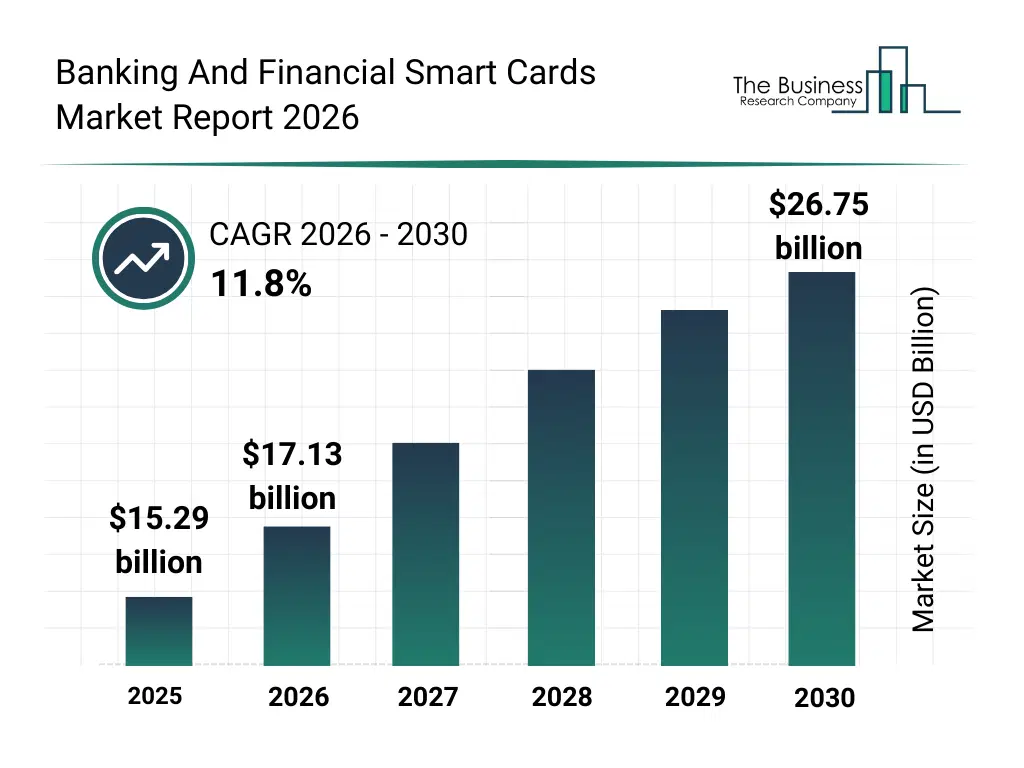
What Is The Banking And Financial Smart Cards Market Size and Share 2026?
The banking and financial smart cards market size has grown rapidly in recent years. It will grow from $15.29 billion in 2025 to $17.13 billion in 2026 at a compound annual growth rate (CAGR) of 12.0%. The growth in the historic period can be attributed to transition from magnetic stripe to chip-based cards, rising global card payment penetration, increasing fraud prevention requirements, expansion of banking services in emerging economies, regulatory mandates for secure payment authentication.What Is The Banking And Financial Smart Cards Market Growth Forecast?
The banking and financial smart cards market size is expected to see rapid growth in the next few years. It will grow to $26.75 billion in 2030 at a compound annual growth rate (CAGR) of 11.8%. The growth in the forecast period can be attributed to increasing adoption of biometric authentication, rising integration with digital wallets, growing demand for secure cross-border transactions, expansion of cashless economies, increasing focus on sustainable card materials. Major trends in the forecast period include increasing adoption of contactless payment cards, rising deployment of biometric smart cards, growing use of dual-interface cards for cross-border payments, expansion of emv chip migration programs, enhanced focus on card-level data encryption.
Global Banking And Financial Smart Cards Market Segmentation
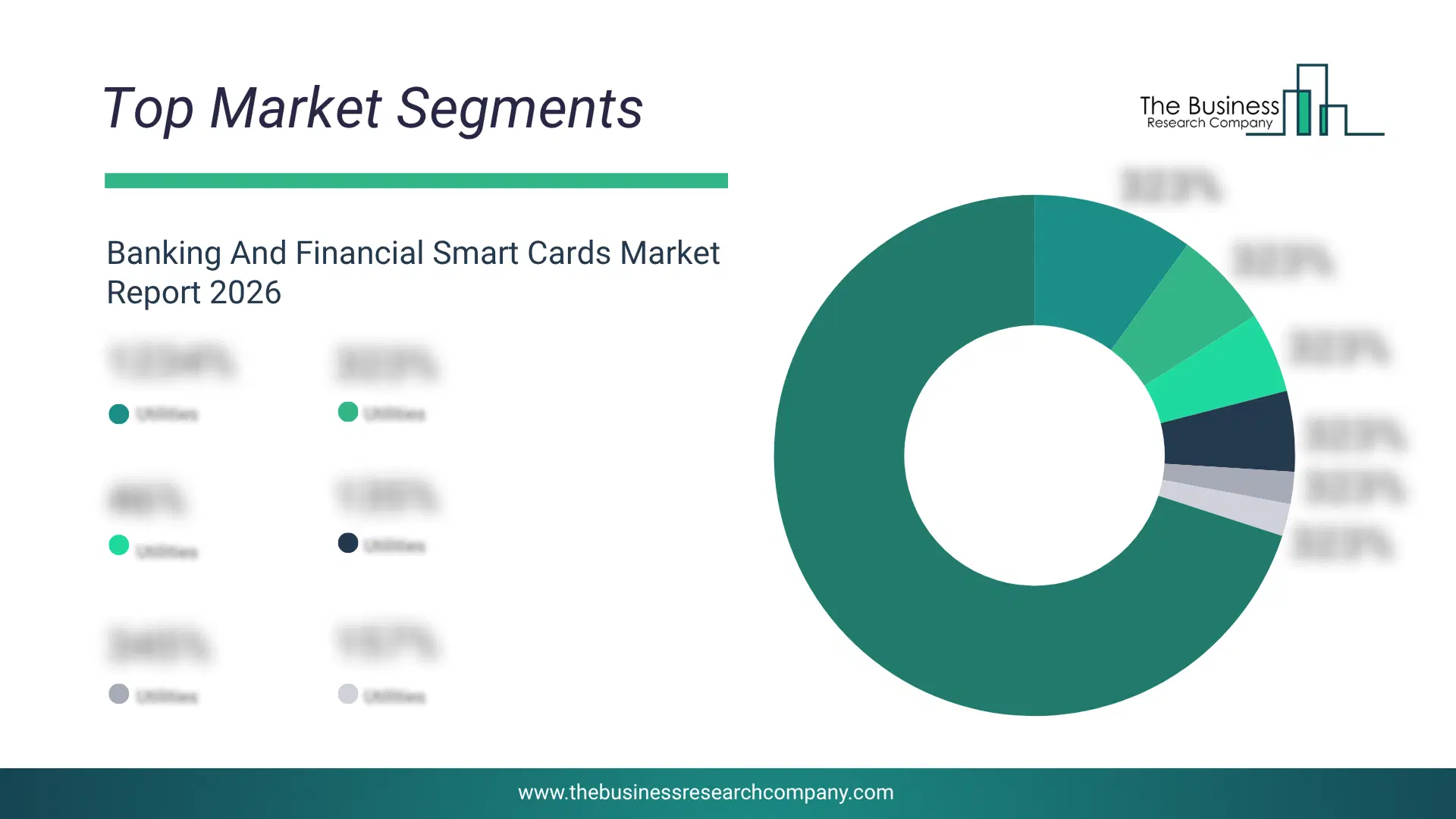
1) By Type: Contact Smart Cards, Contactless Smart Cards, Dual-Interface Smart Cards 2) By Security Feature: Europay, Mastercard, And Visa (EMV) Chip-Enabled Cards, Biometric Smart Cards, Cryptographic Smart Cards 3) By Application Area: Payment Cards, Identification Cards, Healthcare Cards, Access Control Cards 4) By End-User Industry: Banking Sector, Retail Sector, Transportation Sector, Telecommunications Sector Subsegments: 1) By Contact Smart Cards: Europay, Mastercard, And Visa (EMV) Chip Credit Cards, Europay, Mastercard, And Visa (EMV) Chip Debit Cards, Prepaid Contact Smart Cards, Secure Identity Cards For Banking Personnel, Multi-Application Contact Banking Cards, Contact Smart Cards For Microfinance & Rural Banking, Financial Smart Cards For Know Your Customer (KYC) Or Anti-Money Laundering (AML) Compliance 2) By Contactless Smart Cards: Near Field Communication (NFC)-Enabled Credit Cards, Near Field Communication (NFC)-Enabled Debit Cards, Contactless Prepaid Cards, Mobile Wallet-Linked Contactless Cards, Biometric Contactless Payment Cards, Tap-And-Go Transit + Banking Combo Cards, Contactless Cards For Peer-To-Peer Transfers, Crypto Wallet Contactless Cards 3) By Dual-Interface Smart Cards: Dual-Interface Europay, Mastercard, And Visa (EMV) Credit Cards, Dual-Interface Europay, Mastercard, And Visa (EMV) Debit Cards, Government-Issued Financial Smart Identity Document (ID) Cards, Dual-Interface Prepaid Cards, Biometric Dual-Interface Banking Cards, Multi-Currency Dual-Interface Cards, Contactless + Contact Combo Loyalty Cards, Dual-Interface Cards For Cross-Border PaymentsWhat Is The Driver Of The Banking And Financial Smart Cards Market?
The increasing adoption of contactless payment solutions is expected to propel the growth of the banking and financial smart cards market going forward. Contactless payment solutions enable tap-and-go transactions using near field communication (NFC) or radio frequency identification (RFID) technology, allowing fast and secure payments without physical contact. The adoption of contactless payment solutions is increasing as consumers seek faster and more convenient ways to complete transactions, reducing wait times at checkout counters. Banking and financial smart cards enable contactless payments by using a secure chip and near field communication (NFC) technology, making them ideal for fast, tap-and-go transactions. They enhance user convenience by reducing physical contact and improving transaction speed in everyday banking. For instance, in January 2024, according to the European Central Bank, a Germany-based central banking institution, the number of contactless card payments increased by 24.3% in 2023, reaching 20.9 billion transactions, compared to the previous year. Therefore, the increasing adoption of contactless payment solutions is driving the growth of the banking and financial smart cards industry.Key Players In The Global Banking And Financial Smart Cards Market
Major companies operating in the banking and financial smart cards market are American Express Company, Sberbank of Russia, Visa Inc., Mastercard Incorporated, Thales S.A., Infineon Technologies AG, NXP Semiconductors N.V., Toppan Inc., Giesecke+Devrient GmbH, IDEMIA France SAS, HID Global Corporation, CPI Card Group Inc., Bundesdruckerei GmbH, Muehlbauer GmbH & Co. KG, Shenzhen Tianyu Information Industry Co. Ltd., Hengbao Co. Ltd., Inkript Holding SAL, American Banknote Corporation, Trüb AG, Watchdata Technologies Ltd., CardLogix Corporation, Ellams Products Ltd.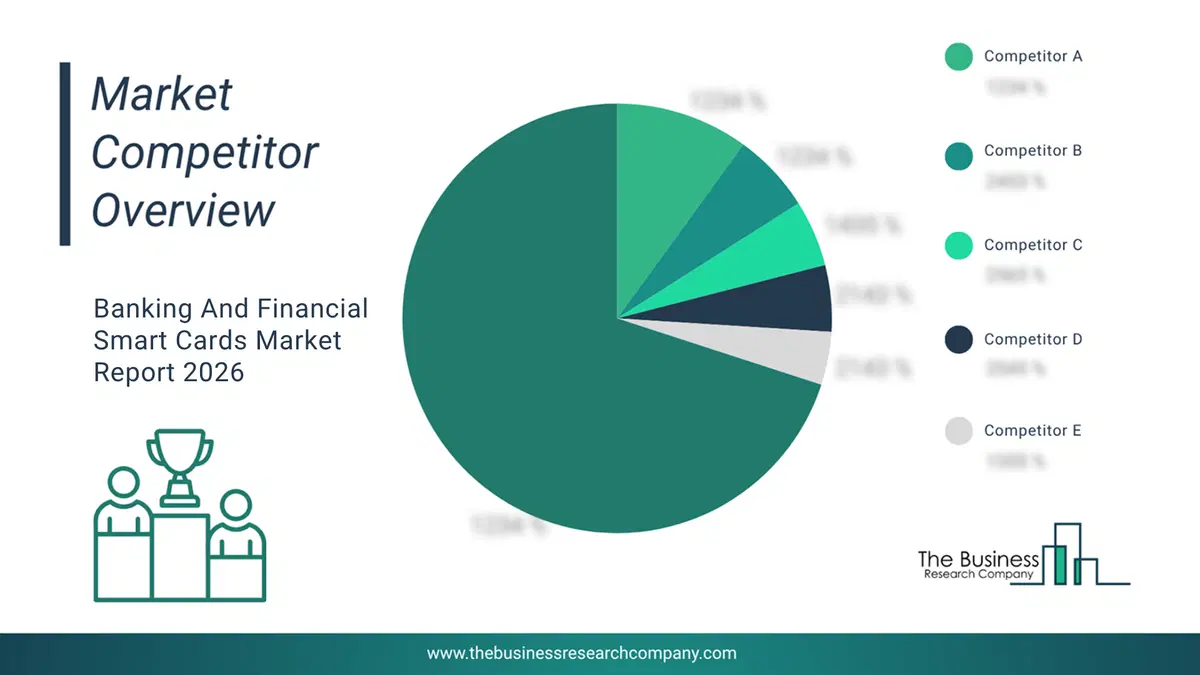
This chart is for illustrative purposes; the full report includes a detailed competitor analysis and comprehensive overview of the top 10 companies in the market.
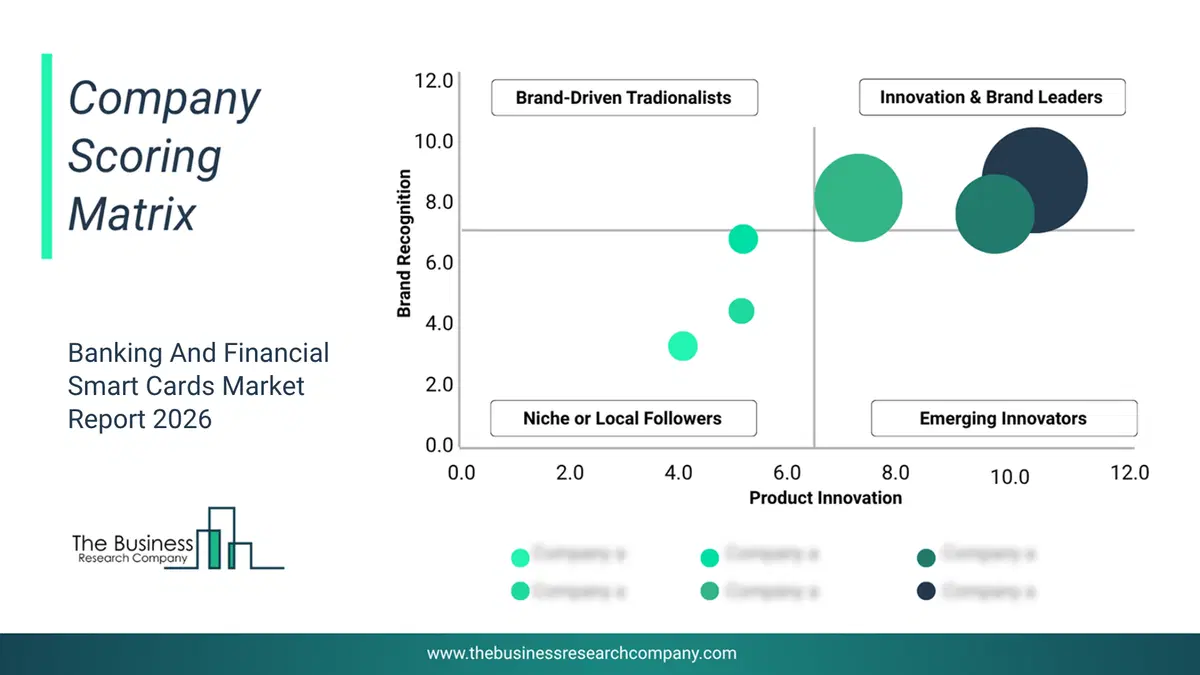
This chart maps companies by product innovation and brand strength, with bubble size indicating relative revenue, helping identify market leaders, challengers, and niche players. This is an illustrative chart; the full report provides a complete and accurate competitive analysis.
Global Banking And Financial Smart Cards Market Trends and Insights
Major companies operating in the banking and financial smart cards market are focusing on developing innovative solutions, such as accessible payment cards with Braille printing technology, to meet the rising demand for inclusive banking, regulatory accessibility requirements, improved customer experience for visually impaired users, and broader social-responsibility initiatives by issuers. An accessible payment card with Braille printing is a physical payment card whose essential details (for example, card number, expiry date, and CVV) are embossed or printed in Braille on the card surface; key features include durable tactile markings integrated during card personalization. For instance, in June 2024, IDEMIA Group a France-based identity and payments technology company, partnered with The Arab National Bank a Saudi Arabia-based bank to launch a payment card featuring Braille printing technology, a country-first deployment in the Kingdom of Saudi Arabia that demonstrates how issuers and vendors are embedding accessibility into mainstream card products. The IDEMIA ANB Braille card is composed and personalized like standard payment cards but includes tactile Braille for card number, expiration date, and CVV. It functions seamlessly at POS terminals and for card-not-present flows while preserving EMV security, offers direct benefits in customer independence and trust, and can be applied across retail, banking, and digital onboarding use cases as part of an issuer’s inclusive product portfolio.What Are Latest Mergers And Acquisitions In The Banking And Financial Smart Cards Market?
In October 2023, IDEX Biometrics ASA, a Norway-based biometrics company, partnered with KONA I to launch biometric cards. This partnership aims to globally scale secure biometric payment cards using recycled PVC and metal, combining expertise in biometrics and smart card manufacturing to meet growing demand for premium, eco-friendly banking solutions. KONA I is a South Korea–based smart card and FinTech solutions provider, specializing in banking and financial smart cards.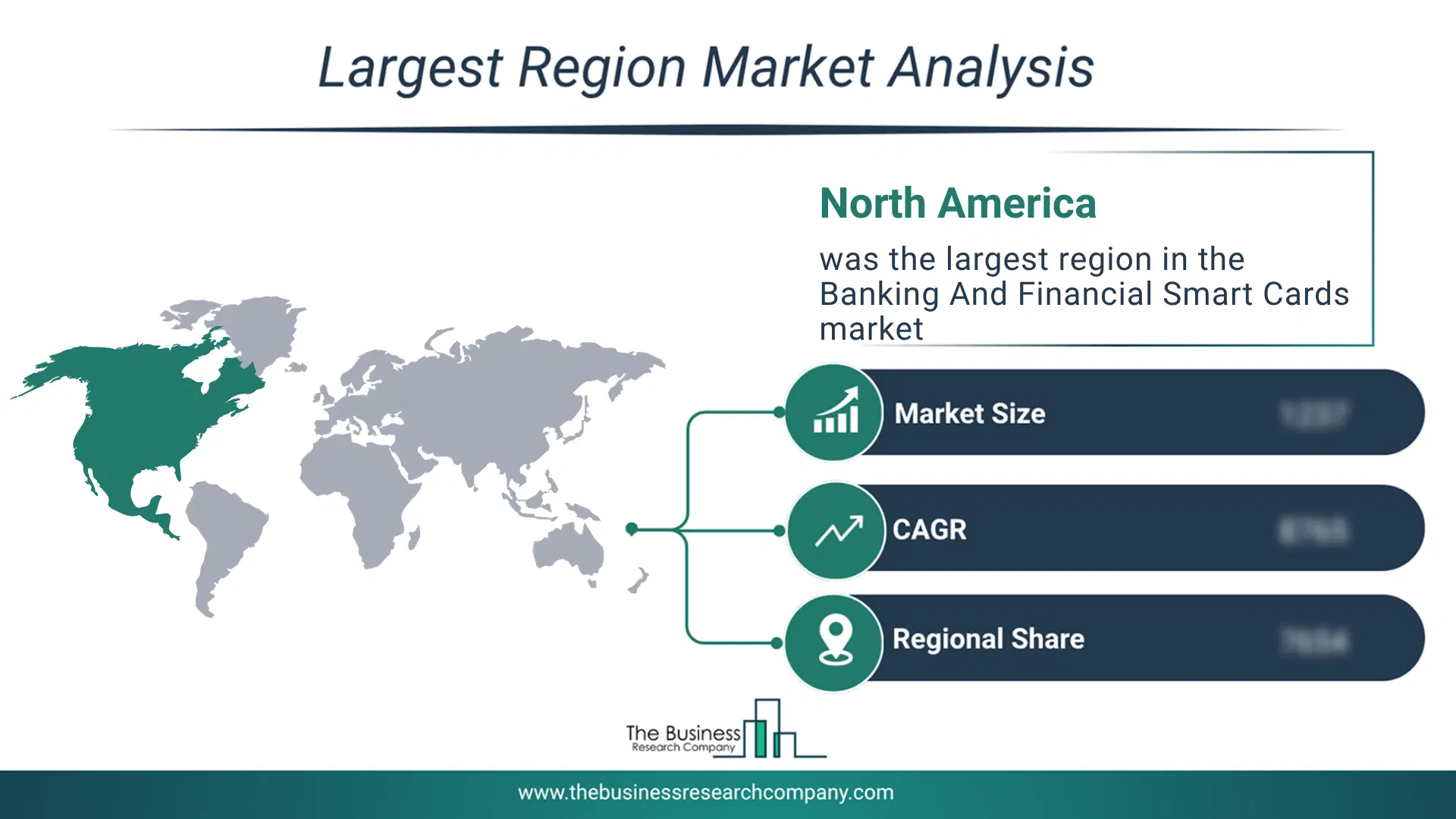
Regional Outlook
North America was the largest region in the banking and financial smart cards market in 2025. Asia-Pacific is expected to be the fastest-growing region in the forecast period. The regions covered in this market report are Asia-Pacific, South East Asia, Western Europe, Eastern Europe, North America, South America, Middle East, Africa. The countries covered in this market report are Australia, Brazil, China, France, Germany, India, Indonesia, Japan, Taiwan, Russia, South Korea, UK, USA, Canada, Italy, Spain.What Defines the Banking And Financial Smart Cards Market?
The banking and financial smart cards market includes revenues earned by entities by providing services such as secure payment transactions, online banking access, cross-border transactions, stored value functionality, and personal financial management. The market value includes the value of related goods sold by the service provider or included within the service offering. The banking and financial smart card market also consists of sales of contactless payment cards, magnetic stripe cards, credit cards, debit cards, prepaid cards, smart card readers, and Europay, Mastercard, and Visa (EMV) smart cards. Values in this market are ‘factory gate’ values, that is, the value of goods sold by the manufacturers or creators of the goods, whether to other entities (including downstream manufacturers, wholesalers, distributors, and retailers) or directly to end customers. The value of goods in this market includes related services sold by the creators of the goods.How is Market Value Defined and Measured?
The market value is defined as the revenues that enterprises gain from the sale of goods and/or services within the specified market and geography through sales, grants, or donations in terms of the currency (in USD unless otherwise specified). The revenues for a specified geography are consumption values that are revenues generated by organizations in the specified geography within the market, irrespective of where they are produced. It does not include revenues from resales along the supply chain, either further along the supply chain or as part of other products.
This chart presents market attractiveness based on a quantitative evaluation of growth, competition, strategic alignment, and risk, offering a clear view of opportunity areas for decision-making. This chart is for illustrative purposes; the full report contains the complete analysis.

This chart highlights the Total Addressable Market (TAM) by estimating the maximum revenue opportunity using an assumption-driven approach, supporting strategic planning and opportunity sizing across markets. The chart is illustrative; the full report provides a more comprehensive analysis.
What Key Data and Analysis Are Included in the Banking And Financial Smart Cards Market Report 2026?
The banking and financial smart cards market research report is one of a series of new reports from The Business Research Company that provides market statistics, including Market Report 2026?global market size, regional shares, competitors with the market share, detailed market segments, market trends and opportunities, and any further data you may need to thrive in the banking and financial smart cards Market Report 2026? The market research report delivers a complete perspective of everything you need, with an in-depth analysis of the current and future state of the Market Report 2026?Banking And Financial Smart Cards Market Report Forecast Analysis
| Report Attribute | Details |
|---|---|
| Market Size Value In 2026 | $17.13 billion |
| Revenue Forecast In 2030 | $26.75 billion |
| Growth Rate | CAGR of 7.9% from 2026 to 2030 |
| Base Year For Estimation | 2025 |
| Actual Estimates/Historical Data | 2020-2025 |
| Forecast Period | 2026 - 2030 |
| Market Representation | Revenue in USD Billion and CAGR from 2026 to 2030 |
| Segments Covered | Type, Security Feature, Application Area, End-User Industry |
| Regional Scope | Asia-Pacific, Western Europe, Eastern Europe, North America, South America, Middle East, Africa |
| Country Scope | The countries covered in the report are Australia, Brazil, China, France, Germany, India, Indonesia, Japan, Taiwan, Russia, South Korea, UK, USA, Canada, Italy, Spain. |
| Key Companies Profiled | American Express Company, Sberbank of Russia, Visa Inc., Mastercard Incorporated, Thales S.A., Infineon Technologies AG, NXP Semiconductors N.V., Toppan Inc., Giesecke+Devrient GmbH, IDEMIA France SAS, HID Global Corporation, CPI Card Group Inc., Bundesdruckerei GmbH, Muehlbauer GmbH & Co. KG, Shenzhen Tianyu Information Industry Co. Ltd., Hengbao Co. Ltd., Inkript Holding SAL, American Banknote Corporation, Trüb AG, Watchdata Technologies Ltd., CardLogix Corporation, Ellams Products Ltd. |
| Customization Scope | Request for Customization |
| Pricing And Purchase Options | Explore Purchase Options |