

Banking, Financial Services, And Insurance (BFSI) Business Intelligence Market Report 2026
Global Outlook – By Component (Software, Services), By Deployment Mode (On-Premises, Cloud), By Organization Size (Small And Medium Enterprises, Large Enterprises), By Application (Risk Management, Fraud Detection And Prevention, Customer Management, Compliance And Security Management, Other Applications), By End-User (Banks, Commercial Banks, Investment Banks) – Market Size, Trends, Strategies, and Forecast to 2030
Banking, Financial Services, And Insurance (BFSI) Business Intelligence Market Overview
• Banking, Financial Services, And Insurance (BFSI) Business Intelligence market size has reached to $24.03 billion in 2025 • Expected to grow to $42.35 billion in 2030 at a compound annual growth rate (CAGR) of 11.9% • Growth Driver: Rising Adoption Of Digital Banking Solutions Driving Growth Of The Market Due To Increasing Smartphone And Internet Penetration • Market Trend: Advancements In AI Agents Driving Automation, Predictive Analytics, And Enhanced Customer Experience In BFSI Operations • North America was the largest region in 2025 and Asia-Pacific is the fastest growing region.Market Gains By 2030 – Top Opportunities By Segment
Market Gain identifies the most promising market opportunities by highlighting the segments or products expected to generate the highest incremental revenue growth over the next five years.
What Is Covered Under Banking, Financial Services, And Insurance (BFSI) Business Intelligence Market?
Banking, financial services, and insurance (BFSI) business intelligence is the practice of gathering and analyzing financial and operational data within the BFSI sector to generate meaningful insights for decision-making. It focuses on interpreting trends, assessing performance, and supporting strategic planning by turning complex data into actionable information. The main components of banking, financial services, and insurance (BFSI) business intelligence include software and services. Software refers to digital solutions that help banks, financial institutions, and insurance companies collect, analyze, and visualize data to improve decision-making, manage risks, detect fraud, ensure compliance, and enhance customer experiences. Business intelligence can be deployed in various modes, such as on-premises and cloud, and is adopted by organizations of different sizes, including small and medium enterprises (SMEs) and large enterprises. It is applied in areas such as risk management, fraud detection and prevention, customer management, compliance and security management, and others by key end users, including banks, commercial banks, and investment banks.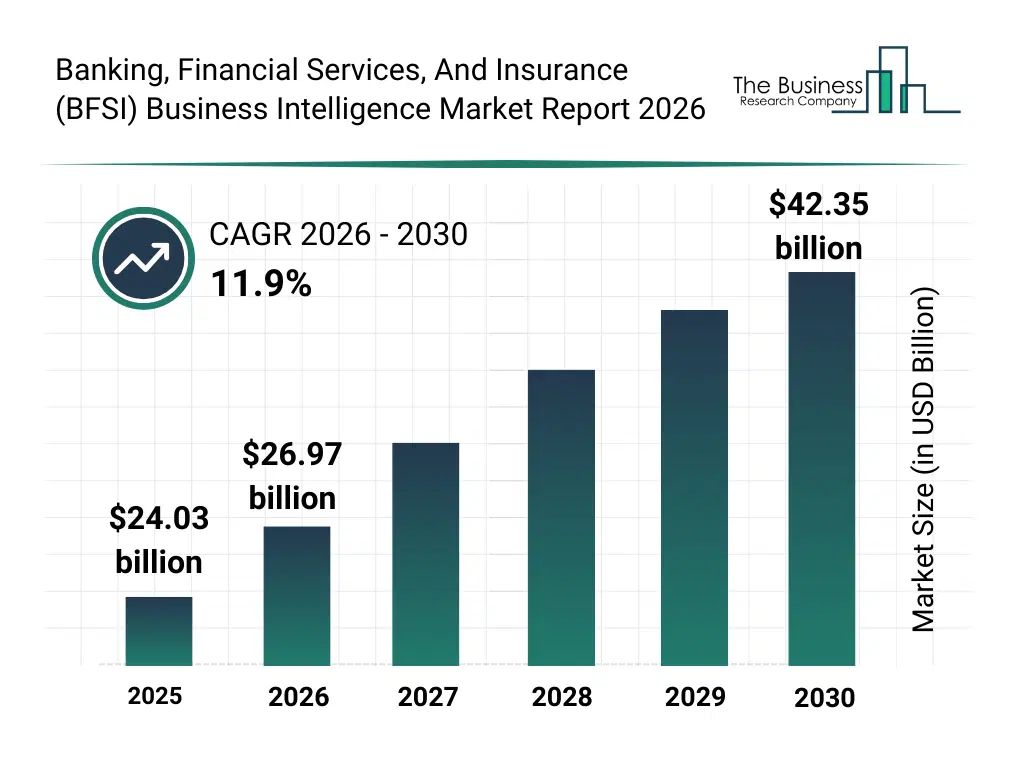
What Is The Banking, Financial Services, And Insurance (BFSI) Business Intelligence Market Size and Share 2026?
The banking, financial services, and insurance (bfsi) business intelligence market size has grown rapidly in recent years. It will grow from $24.03 billion in 2025 to $26.97 billion in 2026 at a compound annual growth rate (CAGR) of 12.2%. The growth in the historic period can be attributed to growth in digital banking data volumes, regulatory reporting requirements, early adoption of data warehousing solutions, increasing complexity of financial products, demand for performance monitoring.What Is The Banking, Financial Services, And Insurance (BFSI) Business Intelligence Market Growth Forecast?
The banking, financial services, and insurance (bfsi) business intelligence market size is expected to see rapid growth in the next few years. It will grow to $42.35 billion in 2030 at a compound annual growth rate (CAGR) of 11.9%. The growth in the forecast period can be attributed to increasing adoption of ai-powered decision intelligence, rising focus on real-time fraud analytics, expansion of cloud-native banking platforms, growing need for personalized financial insights, increased investment in advanced analytics. Major trends in the forecast period include increasing adoption of predictive analytics in bfsi, rising use of real-time risk intelligence platforms, growing integration of ai-driven bi tools, expansion of cloud-based bi solutions, enhanced focus on data visualization.
Global Banking, Financial Services, And Insurance (BFSI) Business Intelligence Market Segmentation
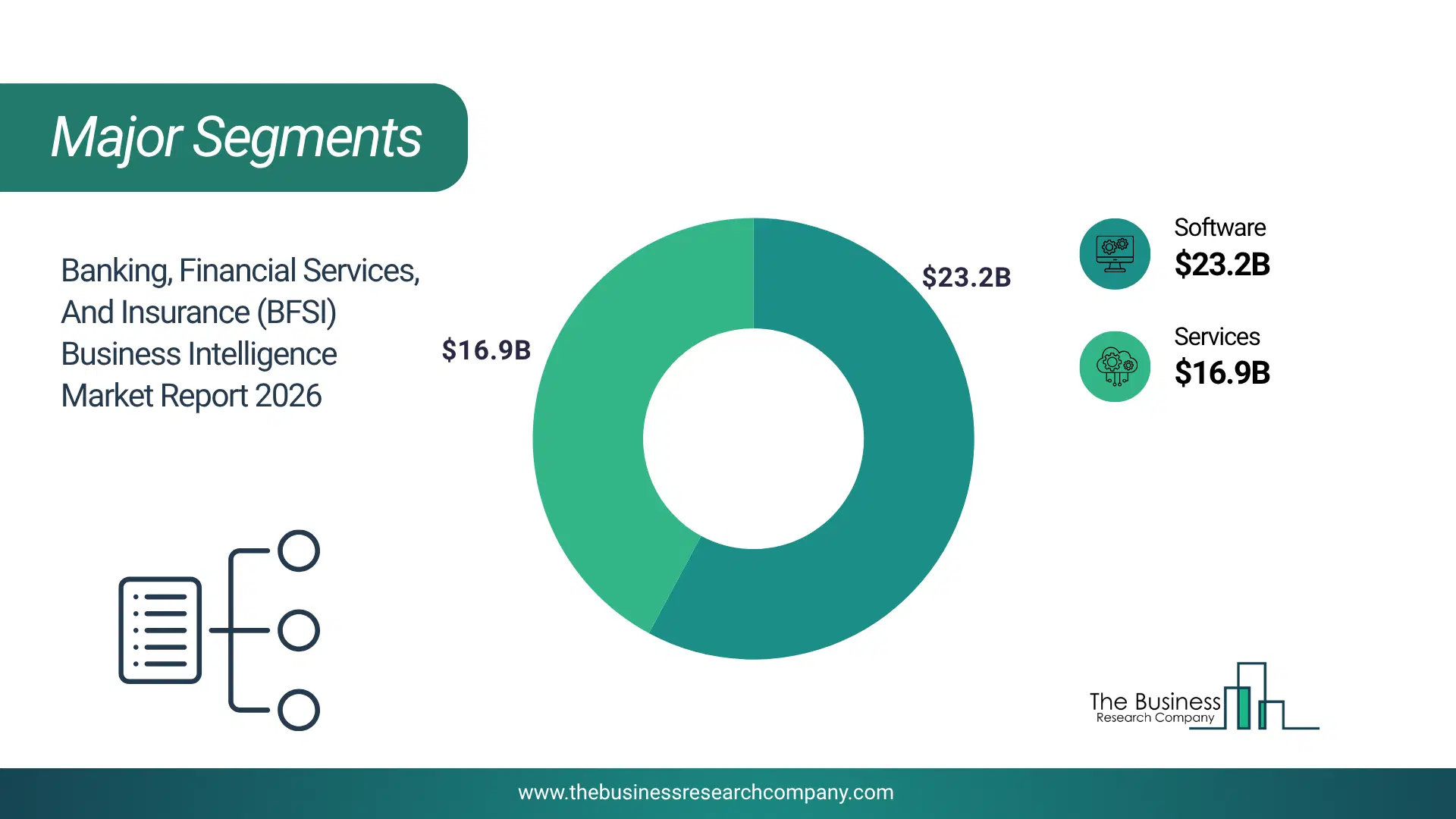
1) By Component: Software, Services 2) By Deployment Mode: On-Premises, Cloud 3) By Organization Size: Small And Medium Enterprises, Large Enterprises 4) By Application: Risk Management, Fraud Detection And Prevention, Customer Management, Compliance And Security Management, Other Applications 5) By End-User: Banks, Commercial Banks, Investment Banks Subsegments: 1) By Software: Data Visualization Tools, Data Management Platforms, Analytics And Reporting Software, Predictive Analytics Software, Risk Management Software 2) By Services: Consulting Services, Integration Services, Managed Services, Support And Maintenance Services, Training And Development Services The top segments in the banking, financial services, and insurance (bfsi) business intelligence market will be: • Software will reach $23.13 billion by 2030. • Services will reach $16.9 billion by 2030.What Is The Driver Of The Banking, Financial Services, And Insurance (BFSI) Business Intelligence Market?
The rising adoption of digital banking solutions is expected to propel the growth of the banking, financial services, and insurance (BFSI) business intelligence market going forward. Digital banking solutions refer to electronic platforms and services that enable customers to perform banking activities online or through mobile devices without visiting a physical branch. The adoption of digital banking solutions is increasing due to growing smartphone and internet penetration, making banking services more accessible and convenient for customers. BFSI business intelligence supports digital banking solutions by analyzing customer transactions and behavior in real time, enabling banks to provide personalized services and offers that boost engagement and satisfaction. For instance, in January 2024, according to the European Central Bank, a Germany-based central bank, in the first half of 2023, the volume of contactless card transactions surged by 24.3%, reaching 20.9 billion transactions compared to the same period in 2022. Therefore, the rising adoption of digital banking solutions drives growth of the banking, financial services, and insurance (BFSI) business intelligence industry.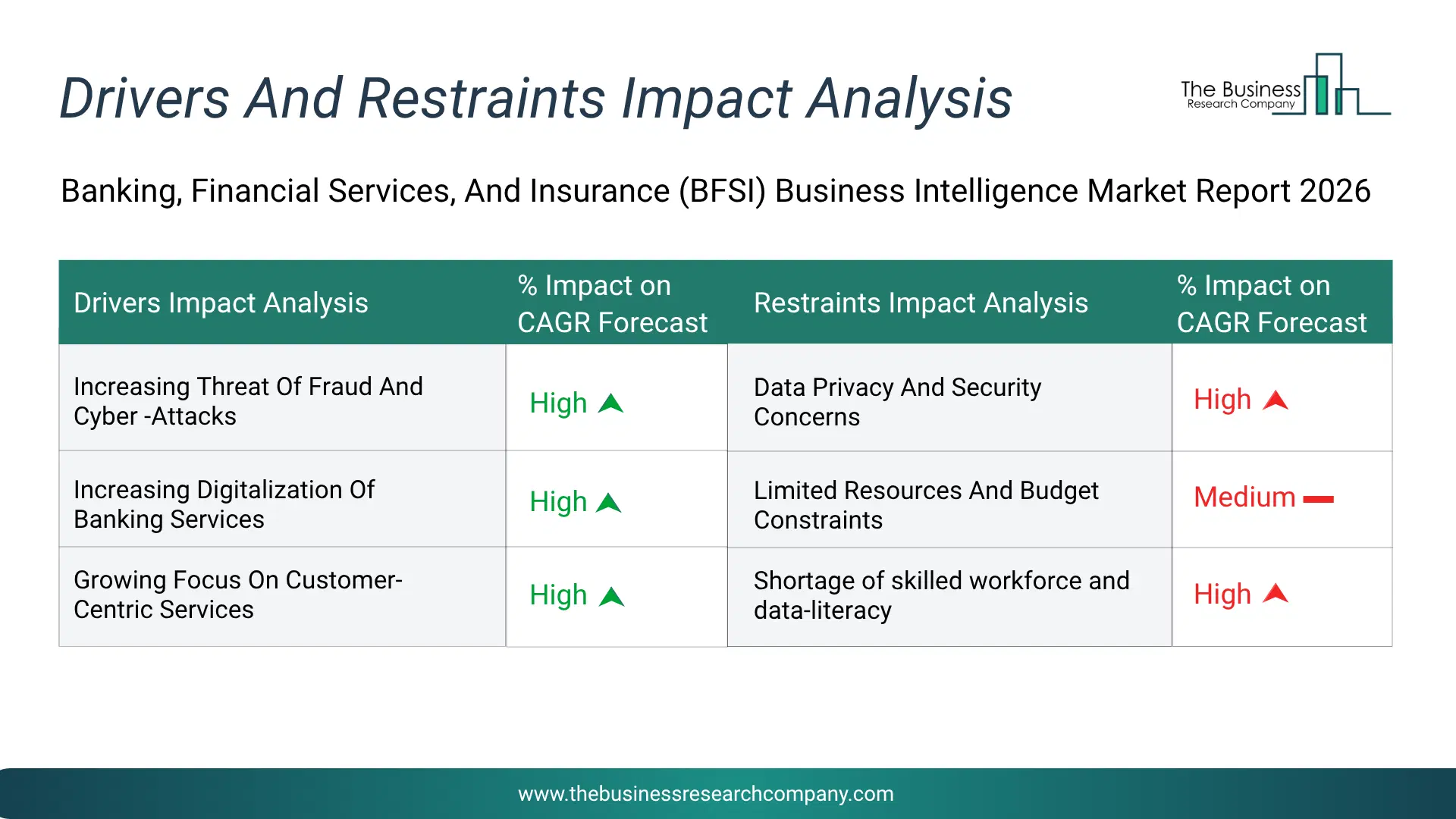
Infographic Chart Showing Key Market Drivers Analysis And Restraints For Banking, Financial Services, And Insurance (Bfsi) Business Intelligence Market
The chart presents an impact analysis of key drivers and restraints, quantifying their relative influence on the market's growth rate and helping assess the balance between growth enablers and limiting factors. This chart offers a high-level perspective; the full report contains more detailed insights.
How Will The Drivers Impact Growth In The Global Banking, Financial Services, And Insurance (BFSI) Business Intelligence Market?
• Increasing Threat Of Fraud And Cyber -Attacks (High) – During the forecast period, the increasing threat of fraud and cyber -attacks is expected to become a key growth driver for the bfsi business intelligence market by 2030. Financial institutions are facing a rising volume of sophisticated cyber threats, fraudulent transactions, and digital payment vulnerabilities, which require advanced analytics and real -time monitoring systems. Business intelligence platforms enable banks and financial service providers to analyze large volumes of transaction data, detect suspicious patterns, and strengthen fraud prevention strategies. Institutions are therefore investing in ai -driven analytics and predictive risk intelligence tools to enhance cybersecurity resilience and safeguard financial assets. This growing emphasis on fraud detection and threat monitoring is reinforcing the adoption of advanced bi platforms across the bfsi sector. • Increasing Digitalization Of Banking Services (High) – During the forecast period, the increasing digitalization of banking services is expected to emerge as a major factor driving the expansion of the bfsi business intelligence market by 2030. The rapid adoption of online banking, mobile financial applications, digital payment systems, and cloud-based financial platforms is generating massive volumes of structured and unstructured data. Financial institutions require advanced bi tools to transform this data into actionable insights that support strategic planning, operational optimization, and regulatory reporting. Organizations are therefore integrating modern analytics platforms that enable real-time dashboards, automated reporting, and cross-channel financial data integration. As digital banking ecosystems continue to expand globally, demand for scalable business intelligence solutions is expected to accelerate. • Growing Focus On Customer-Centric Services (High) – During the forecast period, the growing focus on customer-centric services is expected to act as a key growth catalyst for the bfsi business intelligence market by 2030. Financial institutions are increasingly leveraging data analytics to understand customer behavior, personalize financial products, and enhance customer engagement across digital and physical banking channels. Business intelligence platforms enable banks and insurance providers to analyze customer transaction patterns, credit profiles, and service preferences to deliver targeted financial solutions and improve customer experience. Additionally, personalized banking services and predictive customer insights are becoming critical for improving retention and strengthening competitive positioning in the financial services sector. As financial institutions continue to prioritize customer intelligence and service personalization, demand for advanced bi platforms is expected to increase.How Will The Restraints Impact Growth In The Global Banking, Financial Services, And Insurance (BFSI) Business Intelligence Market?
• Data Privacy And Security Concerns (High) – During the forecast period, the data privacy and security concerns act as a major restraint for the banking, financial services, and insurance (bfsi) business intelligence market. Since bi systems handle large volumes of sensitive financial and personal data, any breach or unauthorized access can lead to severe financial and reputational losses. Strict regulatory requirements like gdpr and data protection laws limit how institutions collect, store, and analyze customer data. This increases compliance costs and slows down bi adoption. As a result, many bfsi firms hesitate to fully implement advanced analytics and cloud-based bi solutions due to potential security risks. • Limited Resources And Budget Constraints (Medium) – During the forecast period, the limited resources and budget constraints act as a major restraint for the banking, financial services, and insurance (bfsi) business intelligence market. Many institutions, especially small and mid-sized ones, struggle to invest in advanced bi tools, skilled personnel, and data infrastructure. The high cost of implementation and maintenance often leads to delays in digital transformation initiatives. Budget limitations also restrict continuous upgrades and integration with modern analytics platforms. As a result, financial organizations face challenges in extracting real-time insights and improving decision-making efficiency. • Shortage of skilled workforce and data-literacy (High) – During the forecast period, the the shortage of skilled professionals and low data literacy act as major restraints for the bfsi business intelligence (bi) market. Implementing bi solutions requires expertise in data analytics, machine learning, and financial domain knowledge, which many institutions lack. This talent gap leads to inefficient use of bi tools, poor data interpretation, and slower decision-making. As a result, many bfsi organizations struggle to fully leverage bi capabilities for strategic insights and operational efficiency.Key Players In The Global Banking, Financial Services, And Insurance (BFSI) Business Intelligence Market
Major companies operating in the banking, financial services, and insurance (bfsi) business intelligence market are Microsoft Corporation, IBM Corporation, Oracle Corporation, SAP SE, SAS Institute Inc., Tableau Software LLC, MicroStrategy Incorporated, Domo Inc., Sisense Inc., GoodData Corporation, InetSoft Solutions, Qlik Technologies Inc., TIBCO Software Inc., Teradata Corporation, Information Builders Inc., FICO LLC, Pegasystems Inc., Alteryx Inc., Splunk Inc., ThoughtSpot Inc., Yellowfin International, Cybertec Gesellschaft m b H, BOARD International, Birst Inc., Logi Analytics Inc.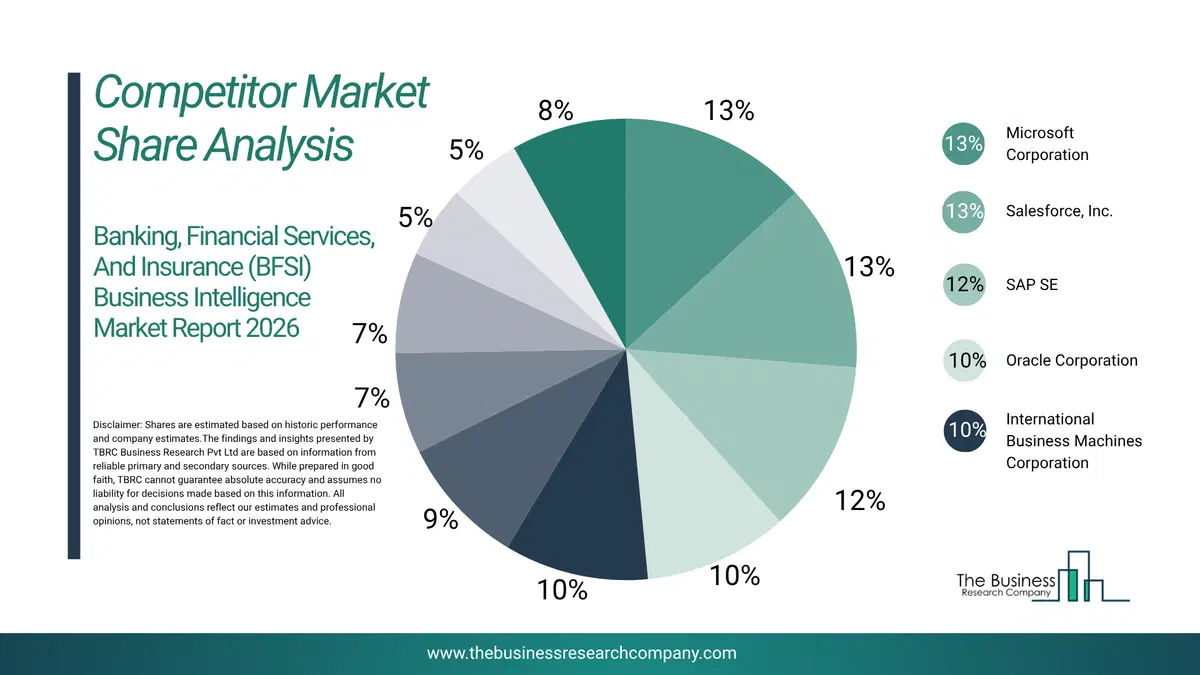
This chart is for illustrative purposes; the full report includes a detailed competitor analysis and comprehensive overview of the top 10 companies in the market.
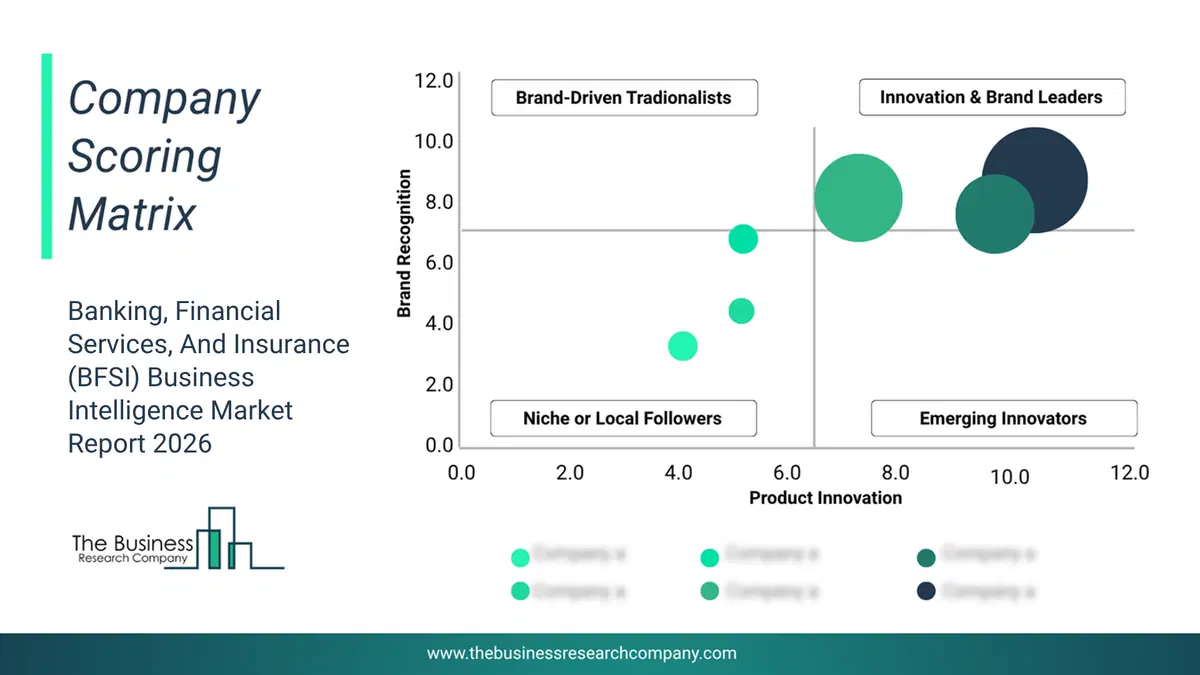
This chart maps companies by product innovation and brand strength, with bubble size indicating relative revenue, helping identify market leaders, challengers, and niche players. This is an illustrative chart; the full report provides a complete and accurate competitive analysis.
Global Banking, Financial Services, And Insurance (BFSI) Business Intelligence Market Trends and Insights
Major companies operating in the banking, financial services, and insurance (BFSI) business intelligence market are focusing on developing advanced solutions, such as artificial intelligence (AI) agents, to enhance predictive analytics, automate decision-making, improve customer insights, and optimize risk management processes. Artificial intelligence (AI) agents refer to software programs that can autonomously perceive their environment, process data, make decisions, and take actions to achieve specific goals. For instance, in November 2024, BUSINESSNEXT Inc., an India-based provider of composable cloud solutions for financial services, launched AGENTNEXT, an artificial intelligence (AI) agent platform designed specifically for the banking, financial services, and insurance (BFSI) sector, aimed at modernizing banking operations by automating 60-70% of routine tasks. This platform features personalized artificial intelligence (AI)-driven banker assistants and artificial intelligence (AI)-powered contact centers that enhance efficiency in sales, marketing, lending, and customer service. The artificial intelligence (AI)-driven automation and advanced analytics capabilities within banking, financial services, and insurance (BFSI) business intelligence platforms enhance operational efficiency while ensuring compliance and delivering personalized financial services for an improved customer experience.What Are Latest Mergers And Acquisitions In The Banking, Financial Services, And Insurance (BFSI) Business Intelligence Market?
In April 2024, Aurionpro Solutions Ltd., an India-based technology solutions provider for financial institutions, acquired a majority stake in Arya.ai for $16.5 million. This move aims to have Aurionpro create a leading enterprise Artificial Intelligence (AI) platform tailored for banks and insurers globally by integrating Arya.ai’s advanced AI, deep learning, and intelligent automation platforms with Aurionpro’s existing fintech offerings. Arya.ai is an India-based provider of BFSI business intelligence solutions.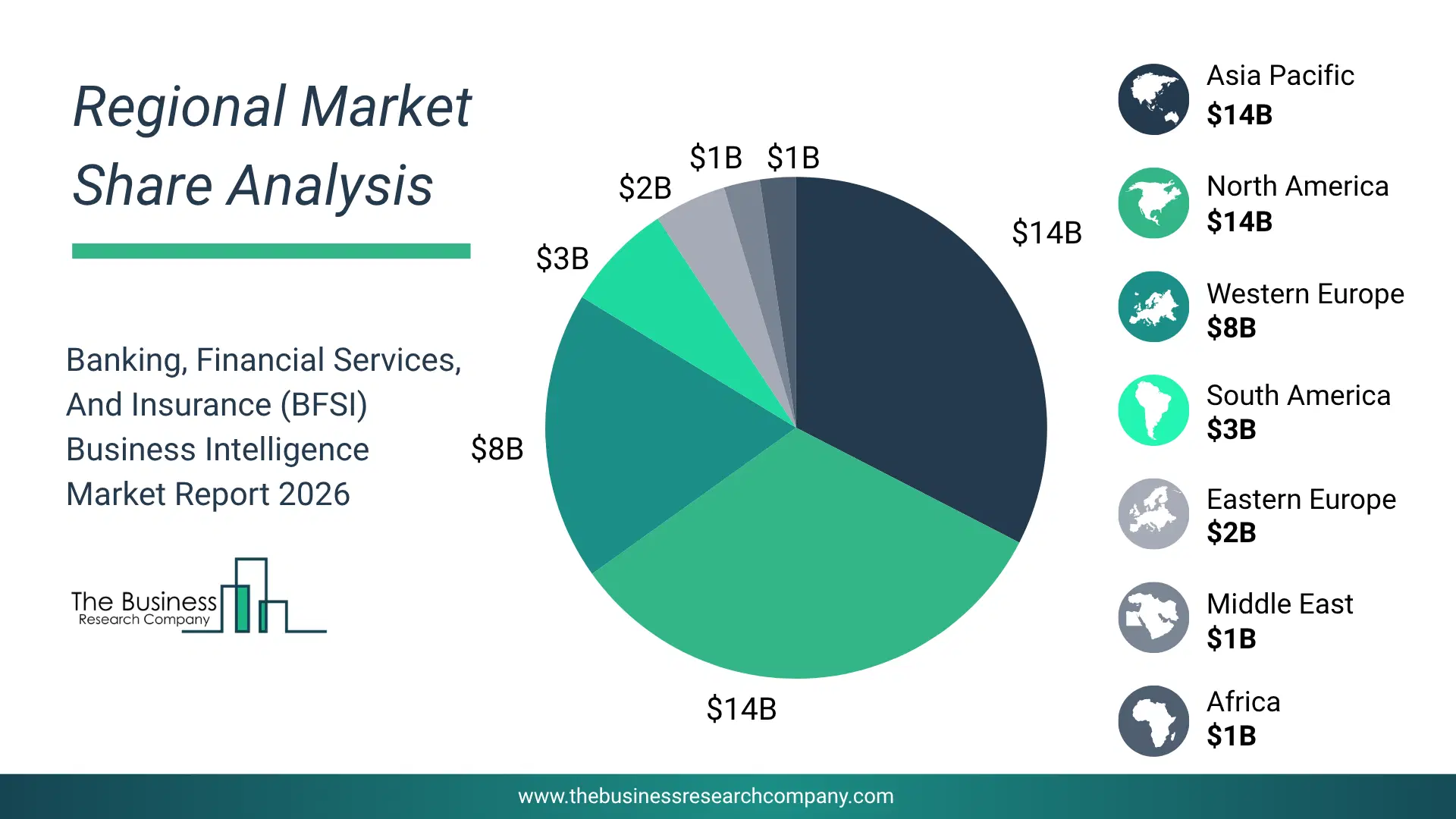
Regional Outlook
North America was the largest region in the banking, financial services, and insurance (BFSI) business intelligence market in 2025. Asia-Pacific is expected to be the fastest-growing region in the forecast period. The regions covered in this market report are Asia-Pacific, South East Asia, Western Europe, Eastern Europe, North America, South America, Middle East, Africa. The countries covered in this market report are Australia, Brazil, China, France, Germany, India, Indonesia, Japan, Taiwan, Russia, South Korea, UK, USA, Canada, Italy, Spain.What Defines the Banking, Financial Services, And Insurance (BFSI) Business Intelligence Market?
The banking, financial services, and insurance (BFSI) business intelligence market consists of revenues earned by entities by providing services such as data warehousing and management, advanced analytics, performance management, and investment analysis. The market value includes the value of related goods sold by the service provider or included within the service offering. Only goods and services traded between entities or sold to end consumers are included.How is Market Value Defined and Measured?
The market value is defined as the revenues that enterprises gain from the sale of goods and/or services within the specified market and geography through sales, grants, or donations in terms of the currency (in USD unless otherwise specified). The revenues for a specified geography are consumption values that are revenues generated by organizations in the specified geography within the market, irrespective of where they are produced. It does not include revenues from resales along the supply chain, either further along the supply chain or as part of other products.
This chart presents market attractiveness based on a quantitative evaluation of growth, competition, strategic alignment, and risk, offering a clear view of opportunity areas for decision-making. This chart is for illustrative purposes; the full report contains the complete analysis.

This chart highlights the Total Addressable Market (TAM) by estimating the maximum revenue opportunity using an assumption-driven approach, supporting strategic planning and opportunity sizing across markets. The chart is illustrative; the full report provides a more comprehensive analysis.
What Key Data and Analysis Are Included in the Banking, Financial Services, And Insurance (BFSI) Business Intelligence Market Report 2026?
The banking, financial services, and insurance (bfsi) business intelligence market research report is one of a series of new reports from The Business Research Company that provides market statistics, including Market Report 2026?global market size, regional shares, competitors with the market share, detailed market segments, market trends and opportunities, and any further data you may need to thrive in the banking, financial services, and insurance (bfsi) business intelligence Market Report 2026? The market research report delivers a complete perspective of everything you need, with an in-depth analysis of the current and future state of the Market Report 2026?Banking, Financial Services, And Insurance (BFSI) Business Intelligence Market Report Forecast Analysis
| Report Attribute | Details |
|---|---|
| Market Size Value In 2026 | $26.97 billion |
| Revenue Forecast In 2030 | $42.35 billion |
| Growth Rate | CAGR of 11.9% from 2026 to 2030 |
| Base Year For Estimation | 2025 |
| Actual Estimates/Historical Data | 2020-2025 |
| Forecast Period | 2026 - 2030 |
| Market Representation | Revenue in USD Billion and CAGR from 2026 to 2030 |
| Segments Covered | Component, Deployment Mode, Organization Size, Application, End-User |
| Regional Scope | Asia-Pacific, Western Europe, Eastern Europe, North America, South America, Middle East, Africa |
| Country Scope | The countries covered in the report are Australia, Brazil, China, France, Germany, India, ... |
| Key Companies Profiled | Microsoft Corporation, IBM Corporation, Oracle Corporation, SAP SE, SAS Institute Inc., Tableau Software LLC, MicroStrategy Incorporated, Domo Inc., Sisense Inc., GoodData Corporation, InetSoft Solutions, Qlik Technologies Inc., TIBCO Software Inc., Teradata Corporation, Information Builders Inc., FICO LLC, Pegasystems Inc., Alteryx Inc., Splunk Inc., ThoughtSpot Inc., Yellowfin International, Cybertec Gesellschaft m b H, BOARD International, Birst Inc., Logi Analytics Inc. |
| Customization Scope | Request for Customization |
| Pricing And Purchase Options | Explore Purchase Options |