
Base Transceiver Station Antenna Market Report 2026
Global Outlook – By Type (Single-Band, Multi-Band), By Vendor Type (Original Equipment Manufacturers, Engineering, Procurement And Construction), By Equipment (Omnidirectional Antennas, Directional (Or Sector) Antennas), By Application (Urban Areas, Rural Areas, Other Applications), By Industry Verticals (Telecom, Defense, Broadcasting) – Market Size, Trends, Strategies, and Forecast to 2030
Base Transceiver Station Antenna Market Overview
• Base Transceiver Station Antenna market size has reached to $8.76 billion in 2025 • Expected to grow to $13.96 billion in 2030 at a compound annual growth rate (CAGR) of 9.4% • Growth Driver: Increasing Demand For Mobile Data Services Drives The Base Transceiver Station Antenna Market • Market Trend: Eco-Friendly Base Transceiver Station Antennas Drive Sustainability In Telecommunications • North America was the largest region in 2025.What Is Covered Under Base Transceiver Station Antenna Market?
A base transceiver station antenna is a component of cellular network infrastructure responsible for transmitting and receiving radio signals between mobile devices and the base station. These antennas are utilized in cellular networks to facilitate wireless communication between mobile devices and the network infrastructure, enabling voice calls, text messages, and data transmission. The main types of base transceiver station antennas are single-band and multiple-band. Single-band base transceiver station antennas operate within a specific frequency band, allowing communication within a single frequency range. It is provided by vendors such as original equipment manufacturers, engineering, procurement, and construction. The equipment involved are omnidirectional antennas, and directional (or sector) antennas, that are used for applications in urban areas, rural areas, and other applications by various industry verticals such as telecom, defense, and broadcasting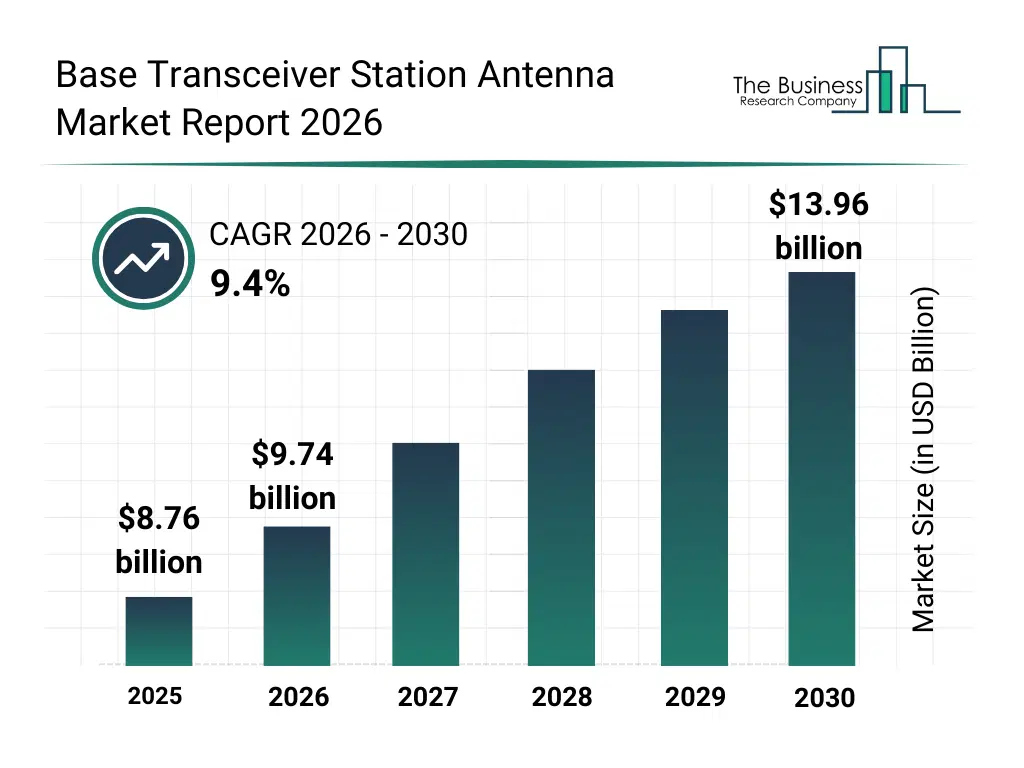
What Is The Base Transceiver Station Antenna Market Size and Share 2026?
The base transceiver station antenna market size has grown rapidly in recent years. It will grow from $8.76 billion in 2025 to $9.74 billion in 2026 at a compound annual growth rate (CAGR) of 11.2%. The growth in the historic period can be attributed to growth of 3g and 4g cellular networks, increasing mobile subscriber base, rising demand for improved network coverage, deployment of single-band antennas, expansion of telecom infrastructure in urban areas.What Is The Base Transceiver Station Antenna Market Growth Forecast?
The base transceiver station antenna market size is expected to see strong growth in the next few years. It will grow to $13.96 billion in 2030 at a compound annual growth rate (CAGR) of 9.4%. The growth in the forecast period can be attributed to deployment of 5G networks, adoption of multi-band and wideband antennas, increasing investments in smart city infrastructure, integration of ai-based network optimization, rising demand for telecom services in rural areas. Major trends in the forecast period include deployment of multi-band antennas, integration of omnidirectional and directional antennas, expansion of urban and rural network coverage, optimization for telecom and broadcasting verticals, advanced antenna materials and design.
Global Base Transceiver Station Antenna Market Segmentation
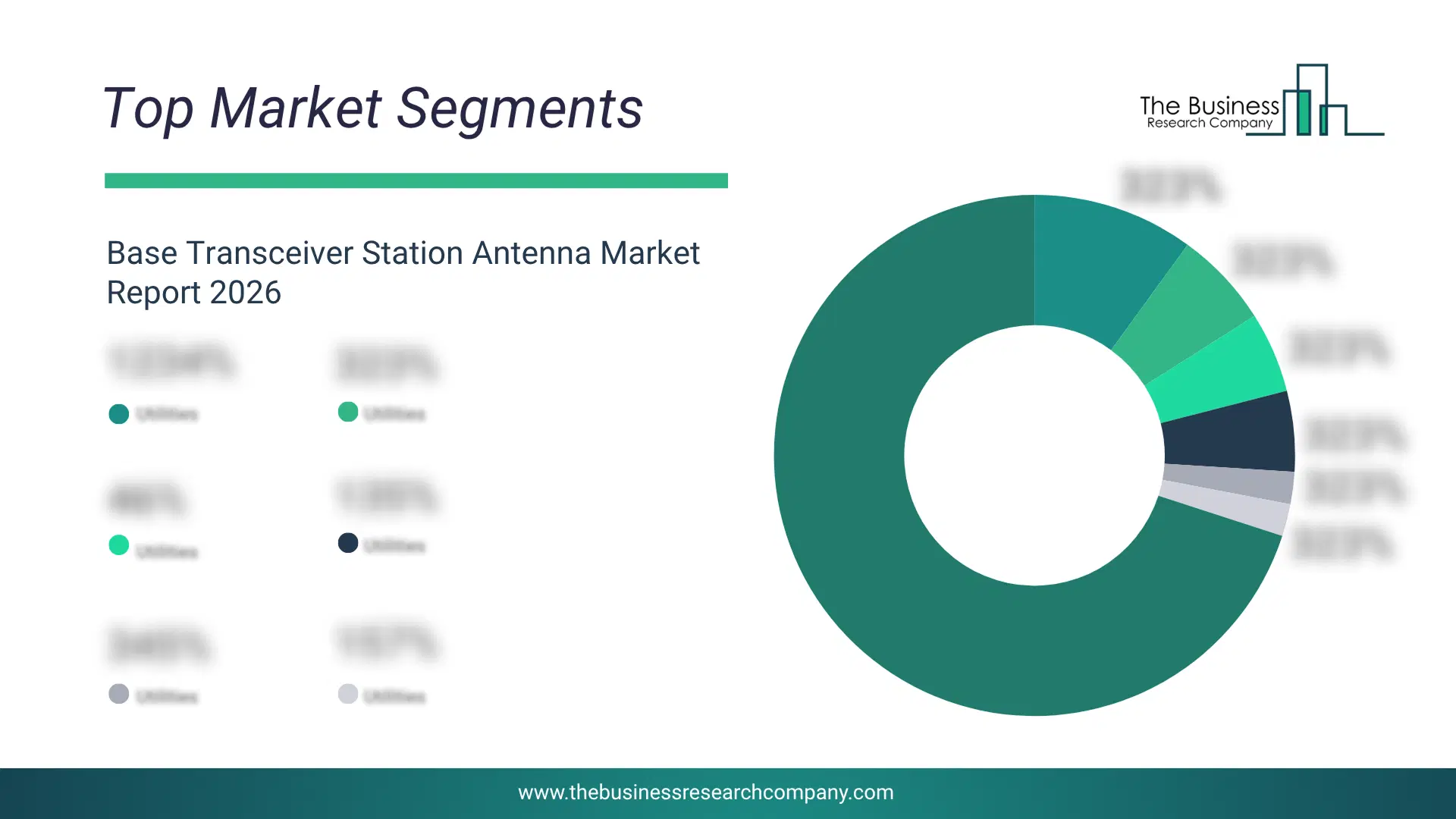
1) By Type: Single-Band, Multi-Band 2) By Vendor Type: Original Equipment Manufacturers, Engineering, Procurement And Construction 3) By Equipment: Omnidirectional Antennas, Directional (Or Sector) Antennas 4) By Application: Urban Areas, Rural Areas, Other Applications 5) By Industry Verticals: Telecom, Defense, Broadcasting Subsegments: 1) By Single-Band: Low Band, High Band 2) By Multi-Band: Dual-Band, Tri-Band, Quad-Band, WidebandWhat Is The Driver Of The Base Transceiver Station Antenna Market?
The increasing demand for mobile data services is expected to propel the growth of the base transceiver station antenna market. Mobile data services refer to wireless connectivity for accessing and transmitting data over cellular networks using mobile devices such as smartphones, tablets, and other portable gadgets. The demand for mobile data services is increasing due to the growing adoption of smartphones and connected devices and the rising popularity of data-intensive applications and services to cater to the evolving needs of consumers for seamless connectivity. Base transceiver station antennas contribute to mobile data services by enhancing network coverage, improving signal strength, enabling reliable data transmission, meeting the growing connectivity needs of users, and supporting the seamless delivery of mobile data services. For instance, in June 2023, according to 5G Americas, a US-based wireless industry trade association, global 5G connections reached 1.2 billion in the first half of 2023 and 1.9 billion by the end of 2023. Further, the projected increase is to 6.8 billion by the end of 2027. Therefore, the increasing demand for mobile data services is driving the growth of the base transceiver station antenna industry.Key Players In The Global Base Transceiver Station Antenna Market
Major companies operating in the base transceiver station antenna market are Huawei Technologies Co Ltd; Cisco Systems Inc; Fujitsu Ltd; Telefonaktiebolaget LM Ericsson; ZTE Corporation; China Tower Corporation Limited; Amphenol Corporation; CommScope Holding Company Inc; Kathrein SE; Comba Telecom Systems Holdings Ltd; ProSoft Technology Group Inc; Alpha Wireless Ltd; Panorama Antennas Ltd; Filtronic plc; JMA Wireless; Carlson Wireless Technologies Inc; Juniper Networks Inc; ADTRAN Inc; Ceragon Networks Ltd; CalAmp Corp; Tongyu Communication Inc; Guangdong Shenglu Telecommunication Tech Co Ltd; Mobi Antenna Technologies (Shenzhen) Co Ltd; Ace Technologies Corporation; Kenbotong Technology Co Ltd; Laird Connectivity Inc
This chart is for illustrative purposes; the full report includes a detailed competitor analysis and comprehensive overview of the top 10 companies in the market.
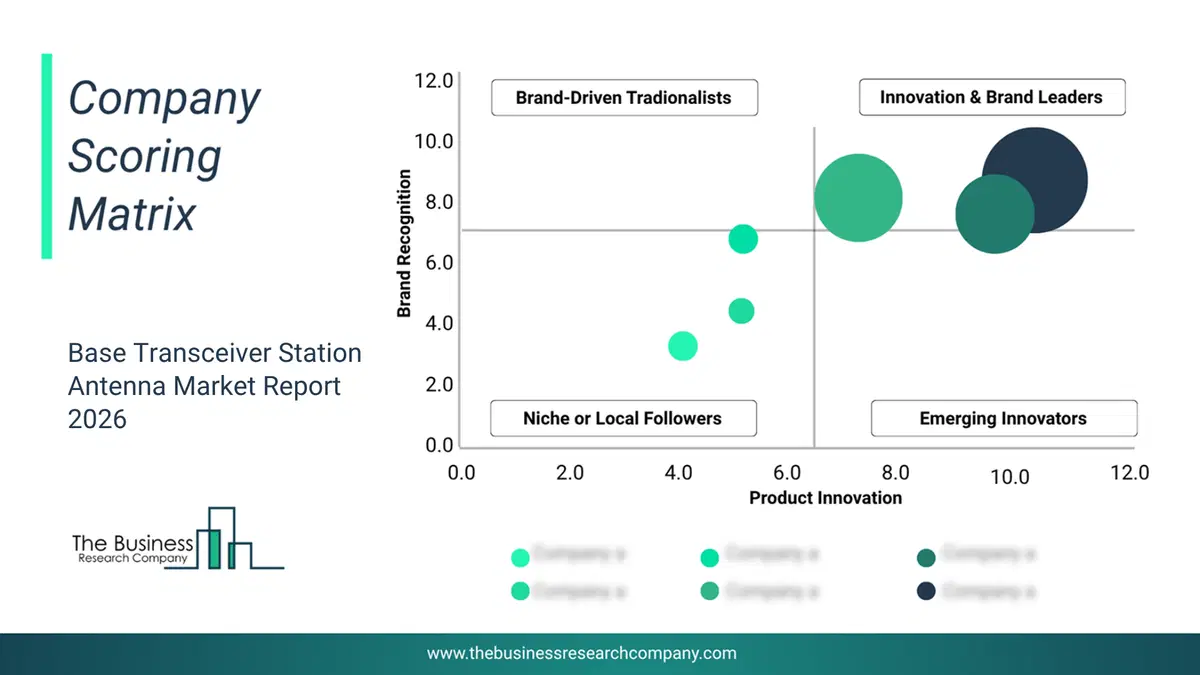
This chart maps companies by product innovation and brand strength, with bubble size indicating relative revenue, helping identify market leaders, challengers, and niche players. This is an illustrative chart; the full report provides a complete and accurate competitive analysis.
Global Base Transceiver Station Antenna Market Trends and Insights
Major companies operating in the base transceiver station antenna market are focusing on innovative solutions, such as low-carbon green antenna, to reduce environmental impact and enhance energy efficiency. A low-carbon green antenna refers to an eco-friendly antenna design that minimizes carbon emissions and energy consumption, promoting sustainable telecommunications. For instance, in February 2023, according to a report published by Comba Telecom, a Hong Kong-based company that offers wireless communication solutions and information applications, launched green base station antenna product series, powered by the innovative Helifeed Platform, which enhances antenna energy efficiency and optimizes energy consumption. This new series incorporates green design concepts throughout its lifecycle to support operators in achieving carbon neutrality goals worldwide.What Are Latest Mergers And Acquisitions In The Base Transceiver Station Antenna Market?
In February 2024, the Spinner Group, a Germany-based company that develops radio frequency (RF) technology products, acquired Radio Frequency Systems (RFS) Broadcast Internet Protocol (IP) for an undisclosed amount. This acquisition expanded Spinner's portfolio, enhancing its service offerings, increasing market competitiveness, fostering innovation, and ensuring customer satisfaction in the base transceiver station antenna market. Radio Frequency Systems (RFS) is a German-based company that designs and manufactures wireless infrastructure components such as coaxial cables, state-of-the-art base station antenna solutions, towers, and radio frequency (RF) filters.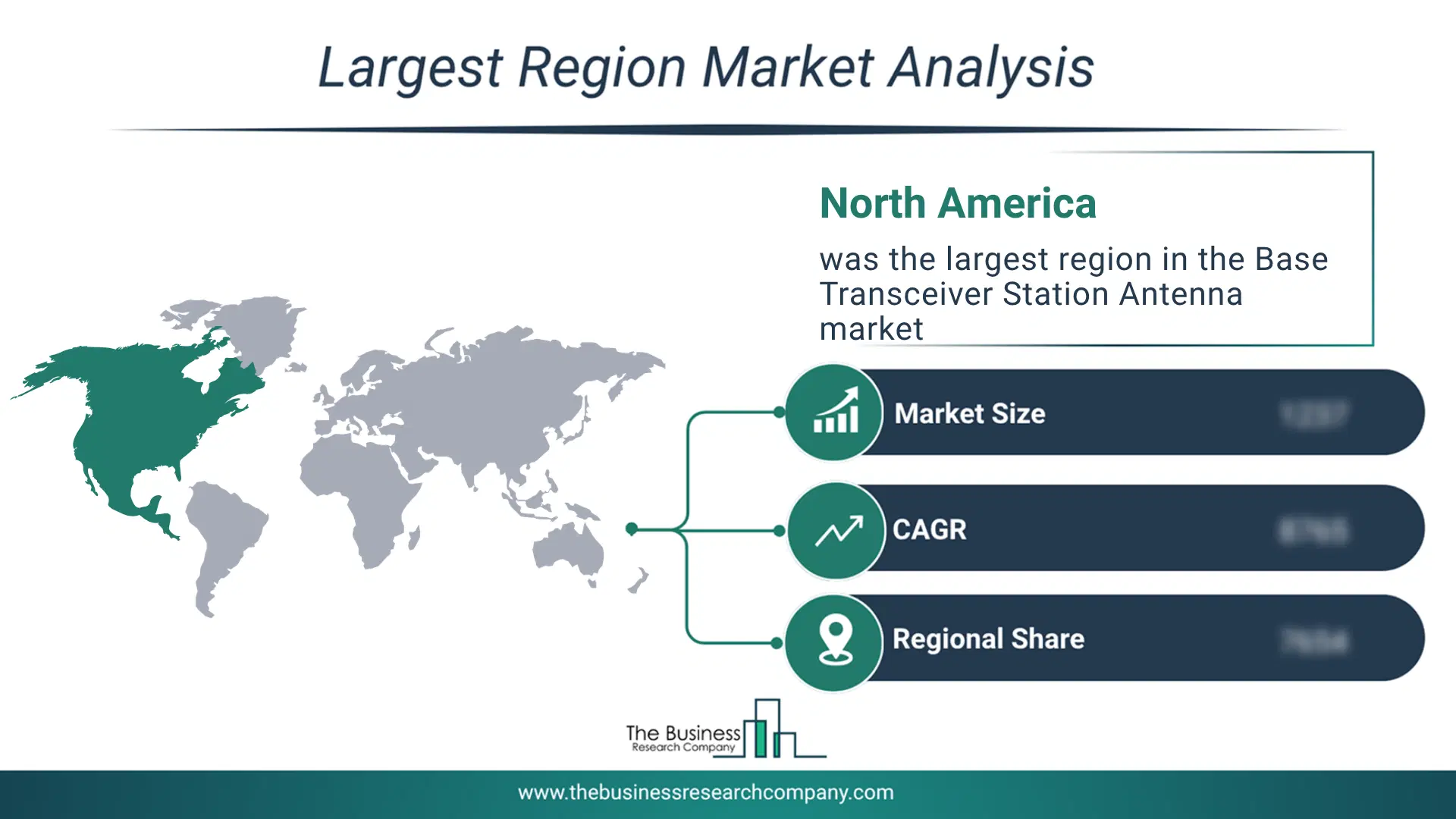
Regional Insights
North America was the largest region in the base transceiver station antenna market in 2025. The regions covered in this market report are Asia-Pacific, South East Asia, Western Europe, Eastern Europe, North America, South America, Middle East, Africa. The countries covered in this market report are Australia, Brazil, China, France, Germany, India, Indonesia, Japan, Taiwan, Russia, South Korea, UK, USA, Canada, Italy, SpainWhat Defines the Base Transceiver Station Antenna Market?
The base transceiver station antenna market consists of sales consisting of collinear, dipole, panel, ground plane, and corner reflectors. Values in this market are ‘factory gate’ values, that is the value of goods sold by the manufacturers or creators of the goods, whether to other entities (including downstream manufacturers, wholesalers, distributors, and retailers) or directly to end customers. The value of goods in this market includes related services sold by the creators of the goods.How is Market Value Defined and Measured?
The market value is defined as the revenues that enterprises gain from the sale of goods and/or services within the specified market and geography through sales, grants, or donations in terms of the currency (in USD unless otherwise specified). The revenues for a specified geography are consumption values that are revenues generated by organizations in the specified geography within the market, irrespective of where they are produced. It does not include revenues from resales along the supply chain, either further along the supply chain or as part of other products.
This chart presents market attractiveness based on a quantitative evaluation of growth, competition, strategic alignment, and risk, offering a clear view of opportunity areas for decision-making. This chart is for illustrative purposes; the full report contains the complete analysis.

This chart highlights the Total Addressable Market (TAM) by estimating the maximum revenue opportunity using an assumption-driven approach, supporting strategic planning and opportunity sizing across markets. The chart is illustrative; the full report provides a more comprehensive analysis.
What Key Data and Analysis Are Included in the Base Transceiver Station Antenna Market Report 2026?
The base transceiver station antenna market research report is one of a series of new reports from The Business Research Company that provides market statistics, including industry global market size, regional shares, competitors with the market share, detailed market segments, market trends and opportunities, and any further data you may need to thrive in the base transceiver station antenna industry. The market research report delivers a complete perspective of everything you need, with an in-depth analysis of the current and future state of the industry.Base Transceiver Station Antenna Market Report Forecast Analysis
| Report Attribute | Details |
|---|---|
| Market Size Value In 2026 | $9.74 billion |
| Revenue Forecast In 2030 | $13.96 billion |
| Growth Rate | CAGR of 9.4% from 2026 to 2030 |
| Base Year For Estimation | 2025 |
| Actual Estimates/Historical Data | 2020-2025 |
| Forecast Period | 2026 - 2030 |
| Market Representation | Revenue in USD Billion and CAGR from 2026 to 2030 |
| Segments Covered | Type, Vendor Type, Equipment, Application, Industry Verticals |
| Regional Scope | Asia-Pacific, Western Europe, Eastern Europe, North America, South America, Middle East, Africa |
| Country Scope | The Countries Covered In This Market Report Are Australia, Brazil, China, France, Germany, India, Indonesia, Japan, Taiwan, Russia, South Korea, Uk, Usa, Canada, Italy, Spain. |
| Key Companies Profiled | Huawei Technologies Co Ltd, Cisco Systems Inc, Fujitsu Ltd, Telefonaktiebolaget LM Ericsson, ZTE Corporation, China Tower Corporation Limited, Amphenol Corporation, CommScope Holding Company Inc, Kathrein SE, Comba Telecom Systems Holdings Ltd, ProSoft Technology Group Inc, Alpha Wireless Ltd, Panorama Antennas Ltd, Filtronic plc, JMA Wireless, Carlson Wireless Technologies Inc, Juniper Networks Inc, ADTRAN Inc, Ceragon Networks Ltd, CalAmp Corp, Tongyu Communication Inc, Guangdong Shenglu Telecommunication Tech Co Ltd, Mobi Antenna Technologies (Shenzhen) Co Ltd, Ace Technologies Corporation, Kenbotong Technology Co Ltd, Laird Connectivity Inc |
| Customization Scope | Request for Customization |
| Pricing And Purchase Options | Explore Purchase Options |