
Battery As A Service Market Report 2026
Global Outlook – By Battery Ownership Models ( Battery Purchase, Battery Lease, Battery Subscription), By Energy Storage Capacity ( Less than 50 kWh, 50-100 kWh, Over 100 kWh), By Vehicle Type ( Two-Wheelers, Three-Wheelers, Passenger Cars, Commercial Vehicles), By Usage ( Private, Commercial), By Application ( Electric Vehicles, Stationary Energy Storage) – Market Size, Trends, Strategies, and Forecast to 2030
Battery As A Service Market Overview
• Battery As A Service market size has reached to $2.64 billion in 2025 • Expected to grow to $4.95 billion in 2030 at a compound annual growth rate (CAGR) of 13.4% • Growth Driver: Rising Adoption Of Electric Vehicles Driving the Growth Of Innovative Battery Solutions Of Innovative Battery Solutions And Advanced Charging Technologies • Market Trend: Leveraging SMART Technology For Enhanced Battery Management And Efficiency • Asia-Pacific was the largest region in 2025 and North America is the fastest growing region.What Is Covered Under Battery As A Service Market?
Battery-as-a-service (BaaS) refers to an electric vehicle (EV) ownership model that allows users to exchange a depleted battery for a fully charged one at a battery swapping station. It is utilized by enabling EV users to swap their depleted batteries for fully charged ones at designated stations, providing a convenient alternative to traditional charging. The main battery ownership models are battery as a service are battery purchase, battery lease, and battery subscription. Battery purchase refers to the act of acquiring a battery for use in various applications, such as powering electric vehicles (EVs), consumer electronics, renewable energy storage systems, or industrial equipment. The various energy storage capacities include less than 50 kWh, 50-100 kWh, and over 100 kWh, and the vehicles used in various types include two-wheelers, three-wheelers, passenger cars, and commercial vehicles. The various usages are private and commercial and are used by several applications such as electric vehicles, stationary energy storage, and portable electronics.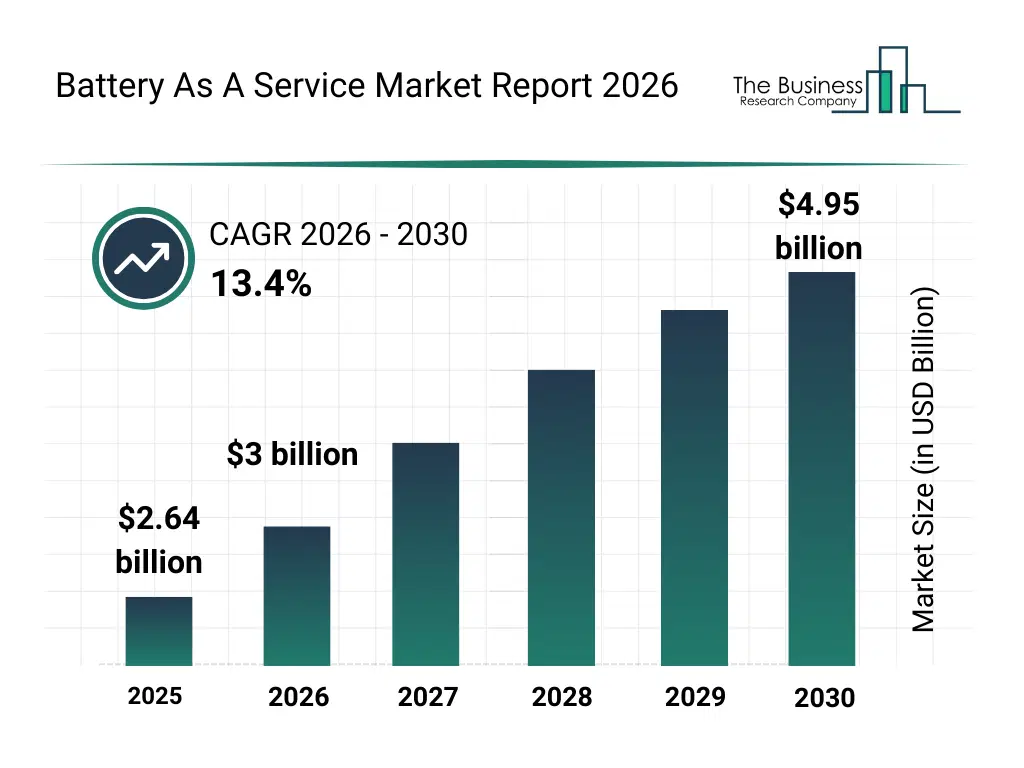
What Is The Battery As A Service Market Size 2026 And Growth Rate?
The battery as a service market size has grown rapidly in recent years. It will grow from $2.64 billion in 2025 to $3 billion in 2026 at a compound annual growth rate (CAGR) of 13.4%. The growth in the historic period can be attributed to rising adoption of electric vehicles, government incentives for evs, limited charging infrastructure, high battery costs, growing environmental awareness.What Is The Battery As A Service Market Growth Forecast?
The battery as a service market size is expected to see rapid growth in the next few years. It will grow to $4.95 billion in 2030 at a compound annual growth rate (CAGR) of 13.4%. The growth in the forecast period can be attributed to expansion of battery swapping stations, advancements in battery technology, increased ev production, strategic partnerships between manufacturers, integration with renewable energy sources. Major trends in the forecast period include swappable battery infrastructure, fast charging network expansion, battery lifecycle management, mobile battery swapping solutions, smart energy management.
Global Battery As A Service Market Segmentation
1) By Battery Ownership Models: Battery Purchase, Battery Lease, Battery Subscription 2) By Energy Storage Capacity: Less than 50 kWh, 50-100 kWh, Over 100 kWh 3) By Vehicle Type: Two-Wheelers, Three-Wheelers, Passenger Cars, Commercial Vehicles 4) By Usage: Private, Commercial 5) By Application: Electric Vehicles, Stationary Energy Storage Subsegments: 1) By Battery Purchase: One-Time Purchase, Bulk Purchase Agreements, Manufacturer-Direct Purchase 2) By Battery Lease: Short-Term Lease, Long-Term Lease, Pay-Per-Use Lease 3) By Battery Subscription: Monthly Subscription, Annual Subscription, Usage-Based SubscriptionWhat Is The Driver Of The Battery As A Service Market?
The increasing prevalence of electric vehicles is expected to propel the growth of the battery-as-a-service market going forward. Electric vehicles (EVs) are vehicles that are powered by electricity stored in batteries, using electric motors for propulsion instead of internal combustion engines. The increasing prevalence of electric vehicles is driven by growing environmental concerns, advancements in battery technology, government incentives, and a shift towards sustainable energy sources. Battery as a Service (BaaS) is useful for electric vehicles as it offers a flexible and cost-effective solution by allowing users to lease batteries rather than purchase them. For instance, in 2024, according to the International Energy Agency (IEA), a France-based autonomous intergovernmental organization, sales of electric cars in 2023 were 3.5 million higher than in 2022, a 35% year-on-year increase. Therefore, the increasing prevalence of electric vehicles is driving growth in the battery-as-a-service market.Key Players In The Global Battery As A Service Market
Major companies operating in the battery as a service market are Ample Inc., Nissan Motor Co. Ltd., Porsche AG, Rivian Automotive Inc., MG Motor India Pvt. Ltd., Gogoro Inc., BYD Company Limited, Autel Robotics USA LLC, Shenzhen ZTT Electric Co. Ltd., Ola Electric Mobility Private Limited, SUN Mobility Pvt. Ltd., Mobius Motors Limited, Energica Motor Company, RENU Energy Limited, Bluebird International, Nuvve Corporation, GreenMo Technologies Pvt. Ltd., Battery Swapping Technologies Pvt Ltd.
This chart is for illustrative purposes; the full report includes a detailed competitor analysis and comprehensive overview of the top 10 companies in the market.
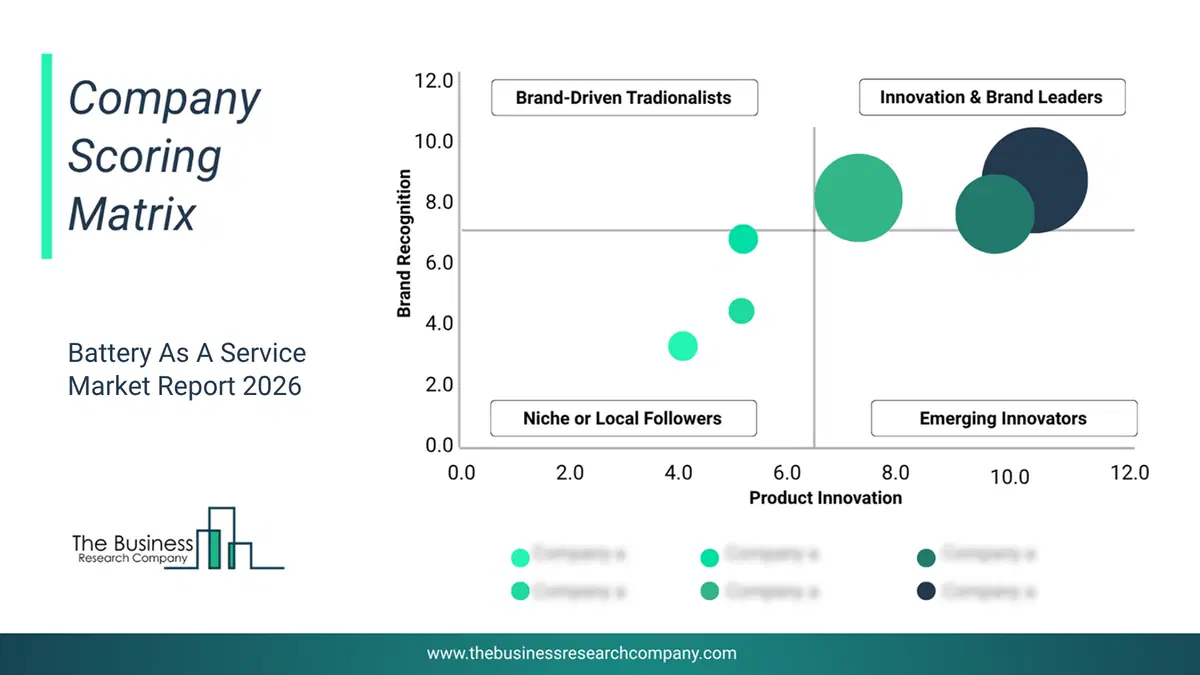
This chart maps companies by product innovation and brand strength, with bubble size indicating relative revenue, helping identify market leaders, challengers, and niche players. This is an illustrative chart; the full report provides a complete and accurate competitive analysis.
Global Battery As A Service Market Trends and Insights
Major companies operating in the battery-as-a-service market are focusing on developing innovative platforms, such as SMART technology, to enhance battery management, improve energy efficiency, and enable real-time monitoring, ultimately optimizing performance, reducing costs, and extending the lifecycle of battery systems for various industries, including electric vehicles and renewable energy sectors. SMART technology refers to an advanced battery management solution that integrates smart sensors, real-time data analytics, and IoT connectivity to optimize the performance and safety of battery systems. For instance, in October 2024, Tecso ChargeZone (P) Ltd., an India-based EV charging company, launched the new Battery Passport System. This system is designed to complement the growing Battery-as-a-Service (BaaS) model, providing EV owners with a comprehensive digital record of their battery’s lifecycle. The Battery Passport System tracks critical parameters such as battery health, charging cycles, and overall performance, ensuring transparency and optimizing battery management.What Are Latest Mergers And Acquisitions In The Battery As A Service Market?
In December 2023, Stellantis N.V., a US-based automotive manufacturing company, partnered with Ample Technologies Private Limited. With this partnership, Stellantis aims to enhance its electric vehicle (EV) offerings by integrating Ample Technologies' battery-swapping solutions into its EV ecosystem. This collaboration seeks to revolutionize EV battery swapping by providing a faster, more efficient alternative to traditional charging methods, significantly reducing charging times for Stellantis EVs. Ample Technologies Private Limited is a US-based company specializing in modular battery swapping technology, contributing to the electric vehicle market by developing efficient battery swapping infrastructure for faster, more sustainable EV adoption.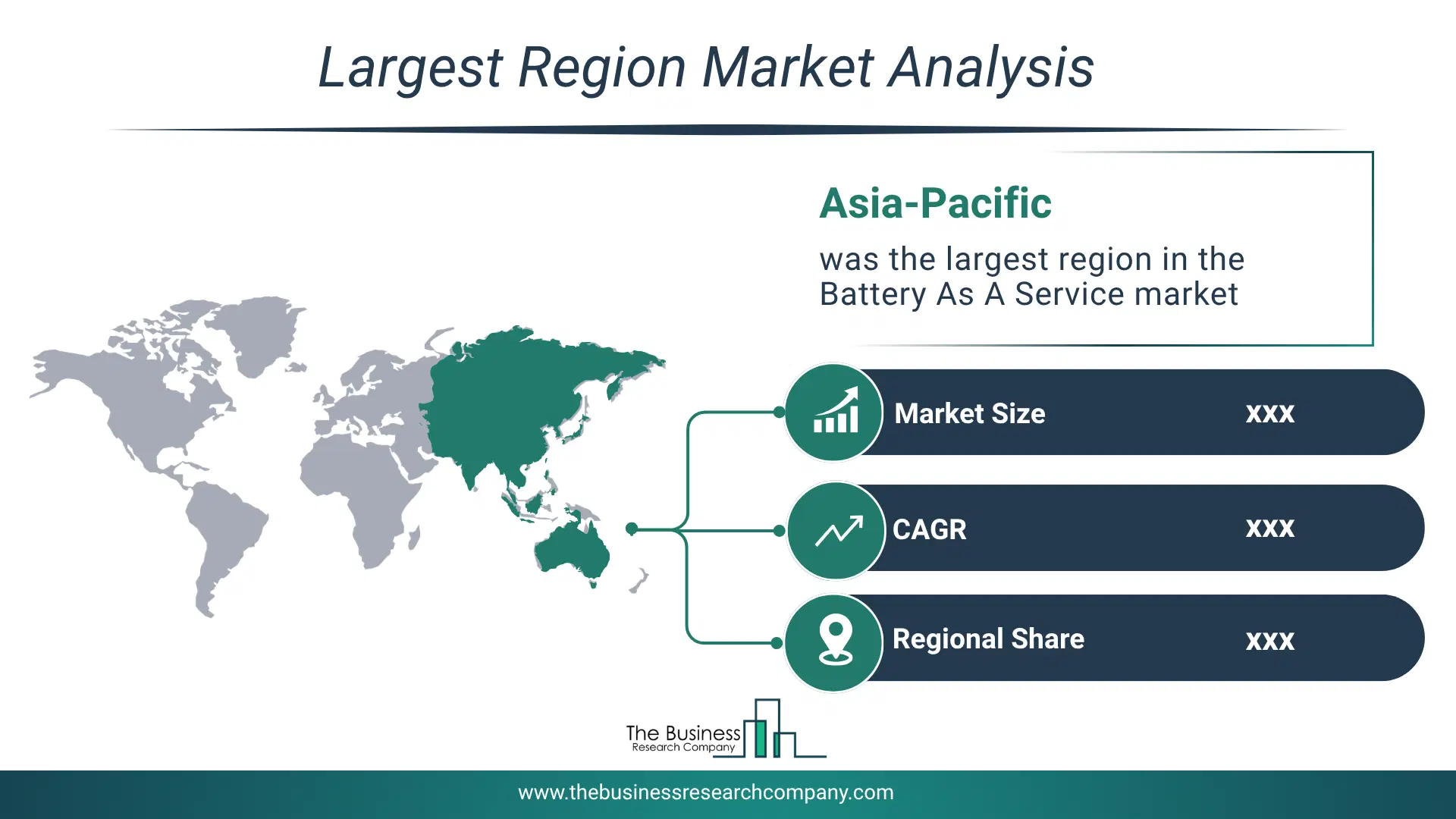
Regional Outlook
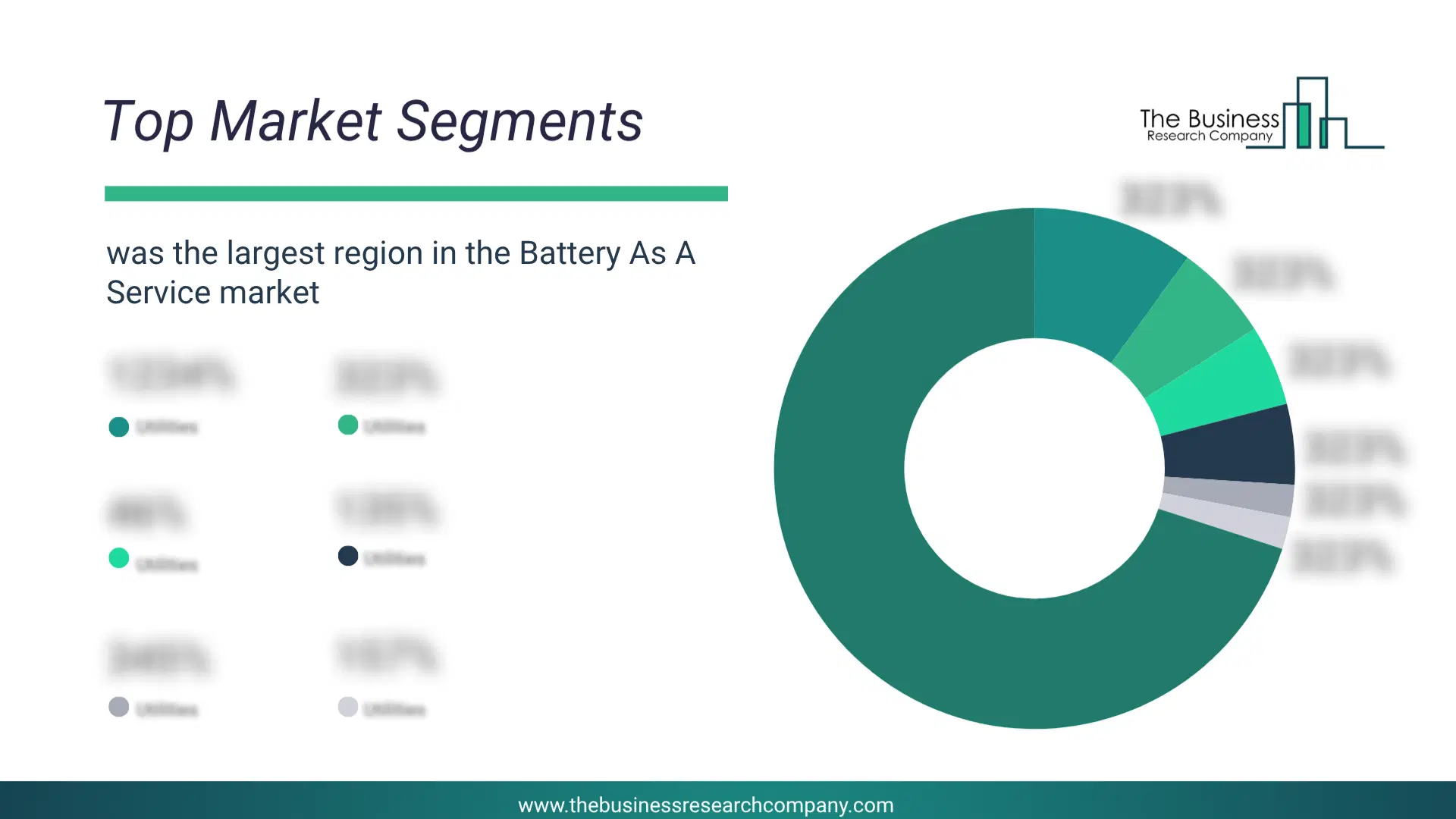
Asia-Pacific was the largest region in the battery as a service market in 2025. North America is expected to be the fastest-growing region in the forecast period. The regions covered in this market report are Asia-Pacific, South East Asia, Western Europe, Eastern Europe, North America, South America, Middle East, Africa. The countries covered in this market report are Australia, Brazil, China, France, Germany, India, Indonesia, Japan, Taiwan, Russia, South Korea, UK, USA, Canada, Italy, Spain.What Defines the Battery As A Service Market?
The battery-as-a-service market consists of revenues earned by entities providing services such as voice services and tracking and monitoring services. The market value includes the value of related goods sold by the service provider or included within the service offering. The battery-as-a-service (BaaS) market also includes sales of battery swapping stations, modular battery packs, and battery recycling equipment. Values in this market are ‘factory gate’ values, that is, the value of goods sold by the manufacturers or creators of the goods, whether to other entities (including downstream manufacturers, wholesalers, distributors, and retailers) or directly to end customers. The value of goods in this market includes related services sold by the creators of the goods.How is Market Value Defined and Measured?
The market value is defined as the revenues that enterprises gain from the sale of goods and/or services within the specified market and geography through sales, grants, or donations in terms of the currency (in USD unless otherwise specified). The revenues for a specified geography are consumption values that are revenues generated by organizations in the specified geography within the market, irrespective of where they are produced. It does not include revenues from resales along the supply chain, either further along the supply chain or as part of other products.
This chart presents market attractiveness based on a quantitative evaluation of growth, competition, strategic alignment, and risk, offering a clear view of opportunity areas for decision-making. This chart is for illustrative purposes; the full report contains the complete analysis.

This chart highlights the Total Addressable Market (TAM) by estimating the maximum revenue opportunity using an assumption-driven approach, supporting strategic planning and opportunity sizing across markets. The chart is illustrative; the full report provides a more comprehensive analysis.
What Key Data and Analysis Are Included in the Battery As A Service Market Report 2026?
The battery as a service market research report is one of a series of new reports from The Business Research Company that provides market statistics, including industry global market size, regional shares, competitors with the market share, detailed market segments, market trends and opportunities, and any further data you may need to thrive in the battery as a service industry. The market research report delivers a complete perspective of everything you need, with an in-depth analysis of the current and future state of the industry.Battery As A Service Market Report Forecast Analysis
| Report Attribute | Details |
|---|---|
| Market Size Value In 2026 | $3 billion |
| Revenue Forecast In 2030 | $4.95 billion |
| Growth Rate | CAGR of 13.4% from 2026 to 2030 |
| Base Year For Estimation | 2025 |
| Actual Estimates/Historical Data | 2020-2025 |
| Forecast Period | 2026 - 2030 |
| Market Representation | Revenue in USD Billion and CAGR from 2026 to 2030 |
| Segments Covered | Battery Ownership Models, Energy Storage Capacity, Vehicle Type, Usage, Application |
| Regional Scope | Asia-Pacific, Western Europe, Eastern Europe, North America, South America, Middle East, Africa |
| Country Scope | The countries covered in the report are Australia, Brazil, China, France, Germany, India, Indonesia, Japan, Taiwan, Russia, South Korea, UK, USA, Canada, Italy, Spain. |
| Key Companies Profiled | Ample Inc., Nissan Motor Co. Ltd., Porsche AG, Rivian Automotive Inc., MG Motor India Pvt. Ltd., Gogoro Inc., BYD Company Limited, Autel Robotics USA LLC, Shenzhen ZTT Electric Co. Ltd., Ola Electric Mobility Private Limited, SUN Mobility Pvt. Ltd., Mobius Motors Limited, Energica Motor Company, RENU Energy Limited, Bluebird International, Nuvve Corporation, GreenMo Technologies Pvt. Ltd., Battery Swapping Technologies Pvt Ltd. |
| Customization Scope | Request for Customization |
| Pricing And Purchase Options | Explore Purchase Options |