
Battery Production Machine Market Report 2026
Global Outlook – By Machine Type (Mixing Machine, Coating And Drying Machine, Calendaring Machines, Slitting Machines, Electrode Stacking Machines, Assembling And Handling Machines, Formation And Testing Machines), By Battery Type (Li-Ion, Nickel Cadmium, Nickel Metal Hydride, Others Types), By Sales Channel (OEM, After Market), By End-Use Industry (Consumer Electronics, Automotive, Power Industry, Others End Users) – Market Size, Trends, Strategies, and Forecast to 2030
Battery Production Machine Market Overview
• Battery Production Machine market size has reached to $10.8 billion in 2025 • Expected to grow to $27.82 billion in 2030 at a compound annual growth rate (CAGR) of 20.7% • Growth Driver: Electric Vehicle Boom Drives Battery Production Machine Market • Market Trend: Innovations In Machine Vision Technology Enhance Quality Control In Battery Cell Manufacturing • Asia-Pacific was the largest region in 2025.What Is Covered Under Battery Production Machine Market?
Battery production machines refer to battery assembly machines that are used to manufacture electrical batteries and battery packs. These machines are essential in automating and optimizing the production of battery cells, modules, and packs. The main types of battery production machines are mixing machines, coating and drying machines, calendaring machines, slitting machines, electrode stacking machines, assembling and handling machines, and formation and testing machines. A mixing machine refers to an industrial mixer designed for bulk processing to mix or blend heterogeneous materials to form a homogeneous end product and it is used in battery manufacturing facilities for efficient and accurate batching of pastes, gels, and powders. Major batteries produced are li-ion, nickel cadmium, nickel metal hydride, and others that are sold via distribution channels OEM and aftermarket and used in consumer electronics, automotive, power industry, and others.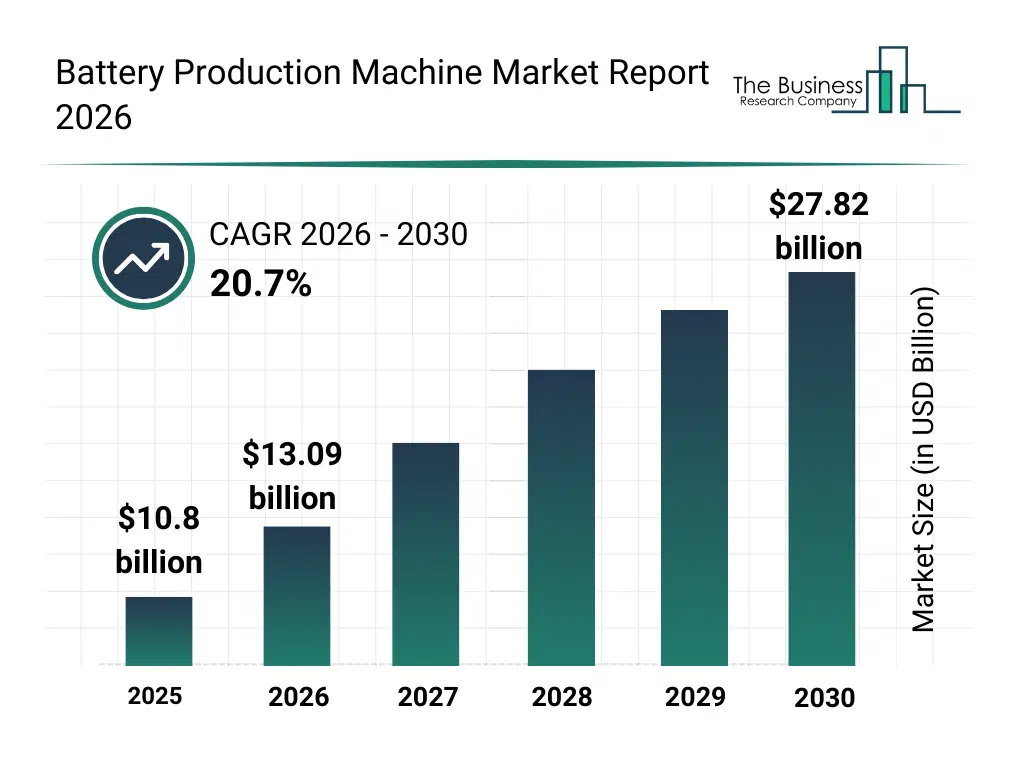
What Is The Battery Production Machine Market Size and Share 2026?
The battery production machine market size has grown exponentially in recent years. It will grow from $10.8 billion in 2025 to $13.09 billion in 2026 at a compound annual growth rate (CAGR) of 21.2%. The growth in the historic period can be attributed to expansion of consumer electronics battery demand, growth of lithium-ion battery adoption, increasing investments in automated manufacturing, scaling of electric vehicle battery production, improvements in battery assembly precision.What Is The Battery Production Machine Market Growth Forecast?
The battery production machine market size is expected to see exponential growth in the next few years. It will grow to $27.82 billion in 2030 at a compound annual growth rate (CAGR) of 20.7%. The growth in the forecast period can be attributed to rising global electric vehicle production, increasing investments in gigafactories, expansion of energy storage systems, growing demand for high-capacity batteries, increasing focus on manufacturing efficiency. Major trends in the forecast period include increasing automation of battery cell manufacturing lines, rising adoption of high-speed electrode processing equipment, growing integration of inline quality inspection systems, expansion of modular battery production lines, enhanced focus on yield optimization.Tariff Impact On Battery Production Machine Market
Tariffs are impacting the battery production machine market by increasing costs of imported precision machinery, robotics, sensors, control systems, and specialty components used in battery manufacturing lines. Automotive and energy storage sectors in North America and Europe are most affected due to reliance on advanced imported equipment, while Asia-Pacific faces export cost pressures for large-scale production machines. These tariffs are increasing capital expenditure and delaying factory expansion plans. However, they are also encouraging local equipment manufacturing, regional technology partnerships, and innovation in cost-optimized battery production systems.
Global Battery Production Machine Market Segmentation
1) By Machine Type: Mixing Machine, Coating And Drying Machine, Calendaring Machines, Slitting Machines, Electrode Stacking Machines, Assembling And Handling Machines, Formation And Testing Machines 2) By Battery Type: Li-Ion, Nickel Cadmium, Nickel Metal Hydride, Others Types 3) By Sales Channel: OEM, After Market 4) By End-Use Industry: Consumer Electronics, Automotive, Power Industry, Others End Users Subsegments: 1) By Mixing Machine: Batch Mixing Machines, Continuous Mixing Machines 2) By Coating And Drying Machine: Roller Coating Machines, Slot Die Coating Machines, Drying Ovens 3) By Calendaring Machines: Single-Stage Calendaring Machines, Multi-Stage Calendaring Machines 4) By Slitting Machines: Rotary Slitting Machines, Shear Slitting Machines 5) By Electrode Stacking Machines: Manual Stacking Machines, Automated Stacking Systems 6) By Assembling And Handling Machines: Module Assembly Machines, Handling And Transport Systems 7) By Formation And Testing Machines: Formation Charging Machines, Testing And Inspection EquipmentWhat Is The Driver Of The Battery Production Machine Market?
The growing demand for electric vehicles is expected to propel the growth of the battery production machine market going forward. An electric vehicle refers to a vehicle that can be powered by an electric motor that draws electricity from a battery and is capable of being charged from an external source. Battery production machines are used in the production of various types of batteries, such as lithium-ion batteries, hybrid nickel-metal batteries, and lead-acid batteries that are commonly used in electric vehicles due to their unique parameters, such as high power-to-weight ratio, low self-discharge energy levels, high volume energy density, and mass-energy density, to provide a sustainable power solution to drive. For instance, in November 2023, according to the U.S. Energy Information Administration, a US-based government agency, the share of battery-electric vehicles (BEVs) in new light-duty vehicle sales reached 17.7% in the third quarter of 2023, with BEVs accounting for 16.0% of total new vehicle sales so far this year, up from 12.5% in 2022. Therefore, the growing demand for electric vehicles is driving the growth of the battery production machine industry.Key Players In The Global Battery Production Machine Market
Major companies operating in the battery production machine market are Hitachi Ltd., Foshan Golden Milky Way Intelligent Equipment Co. Ltd., Wuxi Lead Intelligent Equipment Co. Ltd., Schuler AG, Bühler Group, Guangdong Lyric Robot Automation Co. Ltd., Manz AG, Nordson Corporation, Bry-Air (Asia) Private Limited, Charles Ross & Son Company, CKD Corporation, Kampf LSF GmbH & Co. KG, Mondragon Assembly S.A., Nagano Automation Co. Ltd., Semco Infratech Private Limited, Rosendahl Nextrom GmbH, HIRANO TECSEED Co. Ltd., Shenzhen Yinghe Technology Co. Ltd., Ningde Katop Automation Equipment Co. Ltd., Sony Energy Devices Corporation, BYD Co. Ltd., Panasonic Corporation, LG Chem Ltd., Johnson Controls International plc, Toshiba Corporation, Contemporary Amperex Technology Co. Ltd., Samsung SDI Co. Ltd., GS Yuasa Corporation, Daiichi Jitsugyo Co. Ltd., Xiamen Lith Machine Limited, IPG Photonics Corporation, Mitsubishi Chemical Corporation, Sumitomo Chemical Company Limited, Teijin Limited, Toray Industries Inc., Asahi Kasei Corporation, Arkema SA, Ensinger GmbH, Quadrant AG
This chart is for illustrative purposes; the full report includes a detailed competitor analysis and comprehensive overview of the top 10 companies in the market.
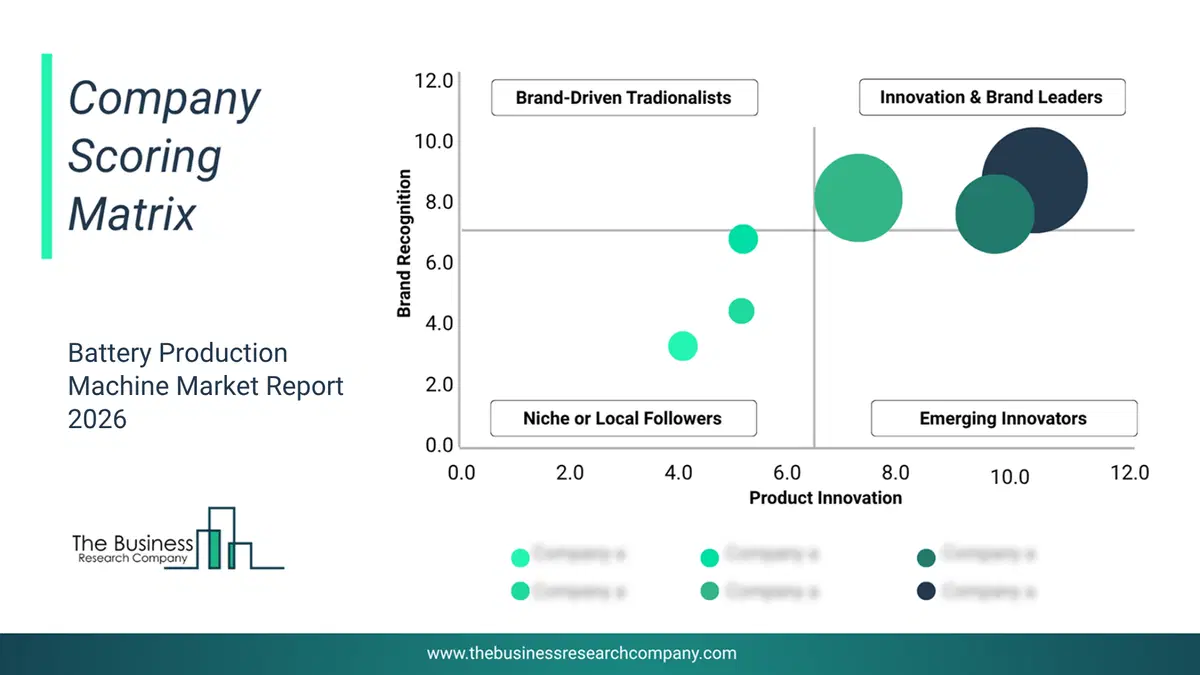
This chart maps companies by product innovation and brand strength, with bubble size indicating relative revenue, helping identify market leaders, challengers, and niche players. This is an illustrative chart; the full report provides a complete and accurate competitive analysis.
Global Battery Production Machine Market Trends and Insights
Major companies operating in the battery production machine market are focusing on developing advanced inspection and quality-control solutions to help manufacturers detect defects earlier, improve production efficiency, and maintain high standards of cell quality. Machine-vision–based inspection systems enable real-time monitoring of battery materials and components, ensuring precise detection of defects throughout the production process. For instance, in February 2024, ISRA VISION AG, a Germany-based provider of industrial machine-vision technologies, received an “Outstanding Supplier” award for its inspection systems used in battery-component manufacturing. These systems deliver 100% inline quality control for coated films and other critical battery materials, allowing manufacturers to identify issues such as dents, pinholes, and coating irregularities at high production speeds. By enabling early fault detection and consistent material quality, these innovations significantly enhance production reliability and operational efficiency in modern battery-cell manufacturing environments.What Are Latest Mergers And Acquisitions In The Battery Production Machine Market?
In February 2023, Hanwha Group, a South Korea-based company, partnered with LG Energy Solution Ltd for an undisclosed amount. With this partnership, Hanwha aims to expand its portfolio by incorporating LG Energy's expertise in providing building energy storage system (ESS) battery production facilities. LG Energy Solution Ltd is a South Korea-based company that offers mixing machines.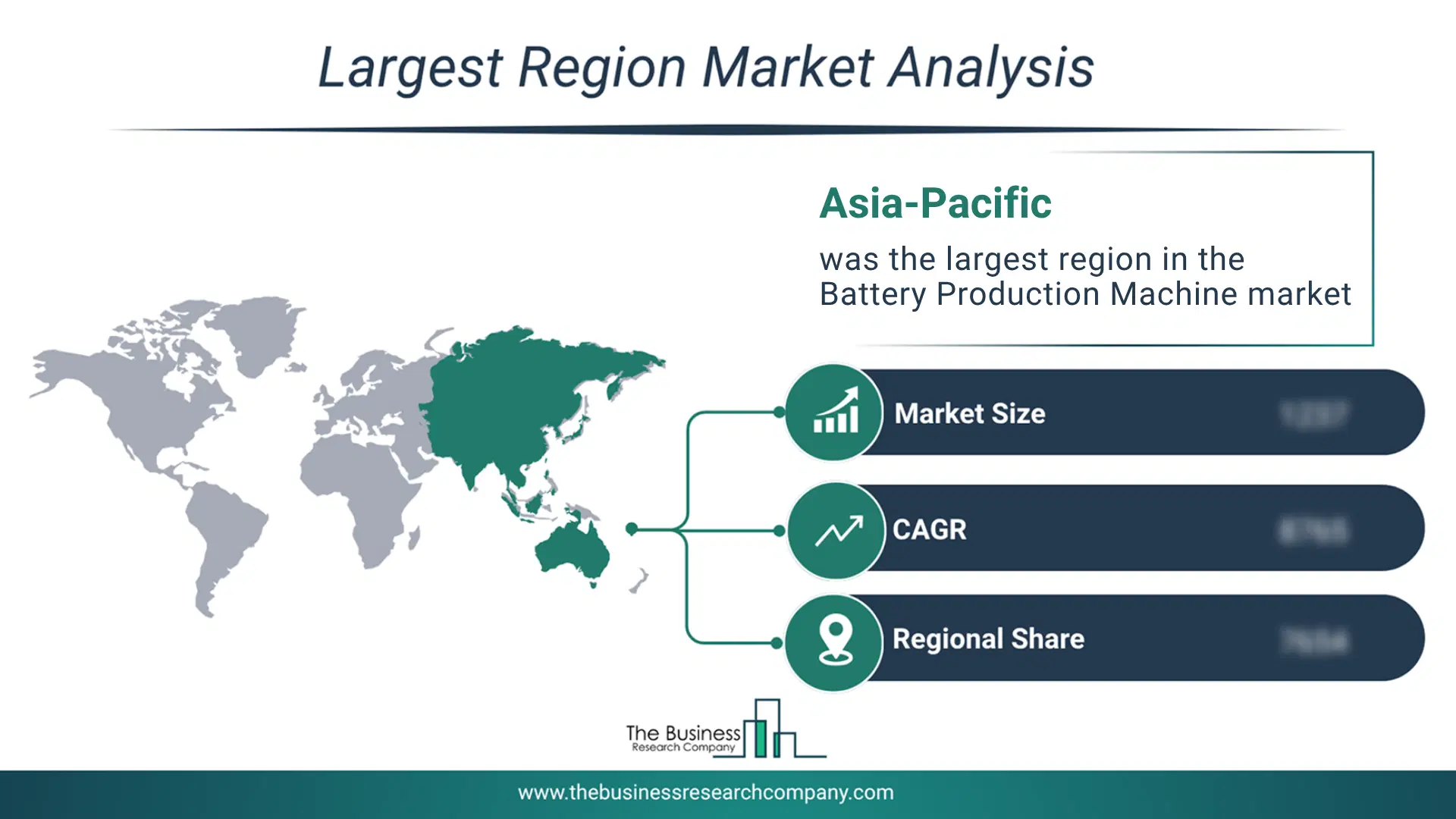
Regional Outlook
Asia-Pacific was the largest region in the battery production machine market in 2025. The regions covered in this market report are Asia-Pacific, South East Asia, Western Europe, Eastern Europe, North America, South America, Middle East, Africa The countries covered in this market report are Australia, Brazil, China, France, Germany, India, Indonesia, Japan, Taiwan, Russia, South Korea, UK, USA, Canada, Italy, Spain.What Defines the Battery Production Machine Market?
The battery production machine market consists of sales of nickel-metal hydride (NiMH), nickel-cadmium (NiCad) batteries, lithium-ion, lead-acid, zinc-air cells, cell winders, and tab welders. Values in this market are ‘factory gate’ values, that is, the value of goods sold by the manufacturers or creators of the goods, whether to other entities (including downstream manufacturers, wholesalers, distributors, and retailers) or directly to end customers. The value of goods in this market includes related services sold by the creators of the goods.How is Market Value Defined and Measured?
The market value is defined as the revenues that enterprises gain from the sale of goods and/or services within the specified market and geography through sales, grants, or donations in terms of the currency (in USD unless otherwise specified). The revenues for a specified geography are consumption values that are revenues generated by organizations in the specified geography within the market, irrespective of where they are produced. It does not include revenues from resales along the supply chain, either further along the supply chain or as part of other products.
This chart presents market attractiveness based on a quantitative evaluation of growth, competition, strategic alignment, and risk, offering a clear view of opportunity areas for decision-making. This chart is for illustrative purposes; the full report contains the complete analysis.

This chart highlights the Total Addressable Market (TAM) by estimating the maximum revenue opportunity using an assumption-driven approach, supporting strategic planning and opportunity sizing across markets. The chart is illustrative; the full report provides a more comprehensive analysis.
What Key Data and Analysis Are Included in the Battery Production Machine Market Report 2026?
The battery production machine market research report is one of a series of new reports from The Business Research Company that provides market statistics, including industry global market size, regional shares, competitors with the market share, detailed market segments, market trends and opportunities, and any further data you may need to thrive in the battery production machine industry. The market research report delivers a complete perspective of everything you need, with an in-depth analysis of the current and future state of the industry.Battery Production Machine Market Report Forecast Analysis
| Report Attribute | Details |
|---|---|
| Market Size Value In 2026 | $13.09 billion |
| Revenue Forecast In 2030 | $27.82 billion |
| Growth Rate | CAGR of 20.7% from 2026 to 2030 |
| Base Year For Estimation | 2025 |
| Actual Estimates/Historical Data | 2020-2025 |
| Forecast Period | 2026 - 2030 |
| Market Representation | Revenue in USD Billion and CAGR from 2026 to 2030 |
| Segments Covered | Machine Type, Battery Type, Sales Channel, End-Use Industry |
| Regional Scope | Asia-Pacific, Western Europe, Eastern Europe, North America, South America, Middle East, Africa |
| Key Companies Profiled | Hitachi Ltd., Foshan Golden Milky Way Intelligent Equipment Co. Ltd., Wuxi Lead Intelligent Equipment Co. Ltd., Schuler AG, Bühler Group, Guangdong Lyric Robot Automation Co. Ltd., Manz AG, Nordson Corporation, Bry-Air (Asia) Private Limited, Charles Ross & Son Company, CKD Corporation, Kampf LSF GmbH & Co. KG, Mondragon Assembly S.A., Nagano Automation Co. Ltd., Semco Infratech Private Limited, Rosendahl Nextrom GmbH, HIRANO TECSEED Co. Ltd., Shenzhen Yinghe Technology Co. Ltd., Ningde Katop Automation Equipment Co. Ltd., Sony Energy Devices Corporation, BYD Co. Ltd., Panasonic Corporation, LG Chem Ltd., Johnson Controls International plc, Toshiba Corporation, Contemporary Amperex Technology Co. Ltd., Samsung SDI Co. Ltd., GS Yuasa Corporation, Daiichi Jitsugyo Co. Ltd., Xiamen Lith Machine Limited, IPG Photonics Corporation, Mitsubishi Chemical Corporation, Sumitomo Chemical Company Limited, Teijin Limited, Toray Industries Inc., Asahi Kasei Corporation, Arkema SA, Ensinger GmbH, Quadrant AG |
| Customization Scope | Request for Customization |
| Pricing And Purchase Options | Explore Purchase Options |