

Beach Hotels Market Report 2026
Global Outlook – By Type (Budget, Premium, Standard), By Service Type (Accommodation, All-Inclusive, Food Services, Events, Other Service Types), By Booking Channel (Offline Booking, Online Booking), By Occupants (Group, Solo) – Market Size, Trends, Strategies, and Forecast to 2030
Beach Hotels Market Overview
• Beach Hotels market size has reached to $164.23 billion in 2025 • Expected to grow to $208.33 billion in 2030 at a compound annual growth rate (CAGR) of 4.9% • Growth Driver: The Impact Of Rising Global Tourism On The Growth Of The Beach Hotels Market • Market Trend: Beach Hotels Elevate Events With Cutting-Edge 3D Mapping Technology • North America was the largest region in 2025 and Asia-Pacific is the fastest growing region.Market Gains By 2030 – Top Opportunities By Segment
Market Gain identifies the most promising market opportunities by highlighting the segments or products expected to generate the highest incremental revenue growth over the next five years.
What Is Covered Under Beach Hotels Market?
Beach hotels are establishments specifically designed to offer accommodation and services directly adjacent to or near a beach. These hotels cater primarily to tourists and travelers seeking a coastal experience, providing amenities and features that enhance their stay by the sea. Beach hotels offer a unique and appealing experience for travelers seeking to enjoy the sun, sea, and sand, combining comfort with easy access to beach activities and attractions. The main types of beach hotels are budget, premium, and standard. Budget beach hotels are accommodations that offer essential services and basic amenities at a low cost. The various types of services include accommodation, all-inclusive, food services, events, and others, and several booking channels including offline booking and online booking. The different occupants including group and solo.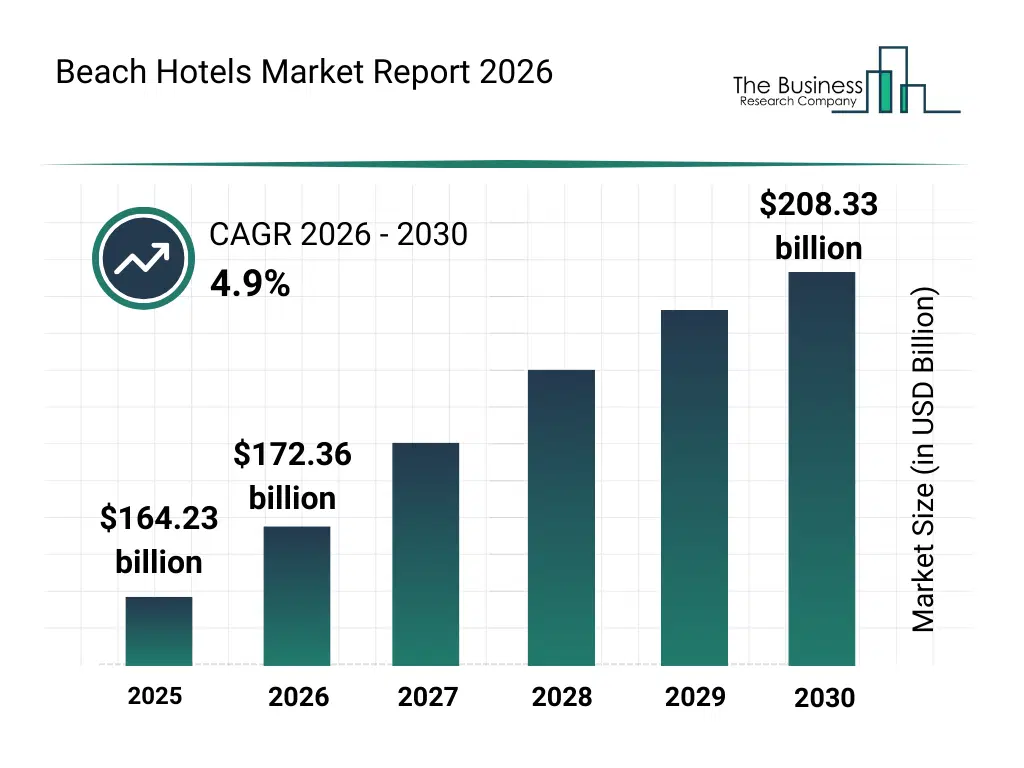
What Is The Beach Hotels Market Size and Share 2026?
The beach hotels market size has grown steadily in recent years. It will grow from $164.23 billion in 2025 to $172.36 billion in 2026 at a compound annual growth rate (CAGR) of 4.9%. The growth in the historic period can be attributed to growth in coastal tourism, rising disposable incomes, expansion of international travel, popularity of leisure vacations, development of beachfront infrastructure.What Is The Beach Hotels Market Growth Forecast?
The beach hotels market size is expected to see steady growth in the next few years. It will grow to $208.33 billion in 2030 at a compound annual growth rate (CAGR) of 4.9%. The growth in the forecast period can be attributed to increase in sustainable tourism demand, growth of wellness travel, expansion of luxury hospitality investments, rise of experiential travel preferences, digital transformation of hotel services. Major trends in the forecast period include rising demand for eco friendly beach resorts, growth of all inclusive beach hotel concepts, expansion of luxury and boutique beach hotels, integration of digital booking and smart services, focus on wellness and experiential tourism.
Global Beach Hotels Market Segmentation
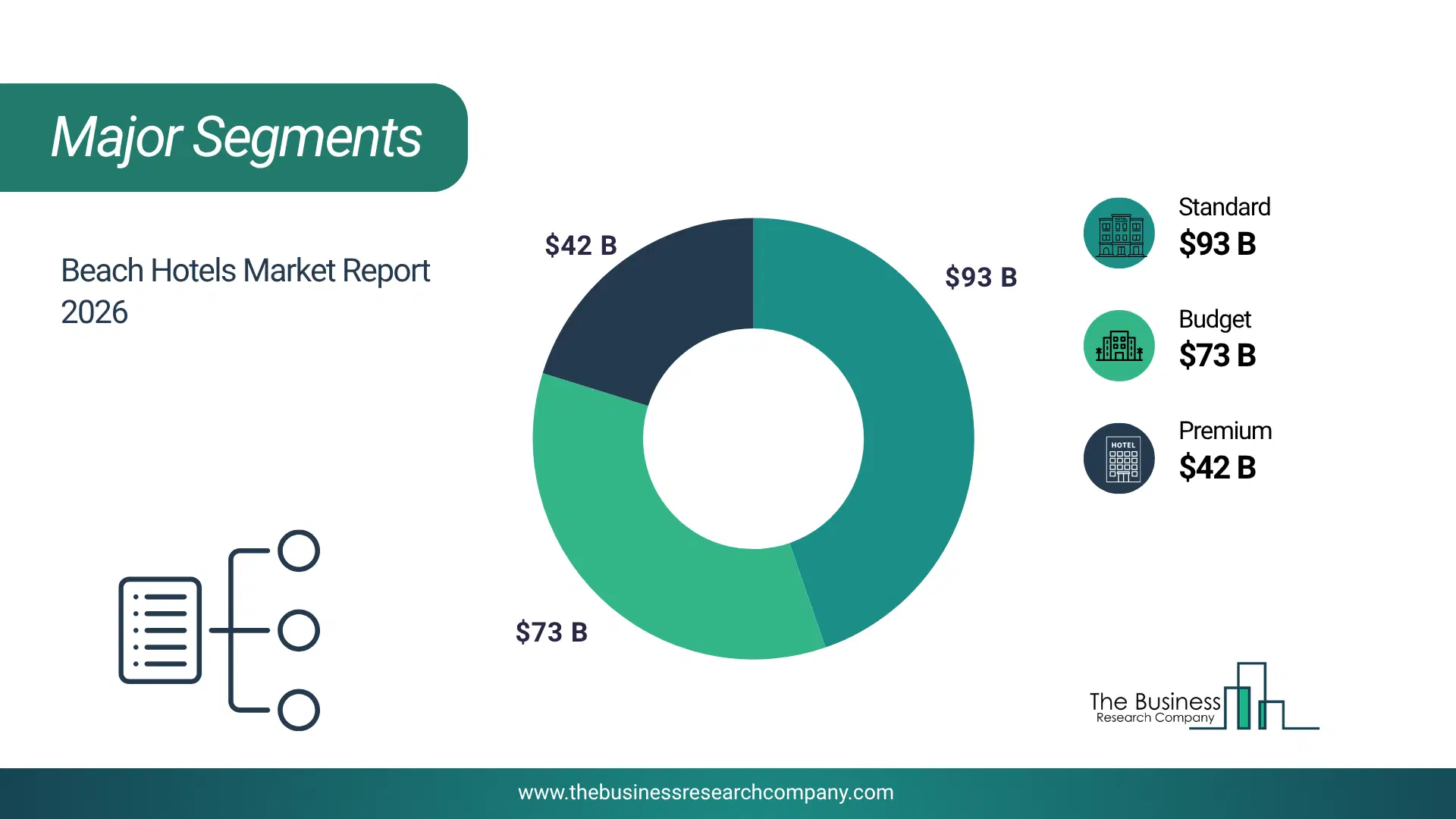
1) By Type: Budget, Premium, Standard 2) By Service Type: Accommodation, All-Inclusive, Food Services, Events, Other Service Types 3) By Booking Channel: Offline Booking, Online Booking 4) By Occupants: Group, Solo Subsegments: 1) By Budget: Economy Beach Hotels, Budget Beach Resorts, Beach Hostels And Guesthouses 2) By Premium: Luxury Beach Resorts, 5-Star Beach Hotels, High-End Boutique Beach Hotels, All-Inclusive Premium Beach Resorts 3) By Standard: Mid-Range Beach Hotels, Standard Beach Resorts, 3-Star Beach Hotels, Comfort-Focused Beach Hotels The top segments in the beach hotels market will be: • Standard will reach $93.03 Billion by 2030. • Budget will reach $72.52 Billion by 2030. • Premium will reach $42.24 Billion by 2030.What Is The Driver Of The Beach Hotels Market?
The rising tourism is expected to propel the growth of the beach hotels market going forward. Tourism is traveling for pleasure, recreation, or business purposes, typically involving staying in places away from one's usual environment. It encompasses a wide range of activities and services to meet travelers' needs and interests. The rise in tourism is due to increasing disposable incomes, improved transportation infrastructure, and the growing desire for new experiences and cultural exploration. Beach hotels bolster the tourism industry by attracting visitors, creating local jobs, supporting businesses, enhancing infrastructure, promoting cultural exchange, and driving sustainable tourism. For instance, in 2024, according to the World Travel and Tourism Council, a UK-based non-profit organization, the travel and tourism sector contributed 9.1% of the global GDP in 2023, marking a 23.2% increase from 2023. Therefore, the rising global tourism is driving the beach hotels industry.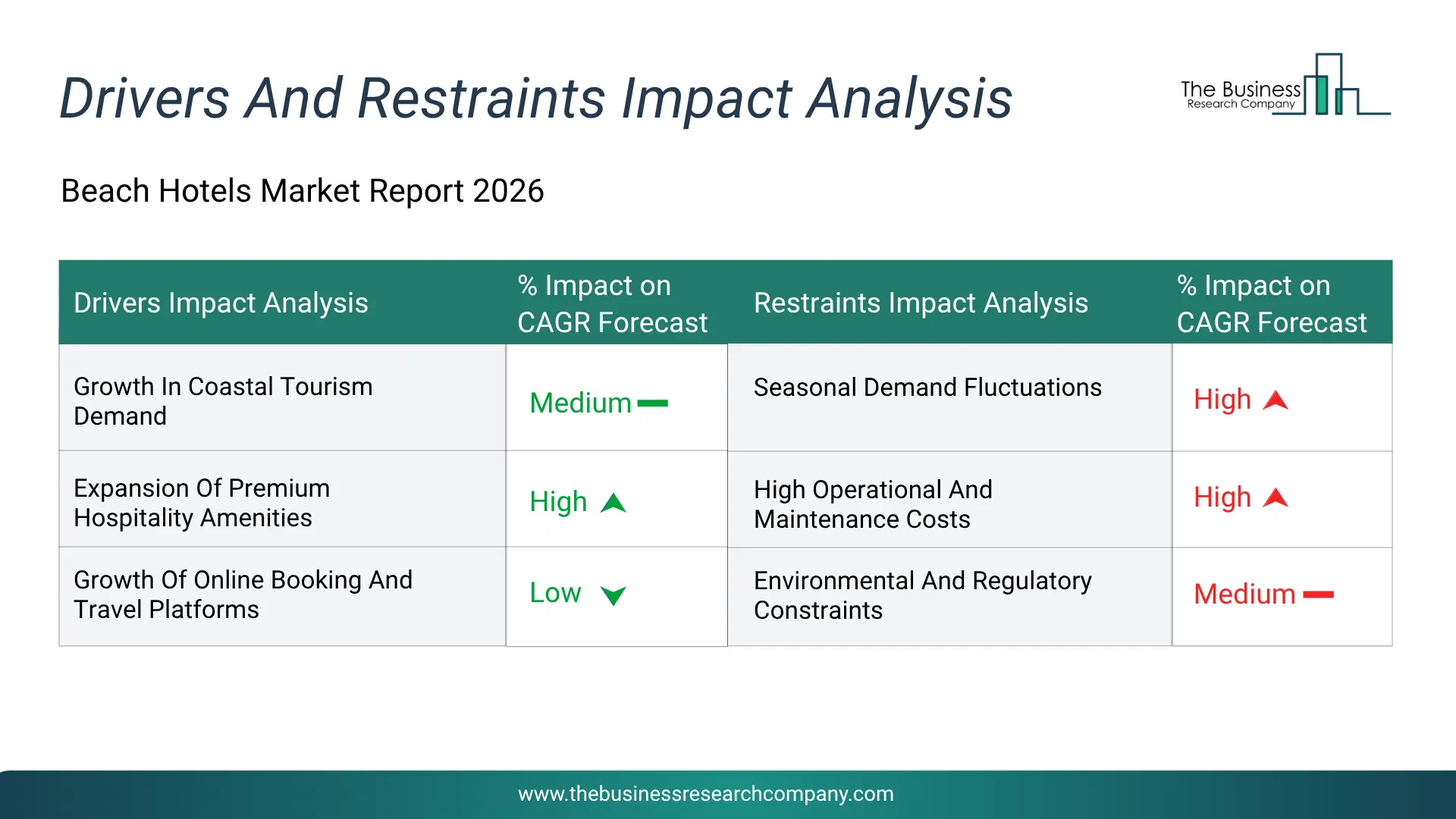
Infographic Chart Showing Key Market Drivers Analysis And Restraints For Beach Hotels Market
The chart presents an impact analysis of key drivers and restraints, quantifying their relative influence on the market's growth rate and helping assess the balance between growth enablers and limiting factors. This chart offers a high-level perspective; the full report contains more detailed insights.
How Will The Drivers Impact Growth In The Global Beach Hotels Market?
• Growth In Coastal Tourism Demand (Medium) – During the forecast period, the growth in coastal tourism demand is expected to become a key growth driver for the beach hotels market by 2030. The increasing preference for coastal and leisure travel is a primary driver for beach hotels. Travelers are actively seeking destinations that offer relaxation, scenic beauty, and recreational beach activities, which directly boosts occupancy rates. Rising disposable incomes and evolving lifestyle preferences are encouraging frequent vacations, particularly in seaside destinations. Growth in international tourism and improved connectivity are further expanding the customer base. Beach hotels benefit significantly due to their direct proximity to beaches and ability to offer bundled experiences. Seasonal peaks also enable premium pricing strategies, enhancing revenue generation. • Expansion Of Premium Hospitality Amenities (High) – During the forecast period, the expansion of premium hospitality amenities is expected to emerge as a major factor driving the expansion of the beach hotels market by 2030. The continuous enhancement of services such as wellness centers, fitness facilities, luxury spas, and concierge services is driving the beach hotels sector. Modern travelers prefer experiential stays, encouraging hotels to invest in differentiated offerings. Family-friendly services and curated beach experiences increase customer satisfaction and spending. These amenities generate additional revenue streams beyond room bookings. Technological integration such as smart rooms and digital services further enhances guest experience. Hotels that offer premium services gain a competitive edge in attracting high-value customers. • Growth Of Online Booking And Travel Platforms (Low) – During the forecast period, the growth of online booking and travel platforms is expected to act as a key growth catalyst for the beach hotels market by 2030. The rise of digital platforms and online travel agencies has improved accessibility and visibility of beach hotels. Consumers can easily compare prices, services, and reviews, leading to increased booking confidence. Digital marketing and social media promotions help hotels attract a global audience. Mobile-based booking convenience has increased last-minute reservations and occupancy rates. Partnerships with aggregators expand geographic reach and customer base. This digital ecosystem reduces dependency on traditional booking channels.How Will The Restraints Impact Growth In The Global Beach Hotels Market?
• Seasonal Demand Fluctuations (Medium) – During the forecast period, seasonal demand fluctuations are significantly restricting the growth of the beach hotels market. Heavy dependence on peak travel seasons leads to inconsistent occupancy rates, revenue volatility, and underutilization of assets during off-peak periods, limiting overall market stability. • High Operational And Maintenance Costs (High) – During the forecast period, high operational and maintenance costs are significantly restricting the growth of the beach hotels market. Rising expenses related to labor, utilities, property maintenance, and beachfront property upkeep are increasing financial pressure on operators and constraining profitability. • Environmental And Regulatory Constraints (Low) – During the forecast period, environmental and regulatory constraints are restricting the growth of the beach hotels market. Strict coastal zone regulations, sustainability requirements, and environmental protection norms are limiting new developments and increasing compliance burdens for existing hotel operators.Key Players In The Global Beach Hotels Market
Major companies operating in the beach hotels market are Marriott International Inc., Radisson Hotel Group, Rosewood Hotels and Resorts LLC, Hilton Worldwide Holdings Inc., ITC Limited, Hyatt Hotels Corporation, Four Seasons Holdings Inc., InterContinental Hotels Group PLC, Accor S.A., Shangri-La International Hotel Management Limited, Jumeirah International LLC, Wyndham Hotels & Resorts Inc., Belmond Ltd., Mandarin Oriental Hotel Group Limited, Soneva Group, Montage International, Royal Cliff Hotels Group, The Oberoi Group, The Indian Hotels Company Limited, Barcelo Hotel Group, Laguna Beach House, Casa Laguna Hotel & Spa., Sunset Key Guest Cottages, Capri Laguna, Jade Mountain Resort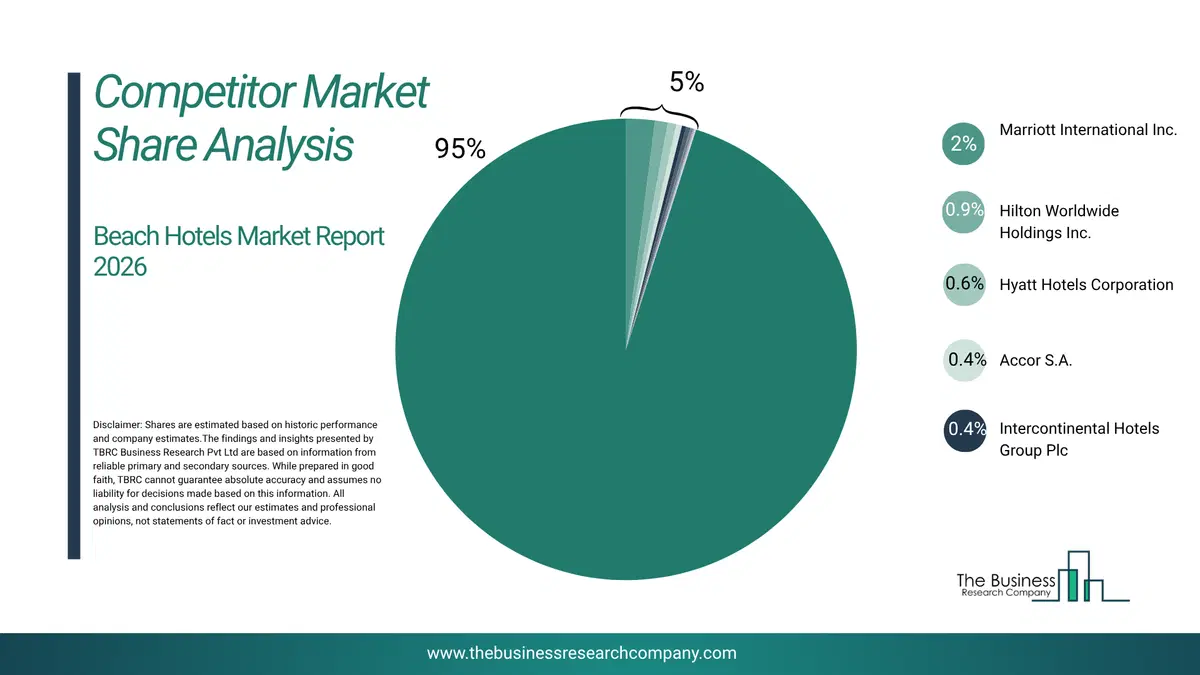
This chart is for illustrative purposes; the full report includes a detailed competitor analysis and comprehensive overview of the top 10 companies in the market.
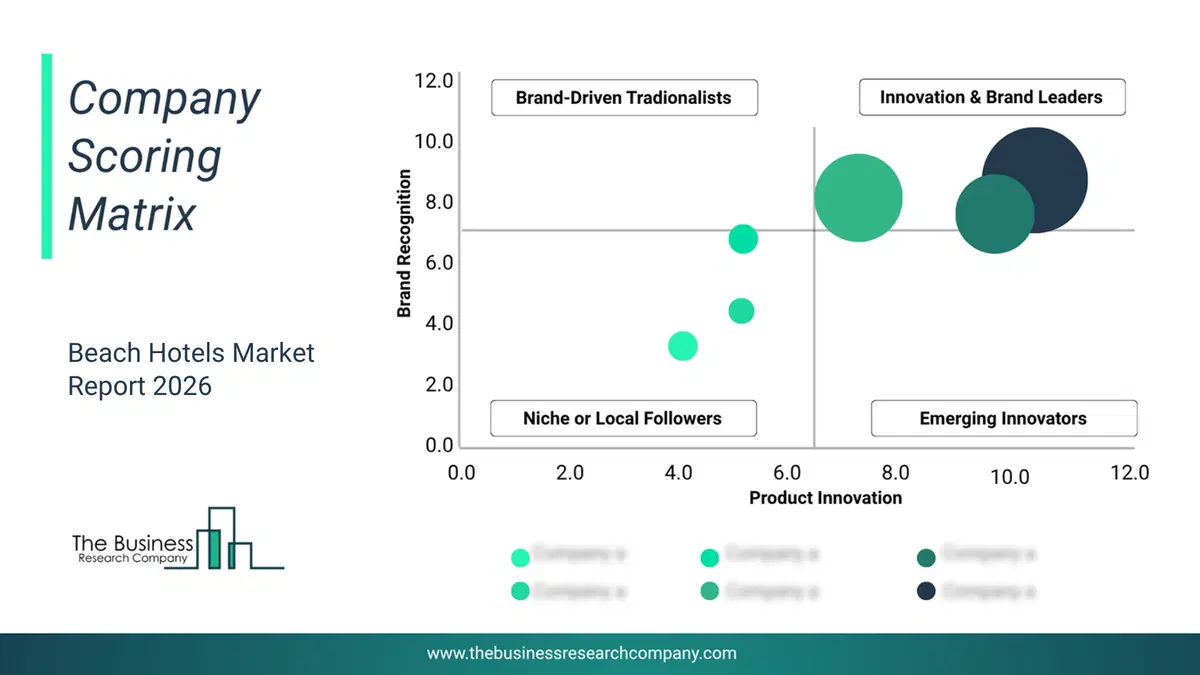
This chart maps companies by product innovation and brand strength, with bubble size indicating relative revenue, helping identify market leaders, challengers, and niche players. This is an illustrative chart; the full report provides a complete and accurate competitive analysis.
Global Beach Hotels Market Trends and Insights
Major companies operating in the beach hotels market are focusing on technological improvements in hotel areas, such as space renovation with 3D mapping technology, to enhance the guest experience and optimize operational efficiencies. 3D mapping technology enables hotels to create detailed virtual tours for guests, enhance space management, optimize event planning, and improve maintenance operations through precise spatial data. For instance, in September 2023, W South Beach, a US-based luxury hotel, launched its $6 million ballroom and meeting space renovation. The space features cutting-edge 360 projection technology, which can recreate any ambiance or experience, ranging from an immersive underwater world to the skyline of any global city, heralding a new standard in exceptional events and experiences. Utilizing 3D-mapping technology, the 4,300-square-foot ballroom is transformed with storytelling, visual effects, and precise audio-visual integration. This innovative setup offers guests a mesmerizing journey akin to the renowned L’Atelier des Lumières in Paris.What Are Latest Mergers And Acquisitions In The Beach Hotels Market?
In December 2023, Golden Sands Hotel Company, a UAE-based hospitality group focused on developing and managing luxury hotels and resorts, acquired Salalah Beach Resort for an undisclosed amount. The acquisition will boost Oman's hospitality sector by improving the resort's offerings and guest experience. Salalah Beach Resort is an Oman-based luxury beachfront property known for its premier hospitality offerings, including the Hilton Salalah Resort.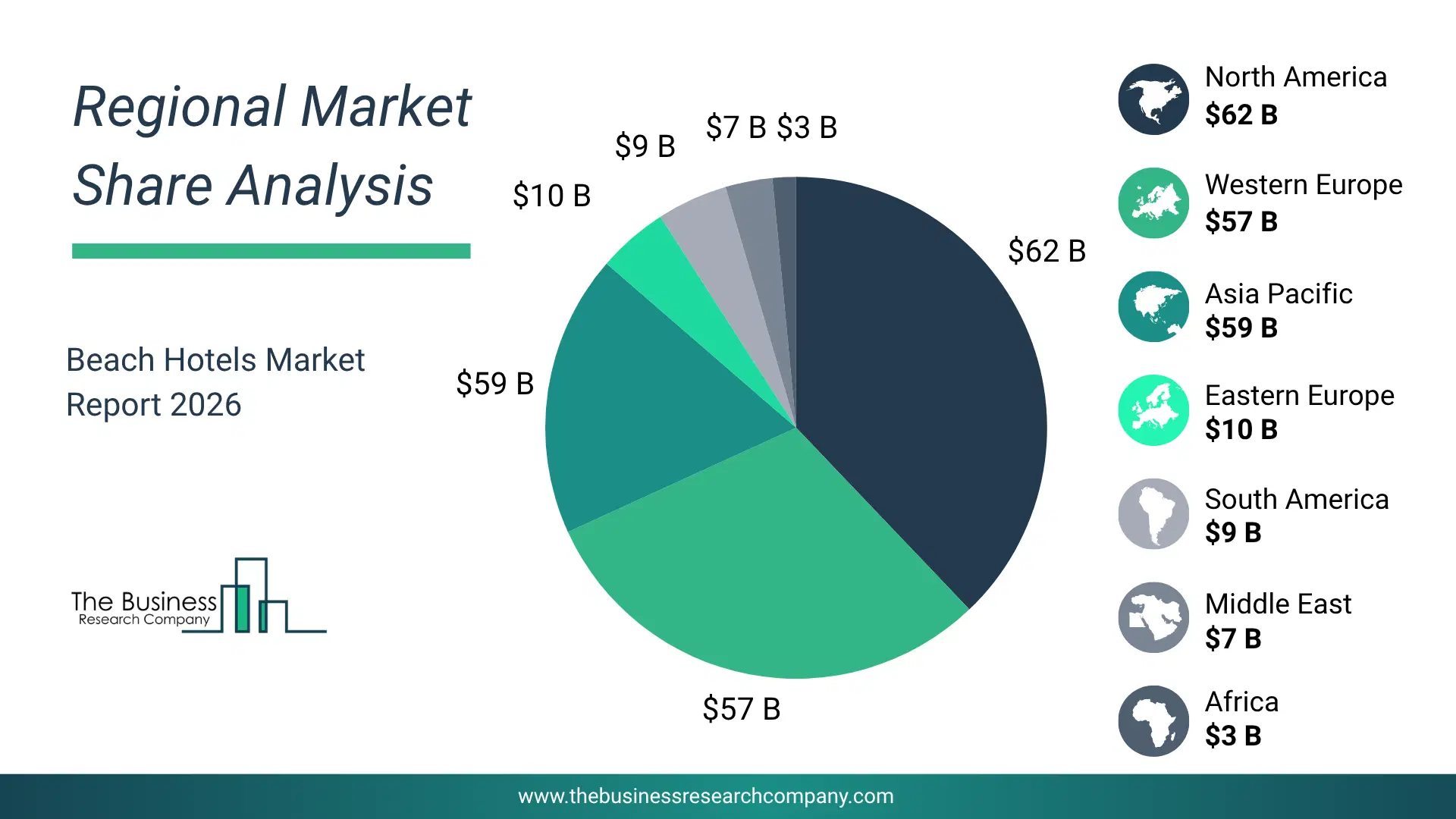
Regional Outlook
North America was the largest region in the beach hotels market in 2025. Asia-Pacific is expected to be the fastest-growing region in the forecast period. The regions covered in this market report are Asia-Pacific, South East Asia, Western Europe, Eastern Europe, North America, South America, Middle East, Africa. The countries covered in this market report are Australia, Brazil, China, France, Germany, India, Indonesia, Japan, Taiwan, Russia, South Korea, UK, USA, Canada, Italy, SpainWhat Defines the Beach Hotels Market?
The beach hotels market includes revenues earned by entities by providing services such as family-friendly services, fitness facilities, and concierge services. The market value includes the value of related goods sold by the service provider or included within the service offering. Only goods and services traded between entities or sold to end consumers are included.How is Market Value Defined and Measured?
The market value is defined as the revenues that enterprises gain from the sale of goods and/or services within the specified market and geography through sales, grants, or donations in terms of the currency (in USD unless otherwise specified). The revenues for a specified geography are consumption values that are revenues generated by organizations in the specified geography within the market, irrespective of where they are produced. It does not include revenues from resales along the supply chain, either further along the supply chain or as part of other products.
This chart presents market attractiveness based on a quantitative evaluation of growth, competition, strategic alignment, and risk, offering a clear view of opportunity areas for decision-making. This chart is for illustrative purposes; the full report contains the complete analysis.

This chart highlights the Total Addressable Market (TAM) by estimating the maximum revenue opportunity using an assumption-driven approach, supporting strategic planning and opportunity sizing across markets. The chart is illustrative; the full report provides a more comprehensive analysis.
What Key Data and Analysis Are Included in the Beach Hotels Market Report 2026?
The beach hotels market research report is one of a series of new reports from The Business Research Company that provides market statistics, including industry global market size, regional shares, competitors with the market share, detailed market segments, market trends and opportunities, and any further data you may need to thrive in the beach hotels industry. The market research report delivers a complete perspective of everything you need, with an in-depth analysis of the current and future state of the industry.Beach Hotels Market Report Forecast Analysis
| Report Attribute | Details |
|---|---|
| Market Size Value In 2026 | $172.36 billion |
| Revenue Forecast In 2030 | $208.33 billion |
| Growth Rate | CAGR of 4.9% from 2026 to 2030 |
| Base Year For Estimation | 2025 |
| Actual Estimates/Historical Data | 2020-2025 |
| Forecast Period | 2026 - 2030 |
| Market Representation | Revenue in USD Billion and CAGR from 2026 to 2030 |
| Segments Covered | Type, Service Type, Booking Channel, Occupants |
| Regional Scope | Asia-Pacific, Western Europe, Eastern Europe, North America, South America, Middle East, Africa |
| Country Scope | The countries covered in the report are Australia, Brazil, China, France, Germany, India, Indonesia, Japan, Taiwan, Russia, South Korea, UK, USA, Canada, Italy, Spain. |
| Key Companies Profiled | Marriott International Inc., Radisson Hotel Group, Rosewood Hotels and Resorts LLC, Hilton Worldwide Holdings Inc., ITC Limited, Hyatt Hotels Corporation, Four Seasons Holdings Inc., InterContinental Hotels Group PLC, Accor S.A., Shangri-La International Hotel Management Limited, Jumeirah International LLC, Wyndham Hotels & Resorts Inc., Belmond Ltd., Mandarin Oriental Hotel Group Limited, Soneva Group, Montage International, Royal Cliff Hotels Group, The Oberoi Group, The Indian Hotels Company Limited, Barcelo Hotel Group, Laguna Beach House, Casa Laguna Hotel & Spa., Sunset Key Guest Cottages, Capri Laguna, Jade Mountain Resort |
| Customization Scope | Request for Customization |
| Pricing And Purchase Options | Explore Purchase Options |