

Benzene Market Report 2026
Global Outlook – By Derivative (Ethylbenzene, Cumene, Cyclohexane, Nitrobenzene, Alkylbenzene, Chlorobenzene, Maleic Anhydride, Other Derivatives), By Manufacturing Process (Catalytic Reforming, Steam Cracking, Toluene Disproportionation, Hydrodealkylation Of Toluene, Other Manufacturing Processes), By Distribution Channel (Direct Sales, Distributors And Traders, Online Chemical Marketplaces), By End Use Industry (Chemicals And Petrochemicals, Automotive, Construction, Packaging, Textiles, Pharmaceuticals, Consumer Goods, Electronics) – Market Size, Trends, Strategies, and Forecast to 2030
Benzene Market Overview
• Benzene market size has reached to $44.48 billion in 2025 • Expected to grow to $64.47 billion in 2030 at a compound annual growth rate (CAGR) of 7.6% • Growth Driver: Expanding Automotive Production Fueling The Market Growth Due To Rising Demand For Synthetic Rubber And Engineering Plastics • Market Trend: Innovations In Sustainable Linear Alkylbenzene (LAB) Production Advance Low-Carbon Chemical Solutions • North America was the largest region in 2025 and Asia-Pacific is the fastest growing region.What Is Covered Under Benzene Market?
Benzene is a colorless, highly flammable aromatic hydrocarbon with the molecular formula C₆H₆, composed of six carbon atoms arranged in a ring with delocalized electrons. It is characterized by its exceptional chemical stability and distinctive aromatic structure, making it one of the fundamental compounds in organic chemistry. The main derivatives of benzene include ethylbenzene, cumene, cyclohexane, nitrobenzene, alkylbenzene, chlorobenzene, maleic anhydride, and other derivatives. Ethylbenzene refers to a key benzene derivative primarily used as an intermediate in the production of styrene for manufacturing plastics, resins, and synthetic rubber. These derivatives are produced through manufacturing processes such as catalytic reforming, steam cracking, toluene disproportionation, hydrodealkylation of toluene, and other manufacturing processes. They are distributed through direct sales, distributors and traders, and online chemical marketplaces and are utilized by end-use industries including chemicals and petrochemicals, automotive, construction, packaging, textiles, pharmaceuticals, consumer goods, and electronics.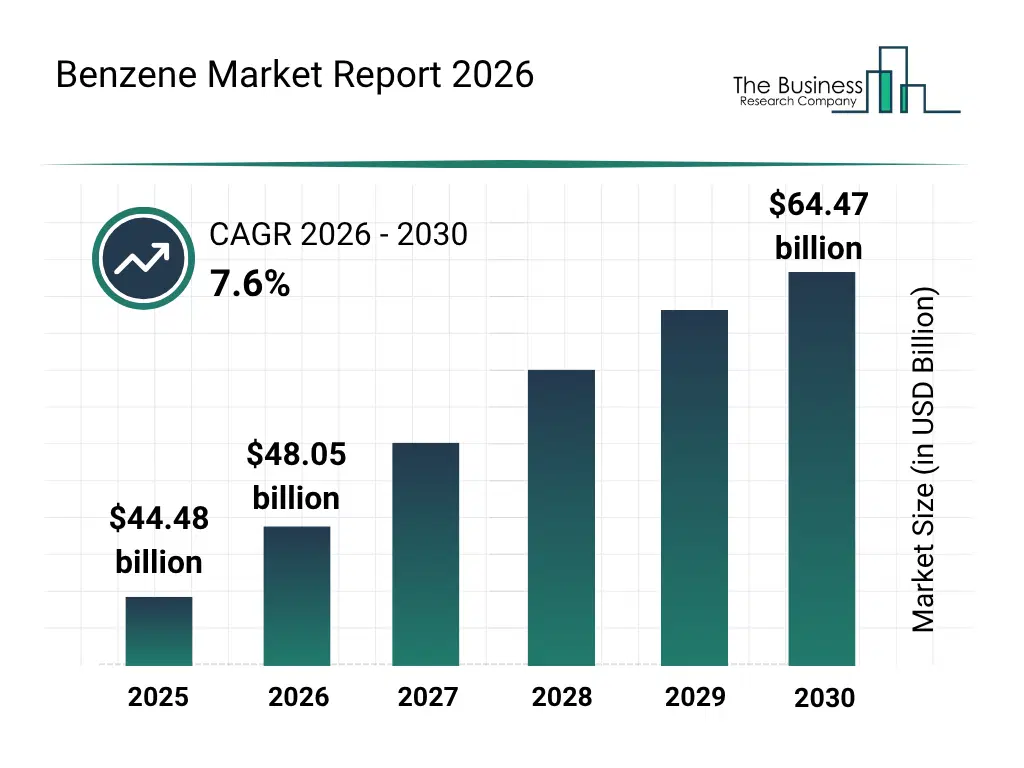
What Is The Benzene Market Size and Share 2026?
The benzene market size has grown strongly in recent years. It will grow from $44.48 billion in 2025 to $48.05 billion in 2026 at a compound annual growth rate (CAGR) of 8.0%. The growth in the historic period can be attributed to increasing demand for benzene derivatives in petrochemical industries, rising growth of plastics and polymer manufacturing, growing adoption of benzene-based chemicals in pharmaceutical production, increasing expansion of chemical manufacturing facilities, rising demand for aromatic hydrocarbons in industrial applications.What Is The Benzene Market Growth Forecast?
The benzene market size is expected to see strong growth in the next few years. It will grow to $64.47 billion in 2030 at a compound annual growth rate (CAGR) of 7.6%. The growth in the forecast period can be attributed to growing demand for benzene derivatives in specialty chemical applications, increasing investments in advanced petrochemical processing technologies, rising adoption of sustainable chemical production methods, growing demand from automotive and construction material industries, increasing utilization of benzene intermediates in high-performance polymers and resins. Major trends in the forecast period include increasing demand for benzene derivatives in chemical manufacturing applications, rising adoption of advanced production methods for efficient benzene processing, growing focus on sustainable and low-emission benzene manufacturing practices, increasing utilization of benzene-based intermediates in specialty chemical production, rising development of high-purity benzene grades for industrial applications.
Global Benzene Market Segmentation
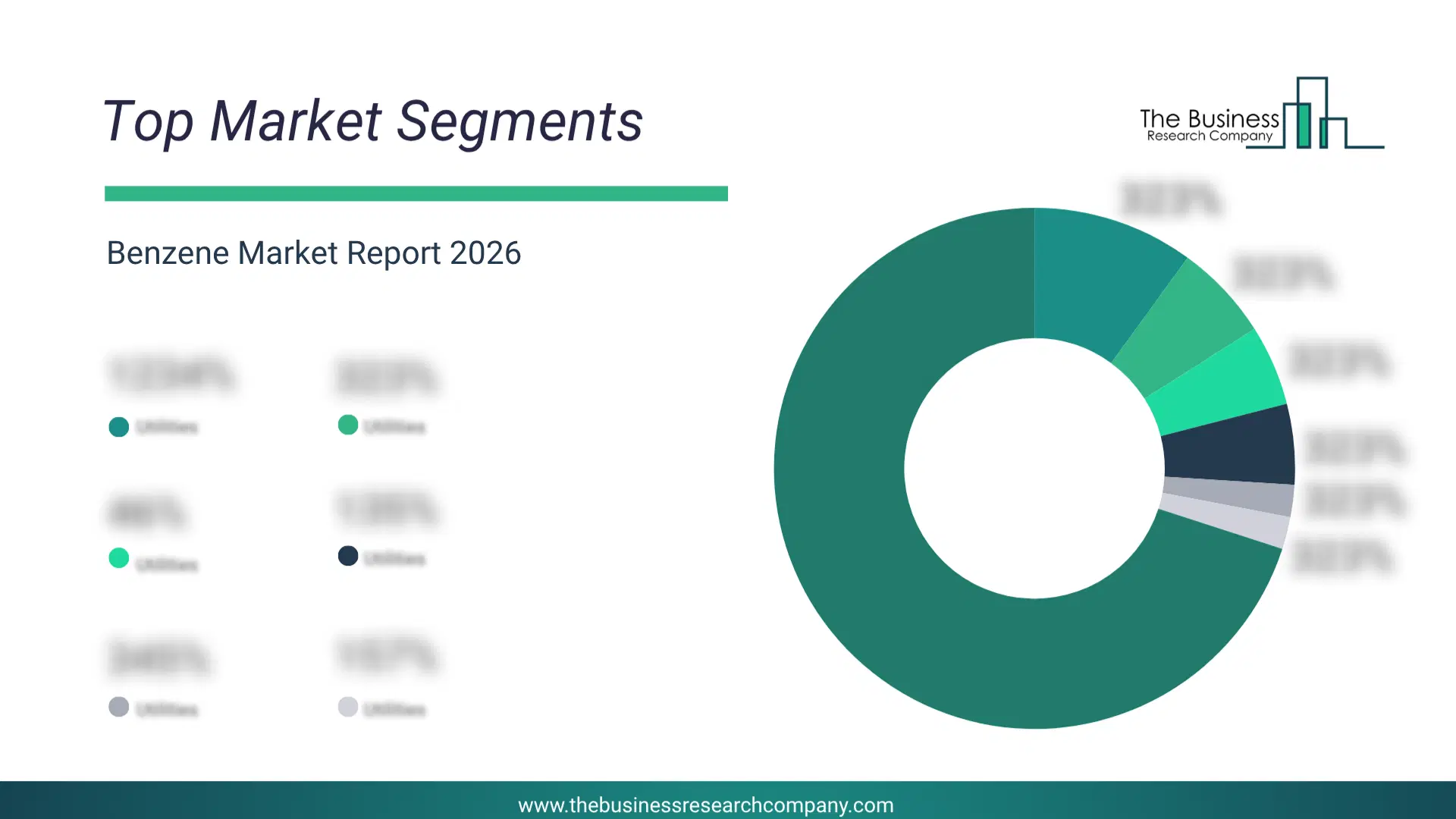
2) By Manufacturing Process: Catalytic Reforming, Steam Cracking, Toluene Disproportionation, Hydrodealkylation Of Toluene, Other Manufacturing Processes 3) By Distribution Channel: Direct Sales, Distributors And Traders, Online Chemical Marketplaces 4) By End Use Industry: Chemicals And Petrochemicals, Automotive, Construction, Packaging, Textiles, Pharmaceuticals, Consumer Goods, Electronics Subsegments: 1) By Ethylbenzene: Styrene Monomer Production, Polystyrene Manufacturing, Acrylonitrile Butadiene Styrene Production, Styrene Butadiene Rubber Production 2) By Cumene: Phenol Production, Acetone Production, Bisphenol A Manufacturing, Phenolic Resin Manufacturing 3) By Cyclohexane: Adipic Acid Production, Caprolactam Production, Nylon Fiber Manufacturing, Nylon Resin Manufacturing 4) By Nitrobenzene: Aniline Production, Methylene Diphenyl Diisocyanate Manufacturing, Rubber Chemical Manufacturing, Dye Intermediate Production 5) By Alkylbenzene: Linear Alkylbenzene Production, Detergent Surfactant Manufacturing, Industrial Cleaner Manufacturing, Household Cleaning Product Manufacturing 6) By Chlorobenzene: Herbicide Manufacturing, Pesticide Manufacturing, Dye Intermediate Production, Rubber Processing Chemical Manufacturing 7) By Maleic Anhydride: Unsaturated Polyester Resin Manufacturing, Lubricant Additive Manufacturing, Copolymer Manufacturing, Surface Coating Resin Manufacturing 8) By Other Derivatives: Benzene Sulfonic Acid Production, Benzoic Acid Production, Benzaldehyde Production, Specialty Chemical ManufacturingWhat Is The Driver Of The Benzene Market?
The growth in the automotive industry is expected to propel the growth of the benzene market going forward. The automotive industry refers to the global sector involved in the development, manufacturing, distribution, and servicing of motor vehicles and their components. The automotive industry is growing due to the increasing adoption of electric vehicles, as government incentives, advancements in battery technology, and rising environmental awareness are accelerating consumer demand for cleaner transportation solutions. Benzene supports the automotive industry by serving as a key raw material for producing synthetic rubber, plastics, resins, and nylon-based materials that are widely used in tires, fuel systems, interior components, coatings, and various lightweight automotive parts. For instance, in January 2025, according to the China Association of Automobile Manufacturers (CAAM), a China-based nonprofit industry association, in 2024, China produced about 31.282 million vehicles, up 3.7% from 2023. Therefore, the growth in the automotive industry is driving the growth of the benzene industry.Key Players In The Global Benzene Market
Major companies operating in the benzene market are China Petroleum and Chemical Corporation, Saudi Basic Industries Corporation, Exxon Mobil Corporation, BASF SE, LyondellBasell Industries N.V., Shell plc, Reliance Industries Limited, TotalEnergies SE, Mitsubishi Chemical Group Corporation, BP plc, Chevron Phillips Chemical Company, Dow Inc., INEOS Group Holdings S.A., Formosa Plastics Corporation, PetroChina Company Limited, PTT Global Chemical Public Company Limited, Hanwha Solutions Corporation, Braskem S.A., SK Geo Centric Co. Ltd., Wanhua Chemical Group Co. Ltd., Versalis S.p.A., Indian Oil Corporation Limited, Toray Industries Inc., Repsol S.A., GS Caltex Corporation, Westlake Corporation, OMV Aktiengesellschaft, LG Chem Ltd.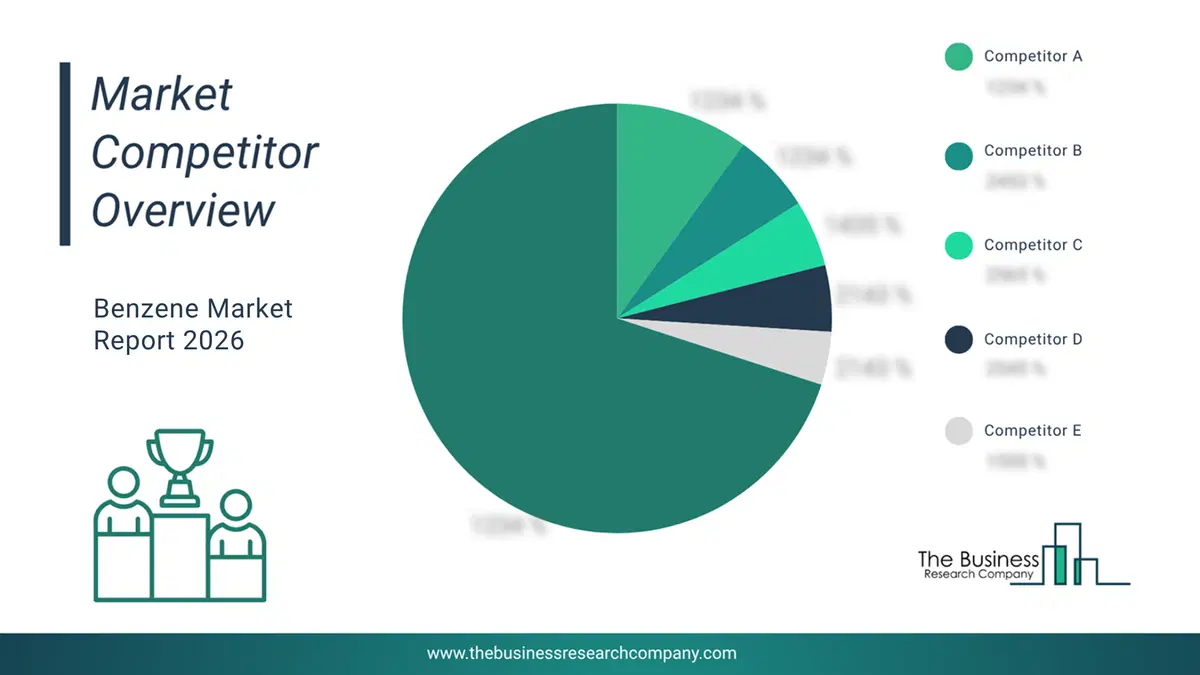
This chart is for illustrative purposes; the full report includes a detailed competitor analysis and comprehensive overview of the top 10 companies in the market.
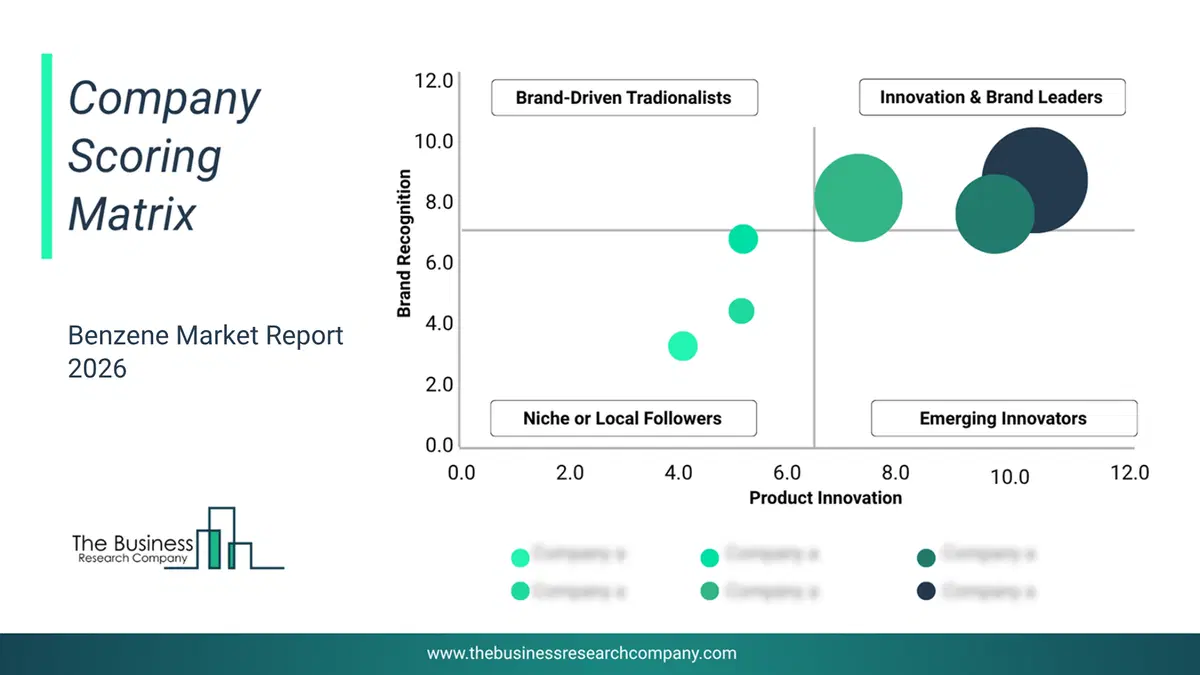
This chart maps companies by product innovation and brand strength, with bubble size indicating relative revenue, helping identify market leaders, challengers, and niche players. This is an illustrative chart; the full report provides a complete and accurate competitive analysis.
Global Benzene Market Trends and Insights
Major companies operating in the benzene market are focusing on developing innovative solutions, such as sustainable linear alkylbenzene, to reduce environmental impact, enhance biodegradability, and support the growing demand for eco-friendly surfactants and detergent formulations. Sustainable linear alkylbenzene (LAB) is a low-carbon or bio-based variant of linear alkylbenzene produced through environmentally responsible processes to support more sustainable detergent and surfactant manufacturing. For instance, in January 2023, Cepsa Química, a Spain-based chemical company, launched a NextLab as the world's first sustainable linear alkylbenzene (LAB) made from renewable raw materials, not fossil fuels. This benzene-based surfactant provides identical performance to traditional LAB while delivering an 80% lower carbon footprint, making it a milestone for circular chemistry in the homecare industry. NextLab is primarily used to produce linear alkylbenzene sulfonate (LAS), the largest-volume synthetic surfactant for eco-friendly detergents and cleaning products, with Unilever serving as its first major customer.What Are Latest Mergers And Acquisitions In The Benzene Market?
In June 2024, Encina Development Group, a US-based chemicals company, partnered with BASF SE to supply circular benzene produced from recycled plastic waste, enabling the use of sustainable feedstocks in the production of chemical and industrial materials. With this partnership, companies aim to advance circular economy goals by increasing the use of recycled, low-carbon feedstocks and reducing reliance on fossil-based raw materials in chemical production. BASF SE is a Germany-based chemicals company that offers benzene.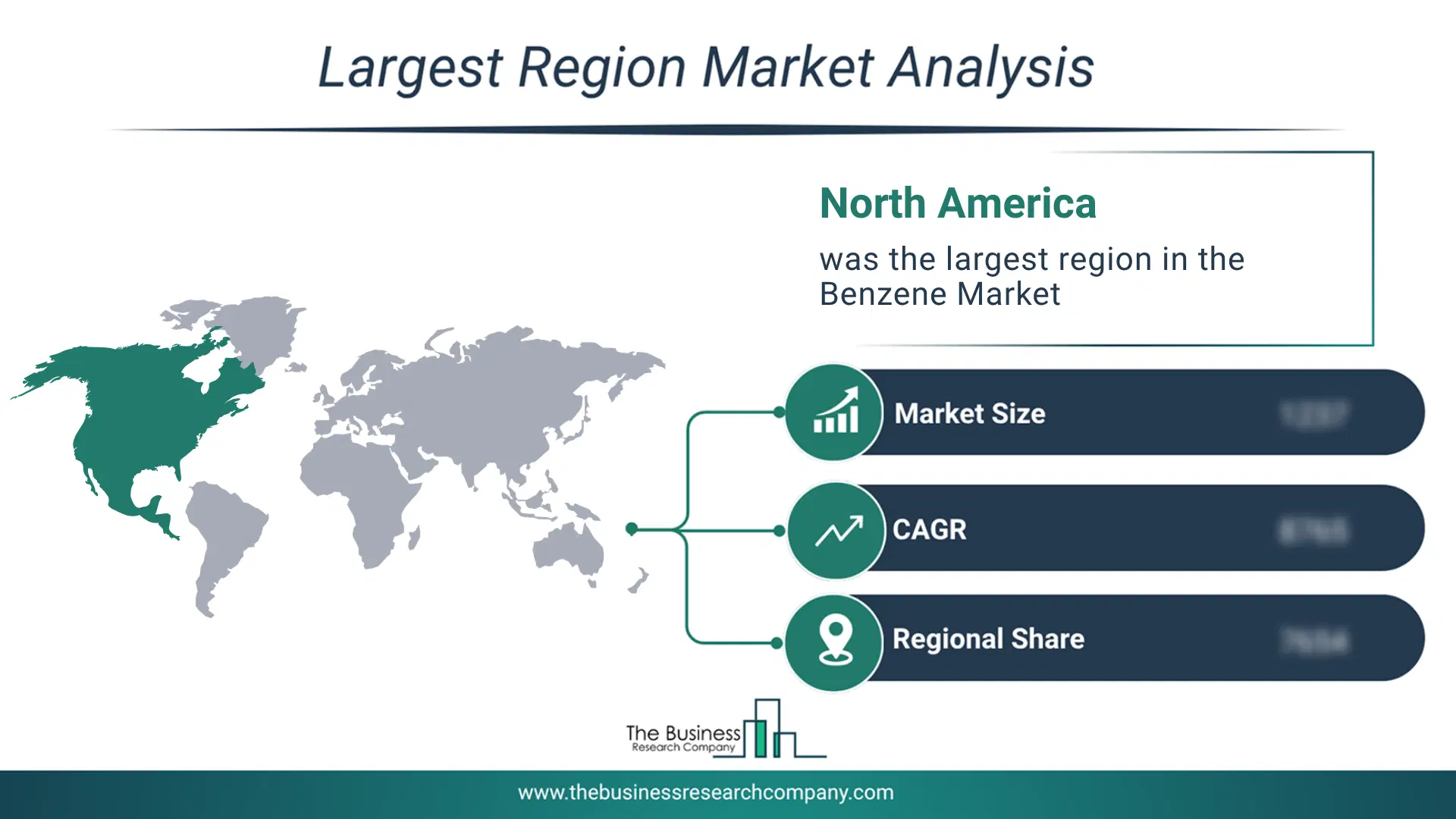
Regional Outlook/Insights
North America was the largest region in the benzene market in 2025. Asia-Pacific is expected to be the fastest-growing region in the forecast period. The regions covered in this market report are Asia-Pacific, South East Asia, Western Europe, Eastern Europe, North America, South America, Middle East, Africa. The countries covered in this market report are Australia, Brazil, China, France, Germany, India, Indonesia, Japan, Taiwan, Russia, South Korea, UK, USA, Canada, Italy, Spain.What Defines the Benzene Market?
The benzene market consists of sales of aniline, phenol, and styrene monomer. Values in this market are ‘factory gate’ values, that is, the value of goods sold by the manufacturers or creators of the goods, whether to other entities (including downstream manufacturers, wholesalers, distributors, and retailers) or directly to end customers. The value of goods in this market includes related services sold by the creators of the goods.How is Market Value Defined and Measured?
The market value is defined as the revenues that enterprises gain from the sale of goods and/or services within the specified market and geography through sales, grants, or donations in terms of the currency (in USD unless otherwise specified). The revenues for a specified geography are consumption values that are revenues generated by organizations in the specified geography within the market, irrespective of where they are produced. It does not include revenues from resales along the supply chain, either further along the supply chain or as part of other products.
This chart presents market attractiveness based on a quantitative evaluation of growth, competition, strategic alignment, and risk, offering a clear view of opportunity areas for decision-making. This chart is for illustrative purposes; the full report contains the complete analysis.

This chart highlights the Total Addressable Market (TAM) by estimating the maximum revenue opportunity using an assumption-driven approach, supporting strategic planning and opportunity sizing across markets. The chart is illustrative; the full report provides a more comprehensive analysis.
What Key Data and Analysis Are Included in the Benzene Market Report 2026?
The benzene market research report is one of a series of new reports from The Business Research Company that provides benzene market statistics, including benzene industry global market size, regional shares, competitors with a benzene market share, detailed benzene market segments, market trends and opportunities, and any further data you may need to thrive in the benzene industry. This benzene market research report delivers a complete perspective of everything you need, with an in-depth analysis of the current and future scenario of the industry.Benzene Market Report Forecast Analysis
| Report Attribute | Details |
|---|---|
| Market Size Value In 2026 | $48.05 billion |
| Revenue Forecast In 2030 | $64.47 billion |
| Growth Rate | CAGR of 7.6% from 2026 to 2030 |
| Base Year For Estimation | 2025 |
| Actual Estimates/Historical Data | 2020-2025 |
| Forecast Period | 2026 - 2030 |
| Market Representation | Revenue in USD Billion and CAGR from 2026 to 2030 |
| Segments Covered | Derivative, Manufacturing Process, Distribution Channel, End Use Industry |
| Regional Scope | Asia-Pacific, Western Europe, Eastern Europe, North America, South America, Middle East, Africa |
| Country Scope | The countries covered in the report are Australia, Brazil, China, France, Germany, India, Indonesia, Japan, Taiwan, Russia, South Korea, UK, USA, Canada, Italy, Spain. |
| Key Companies Profiled | China Petroleum and Chemical Corporation, Saudi Basic Industries Corporation, Exxon Mobil Corporation, BASF SE, LyondellBasell Industries N.V., Shell plc, Reliance Industries Limited, TotalEnergies SE, Mitsubishi Chemical Group Corporation, BP plc, Chevron Phillips Chemical Company, Dow Inc., INEOS Group Holdings S.A., Formosa Plastics Corporation, PetroChina Company Limited, PTT Global Chemical Public Company Limited, Hanwha Solutions Corporation, Braskem S.A., SK Geo Centric Co. Ltd., Wanhua Chemical Group Co. Ltd., Versalis S.p.A., Indian Oil Corporation Limited, Toray Industries Inc., Repsol S.A., GS Caltex Corporation, Westlake Corporation, OMV Aktiengesellschaft, LG Chem Ltd. |
| Customization Scope | Request for Customization |
| Pricing And Purchase Options | Explore Purchase Options |