

Beta-Agonists Alternatives Market Report 2026
Global Outlook – By Product Type (Natural Alternatives, Synthetic Alternatives, Herbal Extracts, Other Product Types), By Distribution Channel (Hospital Pharmacies, Retail Pharmacies, Online Pharmacies, Other Distribution Channels), By Application (Asthma, Chronic Obstructive Pulmonary Disease, Bronchitis, Other Applications), By End User (Adults, Pediatrics, Geriatrics) – Market Size, Trends, Strategies, and Forecast to 2030
Beta-Agonists Alternatives Market Overview
• Beta-Agonists Alternatives market size has reached to $1.93 billion in 2025 • Expected to grow to $2.81 billion in 2030 at a compound annual growth rate (CAGR) of 7.9% • Growth Driver: The Rising Prevalence Of Asthma Drives The Growth Of The Market Due To Increasing Air Pollution • North America was the largest region in 2025 and Asia-Pacific is the fastest growing region.What Is Covered Under Beta-Agonists Alternatives Market?
Beta-agonists alternatives refer to a class of drugs or therapeutic approaches used in place of beta-adrenergic agonists to achieve similar clinical effects, such as bronchodilation or smooth muscle relaxation. These alternatives are typically used when beta-agonists are contraindicated, cause adverse effects, or are less effective in certain patients. Common alternatives may include anticholinergic agents, corticosteroids, or other non-beta receptor-mediated therapies depending on the medical condition being treated. The main product types of beta-agonists alternatives include natural alternatives, synthetic alternatives, herbal extracts, and other product types. Natural alternatives refer to non beta-agonist compounds derived from natural sources that are used to support respiratory function and reduce airway constriction. These products are distributed through hospital pharmacies, retail pharmacies, online pharmacies, and other distribution channels. They find application in asthma, chronic obstructive pulmonary disease, bronchitis, and others, serving end users including adults, pediatrics, and geriatrics.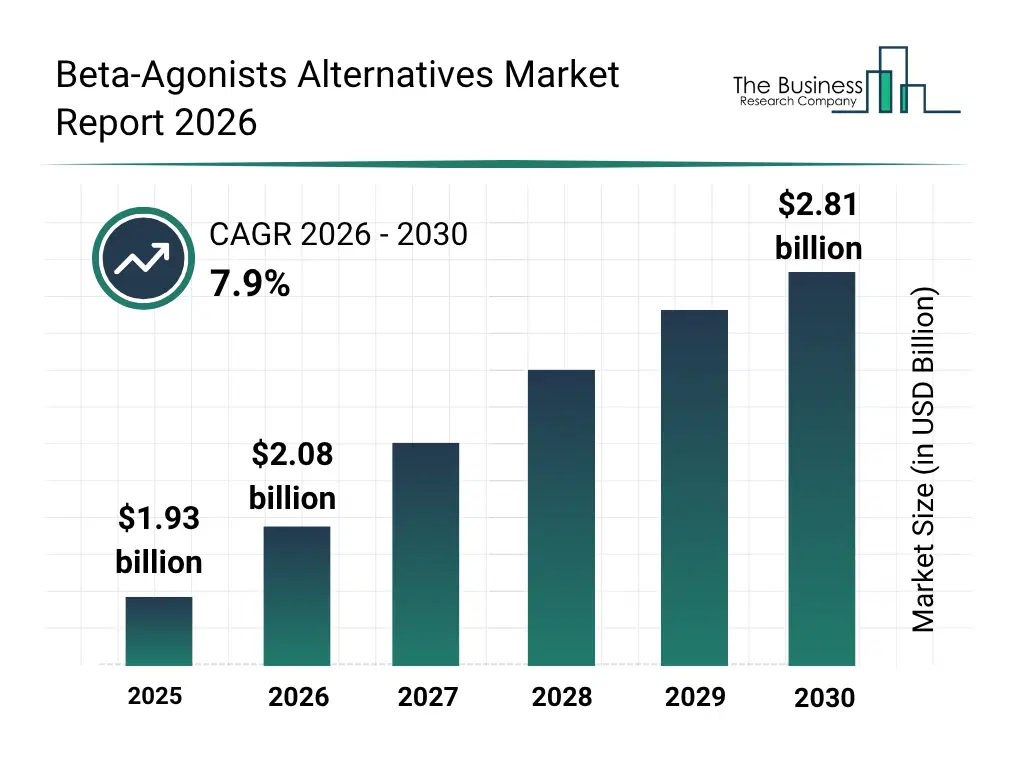
What Is The Beta-Agonists Alternatives Market Size and Share 2026?
The beta-agonists alternatives market size has grown strongly in recent years. It will grow from $1.93 billion in 2025 to $2.08 billion in 2026 at a compound annual growth rate (CAGR) of 7.6%. The growth in the historic period can be attributed to widespread reliance on beta agonist monotherapy in asthma management, rising prevalence of respiratory disorders such as Asthma, increased clinical use of anticholinergic agents like Ipratropium, growing adoption of inhaled corticosteroids for inflammation control, expansion of hospital based respiratory care protocols.What Is The Beta-Agonists Alternatives Market Growth Forecast?
The beta-agonists alternatives market size is expected to see strong growth in the next few years. It will grow to $2.81 billion in 2030 at a compound annual growth rate (CAGR) of 7.9%. The growth in the forecast period can be attributed to increasing shift toward precision respiratory medicine approaches, rising demand for safer long acting bronchodilator alternatives, growth in biologics for severe asthma and COPD treatment, expansion of home based respiratory therapy solutions, advancement in combination therapy drug development for airway diseases. Major trends in the forecast period include increased adoption of non beta receptor mediated bronchodilation therapies in chronic respiratory care, rising shift toward combination inhalation therapies for improved airway management, growth of personalized respiratory treatment regimens based on patient tolerance profiles, expansion of steroid based long term inflammation control strategies in obstructive airway diseases, development of herbal and plant derived respiratory relief alternatives in mild asthma and bronchospasm management.
Global Beta-Agonists Alternatives Market Segmentation
1) By Product Type: Natural Alternatives, Synthetic Alternatives, Herbal Extracts, Other Product Types 2) By Distribution Channel: Hospital Pharmacies, Retail Pharmacies, Online Pharmacies, Other Distribution Channels 3) By Application: Asthma, Chronic Obstructive Pulmonary Disease, Bronchitis, Other Applications 4) By End User: Adults, Pediatrics, Geriatrics Subsegments: 1) By Natural Alternatives: Plant Based Extracts, Essential Oils, Organic Respiratory Supplements, Mineral Based Alternatives 2) By Synthetic Alternatives: Laboratory Developed Compounds, Non Steroidal Respiratory Formulations, Chemically Formulated Bronchodilators, Controlled Release Respiratory Products 3) By Herbal Extracts: Ayurvedic Herbal Extracts, Traditional Chinese Herbal Extracts, Botanical Respiratory Extracts, Medicinal Plant Concentrates 4) By Other Product Types: Combination Respiratory Therapies, Homeopathic Respiratory Products, Nutraceutical Respiratory Solutions, Innovative Respiratory FormulationsWhat Are The Drivers Of The Beta-Agonists Alternatives Market?
The rising prevalence of asthma is expected to propel the growth of the beta-agonists alternatives market going forward. Asthma refers to a long-term inflammatory disease of the airways that causes breathing difficulties due to airway narrowing, swelling, and increased mucus production, leading to symptoms such as wheezing, coughing, chest tightness, and shortness of breath. The rising prevalence of asthma is primarily due to increasing air pollution, which exposes people to harmful particulate matter and gases that irritate the airways and trigger chronic inflammation and respiratory sensitivity. Beta-agonist alternatives help asthma by providing bronchodilation and symptom relief through non-beta-agonist mechanisms, thereby reducing airway inflammation and improving breathing control in patients who may not respond well to traditional beta-agonist therapies. For instance, in October 2024, according to the National Asthma Council, an Australia-based non-profit organization, in 2023, Australia recorded a total of 474 asthma-related deaths, comprising 325 females and 149 males. This figure is almost identical to the 473 asthma-related deaths reported in 2022, highlighting a consistent trend in asthma mortality over the two years. Therefore, rising prevalence of asthma is driving the growth of the beta-agonists alternatives industry. The rising healthcare expenditure is expected to propel the growth of the beta-agonists alternatives market going forward. Healthcare expenditure refers to the total financial resources spent by individuals, organizations, or governments on preventing, treating, and managing health conditions. The rising healthcare expenditure is primarily due to the increasing prevalence of chronic diseases, which require long-term treatment, continuous monitoring, and costly medical interventions. Rising healthcare expenditure drives investment in innovative respiratory therapies and broader patient access, thereby accelerating the demand for beta-agonist alternatives that offer improved efficacy and reduced side effects. For instance, in December 2024, according to the Centers for Medicare and Medicaid Services, a US-based agency responsible for administering the Medicare and Medicaid programs, in 2023, U.S. health care expenditures increased by 7.5%, climbing to $4.9 trillion, or roughly $14,570 for each individual. Therefore, the rising healthcare expenditure is driving the growth of the beta-agonists alternatives industry. The surge in the aging population is expected to propel the growth of the beta-agonists alternatives market going forward. The aging population refers to the increasing proportion of elderly individuals in a society, typically due to declining birth rates and rising life expectancy. The surge in the aging population is primarily due to increased life expectancy, which results from improvements in healthcare, better disease management, improved living standards, and reduced mortality rates. Beta-agonists alternatives help the aging population by providing safer and more tolerable respiratory treatment options that reduce cardiovascular side effects and improve long-term management of chronic airway diseases common in older adults. For instance, in July 2024, according to the UK Parliament's House of Commons Library, a UK-based government administration, in 2022, there were 12.7 million individuals aged 65 or older in the UK, making up 19% of the total population. By 2072, this number is expected to increase to 22.1 million, comprising 27% of the population. Therefore, the surge in the aging population is driving the growth of the beta-agonists alternatives industry.Key Players In The Global Beta-Agonists Alternatives Market
Major companies operating in the beta-agonists alternatives market are AstraZeneca plc, Merck & Co. Inc., Novartis AG, GSK plc, Boehringer Ingelheim International GmbH, Teva Pharmaceutical Industries Ltd., Viatris Inc., Sun Pharmaceutical Industries Ltd., Sumitomo Pharma America, Organon & Co., Hikma Pharmaceuticals, Cipla Limited, Dr. Reddy's Laboratories Ltd., Chiesi Farmaceutici S.p.A., Lupin Limited, Glenmark Pharmaceuticals, Zydus Lifesciences Limited, Theravance Biopharma Inc.Regional Outlook
North America was the largest region in the beta-agonists alternatives market in 2025. Asia-Pacific is expected to be the fastest-growing region in the forecast period. The regions covered in this market report are Australia, Brazil, China, France, Germany, India, Indonesia, Japan, Taiwan, Russia, South Korea, UK, USA, Canada, Italy, Spain. The countries covered in this market report are Australia, Brazil, China, France, Germany, India, Indonesia, Japan, Taiwan, Russia, South Korea, UK, USA, Canada, Italy, Spain.What Defines the Beta-Agonists Alternatives Market?
The beta-agonists alternatives market consists of sales of inhaled corticosteroids, long-acting muscarinic antagonists, and leukotriene receptor antagonists. Values in this market are ‘factory gate’ values, that is, the value of goods sold by the manufacturers or creators of the goods, whether to other entities (including downstream manufacturers, wholesalers, distributors, and retailers) or directly to end customers. The value of goods in this market includes related services sold by the creators of the goods.How is Market Value Defined and Measured?
The market value is defined as the revenues that enterprises gain from the sale of goods and/or services within the specified market and geography through sales, grants, or donations in terms of the currency (in USD unless otherwise specified). The revenues for a specified geography are consumption values that are revenues generated by organizations in the specified geography within the market, irrespective of where they are produced. It does not include revenues from resales along the supply chain, either further along the supply chain or as part of other products.What Key Data and Analysis Are Included in the Beta-Agonists Alternatives Market Report 2026?
The beta-agonists alternatives market research report is one of a series of new reports from The Business Research Company that provides beta-agonists alternatives market statistics, including beta-agonists alternatives industry global market size, regional shares, competitors with a beta-agonists alternatives market share, detailed beta-agonists alternatives market segments, market trends and opportunities, and any further data you may need to thrive in the beta-agonists alternatives industry. This beta-agonists alternatives market research report delivers a complete perspective of everything you need, with an in-depth analysis of the current and future scenario of the industry.Beta-Agonists Alternatives Market Report Forecast Analysis
| Report Attribute | Details |
|---|---|
| Market Size Value In 2026 | $2.08 billion |
| Revenue Forecast In 2030 | $2.81 billion |
| Growth Rate | CAGR of 7.9% from 2026 to 2030 |
| Base Year For Estimation | 2025 |
| Actual Estimates/Historical Data | 2020-2025 |
| Forecast Period | 2026 - 2030 |
| Market Representation | Revenue in USD Billion and CAGR from 2026 to 2030 |
| Segments Covered | Product Type, Distribution Channel, Application, End User |
| Regional Scope | Asia-Pacific, Western Europe, Eastern Europe, North America, South America, Middle East, Africa |
| Country Scope | The countries covered in the beta-agonists alternatives market report are Australia, Brazil, China, France, Germany, India, Indonesia, Japan, Taiwan, Russia, South Korea, UK, USA, Canada, Italy, Spain. |
| Key Companies Profiled | AstraZeneca plc, Merck & Co. Inc., Novartis AG, GSK plc, Boehringer Ingelheim International GmbH, Teva Pharmaceutical Industries Ltd., Viatris Inc., Sun Pharmaceutical Industries Ltd., Sumitomo Pharma America, Organon & Co., Hikma Pharmaceuticals, Cipla Limited, Dr. Reddy's Laboratories Ltd., Chiesi Farmaceutici S.p.A., Lupin Limited, Glenmark Pharmaceuticals, Zydus Lifesciences Limited, Theravance Biopharma Inc. |
| Customization Scope | Request for Customization |
| Pricing And Purchase Options | Explore Purchase Options |