
Bifacial Solar Market Report 2026
Global Outlook – By Type (Monocrystalline Bifacial Solar Panels, Polycrystalline Bifacial Solar Panels, Thin-Film Bifacial Solar Panels), By Installation (Ground-Mounted Bifacial Solar Panels, Rooftop Bifacial Solar Panels), By Cell Type (Passivated Emitter Rear Cell, Heterojunction, Other Cell Types), By End-User (Utility-Scale Solar Projects, Commercial And Industrial (C And I) Sector, Residential Sector) – Market Size, Trends, Strategies, and Forecast to 2030
Bifacial Solar Market Overview
• Bifacial Solar market size has reached to $10.37 billion in 2025 • Expected to grow to $19.74 billion in 2030 at a compound annual growth rate (CAGR) of 13.7% • Growth Driver: Surge In Solar Electricity Demand Boosts Bifacial Solar Market Expansion • Market Trend: Advanced Tunnel Oxide Passivated Contact Bifacial Photovoltaics (PV) Modules Enhance Solar Efficiency And Power Output • North America was the largest region in 2025 and Asia-Pacific is the fastest growing region.What Is Covered Under Bifacial Solar Market?
Bifacial solar refers to panels that are photovoltaic modules that can capture sunlight on both their front and rear sides, increasing energy generation. They are typically more efficient than traditional monofacial panels because they utilize reflected and diffused light from the surrounding environment. Bifacial panels can be installed on various surfaces, including rooftops, ground mounts, and vertical surfaces. They are especially effective in environments with high albedo, such as snowy or sandy areas. The main types of bifacial solar are monocrystalline bifacial solar panels, polycrystalline bifacial solar panels, and thin-film bifacial solar panels. Monocrystalline bifacial solar panels refer to panels made from single-crystal silicon, offering high efficiency and durability. The installation types include ground-mounted bifacial solar panels and rooftop bifacial solar panels. The different cell types are passivated emitter rear cell, heterojunction, and others and are used by various end-users, including utility-scale solar projects, the commercial and industrial (C and I) sectors, and the residential sector.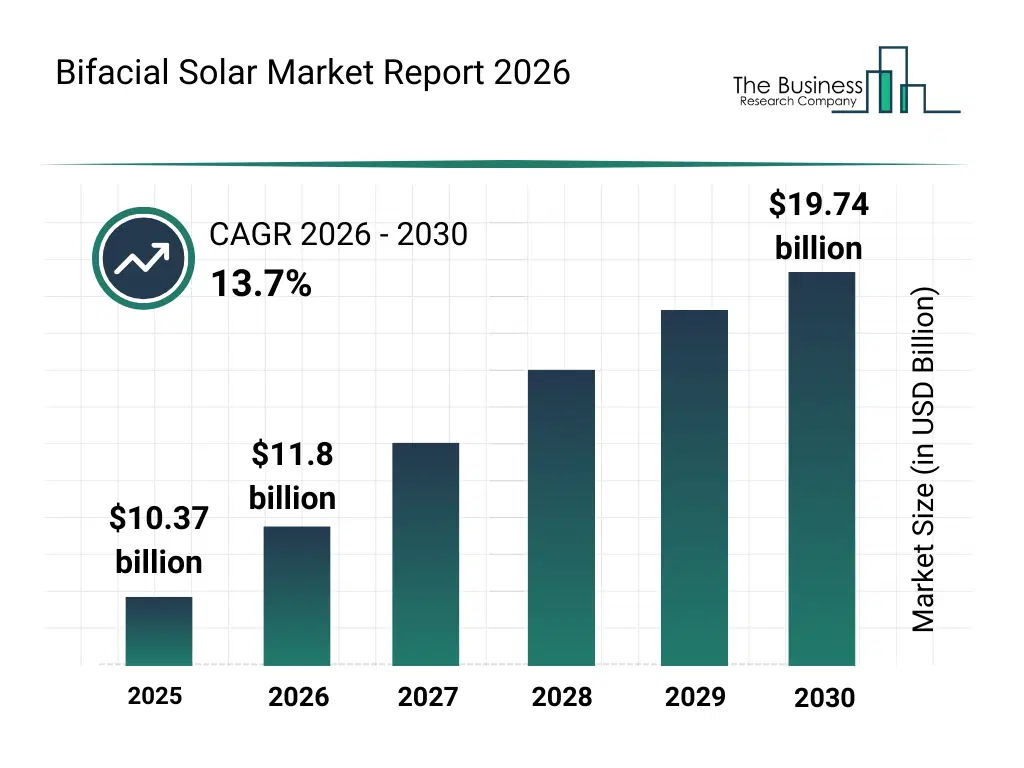
What Is The Bifacial Solar Market Size and Share 2026?
The bifacial solar market size has grown rapidly in recent years. It will grow from $10.37 billion in 2025 to $11.8 billion in 2026 at a compound annual growth rate (CAGR) of 13.8%. The growth in the historic period can be attributed to increasing focus on renewable energy adoption, government incentives for solar power, growth of utility-scale solar projects, advancements in solar panel efficiency, declining cost of photovoltaic modules.What Is The Bifacial Solar Market Growth Forecast?
The bifacial solar market size is expected to see rapid growth in the next few years. It will grow to $19.74 billion in 2030 at a compound annual growth rate (CAGR) of 13.7%. The growth in the forecast period can be attributed to rising demand for bifacial panels in residential and c&i sectors, technological innovations in heterojunction and dual-glass cells, expansion of ground-mounted solar farms, increasing awareness of energy yield optimization, growth of hybrid solar installations combining bifacial and monofacial modules. Major trends in the forecast period include rising adoption of dual-glass bifacial solar panels, growing installation of ground-mounted bifacial solar systems, integration of passivated emitter rear cell (perc) technology, expansion of high-efficiency monocrystalline bifacial panels, increasing deployment in utility-scale solar projects.
Global Bifacial Solar Market Segmentation
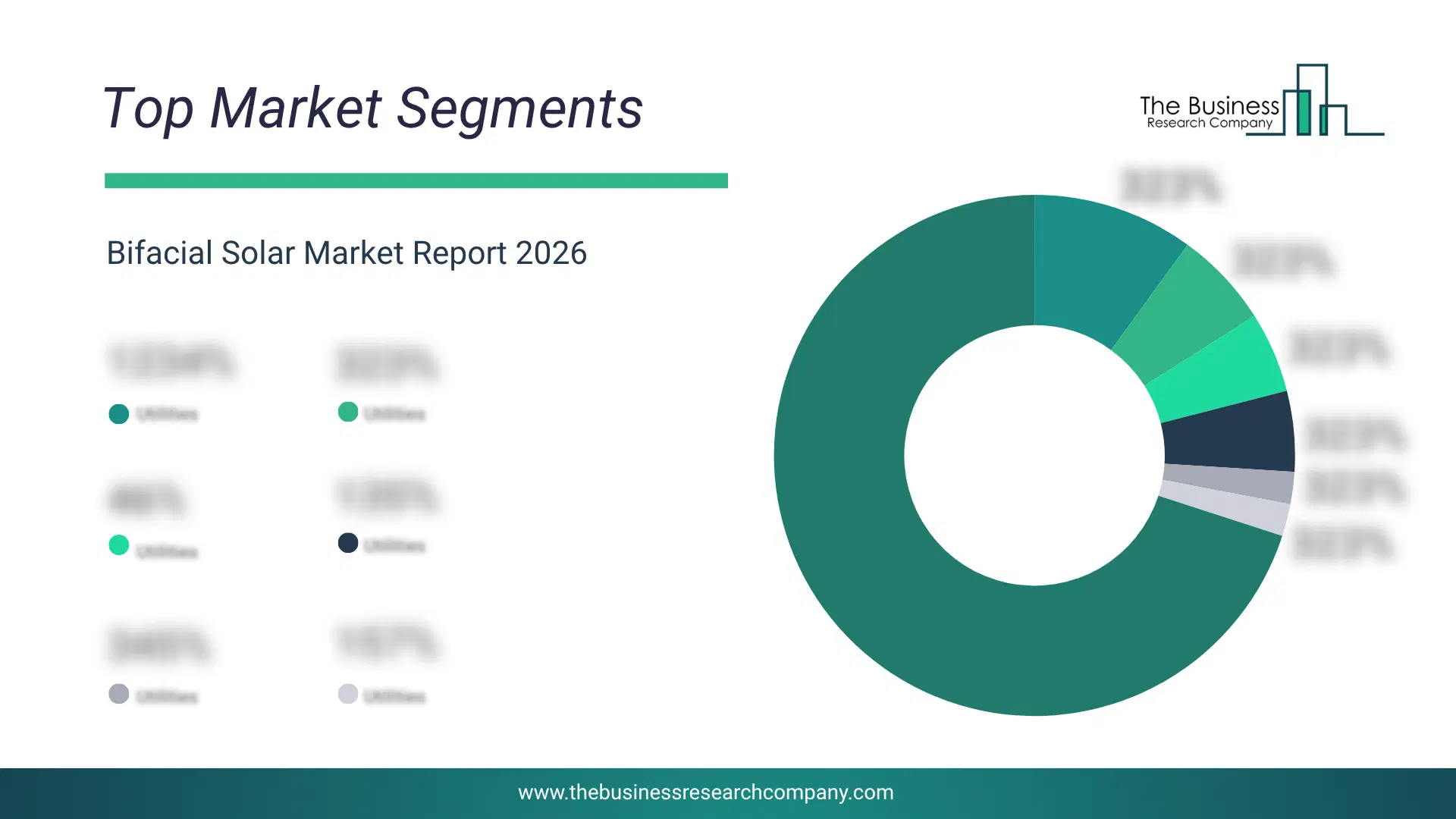
1) By Type: Monocrystalline Bifacial Solar Panels, Polycrystalline Bifacial Solar Panels, Thin-Film Bifacial Solar Panels 2) By Installation: Ground-Mounted Bifacial Solar Panels, Rooftop Bifacial Solar Panels 3) By Cell Type: Passivated Emitter Rear Cell, Heterojunction, Other Cell Types 4) By End-User: Utility-Scale Solar Projects, Commercial And Industrial (C And I) Sector, Residential Sector Subsegments: 1) By Monocrystalline Bifacial Solar Panels: High-Efficiency Monocrystalline Bifacial Panels, PERC (Passivated Emitter and Rear Contact) Monocrystalline Bifacial Panels, Dual-Glass Monocrystalline Bifacial Panels 2) By Polycrystalline Bifacial Solar Panels: Standard Polycrystalline Bifacial Panels, Dual-Glass Polycrystalline Bifacial Panels, High-Performance Polycrystalline Bifacial Panels 3) By Thin-Film Bifacial Solar Panels: Amorphous Silicon Bifacial Panels, Cadmium Telluride (CdTe) Bifacial Panels, Copper Indium Gallium Selenide (CIGS) Bifacial PanelsWhat Is The Driver Of The Bifacial Solar Market?
The increasing demand for solar-based electricity is expected to propel the growth of the bifacial solar market going forward. Solar-based electricity refers to electrical power generated from sunlight using photovoltaic cells or solar thermal systems. The demand for solar-based electricity is experiencing growth due to increasing environmental concerns and the push towards renewable energy sources to mitigate climate change. The bifacial solar enhances solar-based electricity generation by allowing solar panels to capture sunlight from both sides, significantly increasing energy yield compared to traditional monofacial panels. For instance, in January 2024, according to the Energy Information Administration, a US-based government agency, US solar power generation is expected to rise by 75%, from 163 billion kWh in 2023 to 286 billion kWh in 2025. Wind power generation is projected to grow by 11%, increasing from 430 billion kWh in 2023 to 476 billion kWh in 2025. Therefore, the increasing demand for solar-based electricity is driving the growth of the bifacial solar industry.Key Players In The Global Bifacial Solar Market
Major companies operating in the bifacial solar market are Reliance Industries Ltd, LG Electronics, LONGi Green Energy Technology Co. Ltd., Sharp Corporation, Trina Solar Co Ltd, Jinko Solar Holdings, JA Solar Technology Co. Ltd., Hanwha Solutions, Canadian Solar Inc., Risen Energy, First Solar Inc, Sun Power Corporation, GCL System Integration Technology Co Ltd, Wuxi Suntech Power Co. Ltd., Adani Green Energy Ltd, Zhongli Talesun Solar Co. Ltd, SoliTek, Seraphim Solar System Co. Ltd., Jiangsu Sunport Power Corp. Ltd., Yingli Green Energy Holding Co Ltd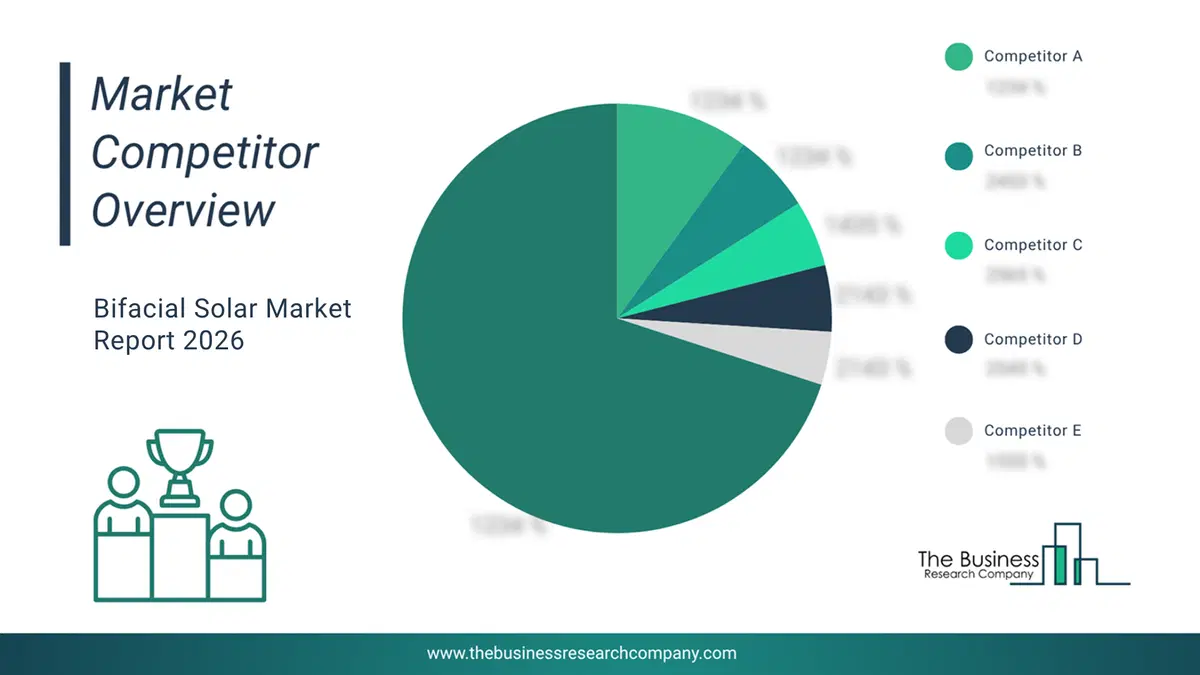
This chart is for illustrative purposes; the full report includes a detailed competitor analysis and comprehensive overview of the top 10 companies in the market.
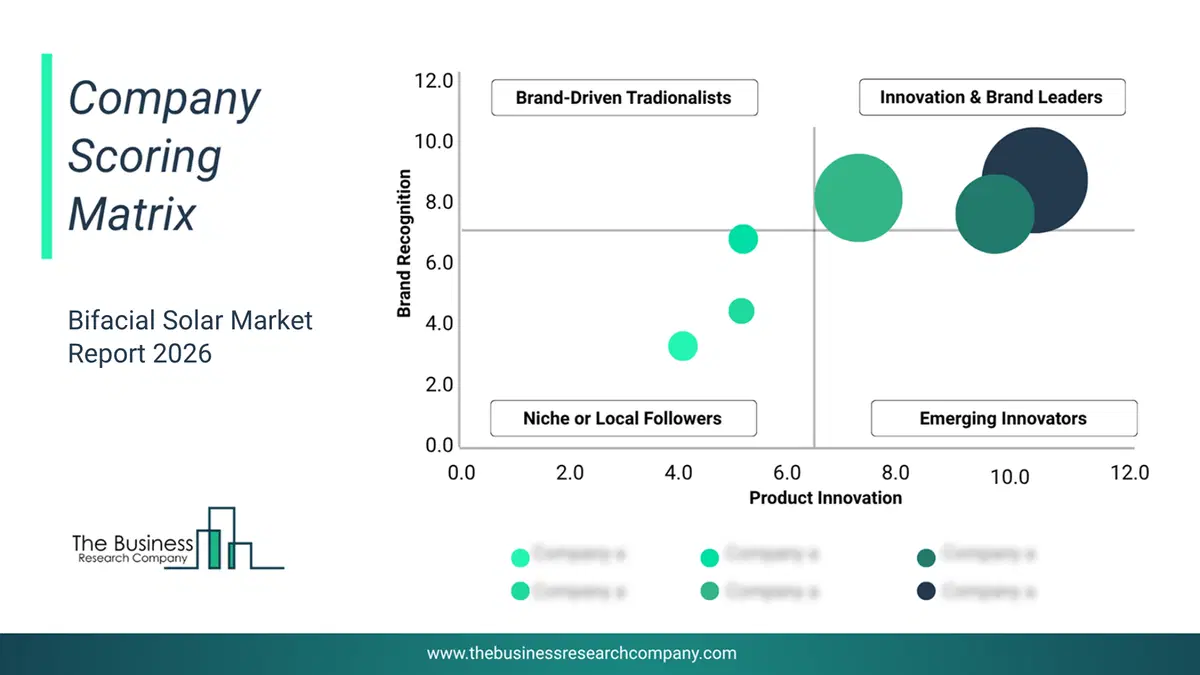
This chart maps companies by product innovation and brand strength, with bubble size indicating relative revenue, helping identify market leaders, challengers, and niche players. This is an illustrative chart; the full report provides a complete and accurate competitive analysis.
Global Bifacial Solar Market Trends and Insights
Major companies operating in the bifacial solar market are focusing on shifting towards advancements in bifacial solar technology, such as TOPCon bifacial PV modules, to gain a competitive edge in the market. TOPCon (Tunnel Oxide Passivated Contact) bifacial PV modules are advanced photovoltaic modules that combine TOPCon technology with bifacial capability. They are designed to capture sunlight from both sides of the module, enhancing energy generation efficiency compared to traditional monofacial modules. For instance, in April 2024, Adani Solar, an India-based solar manufacturing company, launched the 575 W TOPCon bifacial PV module, which offers high power output ranging from 550 W to 575 W with efficiencies up to 22.4%. Designed with domestic content compliance and featuring advanced specifications such as a transparent back sheet and robust performance warranties, these modules cater to demanding solar power projects globally.What Are Latest Mergers And Acquisitions In The Bifacial Solar Market?
In September 2024, Yashika Energy Systems Private Limited, an India-based solar developer, partnered with Next2Sun AG to enhance bifacial solar adoption in India. Through this partnership, Yashika Energy Systems and Next2Sun AG aim to accelerate the deployment of advanced vertical bifacial technology integrated with agricultural applications, enabling dual land use for both farming and energy generation while improving solar energy yield. Next2Sun AG is a Germany-based solar technology company that develops vertical bifacial PV systems capable of generating electricity from both sides of the solar panels, optimizing energy production and land efficiency.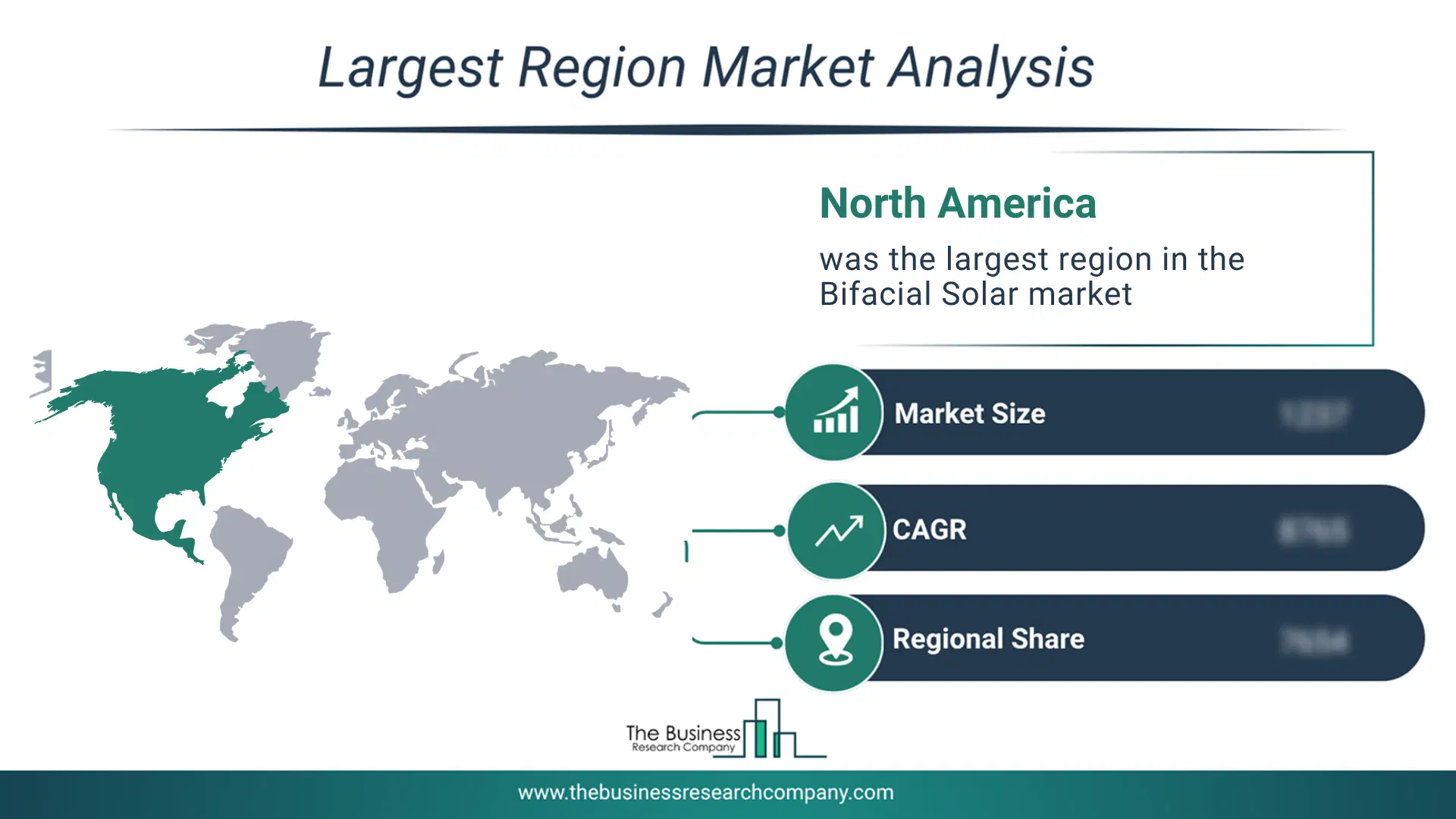
Regional Outlook
North America was the largest region in the bifacial solar market in 2025. Asia-Pacific is expected to be the fastest-growing region in the forecast period. The regions covered in this market report are Asia-Pacific, South East Asia, Western Europe, Eastern Europe, North America, South America, Middle East, Africa. The countries covered in this market report are Australia, Brazil, China, France, Germany, India, Indonesia, Japan, Taiwan, Russia, South Korea, UK, USA, Canada, Italy, SpainWhat Defines the Bifacial Solar Market?
The bifacial solar market consists of sales of bifacial solar panels, inverters, mounting systems, and monitoring solutions. Values in this market are ‘factory gate’ values, that is, the value of goods sold by the manufacturers or creators of the goods, whether to other entities (including downstream manufacturers, wholesalers, distributors, and retailers) or directly to end customers. The value of goods in this market includes related services sold by the creators of the goods.How is Market Value Defined and Measured?
The market value is defined as the revenues that enterprises gain from the sale of goods and/or services within the specified market and geography through sales, grants, or donations in terms of the currency (in USD unless otherwise specified). The revenues for a specified geography are consumption values that are revenues generated by organizations in the specified geography within the market, irrespective of where they are produced. It does not include revenues from resales along the supply chain, either further along the supply chain or as part of other products.
This chart presents market attractiveness based on a quantitative evaluation of growth, competition, strategic alignment, and risk, offering a clear view of opportunity areas for decision-making. This chart is for illustrative purposes; the full report contains the complete analysis.

This chart highlights the Total Addressable Market (TAM) by estimating the maximum revenue opportunity using an assumption-driven approach, supporting strategic planning and opportunity sizing across markets. The chart is illustrative; the full report provides a more comprehensive analysis.
What Key Data and Analysis Are Included in the Bifacial Solar Market Report 2026?
The bifacial solar market research report is one of a series of new reports from The Business Research Company that provides market statistics, including Market Report 2026?global market size, regional shares, competitors with the market share, detailed market segments, market trends and opportunities, and any further data you may need to thrive in the bifacial solar Market Report 2026? The market research report delivers a complete perspective of everything you need, with an in-depth analysis of the current and future state of the Market Report 2026?Bifacial Solar Market Report Forecast Analysis
| Report Attribute | Details |
|---|---|
| Market Size Value In 2026 | $11.8 billion |
| Revenue Forecast In 2030 | $19.74 billion |
| Growth Rate | CAGR of 13.8% from 2026 to 2030 |
| Base Year For Estimation | 2025 |
| Actual Estimates/Historical Data | 2020-2025 |
| Forecast Period | 2026 - 2030 - 2030 |
| Market Representation | Revenue in USD Billion and CAGR from 2026 to 2030 |
| Segments Covered | Type, Installation, Cell Type, End-User |
| Regional Scope | Asia-Pacific, Western Europe, Eastern Europe, North America, South America, Middle East, Africa |
| Country Scope | The countries covered in the report are Australia, Brazil, China, France, Germany, India, Indonesia, Japan, Taiwan, Russia, South Korea, UK, USA, Canada, Italy, Spain. |
| Key Companies Profiled | Reliance Industries Ltd, LG Electronics, LONGi Green Energy Technology Co. Ltd., Sharp Corporation, Trina Solar Co Ltd, Jinko Solar Holdings, JA Solar Technology Co. Ltd., Hanwha Solutions, Canadian Solar Inc., Risen Energy, First Solar Inc, Sun Power Corporation, GCL System Integration Technology Co Ltd, Wuxi Suntech Power Co. Ltd., Adani Green Energy Ltd, Zhongli Talesun Solar Co. Ltd, SoliTek, Seraphim Solar System Co. Ltd., Jiangsu Sunport Power Corp. Ltd., Yingli Green Energy Holding Co Ltd |
| Customization Scope | Request for Customization |
| Pricing And Purchase Options | Explore Purchase Options |