

Big Data Intelligence Engine Market Report 2026
Global Outlook – By Component (Software, Hardware, Services), By Deployment Mode (Cloud, On-Premises), By Analytics Type (Descriptive Analytics, Diagnostic Analytics, Predictive Analytics, Prescriptive Analytics), By Application (Customer Analytics, Fraud Detection And Risk Management, Operations Management, Sales And Marketing), By End-User Industry (Retail And E-Commerce, Healthcare And Life Sciences, Banking, Financial Services, And Insurance (BFSI), Telecommunications, Government, Manufacturing, Energy And Utilities, Media And Entertainment) – Market Size, Trends, Strategies, and Forecast to 2030
Big Data Intelligence Engine Market Overview
• Big Data Intelligence Engine market size has reached to $46.62 billion in 2025 • Expected to grow to $96.34 billion in 2030 at a compound annual growth rate (CAGR) of 15.6% • Growth Driver: The Increasing Data Volume Is Fueling The Growth Of The Market Due To The Rapid Generation Of Structured And Unstructured Information Across Sectors • Market Trend: Advancing Workflow Efficiency And Decision-Making With Conversational AI In Big Data Platforms • North America was the largest region in 2025 and Asia-Pacific is the fastest growing region.Market Gains By 2030 – Top Opportunities By Segment
Market Gain identifies the most promising market opportunities by highlighting the segments or products expected to generate the highest incremental revenue growth over the next five years.
What Is Covered Under Big Data Intelligence Engine Market?
A big data intelligence engine is an advanced system that integrates big data technologies, artificial intelligence, and machine learning to collect, process, and analyze vast amounts of structured and unstructured data from multiple sources in real time. Its purpose is to extract meaningful patterns, generate actionable insights, and support intelligent decision-making across various domains. A big data intelligence engine enables organizations to transform raw data into valuable knowledge, enhance automation, improve efficiency, and respond proactively to emerging trends or anomalies. The main components of big data intelligence engine are software, hardware, and services. Software refers to platforms and tools that collect, process, and analyze large volumes of data to generate actionable insights. The deployment modes are cloud and on-premises, with several analytics types, such as descriptive analytics, diagnostic analytics, predictive analytics, and prescriptive analytics. It is applied in various applications, including customer analytics, fraud detection and risk management, operations management, and sales and marketing, and is used by multiple end-user industries, such as retail and e-commerce, healthcare and life sciences, banking, financial services, and insurance (BFSI), telecommunications, government, manufacturing, energy and utilities, and media and entertainment.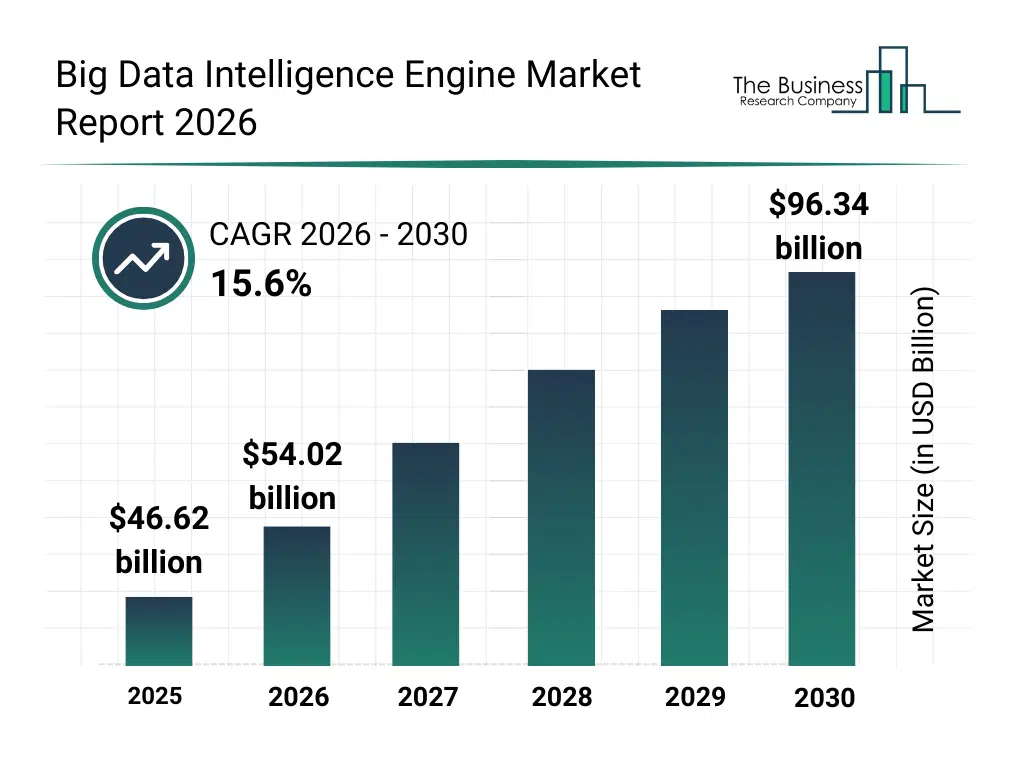
What Is The Big Data Intelligence Engine Market Size and Share 2026?
The big data intelligence engine market size has grown rapidly in recent years. It will grow from $46.62 billion in 2025 to $54.02 billion in 2026 at a compound annual growth rate (CAGR) of 15.9%. The growth in the historic period can be attributed to rise of big data platforms, adoption of AI and ml analytics, increasing enterprise reliance on structured and unstructured data, demand for real-time insights, growth in data storage infrastructure.What Is The Big Data Intelligence Engine Market Growth Forecast?
The big data intelligence engine market size is expected to see rapid growth in the next few years. It will grow to $96.34 billion in 2030 at a compound annual growth rate (CAGR) of 15.6%. The growth in the forecast period can be attributed to expansion of predictive analytics adoption, integration with cloud AI services, enhanced automation in decision-making, use of streaming analytics platforms, implementation of advanced data visualization tools. Major trends in the forecast period include predictive analytics engines, real-time data processing platforms, AI-powered decision support, advanced pattern recognition, automated knowledge extraction.
Global Big Data Intelligence Engine Market Segmentation
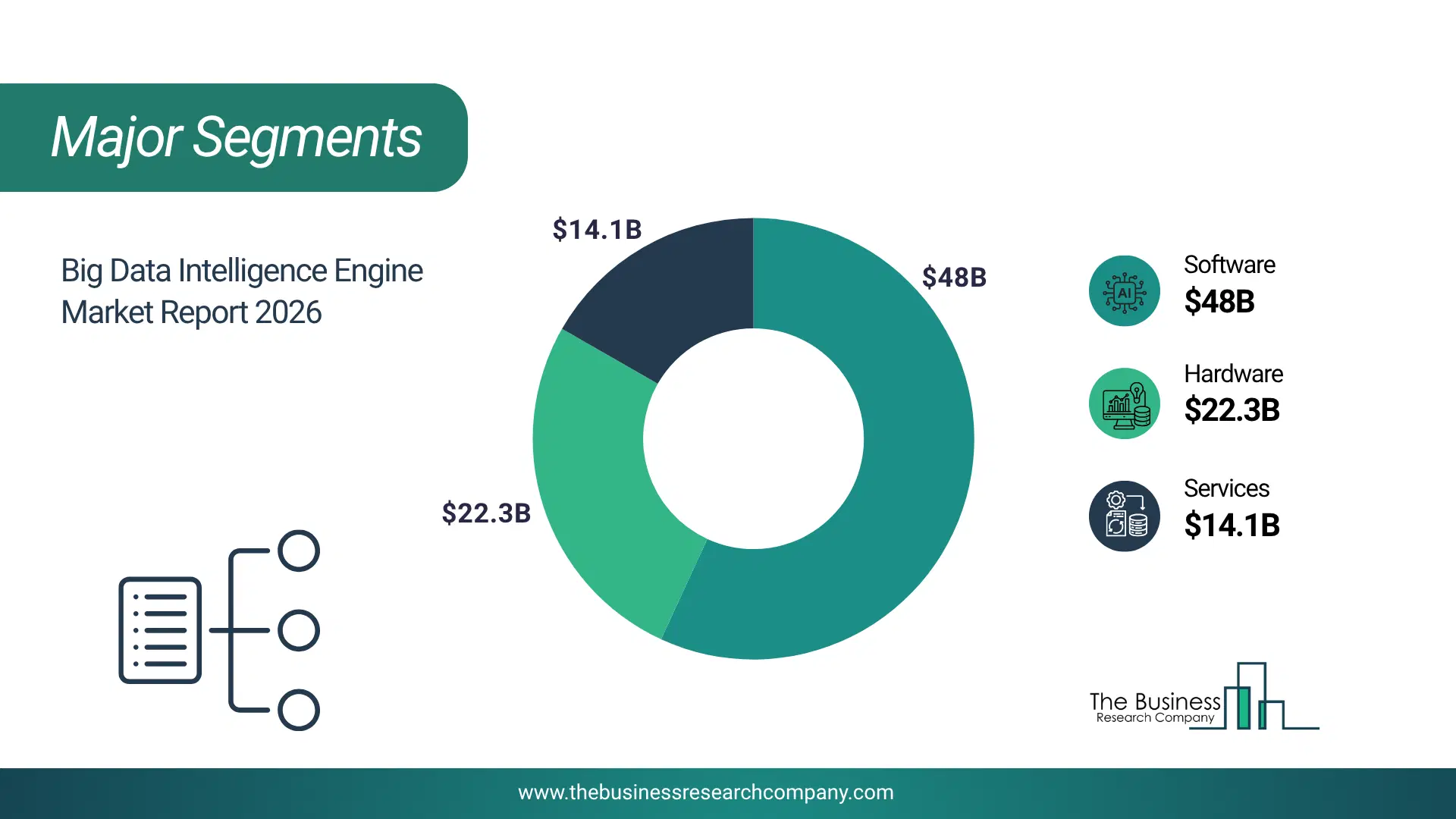
1) By Component: Software, Hardware, Services 2) By Deployment Mode: Cloud, On-Premises 3) By Analytics Type: Descriptive Analytics, Diagnostic Analytics, Predictive Analytics, Prescriptive Analytics 4) By Application: Customer Analytics, Fraud Detection And Risk Management, Operations Management, Sales And Marketing 5) By End-User Industry: Retail And E-Commerce, Healthcare And Life Sciences, Banking, Financial Services, And Insurance (BFSI), Telecommunications, Government, Manufacturing, Energy And Utilities, Media And Entertainment Subsegments: 1) By Software: Data Integration Software, Data Analytics Software, Data Visualization Software, Extract Transform Load (ETL) Tools, Data Quality Management Software, Artificial Intelligence (AI) And Machine Learning (ML) Platforms, Streaming Analytics Platforms 2) By Hardware: Data Storage Appliances, High-Performance Servers, Network Infrastructure Devices, Edge Computing Devices 3) By Services: Managed Big Data Services, Consulting Services, System Integration Services, Support And Maintenance Services The top segments in the big data intelligence engine market will be: • Software will reach $47.92 billion by 2030. • Hardware will reach $22.2 billion by 2030. • Services will reach $14.01 billion by 2030.What Is The Driver Of The Big Data Intelligence Engine Market?
The increasing data volume is expected to propel the growth of the big data intelligence engine market going forward. Data volume refers to the vast amounts of structured and unstructured information generated daily across various sectors. Data volume is increasing as the growing use of digital devices continuously produces vast amounts of information, fueling rapid growth in data storage requirements. A big data intelligence engine manages growing data volumes by efficiently capturing, storing, and processing large datasets in real time and allows organizations to analyze and extract insights quickly, keeping data actionable and scalable. For instance, in November 2024, according to the International Telecommunication Union, a Switzerland-based specialized agency, fixed broadband traffic grew to 6 zettabytes (ZB) in 2024, up from 5.1 ZB in 2023, reflecting about an 18% increase year over year. Therefore, increasing data volume is driving the growth of the big data intelligence engine industry.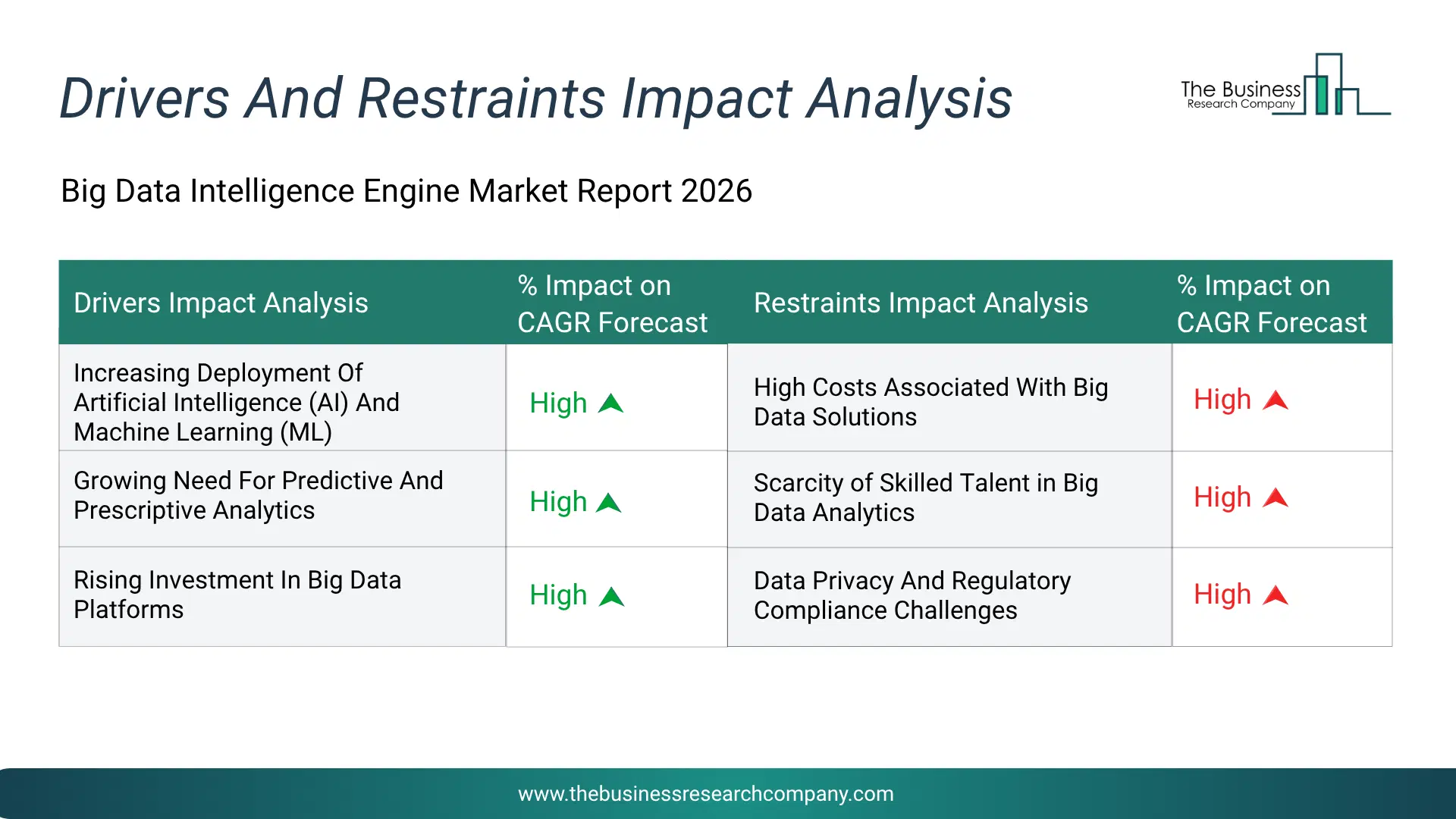
Infographic Chart Showing Key Market Drivers Analysis And Restraints For Big Data Intelligence Engine Market
The chart presents an impact analysis of key drivers and restraints, quantifying their relative influence on the market's growth rate and helping assess the balance between growth enablers and limiting factors. This chart offers a high-level perspective; the full report contains more detailed insights.
How Will The Drivers Impact Growth In The Global Big Data Intelligence Engine Market?
• Increasing Deployment Of Artificial Intelligence (AI) And Machine Learning (ML) (High) – During the forecast period, the increasing deployment of artificial intelligence (ai) and machine learning (ml) is expected to become a key growth driver for the big data intelligence engine market by 2030. Organizations across sectors are integrating ai and ml technologies into data platforms to automate complex data analysis, uncover hidden patterns, and generate actionable insights from large and diverse datasets. These technologies enable intelligent data processing, anomaly detection, and predictive modeling, helping enterprises improve operational efficiency and strategic planning. As businesses increasingly rely on ai -powered analytics to gain competitive advantages and optimize decision -making processes, demand for advanced data intelligence engines is expected to rise steadily. • Growing Need For Predictive And Prescriptive Analytics (High) – During the forecast period, the growing need for predictive and prescriptive analytics is expected to emerge as a major factor driving the expansion of the big data intelligence engine market by 2030. Enterprises are increasingly leveraging advanced analytics tools to forecast future trends, optimize resource allocation, and improve risk management strategies. Predictive analytics enables organizations to anticipate market changes, customer behavior, and operational disruptions, while prescriptive analytics recommends optimal actions based on data-driven insights. Industries such as finance, healthcare, retail, and manufacturing are rapidly adopting these analytics capabilities to enhance strategic planning and operational efficiency. • Rising Investment In Big Data Platforms (High) – During the forecast period, rising investment in big data platforms is expected to act as a key growth catalyst for the big data intelligence engine market by 2030. Enterprises and governments are increasing spending on advanced data infrastructure, including cloud-based analytics platforms, distributed computing frameworks, and scalable data storage systems. These investments support the management and analysis of massive volumes of structured and unstructured data generated across digital ecosystems. As organizations accelerate digital transformation initiatives and seek to harness the full value of enterprise data assets, demand for sophisticated big data intelligence engines is expected to grow significantly.How Will The Restraints Impact Growth In The Global Big Data Intelligence Engine Market?
• High Costs Associated With Big Data Solutions (High) – During the forecast period, the the high costs of implementing and maintaining big data intelligence engines act as a major restraint on market growth, as organizations must invest significantly in hardware, software, and skilled personnel. Small and medium-sized enterprises (smes), in particular, may face budget constraints that limit their ability to adopt advanced analytics solutions. Additionally, ongoing operational and maintenance expenses add to the financial burden, slowing down adoption rates. As a result, the high cost of big data solutions restricts market expansion and delays broader deployment across industries. • Scarcity of Skilled Talent in Big Data Analytics (High) – During the forecast period, the the shortage of qualified professionals in big data analytics is another key restraint that limits market growth. Organizations often struggle to find experts capable of managing complex data environments, developing machine learning models, and ensuring data quality. This talent gap can lead to inefficiencies, delayed project execution, and underutilization of advanced big data tools. Consequently, the scarcity of skilled personnel slows the adoption of big data intelligence engines and constrains the overall growth of the market. • Data Privacy And Regulatory Compliance Challenges (High) – During the forecast period, the big data intelligence engines process vast amounts of structured and unstructured data, often including sensitive customer and business information. Compliance with evolving data privacy regulations such as gdpr, ccpa, and other regional data protection laws can be complex and resource-intensive. Organizations must invest heavily in governance frameworks, security controls, and compliance monitoring systems. Failure to meet regulatory requirements can result in substantial financial penalties, reputational damage, and reduced adoption of big data intelligence solutions.Key Players In The Global Big Data Intelligence Engine Market
Major companies operating in the big data intelligence engine market are Google LLC, Microsoft Corporation, Alibaba Cloud Computing Co Ltd, Amazon Web Services Inc, Dell Technologies Inc., Huawei Technologies Co Ltd, Tencent Cloud International Limited, International Business Machines Corporation, Cisco Systems Inc, Oracle Corporation, Salesforce Inc, SAP SE, Hewlett Packard Enterprise Company, SAS Institute Inc, Databricks Inc, Snowflake Inc, Palantir Technologies Inc, Teradata Corporation, MicroStrategy Incorporated, Domo Inc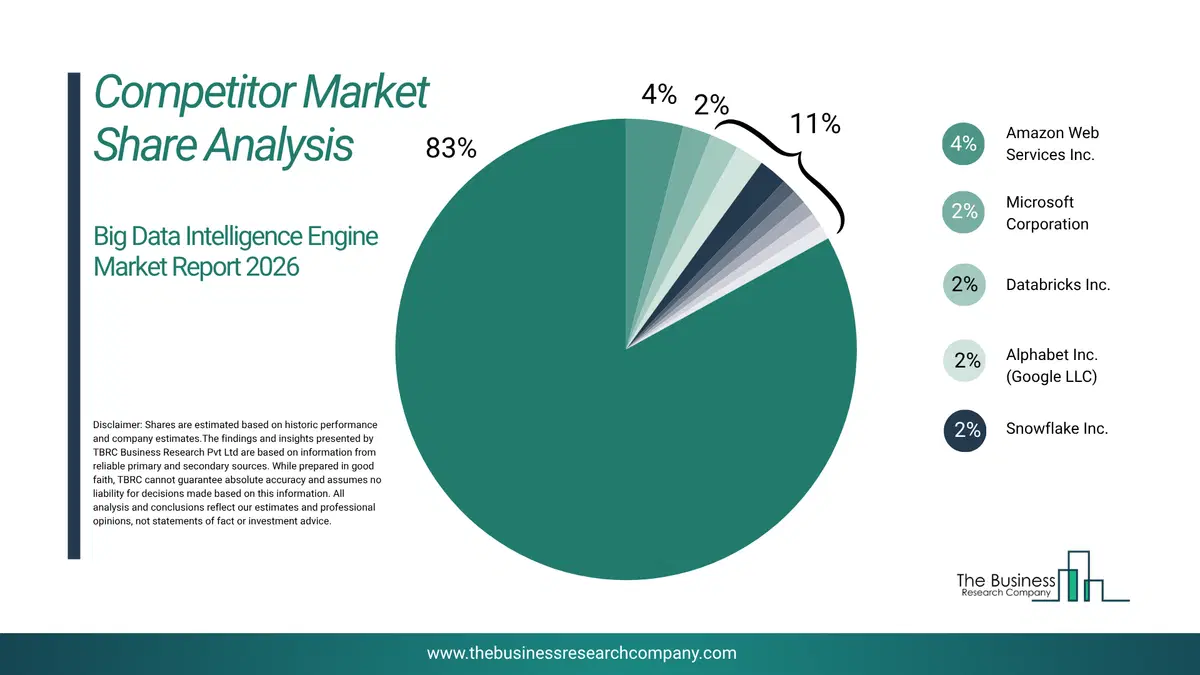
This chart is for illustrative purposes; the full report includes a detailed competitor analysis and comprehensive overview of the top 10 companies in the market.
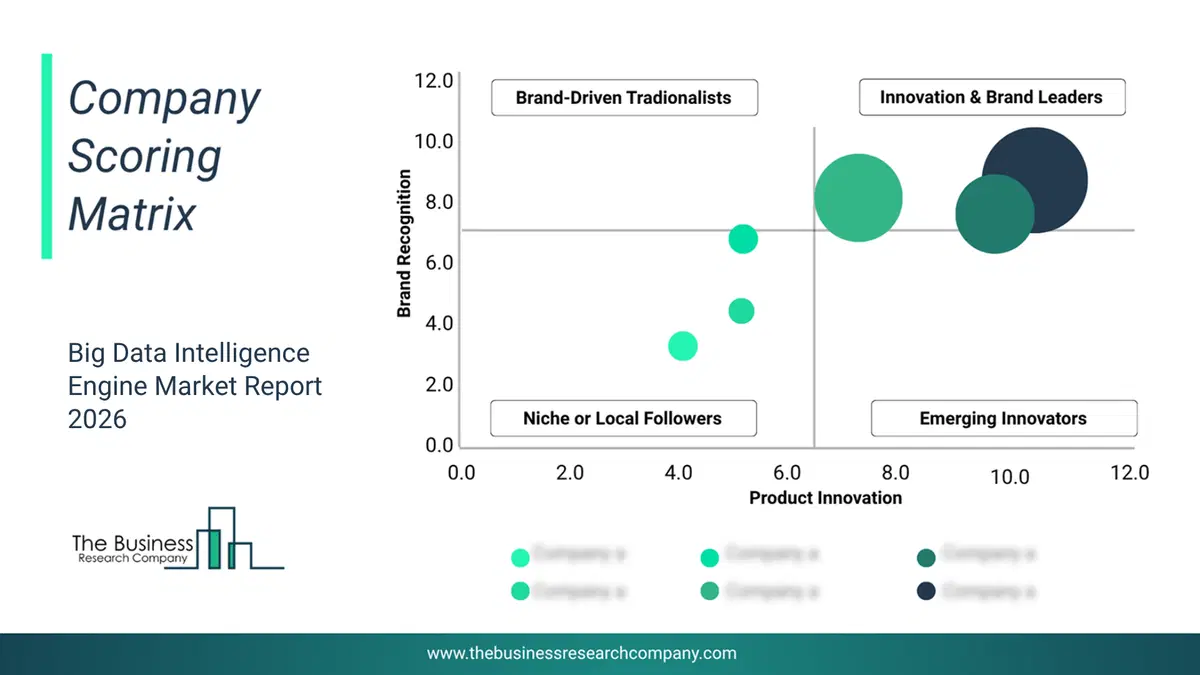
This chart maps companies by product innovation and brand strength, with bubble size indicating relative revenue, helping identify market leaders, challengers, and niche players. This is an illustrative chart; the full report provides a complete and accurate competitive analysis.
Global Big Data Intelligence Engine Market Trends and Insights
Major companies operating in the big data intelligence engine market are focusing on developing advanced solutions such as conversational artificial intelligence (AI) to enhance workflow efficiency and decision-making. Conversational AI is an intelligent interface that allows users to interact with vast datasets through natural language queries, providing auditable answers and actionable insights while reducing manual research efforts. For instance, in November 2024, FactSet, a US-based provider of financial digital platforms and enterprise solutions, launched the Intelligent Platform initiative featuring FactSet Mercury, a conversational knowledge engine integrated with AI-powered solutions through a global assistant. The platform offers Enterprise AI Building Blocks to bring AI technology in-house, a Conversational API for embedding Mercury-powered chatbots into client systems, and GenAI Data Packages to consolidate critical data feeds. Its key features include Pitch Creator, which automates pitch book creation for bankers and analysts, Portfolio Commentary, providing AI-generated analysis of portfolio performance with enhanced search and customization, IRN 2.0, a research management tool for buy-side analysts and portfolio managers, and an expanded corporate solution that enables structured and unstructured data search to support Investor Relations and Corporate Strategy teams.What Are Latest Mergers And Acquisitions In The Big Data Intelligence Engine Market?
In March 2024, Cisco Systems, Inc., a US-based networking and information technology infrastructure company, acquired Splunk Inc. for $28 billion. Through this acquisition, Cisco aims to strengthen its cybersecurity capabilities, expand observability solutions, and accelerate the adoption of artificial intelligence-driven innovations across digital systems. Splunk Inc. is a US-based software company that provides a big data collection and analytics platform to derive insights from large volumes of machine data.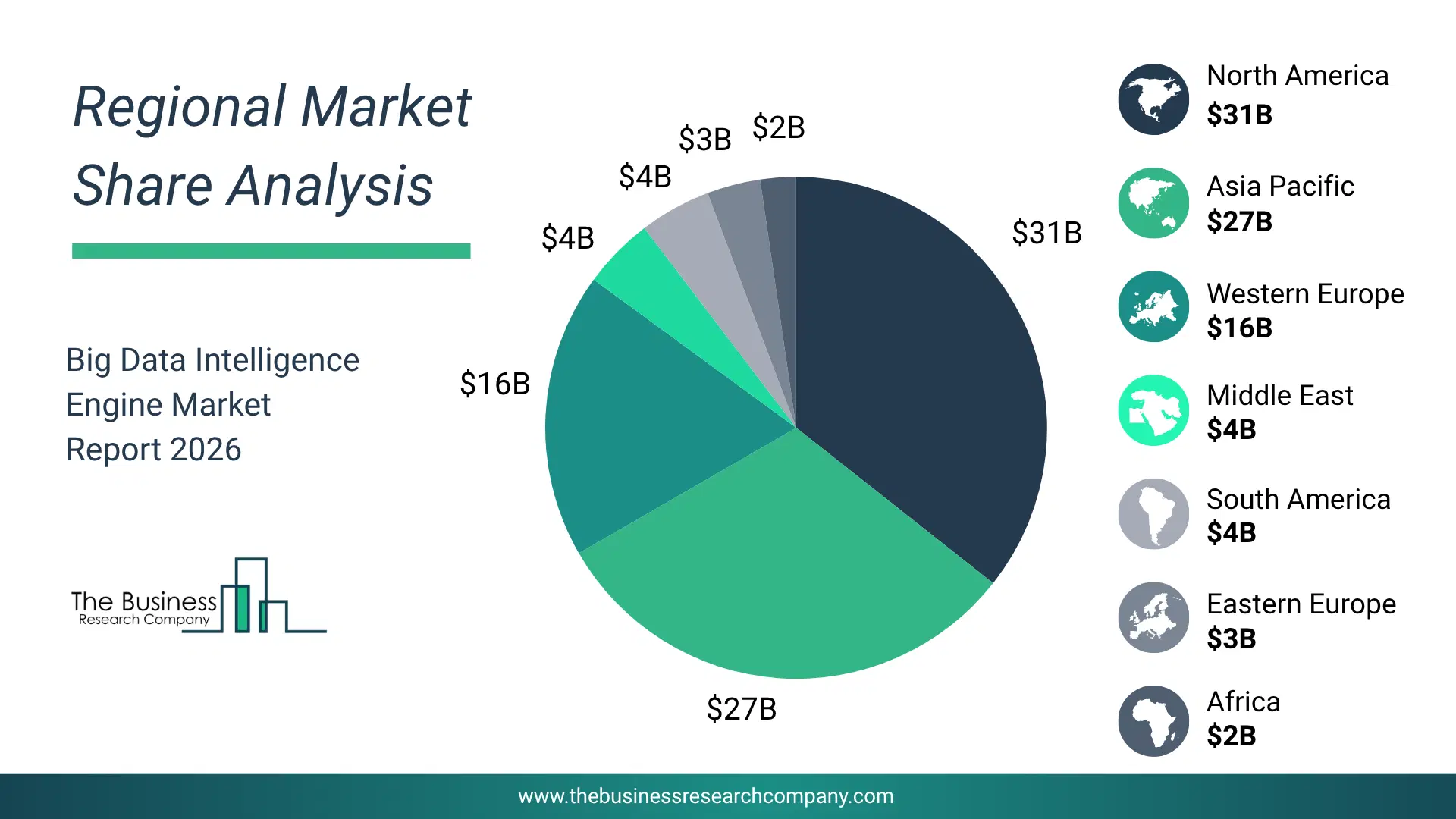
Regional Insights
North America was the largest region in the big data intelligence engine market in 2025. Asia-Pacific is expected to be the fastest-growing region in the forecast period. The regions covered in this market report are Asia-Pacific, South East Asia, Western Europe, Eastern Europe, North America, South America, Middle East, Africa. The countries covered in this market report are Australia, Brazil, China, France, Germany, India, Indonesia, Japan, Taiwan, Russia, South Korea, UK, USA, Canada, Italy, Spain.What Defines the Big Data Intelligence Engine Market?
The big data intelligence engine market consists of revenues earned by entities by providing services such as data collection and integration, data processing and transformation, real-time analytics and reporting, and predictive and prescriptive modeling. The market value includes the value of related goods sold by the service provider or included within the service offering. The big data intelligence engine market also includes sales of data storage appliances, high-performance servers, network infrastructure devices, and edge computing devices. Values in this market are ‘factory gate’ values, that is, the value of goods sold by the manufacturers or creators of the goods, whether to other entities (including downstream manufacturers, wholesalers, distributors, and retailers) or directly to end customers. The value of goods in this market includes related services sold by the creators of the goods.How is Market Value Defined and Measured?
The market value is defined as the revenues that enterprises gain from the sale of goods and/or services within the specified market and geography through sales, grants, or donations in terms of the currency (in USD unless otherwise specified). The revenues for a specified geography are consumption values that are revenues generated by organizations in the specified geography within the market, irrespective of where they are produced. It does not include revenues from resales along the supply chain, either further along the supply chain or as part of other products.
This chart presents market attractiveness based on a quantitative evaluation of growth, competition, strategic alignment, and risk, offering a clear view of opportunity areas for decision-making. This chart is for illustrative purposes; the full report contains the complete analysis.

This chart highlights the Total Addressable Market (TAM) by estimating the maximum revenue opportunity using an assumption-driven approach, supporting strategic planning and opportunity sizing across markets. The chart is illustrative; the full report provides a more comprehensive analysis.
What Key Data and Analysis Are Included in the Big Data Intelligence Engine Market Report 2026?
The big data intelligence engine market research report is one of a series of new reports from The Business Research Company that provides market statistics, including industry global market size, regional shares, competitors with the market share, detailed market segments, market trends and opportunities, and any further data you may need to thrive in the big data intelligence engine industry. The market research report delivers a complete perspective of everything you need, with an in-depth analysis of the current and future state of the industry.Big Data Intelligence Engine Market Report Forecast Analysis
| Report Attribute | Details |
|---|---|
| Market Size Value In 2026 | $54.02 billion |
| Revenue Forecast In 2030 | $96.34 billion |
| Growth Rate | CAGR of 15.6% from 2026 to 2030 |
| Base Year For Estimation | 2025 |
| Actual Estimates/Historical Data | 2020-2025 |
| Forecast Period | 2026 - 2030 |
| Market Representation | Revenue in USD Billion and CAGR from 2026 to 2030 |
| Segments Covered | Component, Deployment Mode, Analytics Type, Application, End-User Industry |
| Regional Scope | Asia-Pacific, Western Europe, Eastern Europe, North America, South America, Middle East, Africa |
| Country Scope | The countries covered in the report are Australia, Brazil, China, France, Germany, India, ... |
| Key Companies Profiled | Google LLC, Microsoft Corporation, Alibaba Cloud Computing Co Ltd, Amazon Web Services Inc, Dell Technologies Inc., Huawei Technologies Co Ltd, Tencent Cloud International Limited, International Business Machines Corporation, Cisco Systems Inc, Oracle Corporation, Salesforce Inc, SAP SE, Hewlett Packard Enterprise Company, SAS Institute Inc, Databricks Inc, Snowflake Inc, Palantir Technologies Inc, Teradata Corporation, MicroStrategy Incorporated, Domo Inc |
| Customization Scope | Request for Customization |
| Pricing And Purchase Options | Explore Purchase Options |