

Bio-Based Epoxy Resin Market Report 2026
Global Outlook – By Type (Vegetable Oil-Based, Soybean Oil-Based, Cardanol-Based, Furan-Based, Lignin-Based, Other Types), By Curing Method (Thermal Curing, Ultraviolet (UV) Curing, Chemical Curing), By Reactive Diluent (Bio-Based Glycidyl Ethers, Bio-Based Diluents), By Application (Paints And Coatings, Adhesives, Composites, Laminates, Other Applications), By End-Use (Building And Construction, Automotive And Transportation, Wind Energy, Consumer Goods, General Industrial, Other End-Users) – Market Size, Trends, Strategies, and Forecast to 2030
Bio-Based Epoxy Resin Market Overview
• Bio-Based Epoxy Resin market size has reached to $3.88 billion in 2025 • Expected to grow to $5.58 billion in 2030 at a compound annual growth rate (CAGR) of 7.5% • Growth Driver: Increasing Demand For Renewable Energy Is Fueling The Market Growth Due To The Shift Toward Low-Carbon Energy Solutions • Market Trend: Innovation in Sustainable Bio-Based Epoxy Resin Development Replacing Harmful Chemicals With Eco-Friendly Alternatives • Asia-Pacific was the largest region and fastest growing region.What Is Covered Under Bio-Based Epoxy Resin Market?
Bio-based epoxy resin is a type of epoxy resin formulated using plant-derived or renewable raw materials instead of traditional petroleum-based sources. These resins maintain the core performance characteristics of conventional epoxies-such as strong adhesion, chemical resistance, and durability-while offering a more sustainable and environmentally friendly alternative. The main types of bio-based epoxy resin are vegetable oil-based, soybean oil-based, cardanol-based, furan-based, lignin-based, and other types. Vegetable oil-based bio-epoxy resins are derived from natural oils such as linseed, castor, or palm oil, which are processed into epoxy monomers that can replace traditional petroleum-based inputs. The various curing methods for these resins include thermal curing, ultraviolet (UV) curing, moisture curing, and chemical curing. The various reactive diluents consist of bio-based glycidyl ethers and other bio-based diluents. They are used in various applications, including paints and coatings, adhesives, composites, laminates, and others. They serve multiple end-use industries such as building and construction, automotive and transportation, wind energy, consumer goods, general industrial, and other end-users.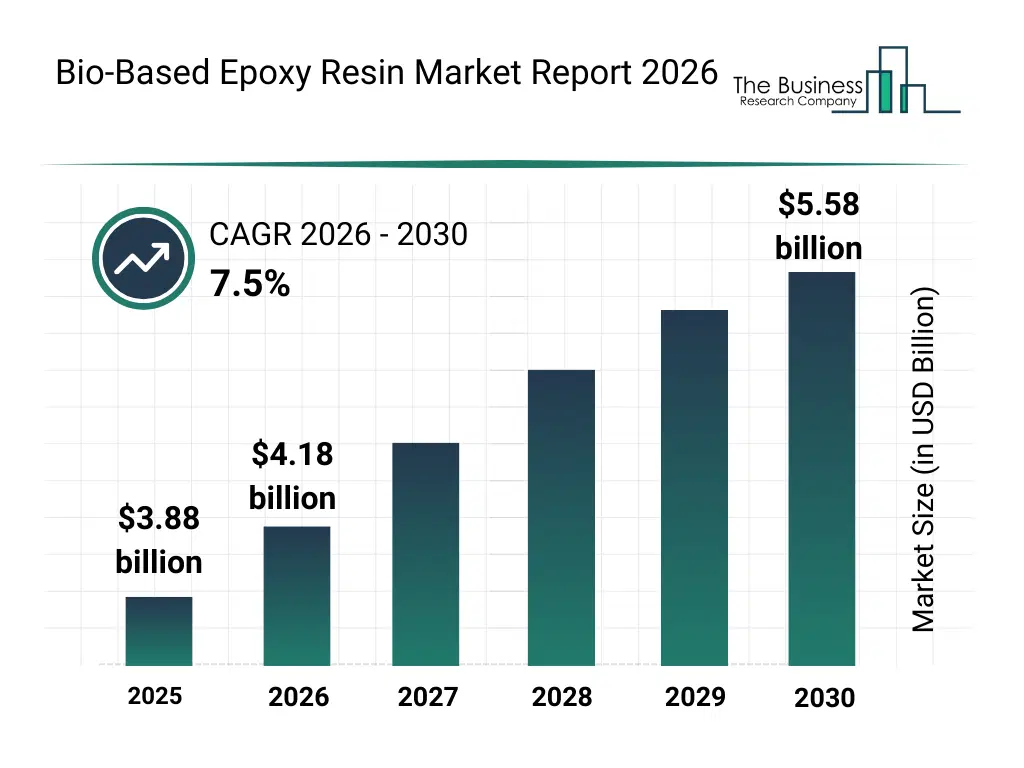
What Is The Bio-Based Epoxy Resin Market Size and Share 2026?
The bio-based epoxy resin market size has grown strongly in recent years. It will grow from $3.88 billion in 2025 to $4.18 billion in 2026 at a compound annual growth rate (CAGR) of 7.8%. The growth in the historic period can be attributed to early bio resin R&D investments, volatility in petroleum prices, sustainability regulations, adoption in niche composites, academic material research.What Is The Bio-Based Epoxy Resin Market Growth Forecast?
The bio-based epoxy resin market size is expected to see strong growth in the next few years. It will grow to $5.58 billion in 2030 at a compound annual growth rate (CAGR) of 7.5%. The growth in the forecast period can be attributed to green construction growth, wind energy expansion, low VOC coating demand, bio-based material innovation, corporate sustainability commitments. Major trends in the forecast period include rising adoption of renewable raw material resins, growing use in sustainable coatings and adhesives, increased demand from wind energy applications, expansion of bio-based composite materials, focus on performance parity with petro-based epoxies.
Global Bio-Based Epoxy Resin Market Segmentation
1) By Type: Vegetable Oil-Based, Soybean Oil-Based, Cardanol-Based, Furan-Based, Lignin-Based, Other Types 2) By Curing Method: Thermal Curing, Ultraviolet (UV) Curing, Chemical Curing 3) By Reactive Diluent: Bio-Based Glycidyl Ethers, Bio-Based Diluents 4) By Application: Paints And Coatings, Adhesives, Composites, Laminates, Other Applications 5) By End-Use: Building And Construction, Automotive And Transportation, Wind Energy, Consumer Goods, General Industrial, Other End-Users Subsegments: 1) By Vegetable Oil-Based: Castor Oil-Based, Palm Oil-Based, Linseed Oil-Based, Sunflower Oil-Based 2) By Soybean Oil-Based: Epoxidized Soybean Oil (ESO), Acrylated Epoxidized Soybean Oil (AESO), Hydrolyzed Soybean Oil Derivatives 3) By Cardanol-Based: Mono-Functional Cardanol Epoxies, Di-Functional Cardanol Epoxies, Tri-Functional Cardanol Epoxies 4) By Furan-Based: Furfuryl Alcohol Epoxies, Furan-2,5-Dicarboxylic Acid (FDCA)-Based Epoxies, Hydroxymethyl Furan Derivatives 5) By Lignin-Based: Kraft Lignin-Based Epoxies, Organosolv Lignin-Based Epoxies, Sulfite Lignin-Based Epoxies 6) By Other Types: Cellulose-Based Epoxies, Tannin-Based Epoxies, Sugar-Derived Epoxy ResinsWhat Are The Drivers Of The Bio-Based Epoxy Resin Market?
The increasing demand for renewable energy is expected to propel the growth of the bio-based epoxy resin market going forward. Renewable energy is energy generated from natural sources that are continuously replenished, such as solar, wind, hydro, and geothermal power. The rising demand for renewable energy is primarily driven by the increasing need to reduce greenhouse gas emissions, as countries and industries aim to transition away from fossil fuels to mitigate climate change and meet global climate targets. Bio-based epoxy resin supports renewable energy by providing a sustainable, high-performance alternative to petroleum-based resins used in wind turbine blades and solar panel components, enhancing durability while reducing environmental impact. For instance, in December 2024, according to the Eurostat, a Luxembourg-based government agency, in 2023, renewable energy represented 24.5% of the European Union's total energy consumption, up from 23.0% in 2022. Therefore, the increasing demand for renewable energy is driving the growth of the bio-based epoxy resin industry. The growth in the automotive industry is expected to propel the demand for based epoxy resin going forward. The automotive industry refers to the global sector involved in the design, development, production, marketing, and sale of motor vehicles. Growth in the automotive industry is driven by increasing consumer demand, rising disposable incomes, and expanding urbanization, which together fuel higher vehicle production and sales. This growth, in turn, boosts demand for advanced materials such as based epoxy resins, which are widely used for coatings, adhesives, composites, and structural components due to their high strength, durability, and chemical resistance. For instance, in October 2025, according to a report published by ICAEW (Institute of Chartered Accountants in England and Wales), a UK-based professional body, worldwide motor-vehicle sales reached approximately 95 million units in 2024, representing an increase from 92.8 million units sold in 2023. Therefore, the growth in the automotive industry is driving the demand for based epoxy resin market.Key Players In The Global Bio-Based Epoxy Resin Market
Major companies operating in the bio-based epoxy resin market are Cargill Incorporated, Sika AG, Kaneka Corporation, Cardolite Corporation, Sicomin Holding, Gougeon Brothers Inc., Bitrez Limited, EcoPoxy USA Inc., RESOLTECH SAS, Entropy Resins Inc., INCA Renewtech Inc., Wessex Resins and Adhesives Limited, Specific Polymers S.A.S., Aditya Birla Speciality Chemicals Private Limited, Huntsman Corporation, Olin Corporation, Hexion Inc., Chang Chun Group, Nan Ya Plastics Corporation, Mitsubishi Chemical Group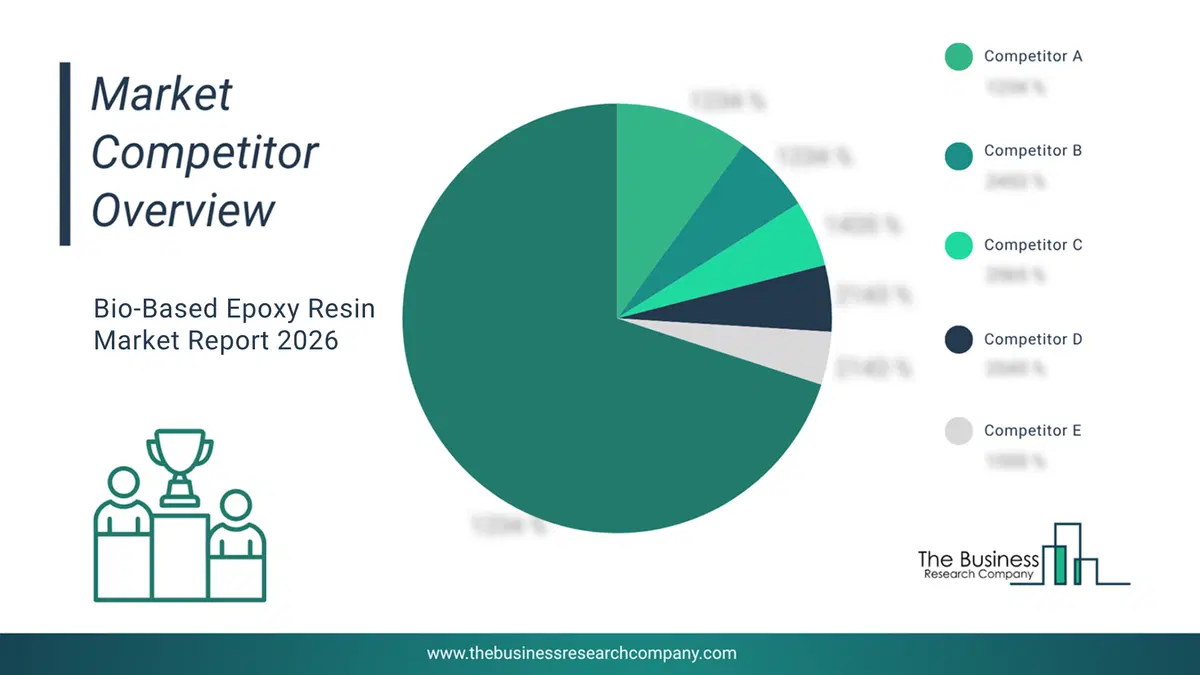
This chart is for illustrative purposes; the full report includes a detailed competitor analysis and comprehensive overview of the top 10 companies in the market.
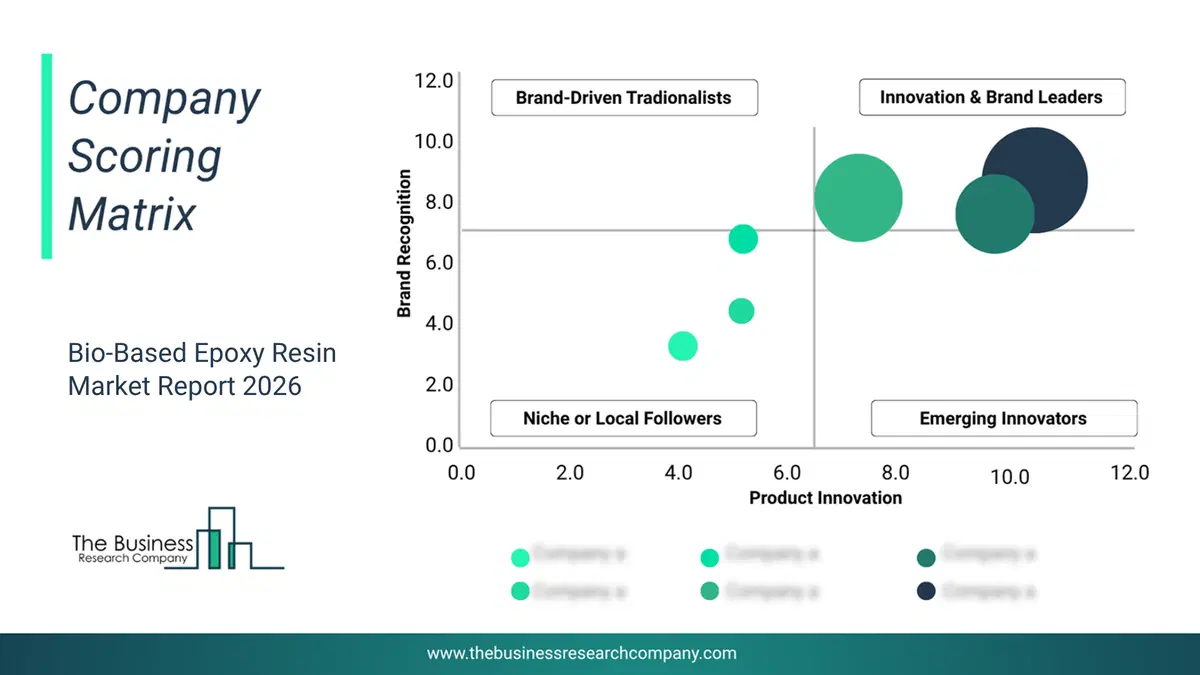
This chart maps companies by product innovation and brand strength, with bubble size indicating relative revenue, helping identify market leaders, challengers, and niche players. This is an illustrative chart; the full report provides a complete and accurate competitive analysis.
Global Bio-Based Epoxy Resin Market Trends and Insights
Major companies operating in the bio-based epoxy resin market are developing bio-based epoxy coatings using lignin to create sustainable, eco-friendly alternatives that reduce reliance on harmful chemicals like Bisphenol A while maintaining high performance and durability. Bio-based epoxy coatings using lignin are environmentally friendly protective finishes formulated by replacing traditional petroleum-derived components with lignin, a natural polymer from plant biomass, to reduce toxicity and enhance sustainability without compromising performance. For instance, in July 2024, AGC Vinythai Public Company Limited, a Thailand-based chemical manufacturing company, partnered with Michigan State University (MSU), a Michigan-based university to develop fully bio-based epoxy coatings using lignin as a sustainable alternative to Bisphenol A. With this partnership, the aim is to develop sustainable, 100% bio-based epoxy resins and coatings utilizing bio-based epichlorohydrin, thereby reducing the environmental impact of industrial resins and coatings while maintaining high performance and safety standards.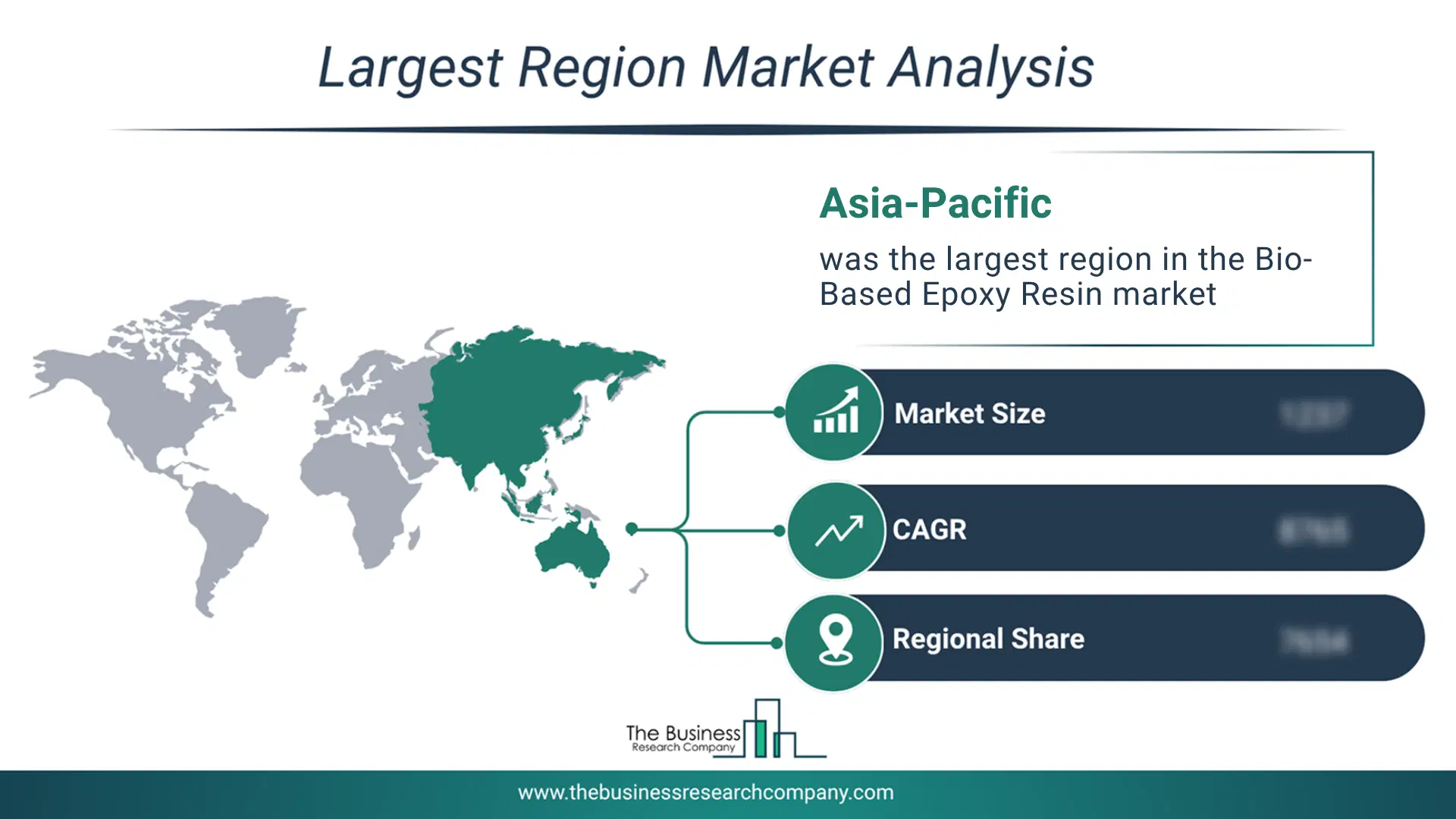
Regional Insights
Asia-Pacific was the largest region in the bio-based epoxy resin market in 2025. The regions covered in this market report are Asia-Pacific, South East Asia, Western Europe, Eastern Europe, North America, South America, Middle East, Africa The countries covered in this market report are Australia, Brazil, China, France, Germany, India, Indonesia, Japan, Taiwan, Russia, South Korea, UK, USA, Canada, Italy, SpainWhat Defines the Bio-Based Epoxy Resin Market?
The bio-based epoxy resin market consists of sales of hardener systems, epoxy adhesives, epoxy coatings, epoxy composites for automotive and aerospace, epoxy flooring systems, electrical and electronic encapsulants. Values in this market are ‘factory gate’ values, that is, the value of goods sold by the manufacturers or creators of the goods, whether to other entities (including downstream manufacturers, wholesalers, distributors, and retailers) or directly to end customers. The value of goods in this market includes related services sold by the creators of the goods.How is Market Value Defined and Measured?
The market value is defined as the revenues that enterprises gain from the sale of goods and/or services within the specified market and geography through sales, grants, or donations in terms of the currency (in USD unless otherwise specified). The revenues for a specified geography are consumption values that are revenues generated by organizations in the specified geography within the market, irrespective of where they are produced. It does not include revenues from resales along the supply chain, either further along the supply chain or as part of other products.
This chart presents market attractiveness based on a quantitative evaluation of growth, competition, strategic alignment, and risk, offering a clear view of opportunity areas for decision-making. This chart is for illustrative purposes; the full report contains the complete analysis.

This chart highlights the Total Addressable Market (TAM) by estimating the maximum revenue opportunity using an assumption-driven approach, supporting strategic planning and opportunity sizing across markets. The chart is illustrative; the full report provides a more comprehensive analysis.
What Key Data and Analysis Are Included in the Bio-Based Epoxy Resin Market Report 2026?
The bio-based epoxy resin market research report is one of a series of new reports from The Business Research Company that provides market statistics, including industry global market size, regional shares, competitors with the market share, detailed market segments, market trends and opportunities, and any further data you may need to thrive in the bio-based epoxy resin industry. The market research report delivers a complete perspective of everything you need, with an in-depth analysis of the current and future state of the industry.Bio Based Epoxy Resin Market Report Forecast Analysis
| Report Attribute | Details |
|---|---|
| Market Size Value In 2026 | $4.18 billion |
| Revenue Forecast In 2030 | $5.58 billion |
| Growth Rate | CAGR of 7.8% from 2026 to 2030 |
| Base Year For Estimation | 2025 |
| Actual Estimates/Historical Data | 2020-2025 |
| Forecast Period | 2026 - 2030 |
| Market Representation | Revenue in USD Billion and CAGR from 2026 to 2030 |
| Segments Covered | Type, Curing Method, Reactive Diluent, Application, End-Use |
| Regional Scope | Asia-Pacific, Western Europe, Eastern Europe, North America, South America, Middle East, Africa |
| Country Scope | The countries covered in this market report are Australia, Brazil, China, France, Germany, India, Indonesia, Japan, Taiwan, Russia, South Korea, UK, USA, Canada, Italy, Spain |
| Key Companies Profiled | Cargill Incorporated, Sika AG, Kaneka Corporation, Cardolite Corporation, Sicomin Holding, Gougeon Brothers Inc., Bitrez Limited, EcoPoxy USA Inc., RESOLTECH SAS, Entropy Resins Inc., INCA Renewtech Inc., Wessex Resins and Adhesives Limited, Specific Polymers S.A.S., Aditya Birla Speciality Chemicals Private Limited, Huntsman Corporation, Olin Corporation, Hexion Inc., Chang Chun Group, Nan Ya Plastics Corporation, Mitsubishi Chemical Group |
| Customization Scope | Request for Customization |
| Pricing And Purchase Options | Explore Purchase Options |