
Bio-Based Nonionic Surfactants Market Report 2026
Global Outlook – By Product Type (Alkyl Polyglucosides, Fatty Alcohol Ethoxylates, Sorbitan Esters, Sucrose Esters, Other Product Types), By Source (Plant-Based, Animal-Based, Other Sources), By Form (Liquid, Paste, Powder Or Flakes, Blends Or Systems), By Application (Detergents And Cleaners, Personal Care, Industrial And Institutional Cleaning, Agriculture, Oilfield Chemicals, Other Applications), By End User (Household, Industrial, Commercial, Other End Users) – Market Size, Trends, Strategies, and Forecast to 2030
Bio-Based Nonionic Surfactants Market Overview
• Bio-Based Nonionic Surfactants market size has reached to $2.01 billion in 2025 • Expected to grow to $3.15 billion in 2030 at a compound annual growth rate (CAGR) of 9.3% • Growth Driver: Growing Adoption Of Renewable Feedstocks And Circular Materials Driving The Market Growth Due To Rising Environmental Concerns • Market Trend: Innovative Sustainable Surfactant Technologies Enhancing Cleansing Performance And Environmental Benefits • Asia-Pacific was the largest region and fastest growing region.What Is Covered Under Bio-Based Nonionic Surfactants Market?
Bio-based nonionic surfactants refer to surface-active agents derived from renewable biological feedstocks that reduce surface and interfacial tension without forming charged ions in solution. These surfactants provide effective wetting, emulsifying, dispersing, solubilizing, and foaming properties while offering improved biodegradability and compatibility with environmentally sustainable formulations. They are engineered to deliver efficient performance across a wide range of industrial and consumer applications while reducing dependence on petrochemical-based raw materials. The main product types of bio-based nonionic surfactants include alkyl polyglucosides, fatty alcohol ethoxylates, sorbitan esters, sucrose esters, and other product types. Alkyl polyglucosides refer to nonionic surfactants derived from renewable sugars and fatty alcohols, offering biodegradability, mildness, and effective cleaning properties. These surfactants are sourced from plant-based, animal-based, and other sources, and are available in liquid, paste, powder or flakes, and blends or systems. The key applications of detergents and cleaners, personal care, industrial and institutional cleaning, agriculture, oilfield chemicals, and others, while the end users include household, industrial, commercial, and others.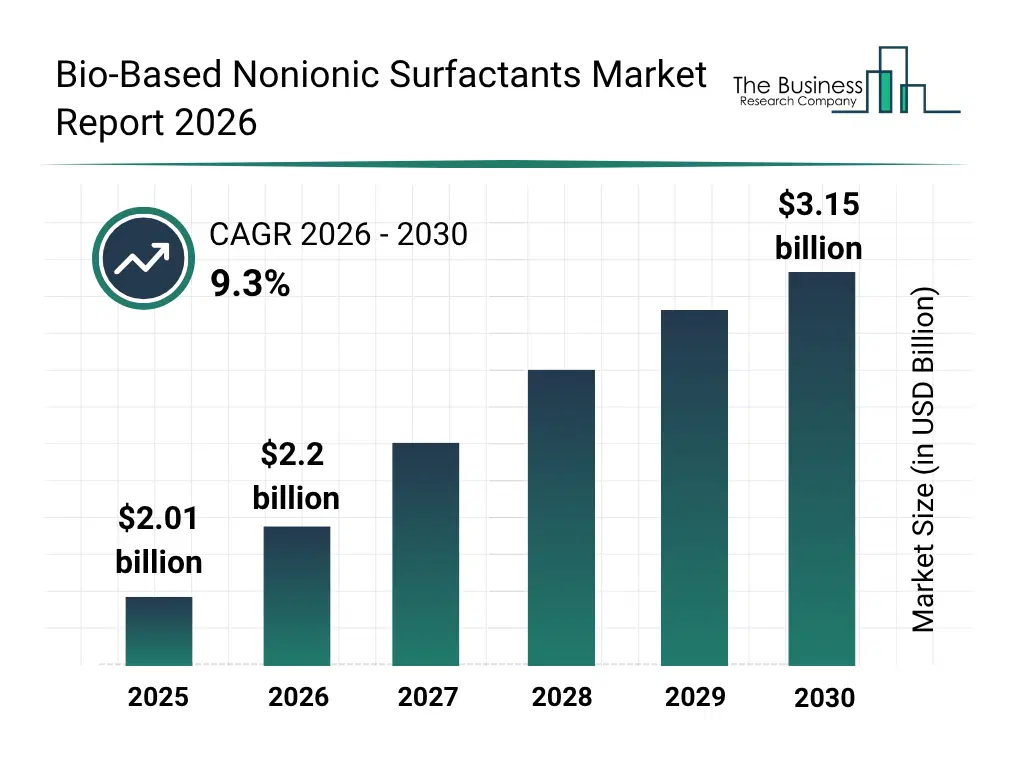
What Is The Bio-Based Nonionic Surfactants Market Size and Share 2026?
The bio-based nonionic surfactants market size has grown strongly in recent years. It will grow from $2.01 billion in 2025 to $2.2 billion in 2026 at a compound annual growth rate (CAGR) of 9.7%. The growth in the historic period can be attributed to rising demand for biodegradable cleaning products, growing adoption of plant-based surfactants, increasing consumer preference for sustainable personal care products, expanding use of bio-based ingredients in industrial cleaning, rising demand for environmentally compatible agricultural formulations.What Is The Bio-Based Nonionic Surfactants Market Growth Forecast?
The bio-based nonionic surfactants market size is expected to see strong growth in the next few years. It will grow to $3.15 billion in 2030 at a compound annual growth rate (CAGR) of 9.3%. The growth in the forecast period can be attributed to increasing regulatory pressure to reduce persistent chemical ingredients, growing demand for renewable surfactants across consumer products, expanding use of bio-based ingredients in institutional cleaning, rising demand for sustainable oilfield chemical formulations, increasing preference for high-performance biodegradable surfactants. Major trends in the forecast period include growing use of plant-derived feedstocks for nonionic surfactant production, rising demand for highly biodegradable nonionic surfactant formulations, increasing adoption of low-toxicity surfactants in consumer formulations, expanding use of bio-based nonionic surfactants across diverse formulation types, growing demand for renewable alternatives to petrochemical-derived surfactants.Tariff Impact On Bio-Based Nonionic Surfactants Market
Tariffs are impacting the bio-based nonionic surfactants market by increasing the cost of imported plant-based feedstocks, specialty fatty alcohols, processing equipment, and other chemical inputs used in surfactant production. This is raising manufacturing costs and can slow adoption across detergents and cleaners, personal care, industrial and institutional cleaning, agriculture, and oilfield chemicals, particularly in regions dependent on imported raw materials. Product types such as alkyl polyglucosides, fatty alcohol ethoxylates, and sucrose esters are particularly affected where manufacturers rely on globally sourced specialty ingredients. However, tariffs are also encouraging domestic feedstock sourcing, regional supplier diversification, local production, and greater development of renewable surfactant supply chains.
Global Bio Based Nonionic Surfactants Market Segmentation
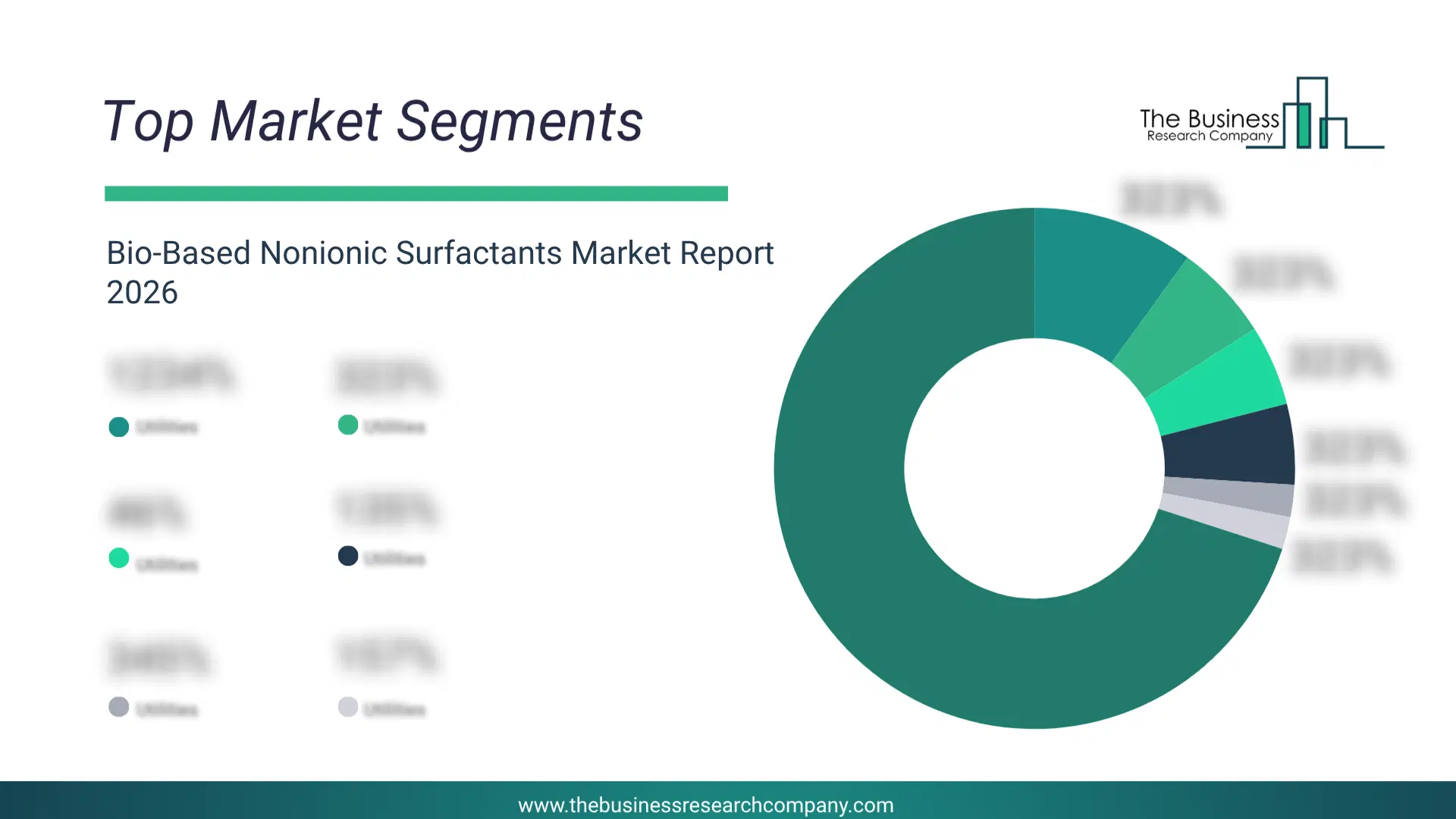
1) By Product Type: Alkyl Polyglucosides, Fatty Alcohol Ethoxylates, Sorbitan Esters, Sucrose Esters, Other Product Types 2) By Source: Plant-Based, Animal-Based, Other Sources 3) By Form: Liquid, Paste, Powder Or Flakes, Blends Or Systems 4) By Application: Detergents And Cleaners, Personal Care, Industrial And Institutional Cleaning, Agriculture, Oilfield Chemicals, Other Applications 5) By End User: Household, Industrial, Commercial, Other End Users Subsegments: 1) By Alkyl Polyglucosides: Caprylyl Capryl Glucoside, Coco Glucoside, Decyl Glucoside, Lauryl Glucoside, Cetearyl Glucoside 2) By Fatty Alcohol Ethoxylates: Lauryl Alcohol Ethoxylates, Cetyl Alcohol Ethoxylates, Stearyl Alcohol Ethoxylates, Oleyl Alcohol Ethoxylates, Cetearyl Alcohol Ethoxylates 3) By Sorbitan Esters: Sorbitan Monolaurate, Sorbitan Monopalmitate, Sorbitan Monostearate, Sorbitan Monooleate, Sorbitan Trioleate 4) By Sucrose Esters: Sucrose Laurate, Sucrose Palmitate, Sucrose Stearate, Sucrose Oleate, Sucrose Erucate 5) By Other Product Types: Polyglycerol Esters, Methyl Glucoside Esters, Alkyl Lactates, Fatty Acid Esters, Ethoxylated Methyl EstersWhat Is The Driver Of The Bio-Based Nonionic Surfactants Market?
The growing adoption of renewable feedstocks and circular materials is expected to propel the growth of the bio-based nonionic surfactants market going forward. Renewable feedstocks are raw materials derived from naturally replenishing sources, such as plant oils, sugars, and agricultural residues, while circular materials are resources that are reused, recycled, or regenerated to minimize waste and maximize resource efficiency. The adoption of renewable feedstocks and circular materials is increasing due to rising environmental concerns, as governments, industries, and consumers seek to reduce carbon emissions, minimize waste generation, decrease reliance on fossil-based resources, and promote sustainable production practices. Rising adoption of renewable feedstocks and circular materials drives demand for bio-based nonionic surfactants by increasing the need for biodegradable, renewable, and environmentally friendly surfactant formulations that reduce dependence on petrochemical-based alternatives while supporting circular economy initiatives. For instance, in April 2026, according to LyondellBasell Industries N.V., a Netherlands-based chemical company, it aims to produce and market 800,000 metric tons per year of recycled and renewable-based polymers by 2030, following a revision of its previous target of 2 million metric tons per year in February 2026. Therefore, the growing adoption of renewable feedstocks and circular materials is driving the growth of the bio-based nonionic surfactants industry.Key Players In The Global Bio-Based Nonionic Surfactants Market
Major companies operating in the bio-based nonionic surfactants market are BASF SE, The Dow Chemical Company, Syensqo SA, Arkema, Huntsman Corporation, Evonik Industries AG, Clariant AG, Wilmar International Limited, Croda International Plc, Sasol Limited, Kao Corporation, Stepan Company, Musim Mas Holdings Pte. Ltd., Godrej Industries Limited, Innospec Inc., Emery Oleochemicals, Galaxy Surfactants Limited, Ecogreen Oleochemicals Pte. Ltd., VVF Limited, Kuala Lumpur Kepong Berhad, Zschimmer & Schwarz GmbH & Co KG Chemische Fabriken, Colonial Chemical Inc., PCC Exol S.A., Lankem Limited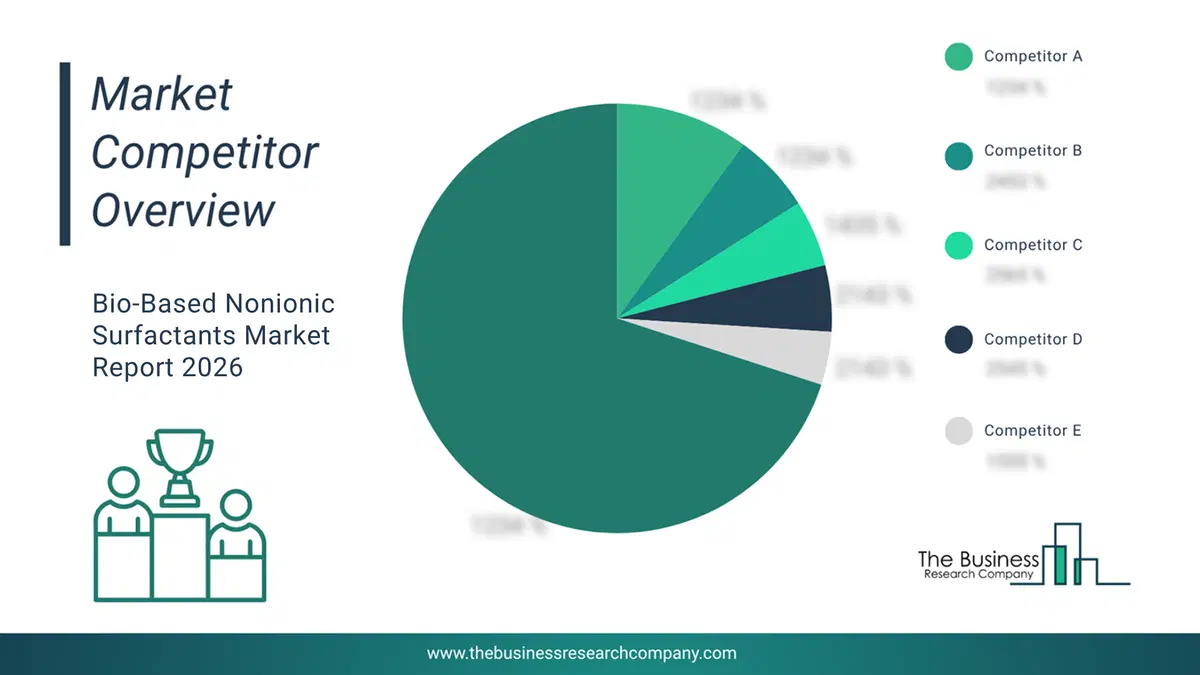
This chart is for illustrative purposes; the full report includes a detailed competitor analysis and comprehensive overview of the top 10 companies in the market.
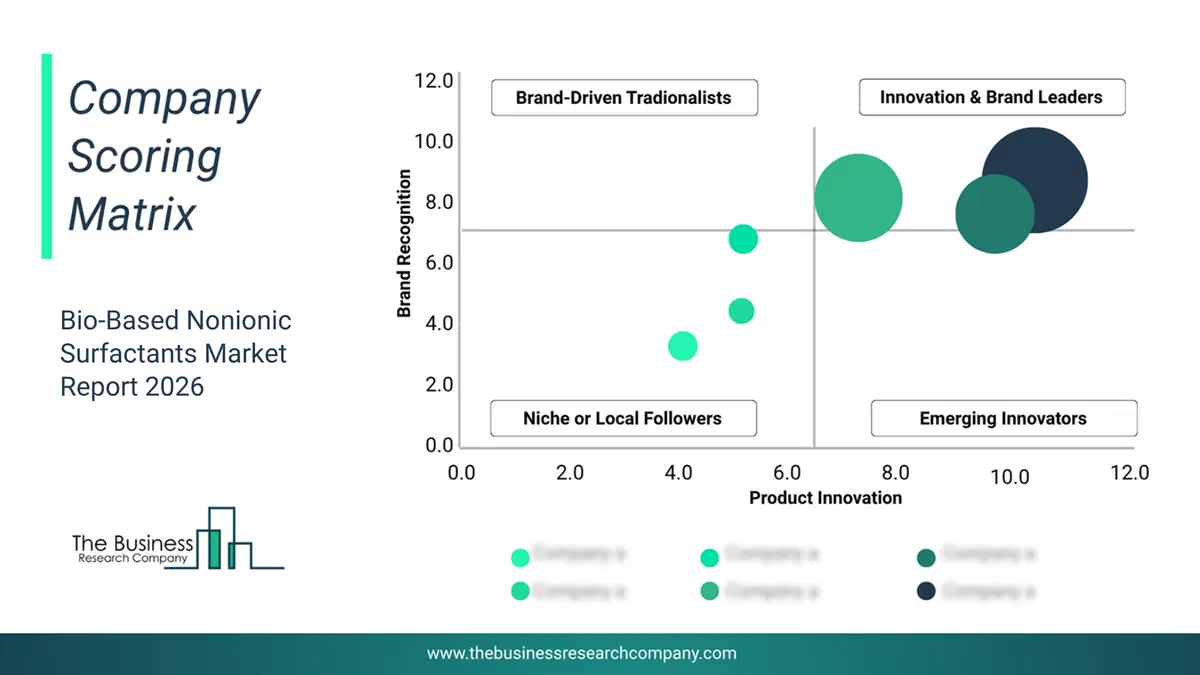
This chart maps companies by product innovation and brand strength, with bubble size indicating relative revenue, helping identify market leaders, challengers, and niche players. This is an illustrative chart; the full report provides a complete and accurate competitive analysis.
Global Bio-Based Nonionic Surfactants Market Trends and Insights
Major companies operating in the bio-based nonionic surfactants market are focusing on developing advanced surfactants such as, bio-based furan-structured nonionic surfactants to enhance sustainable personal care formulations, reduce greenhouse gas emissions, and improve cleansing performance with milder ingredients. Bio-based furan-structured nonionic surfactants are renewable surfactants derived from upcycled bio-based feedstocks that utilize furan chemistry instead of conventional petrochemical raw materials, helping manufacturers reduce environmental impact while providing excellent foaming, cleansing efficiency, formulation compatibility, and improved skin mildness compared to traditional petrochemical nonionic surfactants. For instance, in March 2026, Sironix Renewables Inc., a US-based renewable chemicals company, launched Furasoft-SF, a next-generation bio-based nonionic surfactant developed for personal care applications. Produced from upcycled feedstocks, Furasoft-SF is 100% bio-based and sustainably sourced, delivering 65–75% lower greenhouse gas emissions than conventional petrochemical surfactants while being free from PEG, sulfates, nitrosamines, and 1,4-dioxane. The surfactant provides rich, long-lasting foam, enhanced foam density and stability, a broader salt-viscosity curve for formulation flexibility, and seamless integration into existing manufacturing processes for products such as shampoos, body washes, and hand soaps.What Are Latest Mergers And Acquisitions In The Bio-Based Nonionic Surfactants Market?
In November 2025, Stepan Company, a US-based specialty and intermediate chemicals company, partnered with AmphiStar BV to expand the distribution of sustainable biosurfactants across the EMEA region. Through this partnership, Stepan Company and AmphiStar BV aim to expand the distribution of upcycled biosurfactants, accelerate the adoption of sustainable cleaning solutions, support Home Care and Industrial & Institutional (I&I) cleaning applications, reduce product carbon footprints and life-cycle impacts, and promote the use of circular and lower-carbon surfactant solutions. AmphiStar BV is a Belgium-based biotechnology company that specializes in developing and producing bio-based nonionic surfactants.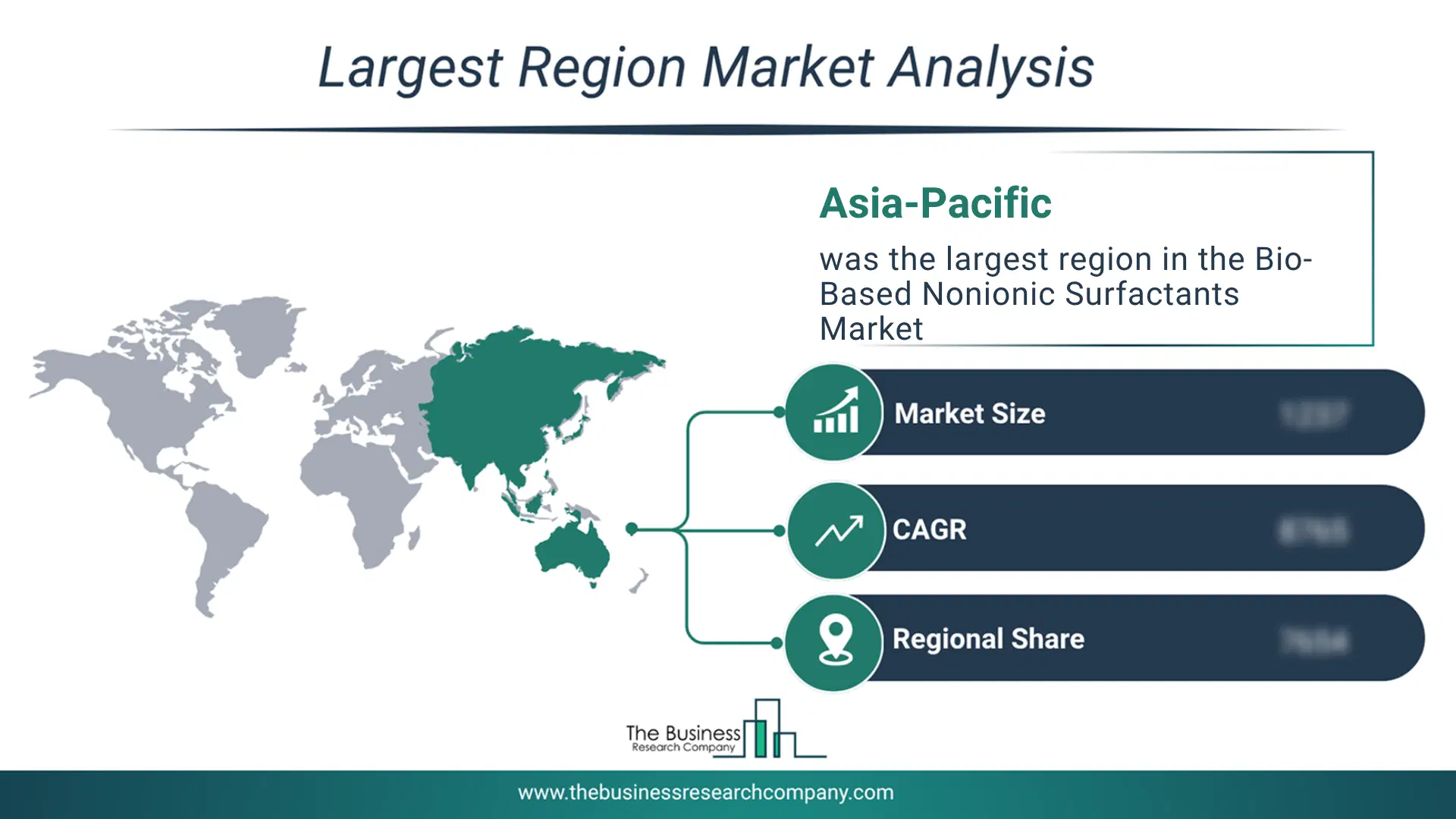
Regional Outlook
Asia-Pacific was the largest region in the bio-based nonionic surfactants market in 2025. Asia-Pacific is expected to be the fastest-growing region in the forecast period. The regions covered in this market report are Asia-Pacific, South East Asia, Western Europe, Eastern Europe, North America, South America, Middle East, Africa. The countries covered in this market report are Australia, Brazil, China, France, Germany, India, Indonesia, Japan, Taiwan, Russia, South Korea, UK, USA, Canada, Italy, Spain.What Defines the Bio-Based Nonionic Surfactants Market?
The bio-based nonionic surfactants market consists of sales of bio-based nonionic surfactant formulations, surfactant concentrates, specialty surfactant blends, emulsifiers, wetting agents, dispersing agents, foaming agents, defoaming agents, and solubilizing agents. Values in this market are ‘factory gate’ values, that is, the value of goods sold by the manufacturers or creators of the goods, whether to other entities (including downstream manufacturers, wholesalers, distributors, and retailers) or directly to end customers. The value of goods in this market includes related services sold by the creators of the goods.How is Market Value Defined and Measured?
The market value is defined as the revenues that enterprises gain from the sale of goods and/or services within the specified market and geography through sales, grants, or donations in terms of the currency (in USD unless otherwise specified). The revenues for a specified geography are consumption values that are revenues generated by organizations in the specified geography within the market, irrespective of where they are produced. It does not include revenues from resales along the supply chain, either further along the supply chain or as part of other products.
This chart presents market attractiveness based on a quantitative evaluation of growth, competition, strategic alignment, and risk, offering a clear view of opportunity areas for decision-making. This chart is for illustrative purposes; the full report contains the complete analysis.

This chart highlights the Total Addressable Market (TAM) by estimating the maximum revenue opportunity using an assumption-driven approach, supporting strategic planning and opportunity sizing across markets. The chart is illustrative; the full report provides a more comprehensive analysis.
What Key Data and Analysis Are Included in the Bio-Based Nonionic Surfactants Market Report 2026?
The bio-based nonionic surfactants market research report is one of a series of new reports from The Business Research Company that provides market statistics, including industry global market size, regional shares, competitors with the market share, detailed market segments, market trends and opportunities, and any further data you may need to thrive in the bio-based nonionic surfactants industry. The market research report delivers a complete perspective of everything you need, with an in-depth analysis of the current and future state of the industry.Bio-Based Nonionic Surfactants Market Report Forecast Analysis
| Report Attribute | Details |
|---|---|
| Market Size Value In 2026 | $2.2 billion |
| Revenue Forecast In 2030 | $3.15 billion |
| Growth Rate | CAGR of 9.3% from 2026 to 2030 |
| Base Year For Estimation | 2025 |
| Actual Estimates/Historical Data | 2020-2025 |
| Forecast Period | 2026 - 2030 |
| Market Representation | Revenue in USD Billion and CAGR from 2026 to 2030 |
| Segments Covered | Product Type, Source, Form, Application, End User |
| Regional Scope | Asia-Pacific, Western Europe, Eastern Europe, North America, South America, Middle East, Africa |
| Country Scope | The countries covered in the report are Australia, Brazil, China, France, Germany, India, Indonesia, Japan, Taiwan, Russia, South Korea, UK, USA, Canada, Italy, Spain. |
| Key Companies Profiled | BASF SE, The Dow Chemical Company, Syensqo SA, Arkema, Huntsman Corporation, Evonik Industries AG, Clariant AG, Wilmar International Limited, Croda International Plc, Sasol Limited, Kao Corporation, Stepan Company, Musim Mas Holdings Pte. Ltd., Godrej Industries Limited, Innospec Inc., Emery Oleochemicals, Galaxy Surfactants Limited, Ecogreen Oleochemicals Pte. Ltd., VVF Limited, Kuala Lumpur Kepong Berhad, Zschimmer & Schwarz GmbH & Co KG Chemische Fabriken, Colonial Chemical Inc., PCC Exol S.A., Lankem Limited |
| Customization Scope | Request for Customization |
| Pricing And Purchase Options | Explore Purchase Options |