
Bio-Based Polyester Precursors For High-Performance Bioplastics Market Report 2026
Global Outlook – By Product Type (Bio-Based Dicarboxylic Acids, Bio-Based Diols, Bio-Based Polyols, Bio-Based Lactones And Hydroxy Acids), By Feedstock (Sugar-Based Feedstocks, Starch-Based Feedstocks, Vegetable Oil-Based Feedstocks, Lignocellulosic Biomass, Waste-Derived Biomass, Other Feedstocks), By Bioplastic Type (Polyethylene Furanoate, Polybutylene Succinate, Polytrimethylene Terephthalate, Bio-Based Polyethylene Terephthalate, Other Polyester Bioplastics), By Distribution Channel (Direct Sales, Distributors And Traders, Online Sales), By Application (Packaging, Automotive Components, Electrical And Electronics, Consumer Goods, Textiles, Medical And Healthcare, Other Applications) – Market Size, Trends, Strategies, and Forecast to 2030
Bio-Based Polyester Precursors For High-Performance Bioplastics Market Overview
• Bio-Based Polyester Precursors For High-Performance Bioplastics market size has reached to $1.86 billion in 2025 • Expected to grow to $3.41 billion in 2030 at a compound annual growth rate (CAGR) of 12.8% • Growth Driver: Expansion Of The Packaging Industry Fueling The Growth Of The Market Due To Rising Demand For Sustainable Packaging Materials • Market Trend: Commercial FDCA Production Facilities Advance Bio-Based Polyester Precursors • Asia-Pacific was the largest region and fastest growing region.What Is Covered Under Bio-Based Polyester Precursors For High-Performance Bioplastics Market?
Bio-based polyester precursors are renewable chemical building blocks derived from biomass sources such as sugarcane, corn, agricultural residues, vegetable oils, and other plant-based feedstocks. These precursors are used to manufacture high-performance polyester bioplastics that offer excellent mechanical strength, thermal stability, chemical resistance, and reduced environmental impact compared to conventional petroleum-based plastics. The main product types of bio-based polyester precursors for high-performance bioplastics include bio-based dicarboxylic acids, bio-based diols, bio-based polyols, and bio-based lactones and hydroxy acids. Bio-based dicarboxylic acids refer to organic compounds derived from renewable biological sources and used as building blocks for producing polyester materials. These precursors are derived from sugar-based feedstocks, starch-based feedstocks, vegetable oil-based feedstocks, lignocellulosic biomass, waste-derived biomass, and other feedstocks and are used to produce polyethylene furanoate, polybutylene succinate, polytrimethylene terephthalate, bio-based polyethylene terephthalate, and other polyester bioplastics. They are distributed through direct sales, distributors and traders, and online sales and are used applications in packaging, automotive components, electrical and electronics, consumer goods, textiles, medical and healthcare, and others.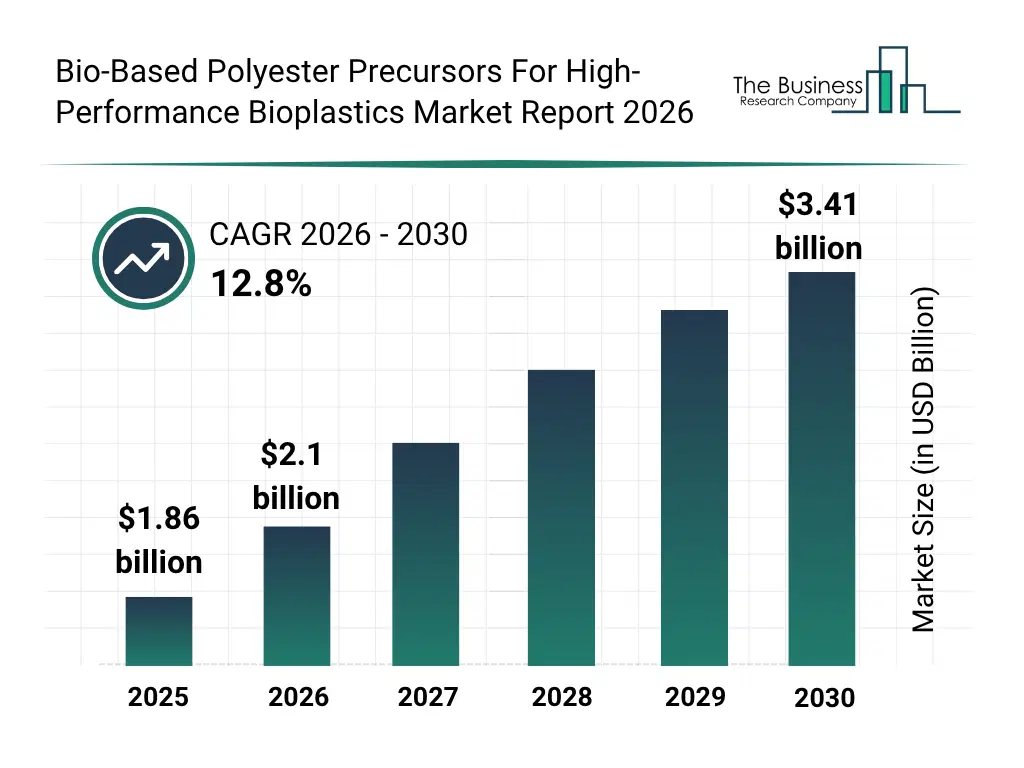
What Is The Bio-Based Polyester Precursors For High-Performance Bioplastics Market Size and Share 2026?
The bio-based polyester precursors for high-performance bioplastics market size has grown rapidly in recent years. It will grow from $1.86 billion in 2025 to $2.1 billion in 2026 at a compound annual growth rate (CAGR) of 13.3%. The growth in the historic period can be attributed to rising demand for renewable plastic feedstocks, growing adoption of bio-based polyester bioplastics, increasing use of sugar and starch-based feedstocks, expanding demand for sustainable packaging materials, rising utilization of vegetable oil-derived chemical building blocks.What Is The Bio-Based Polyester Precursors For High-Performance Bioplastics Market Growth Forecast?
The bio-based polyester precursors for high-performance bioplastics market size is expected to see rapid growth in the next few years. It will grow to $3.41 billion in 2030 at a compound annual growth rate (CAGR) of 12.8%. The growth in the forecast period can be attributed to increasing demand for low-carbon polyester production, growing adoption of bio-based materials in automotive components, expanding use of renewable polyester materials in electrical and electronics applications, rising demand for bio-based materials in medical and healthcare products, increasing availability of waste-derived and lignocellulosic biomass feedstocks. Major trends in the forecast period include rising use of sugar-based feedstocks for polyester precursor production, growing adoption of lignocellulosic biomass as a renewable carbon source, increasing production of bio-based dicarboxylic acids and diols, expanding use of bio-based polyester precursors in high-performance packaging, rising demand for renewable polyester building blocks with improved material performance.Tariff Impact On Bio-Based Polyester Precursors For High-Performance Bioplastics Market
Tariffs are impacting the bio-based polyester precursors for high-performance bioplastics market by increasing the cost of imported biomass feedstocks, bio-based dicarboxylic acids, diols, polyols, processing equipment, and specialty chemical inputs. This is raising production costs and can slow adoption across packaging, automotive components, electrical and electronics, consumer goods, textiles, and medical and healthcare applications, particularly in regions dependent on imported renewable feedstocks and specialty chemicals. Feedstock-intensive segments such as sugar-based, vegetable oil-based, lignocellulosic, and waste-derived biomass are most affected by higher import costs and supply-chain disruptions. However, tariffs are also encouraging domestic biomass sourcing, regional supplier diversification, local precursor production, and development of resilient renewable chemical supply chains.
Global Bio Based Polyester Precursors For High Performance Bioplastics Market Segmentation
1) By Product Type: Bio-Based Dicarboxylic Acids, Bio-Based Diols, Bio-Based Polyols, Bio-Based Lactones And Hydroxy Acids 2) By Feedstock: Sugar-Based Feedstocks, Starch-Based Feedstocks, Vegetable Oil-Based Feedstocks, Lignocellulosic Biomass, Waste-Derived Biomass, Other Feedstocks 3) By Bioplastic Type: Polyethylene Furanoate, Polybutylene Succinate, Polytrimethylene Terephthalate, Bio-Based Polyethylene Terephthalate, Other Polyester Bioplastics 4) By Distribution Channel: Direct Sales, Distributors And Traders, Online Sales 5) By Application: Packaging, Automotive Components, Electrical And Electronics, Consumer Goods, Textiles, Medical And Healthcare, Other Applications Subsegments: 1) By Bio-Based Dicarboxylic Acids: Bio-Based Succinic Acid, Bio-Based Adipic Acid, Bio-Based 2,5-Furandicarboxylic Acid, Bio-Based Sebacic Acid, Bio-Based Itaconic Acid 2) By Bio-Based Diols: Bio-Based 1,3-Propanediol, Bio-Based 1,4-Butanediol, Bio-Based Ethylene Glycol, Bio-Based 1,5-Pentanediol, Bio-Based Isosorbide 3) By Bio-Based Polyols: Bio-Based Polyester Polyol, Bio-Based Polyether Polyol, Vegetable Oil-Based Polyol, Sugar-Based Polyol, Castor Oil-Based Polyol 4) By Bio-Based Lactones And Hydroxy Acids: Bio-Based Epsilon-Caprolactone, Bio-Based Lactic Acid, Bio-Based Glycolic Acid, Bio-Based 3-Hydroxypropionic Acid, Bio-Based Hydroxybutyric AcidWhat Is The Driver Of The Bio-Based Polyester Precursors For High-Performance Bioplastics Market?
The expansion of the packaging industry is expected to propel the growth of the bio-based polyester precursors for high-performance bioplastics market going forward. The packaging industry encompasses the design, production, and distribution of materials and products used to protect, preserve, transport, and market goods across various end-use sectors. The expansion of the packaging industry is driven by the growing demand for packaged food and beverages, which requires greater production of packaging materials to ensure product protection, safety, and convenience. The expanding packaging industry increases demand for bio-based polyester precursors for high-performance bioplastics as manufacturers are adopting renewable and high-performance bioplastic materials to produce sustainable packaging solutions that meet regulatory requirements and consumer preferences for environmentally friendly products. For instance, in April 2026, according to the Flexible Packaging Association (FPA), a US-based association, the U.S. flexible packaging industry reached an estimated value of US$44.6 billion in 2025, with flexible packaging accounting for approximately 20% of the total U.S. packaging market, making it the second-largest packaging segment after corrugated packaging. Therefore, the expansion of the packaging industry is driving the growth of the bio-based polyester precursors for high-performance bioplastics industry.Key Players In The Global Bio-Based Polyester Precursors For High-Performance Bioplastics Market
Major companies operating in the bio-based polyester precursors for high-performance bioplastics market are BASF SE, Cargill Incorporated, Mitsubishi Chemical Group Corporation, TotalEnergies Corbion B.V., Toray Industries Inc., Eastman Chemical Company, Syensqo SA, Covestro AG, Arkema S.A., Roquette Frères S.A., NatureWorks LLC, Cathay Biotech Inc., Geno Inc., Jayant Agro-Organics Limited, Verbio Life Chemicals GmbH, Avantium N.V., Lygos Inc., Worlée-Chemie GmbH, RAMPF Holding GmbH & Co. KG, Purinova Sp. z o.o., D.R. Coats Ink & Resins Pvt. Ltd., Expanded Polymer Systems Private Limited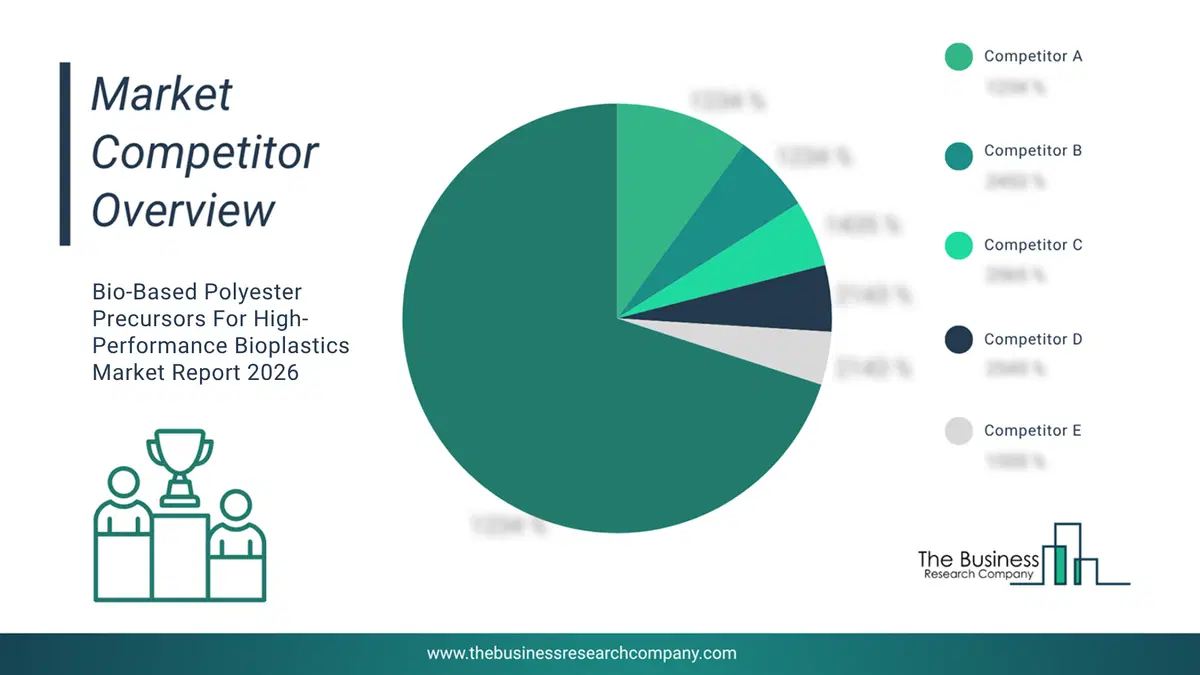
This chart is for illustrative purposes; the full report includes a detailed competitor analysis and comprehensive overview of the top 10 companies in the market.
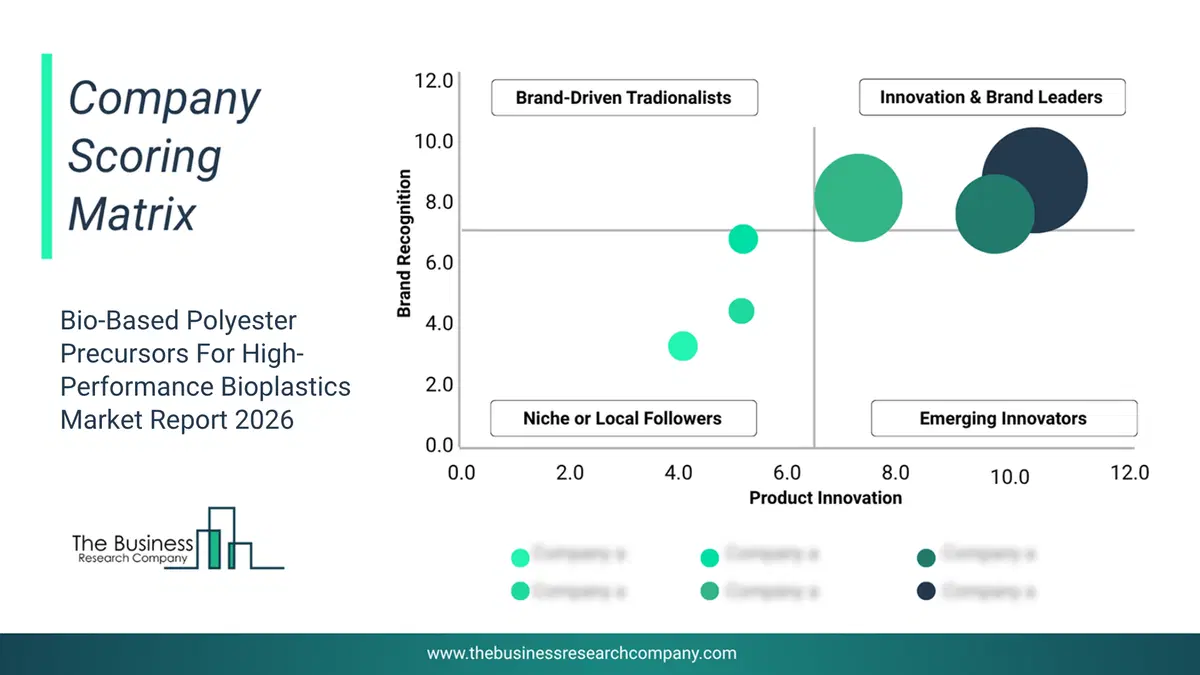
This chart maps companies by product innovation and brand strength, with bubble size indicating relative revenue, helping identify market leaders, challengers, and niche players. This is an illustrative chart; the full report provides a complete and accurate competitive analysis.
Global Bio-Based Polyester Precursors For High-Performance Bioplastics Market Trends and Insights
Major companies operating in the bio-based polyester precursors for high-performance bioplastics market are focusing on expanding commercial production capabilities, such as FDCA flagship plants, to accelerate the adoption of renewable polyester materials and reduce reliance on fossil-based feedstocks. An FDCA (2,5-furandicarboxylic acid) flagship plant is a commercial-scale production facility that manufactures bio-based FDCA, a renewable polyester precursor used as a key building block for producing polyethylene furanoate (PEF), a high-performance, recyclable, and plant-based polyester bioplastic. For instance, in August 2025, Avantium N.V., a Netherlands-based renewable and sustainable chemistry company, successfully started up the first part of its world's first commercial FDCA Flagship Plant. The facility is designed to produce commercial-scale bio-based FDCA from renewable plant-based feedstocks, supporting the commercialization of PEF and advancing the transition toward high-performance, bio-based polyester materials for packaging, textiles, and other sustainable applications.What Are Latest Mergers And Acquisitions In The Bio-Based Polyester Precursors For High-Performance Bioplastics Market?
In June 2025, Teknor Apex, a US-based manufacturer of custom polymer compounds and plastic materials, acquired Danimer Scientific for $19 million. Through this acquisition, Teknor Apex aims to strengthen its sustainable materials portfolio by integrating Danimer Scientific's biodegradable biopolymer technologies, including polyhydroxyalkanoates (PHA), while expanding its capabilities in renewable and compostable polymer solutions. Danimer Scientific is a US-based bioplastics company specializing in the development and production of polyhydroxyalkanoate (PHA) biodegradable polymers.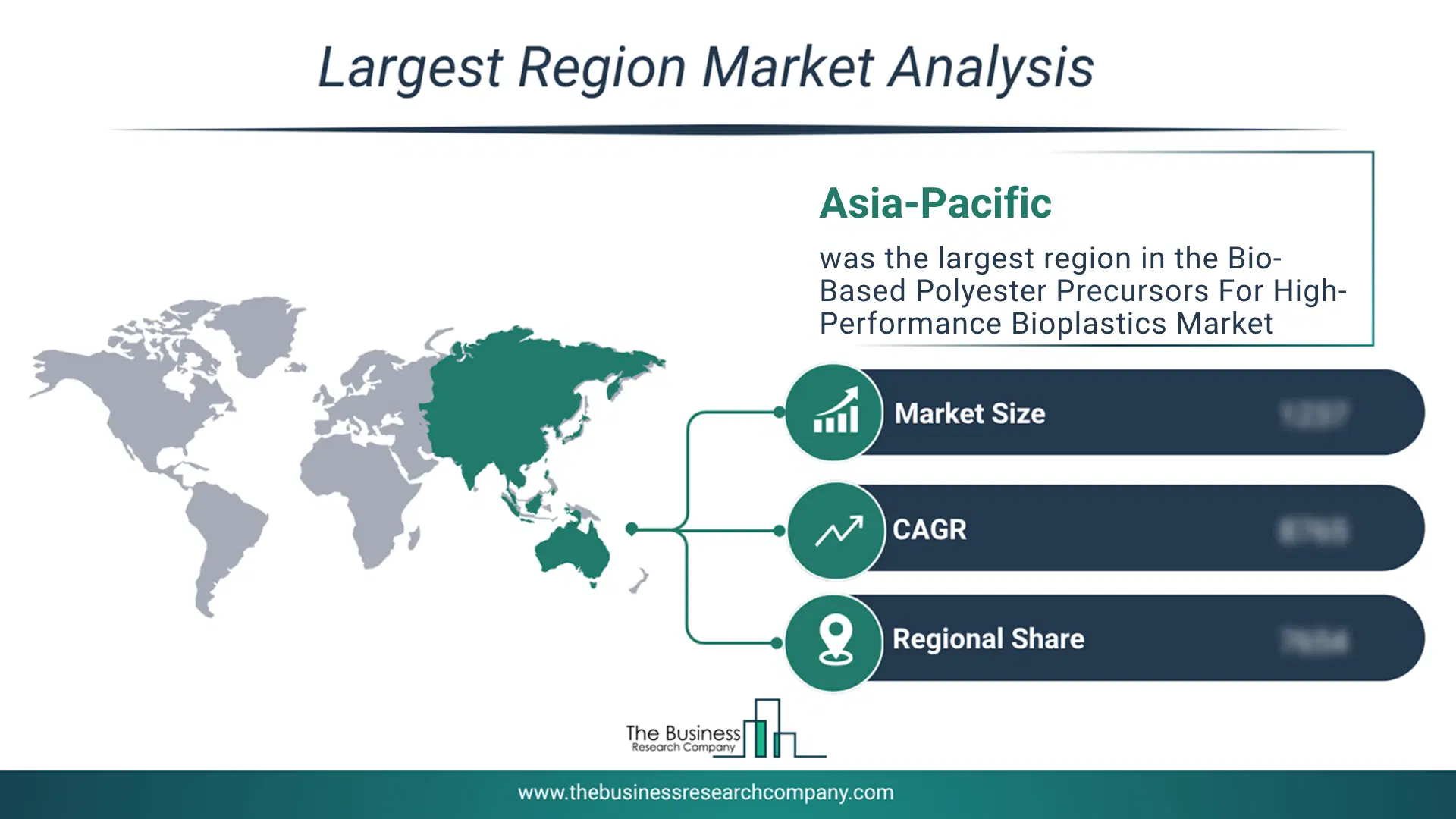
Regional Outlook
Asia-Pacific was the largest region in the bio-based polyester precursors for high-performance bioplastics market in 2025. Asia-Pacific is expected to be the fastest-growing region in the forecast period. The regions covered in this market report are Asia-Pacific, South East Asia, Western Europe, Eastern Europe, North America, South America, Middle East, Africa. The countries covered in this market report are Australia, Brazil, China, France, Germany, India, Indonesia, Japan, Taiwan, Russia, South Korea, UK, USA, Canada, Italy, Spain.What Defines the Bio-Based Polyester Precursors For High-Performance Bioplastics Market?
The bio-based polyester precursors for high-performance bioplastics market consists of sales of bio-based polyester resin intermediates, bio-based cyclic ester monomers, bio-based polymer building blocks, bio-based polyester oligomers, bio-based reactive intermediates for engineering bioplastics, bio-based specialty monomers for high-performance polyesters, and renewable polymer precursor formulations. Values in this market are ‘factory gate’ values, that is the value of goods sold by the manufacturers or creators of the goods, whether to other entities (including downstream manufacturers, wholesalers, distributors and retailers) or directly to end customers. The value of goods in this market includes related services sold by the creators of the goods.How is Market Value Defined and Measured?
The market value is defined as the revenues that enterprises gain from the sale of goods and/or services within the specified market and geography through sales, grants, or donations in terms of the currency (in USD unless otherwise specified). The revenues for a specified geography are consumption values that are revenues generated by organizations in the specified geography within the market, irrespective of where they are produced. It does not include revenues from resales along the supply chain, either further along the supply chain or as part of other products.
This chart presents market attractiveness based on a quantitative evaluation of growth, competition, strategic alignment, and risk, offering a clear view of opportunity areas for decision-making. This chart is for illustrative purposes; the full report contains the complete analysis.

This chart highlights the Total Addressable Market (TAM) by estimating the maximum revenue opportunity using an assumption-driven approach, supporting strategic planning and opportunity sizing across markets. The chart is illustrative; the full report provides a more comprehensive analysis.
What Key Data and Analysis Are Included in the Bio-Based Polyester Precursors For High-Performance Bioplastics Market Report 2026?
The bio-based polyester precursors for high-performance bioplastics market research report is one of a series of new reports from The Business Research Company that provides market statistics, including industry global market size, regional shares, competitors with the market share, detailed market segments, market trends and opportunities, and any further data you may need to thrive in the bio-based polyester precursors for high-performance bioplastics industry. The market research report delivers a complete perspective of everything you need, with an in-depth analysis of the current and future state of the industry.Bio-Based Polyester Precursors For High-Performance Bioplastics Market Report Forecast Analysis
| Report Attribute | Details |
|---|---|
| Market Size Value In 2026 | $2.1 billion |
| Revenue Forecast In 2030 | $3.41 billion |
| Growth Rate | CAGR of 12.8% from 2026 to 2030 |
| Base Year For Estimation | 2025 |
| Actual Estimates/Historical Data | 2020-2025 |
| Forecast Period | 2026 - 2030 |
| Market Representation | Revenue in USD Billion and CAGR from 2026 to 2030 |
| Segments Covered | Product Type, Feedstock, Bioplastic Type, Distribution Channel, Application |
| Regional Scope | Asia-Pacific, Western Europe, Eastern Europe, North America, South America, Middle East, Africa |
| Country Scope | The countries covered in the report are Australia, Brazil, China, France, Germany, India, Indonesia, Japan, Taiwan, Russia, South Korea, UK, USA, Canada, Italy, Spain. |
| Key Companies Profiled | BASF SE, Cargill Incorporated, Mitsubishi Chemical Group Corporation, TotalEnergies Corbion B.V., Toray Industries Inc., Eastman Chemical Company, Syensqo SA, Covestro AG, Arkema S.A., Roquette Frères S.A., NatureWorks LLC, Cathay Biotech Inc., Geno Inc., Jayant Agro-Organics Limited, Verbio Life Chemicals GmbH, Avantium N.V., Lygos Inc., Worlée-Chemie GmbH, RAMPF Holding GmbH & Co. KG, Purinova Sp. z o.o., D.R. Coats Ink & Resins Pvt. Ltd., Expanded Polymer Systems Private Limited |
| Customization Scope | Request for Customization |
| Pricing And Purchase Options | Explore Purchase Options |