

Bio-Based Structural Wood Adhesives For Modular Construction Market Report 2026
Global Outlook – By Resin Type (Lignin-Based Adhesives, Soy-Based Adhesives, Tannin-Based Adhesives, Starch-Based Adhesives, Other Bio-Polymers), By Performance Type (Structural Load-Bearing Adhesives, Semi-Structural Adhesives, Non-Structural Adhesives, Other Performance Types), By Curing Technology (Cold-Set Adhesives, Hot-Press Adhesives, Hybrid Curing Systems, Other Curing Technologies), By Application In Modular Construction (Cross-Laminated Timber Panels, Glue Laminated Beams, Laminated Veneer Lumber, Prefabricated Wall Systems, Roof And Floor Panels), By End-Use Sector (Residential Modular Construction, Commercial Modular Buildings, Institutional, Other End-Use Sectors) – Market Size, Trends, Strategies, and Forecast to 2035
Bio-Based Structural Wood Adhesives For Modular Construction Market Overview
• Bio-Based Structural Wood Adhesives For Modular Construction market size has reached to $1.03 billion in 2025 • Expected to grow to $1.65 billion in 2030 at a compound annual growth rate (CAGR) of 9.9% • Growth Driver: Increasing Demand For Sustainable Construction Is Fueling The Growth Of The Market Due To Rising Focus On Low-Carbon Building Materials And Eco-Friendly Adhesive Solutions • Market Trend: Enhancing Structural Strength Through Bio-Based Adhesive Innovation • Europe was the largest region in 2025 and Asia-Pacific is the fastest growing region.What Is Covered Under Bio-Based Structural Wood Adhesives For Modular Construction Market?
Bio-based structural wood adhesives for modular construction are bonding materials derived from renewable biological sources that provide high-strength adhesion for engineered wood components. They are formulated to deliver durability, load-bearing performance, and resistance to environmental factors while supporting prefabricated building methods. These adhesives enable sustainable construction practices by reducing reliance on petrochemical inputs and lowering environmental impact. The main resin types of bio-based structural wood adhesives for modular construction include lignin-based adhesives, soy-based adhesives, tannin-based adhesives, starch-based adhesives, and other bio-polymers. Lignin-based adhesives refer to bio-derived bonding agents extracted from lignin compounds, used to provide structural strength and sustainability in engineered wood applications. These products are available across performance types including structural load-bearing adhesives, semi-structural adhesives, non-structural adhesives, and other performance types and are manufactured using curing technologies such as cold-set adhesives, hot-press adhesives, hybrid curing systems, and other curing technologies. They find application in cross-laminated timber panels, glue laminated beams, laminated veneer lumber, prefabricated wall systems, and roof and floor panels, serving end use sectors including residential modular construction, commercial modular buildings, institutional, and others.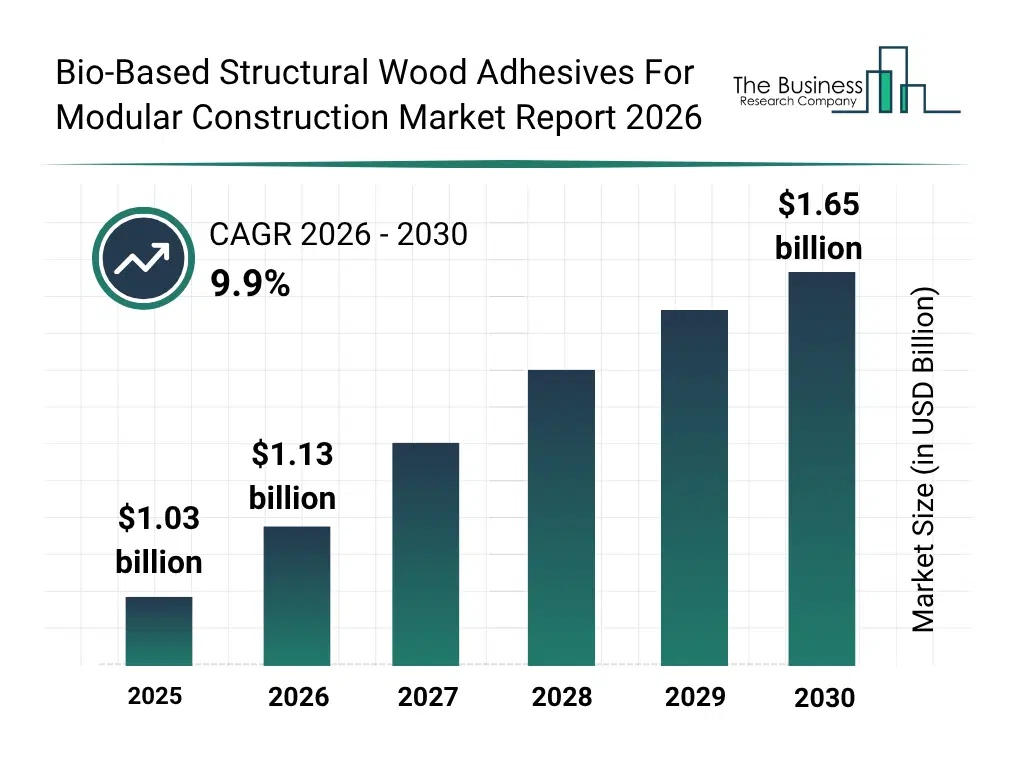
What Is The Bio-Based Structural Wood Adhesives For Modular Construction Market Size and Share 2026?
The bio-based structural wood adhesives for modular construction market size has grown strongly in recent years. It will grow from $1.03 billion in 2025 to $1.13 billion in 2026 at a compound annual growth rate (CAGR) of 9.7%. The growth in the historic period can be attributed to growth in traditional timber construction practices, increasing demand for cost-effective wood bonding solutions, expansion of plywood and engineered wood manufacturing, rising environmental concerns over petrochemical adhesives, development of early bio-based resin research.What Is The Bio-Based Structural Wood Adhesives For Modular Construction Market Growth Forecast?
The bio-based structural wood adhesives for modular construction market size is expected to see strong growth in the next few years. It will grow to $1.65 billion in 2030 at a compound annual growth rate (CAGR) of 9.9%. The growth in the forecast period can be attributed to rising adoption of sustainable and green building materials, increasing demand for modular and prefabricated construction systems, growth in cross-laminated timber and mass timber projects, advancements in bio-polymer chemistry improving adhesive performance, stricter regulations on formaldehyde and VOC emissions in construction materials. Major trends in the forecast period include increasing adoption of lignin-based adhesives for engineered wood bonding in modular construction, growing use of soy-based bio adhesives in cross-laminated timber production, rising demand for low-voc and formaldehyde-free structural wood adhesives, expansion of bio-based adhesive use in prefabricated wall and floor panel systems, increasing focus on high-performance bio-polymer adhesives for load-bearing engineered wood structures.
Global Bio-Based Structural Wood Adhesives For Modular Construction Market Segmentation
1) By Resin Type: Lignin-Based Adhesives, Soy-Based Adhesives, Tannin-Based Adhesives, Starch-Based Adhesives, Other Bio-Polymers 2) By Performance Type: Structural Load-Bearing Adhesives, Semi-Structural Adhesives, Non-Structural Adhesives, Other Performance Types 3) By Curing Technology: Cold-Set Adhesives, Hot-Press Adhesives, Hybrid Curing Systems, Other Curing Technologies 4) By Application In Modular Construction: Cross-Laminated Timber Panels, Glue Laminated Beams, Laminated Veneer Lumber, Prefabricated Wall Systems, Roof And Floor Panels 5) By End-Use Sector: Residential Modular Construction, Commercial Modular Buildings, Institutional, Other End-Use Sectors Subsegments: 1) By Lignin-Based Adhesives: Kraft Lignin-Based Adhesives, Organosolv Lignin-Based Adhesives, Lignosulfonate-Based Adhesives, Modified Lignin Adhesives, Blended Lignin Polymer Adhesives 2) By Soy-Based Adhesives: Soy Protein-Based Adhesives, Soy Flour-Based Adhesives, Enzyme Modified Soy Adhesives, Cross-Linked Soy Adhesives, Water Resistant Soy Adhesives 3) By Tannin-Based Adhesives: Condensed Tannin Adhesives, Hydrolyzable Tannin Adhesives, Mimosa Tannin Adhesives, Quebracho Tannin Adhesives, Modified Tannin Resin Adhesives 4) By Starch-Based Adhesives: Native Starch Adhesives, Oxidized Starch Adhesives, Cationic Starch Adhesives, Dextrin-Based Adhesives, Modified Starch Polymer Adhesives 5) By Other Bio-Polymers: Cellulose-Based Adhesives, Chitosan-Based Adhesives, Protein-Based Natural Adhesives, Natural Rubber-Based Adhesives, Polylactic Acid-Based AdhesivesWhat Is The Driver Of The Bio-Based Structural Wood Adhesives For Modular Construction Market?
The increasing demand for sustainable construction is expected to propel the growth of the bio-based structural wood adhesives for modular construction market going forward. Sustainable construction refers to building practices that reduce environmental impact through the use of low-carbon materials, energy efficiency, and resource optimization. The rise in demand for sustainable construction due to growing regulatory and environmental focus on reducing carbon emissions is driving adoption of eco-friendly building materials. Bio-based structural wood adhesives for modular construction supports this demand by providing renewable and low-emission bonding solutions that enhance structural performance while reducing environmental footprint. For instance, in February 2024, according to the Green Building Council, a US-based non-profit organization, in 2023, there was a 9% rise in LEED certifications from the previous year, along with 21 additional certifications for single-family homes. New LEED project registrations jumped by 51%. Therefore, the increasing demand for sustainable construction is driving the growth of the bio-based structural wood adhesives for modular construction industry.Key Players In The Global Bio-Based Structural Wood Adhesives For Modular Construction Market
Major companies operating in the bio-based structural wood adhesives for modular construction market are BASF SE, Dow Inc., Henkel AG & Co. KGaA, Sika AG, Akzo Nobel N.V., UPM Biochemicals, Arkema S.A., Stora Enso Oyj, Huntsman Corporation, H.B. Fuller Company, Ashland Inc., Aica Kogyo Co. Ltd., Pidilite Industries Limited, Borregaard ASA, Dynea AS, KLEIBERIT SE & Co. KG, Franklin International Inc., Follmann GmbH & Co. KG, Jowat SE, Chimar Hellas S.A.Global Bio-Based Structural Wood Adhesives For Modular Construction Market Trends and Insights
Major companies operating in the bio-based structural wood adhesives for modular construction market are focusing on advancement in high performance bio adhesive formulations, such as bio-based polyurethane structural adhesives, to gain a competitive advantage. Bio-based polyurethane structural adhesives refer to high-strength bonding materials derived partially from renewable feedstocks that provide load-bearing capacity, durability, and reduced environmental impact for engineered wood applications in modular construction. For instance, in November 2023, Henkel, a Germany-based chemical and materials company, launched Loctite HB S ECO and CR 821 ECO, bio-based polyurethane adhesives for load-bearing timber construction. These adhesives contain up to 71% bio-based raw materials, reduce CO₂ emissions by more than 60%, and offer solvent-free formulations with high durability and reliability. These advancements enhance sustainability and performance; however, feedstock variability and cost pressures remain key challenges.What Are Latest Mergers And Acquisitions In The Bio-Based Structural Wood Adhesives For Modular Construction Market?
In May 2023, Fraunhofer Institute for Wood Research (WKI), a Germany-based research institute specializing in wood materials and adhesive technologies, collaborated with Instituto de Materiales de Misiones (IMAM) to replace conventional phenol-formaldehyde resins used in wood panels. Through this collaboration, the partners aim to develop fully bio-based structural adhesives by replacing conventional petrochemical-based resins with lignin-and sugar-derived systems, enabling formaldehyde-free bonding solutions while maintaining high mechanical strength and compatibility with existing modular and prefabricated construction processes. Instituto de Materiales de Misiones (IMAM) is an Argentina-based research organization specializing in material science and biomass utilization, contributing expertise in bio-based raw material processing and adhesive formulation.Regional Outlook/Insights
Europe was the largest region in the bio-based structural wood adhesives for modular construction market in 2025. Asia-Pacific is expected to be the fastest-growing region in the forecast period. The regions covered in this market report are Asia-Pacific, South East Asia, Western Europe, Eastern Europe, North America, South America, Middle East, Africa. The countries covered in this market report are Australia, Brazil, China, France, Germany, India, Indonesia, Japan, Taiwan, Russia, South Korea, UK, USA, Canada, Italy, Spain.What Defines the Bio-Based Structural Wood Adhesives For Modular Construction Market?
The bio-based structural wood adhesives for modular construction market consists of sales of plant-derived resin adhesives, lignin-based bonding agents, soy protein adhesives, and other renewable-source formulations. Values in this market are ‘factory gate’ values, that is, the value of goods sold by the manufacturers or creators of the goods, whether to other entities (including downstream manufacturers, wholesalers, distributors, and retailers) or directly to end customers. The value of goods in this market includes related services sold by the creators of the goods.How is Market Value Defined and Measured?
The market value is defined as the revenues that enterprises gain from the sale of goods and/or services within the specified market and geography through sales, grants, or donations in terms of the currency (in USD unless otherwise specified). The revenues for a specified geography are consumption values that are revenues generated by organizations in the specified geography within the market, irrespective of where they are produced. It does not include revenues from resales along the supply chain, either further along the supply chain or as part of other products.What Key Data and Analysis Are Included in the Bio-Based Structural Wood Adhesives For Modular Construction Market Report 2026?
The bio-based structural wood adhesives for modular construction market research report is one of a series of new reports from The Business Research Company that provides market statistics, including industry global market size, regional shares, competitors with the market share, detailed market segments, market trends and opportunities, and any further data you may need to thrive in the bio-based structural wood adhesives for modular construction industry. The market research report delivers a complete perspective of everything you need, with an in-depth analysis of the current and future state of the industry.Bio-Based Structural Wood Adhesives For Modular Construction Market Report Forecast Analysis
| Report Attribute | Details |
|---|---|
| Market Size Value In 2026 | $1.13 billion |
| Revenue Forecast In 2035 | $1.65 billion |
| Growth Rate | CAGR of 9.9% from 2026 to 2035 |
| Base Year For Estimation | 2025 |
| Actual Estimates/Historical Data | 2020-2025 |
| Forecast Period | 2026 - 2030 - 2035 |
| Market Representation | Revenue in USD Billion and CAGR from 2026 to 2035 |
| Segments Covered | Resin Type, Performance Type, Curing Technology, Application In Modular Construction, End-Use Sector |
| Regional Scope | Asia-Pacific, Western Europe, Eastern Europe, North America, South America, Middle East, Africa |
| Country Scope | The countries covered in the report are Australia, Brazil, China, France, Germany, India, Indonesia, Japan, Taiwan, Russia, South Korea, UK, USA, Canada, Italy, Spain. |
| Key Companies Profiled | BASF SE, Dow Inc., Henkel AG & Co. KGaA, Sika AG, Akzo Nobel N.V., UPM Biochemicals, Arkema S.A., Stora Enso Oyj, Huntsman Corporation, H.B. Fuller Company, Ashland Inc., Aica Kogyo Co. Ltd., Pidilite Industries Limited, Borregaard ASA, Dynea AS, KLEIBERIT SE & Co. KG, Franklin International Inc., Follmann GmbH & Co. KG, Jowat SE, Chimar Hellas S.A. |
| Customization Scope | Request for Customization |
| Pricing And Purchase Options | Explore Purchase Options |