
Bio Compatible Battery Market Report 2026
Global Outlook – By Type ( Lithium-Ion Batteries, Sodium-Ion Batteries, Metal-Air Batteries), By Material ( Polymer, Metal, Ceramic, Other Materials), By Application ( Medical Devices, Wearable Electronics, Implantable Devices, Other Applications), By End User ( Consumer Electronics, Healthcare, Other End Users) – Market Size, Trends, Strategies, and Forecast to 2030
Bio Compatible Battery Market Overview
• Bio Compatible Battery market size has reached to $1.36 billion in 2025 • Expected to grow to $2.58 billion in 2030 at a compound annual growth rate (CAGR) of 13.6% • Growth Driver: The Increase In Demand For Medical Devices Is Driving The Market Through Advanced Healthcare Adoption • Market Trend: Emerging Soft Biodegradable Micro Batteries Revolutionize Biomedical And Microrobotic Applications • Asia-Pacific was the largest region and fastest growing region.What Is Covered Under Bio Compatible Battery Market?
Bio-compatible batteries are energy storage devices designed to safely interact with biological systems, using non-toxic, often biodegradable or implantable materials such as magnesium, sodium, and specific polymers. Their primary goal is to power medical and diagnostic devices without harming the body or requiring surgical removal. Bio-compatible batteries enable advanced implantable medical devices, support ingestible electronics, enhance patient care and safety, and promote the development of sustainable, transient technology. The main types of bio compatible batteries are lithium-ion batteries, sodium-ion batteries, redox flow batteries, alkaline batteries, and metal-air batteries. Lithium-ion bio-compatible batteries are rechargeable energy storage devices designed using biocompatible materials, making them safe for use in medical implants and wearable healthcare devices. The materials of these are polymer, metal, ceramic, and others, used in applications such as medical devices, wearable electronics, implantable devices, and others, in the end users including automotive, consumer electronics, healthcare, and others.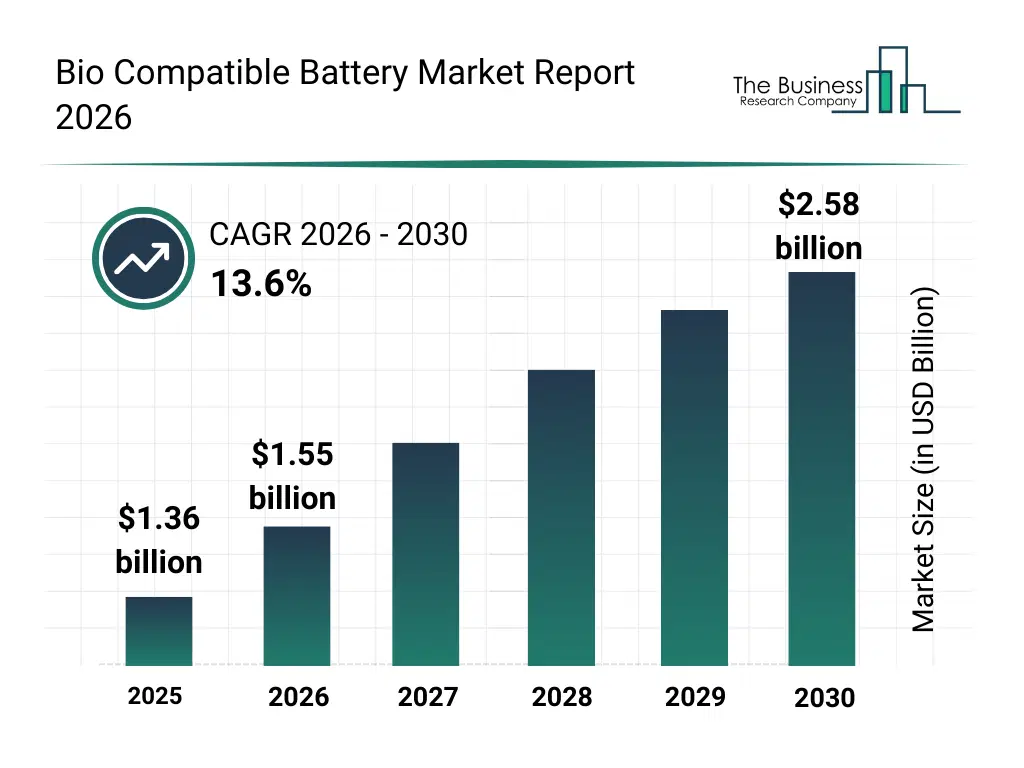
What Is The Bio Compatible Battery Market Size 2026 And Growth Rate?
The bio compatible battery market size has grown rapidly in recent years. It will grow from $1.36 billion in 2025 to $1.55 billion in 2026 at a compound annual growth rate (CAGR) of 13.9%. The growth in the historic period can be attributed to growth in implantable medical devices, advancements in polymer and metal-based materials, rising demand for patient safety, early adoption of ingestible electronics, increased healthcare R&D spending.What Is The Bio Compatible Battery Market Growth Forecast?
The bio compatible battery market size is expected to see rapid growth in the next few years. It will grow to $2.58 billion in 2030 at a compound annual growth rate (CAGR) of 13.6%. The growth in the forecast period can be attributed to expansion of precision medicine, demand for biodegradable energy storage, growth in long-term implants, regulatory push for safer implants, innovation in transient electronics. Major trends in the forecast period include AI-enabled implantable power management, sustainable and biodegradable battery materials, connected medical and wearable power systems, precision manufacturing for micro-scale batteries, smart production automation for bio-compatible cells.
Global Bio Compatible Battery Market Segmentation
1) By Type: Lithium-Ion Batteries, Sodium-Ion Batteries, Metal-Air Batteries 2) By Material: Polymer, Metal, Ceramic, Other Materials 3) By Application: Medical Devices, Wearable Electronics, Implantable Devices, Other Applications 4) By End User: Consumer Electronics, Healthcare, Other End Users Subsegments: 1) By Lithium-Ion Batteries: Rechargeable Lithium-Ion Batteries, Non-Rechargeable Lithium-Ion Batteries 2) By Sodium-Ion Batteries: Solid-State Sodium-Ion Batteries, Liquid-State Sodium-Ion Batteries 3) By Metal-Air Batteries: Zinc Air Batteries, Aluminum Air Batteries, Lithium Air BatteriesWhat Is The Driver Of The Bio Compatible Battery Market?
The increase in demand for medical devices is expected to propel the growth of the biocompatible battery market going forward. Medical devices are instruments, apparatuses, machines, implants, or similar articles that are designed for use in the diagnosis, prevention, monitoring, treatment, or alleviation of disease or injury, and they function primarily through physical or mechanical means rather than pharmacological or metabolic action. A principal factor driving the increasing demand for medical devices is the growing emphasis on minimally invasive procedures, as these technologies reduce patient recovery time, minimize complications, and enhance overall treatment outcomes. Biocompatible batteries enable the safe, long-term, and efficient powering of implantable and wearable medical devices, thus supporting their reliability and expanding their applications in modern healthcare. For instance, in August 2023, according to the Department of Health and Social Care, a UK-based government department, the number of medical products registered with the Medicines and Healthcare Products Regulatory Agency rose from approximately 2.25 million in 2022 to about 3.25 million in 2024. Therefore, the increase in demand for medical devices is driving the growth of the biocompatible battery market.Key Players In The Global Bio Compatible Battery Market
Major companies operating in the bio compatible battery market are Jenax Inc., BeFC Bioenzymatic Fuel Cells, Enfucell Oy, Ilika plc, Blue Spark Technologies Inc., Murata Manufacturing Co. Ltd., Ultralife Corporation, Stora Enso Oyj, Nexus Power Pvt. Ltd., Integer Holdings Corporation, EaglePicher Technologies LLC, Resonetics LLC, City Labs Inc., Better Battery Co. Ltd., KEMIWATT SAS, CMBlu Energy AG, ZincFive Inc., Cymbet Corporation, BioVolt Ltd., EcoCell Inc., Medtronic plc, Abbott Laboratories, Boston Scientific Corporation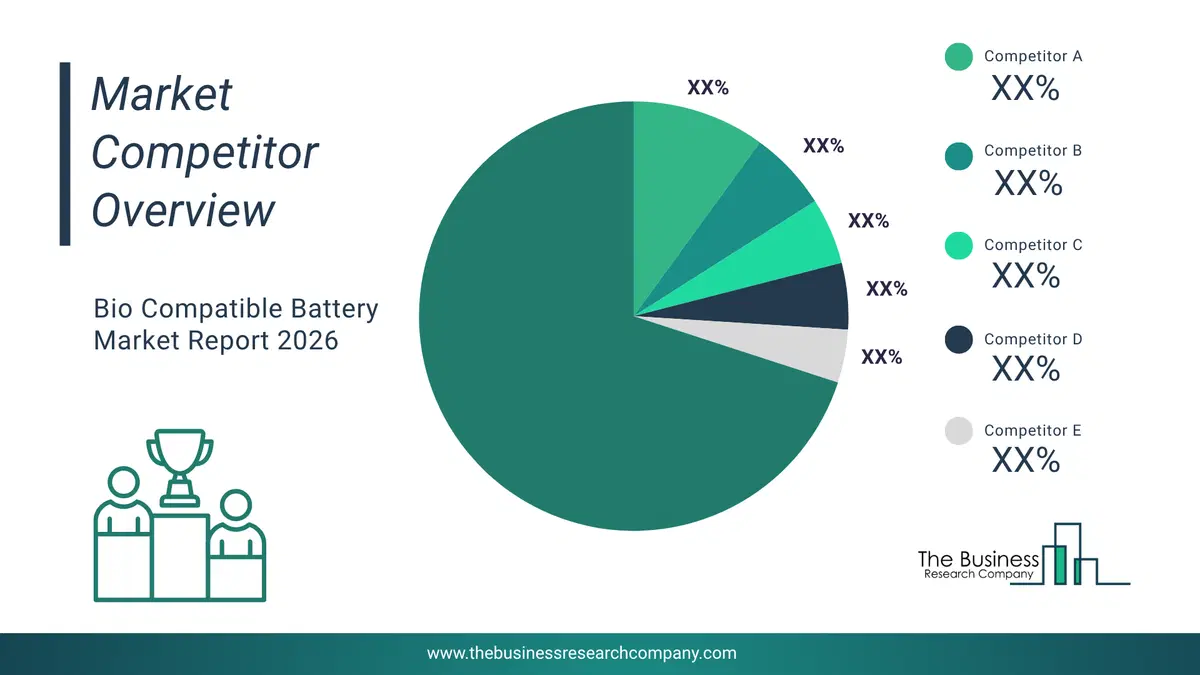
This chart is for illustrative purposes; the full report includes a detailed competitor analysis and comprehensive overview of the top 10 companies in the market.
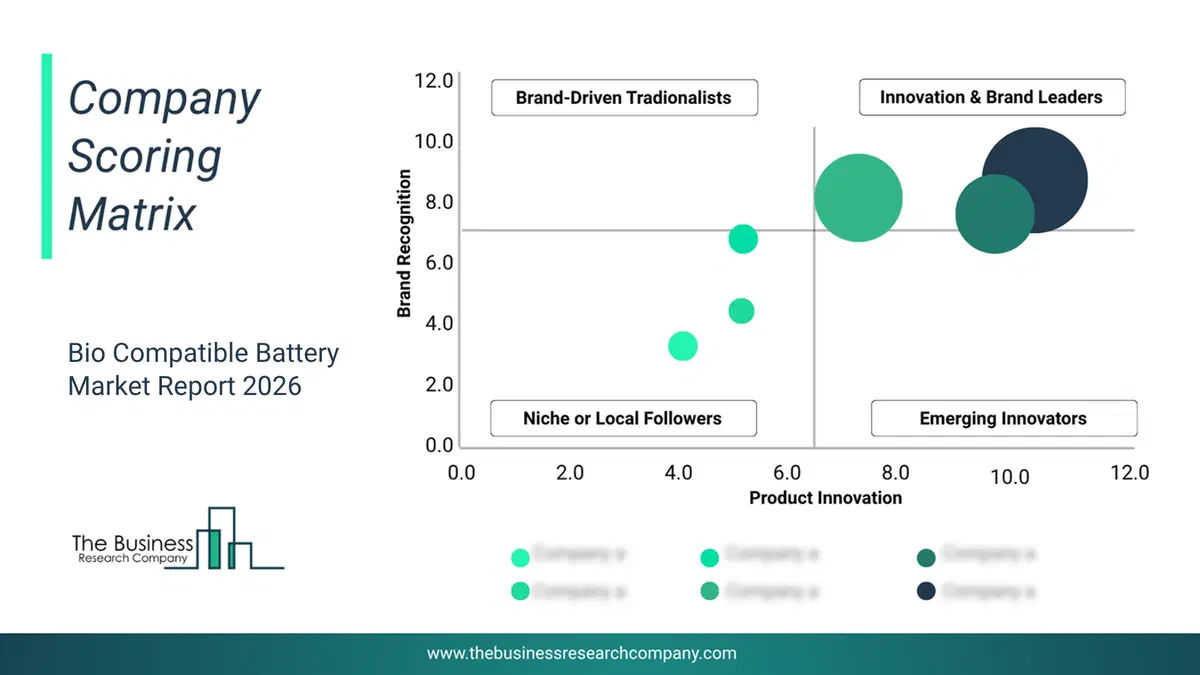
This chart maps companies by product innovation and brand strength, with bubble size indicating relative revenue, helping identify market leaders, challengers, and niche players. This is an illustrative chart; the full report provides a complete and accurate competitive analysis.
Global Bio Compatible Battery Market Trends and Insights
Major companies operating in the bio-compatible battery market are focusing on developing innovative advancements such as soft biodegradable micro batteries to enable safe, miniature, and versatile power sources for biomedical and micro robotic applications. A soft biodegradable micro battery is a microscale energy storage device fabricated from biocompatible materials that can safely operate within biological environments and degrade after use. For instance, in October 2024, the University of Oxford, a UK-based research institution, launched the miniature soft lithium-ion battery. The battery represents a significant advancement, as it combines high energy density with soft, biocompatible, and biodegradable construction, making it suitable for implantation and minimally invasive procedures. Additionally, it supports multifunctional applications, including powering drug delivery, controlling heart rhythm, and enabling mobile energy transfer for micro robotic devices.What Are Latest Mergers And Acquisitions In The Bio Compatible Battery Market?
In June 2024, Stora Enso, a Finland-based renewable materials company, partnered with Altris AB to develop and commercialize a sustainable sodium-ion battery using Stora Enso’s bio-based hard carbon anode material, Lignode. This deal aims to establish a Europe-based sustainable battery value chain, promote bio-compatible battery technology, and reduce the environmental impact of battery production. Altris AB is a Sweden-based cathode material for sustainable sodium-ion batteries.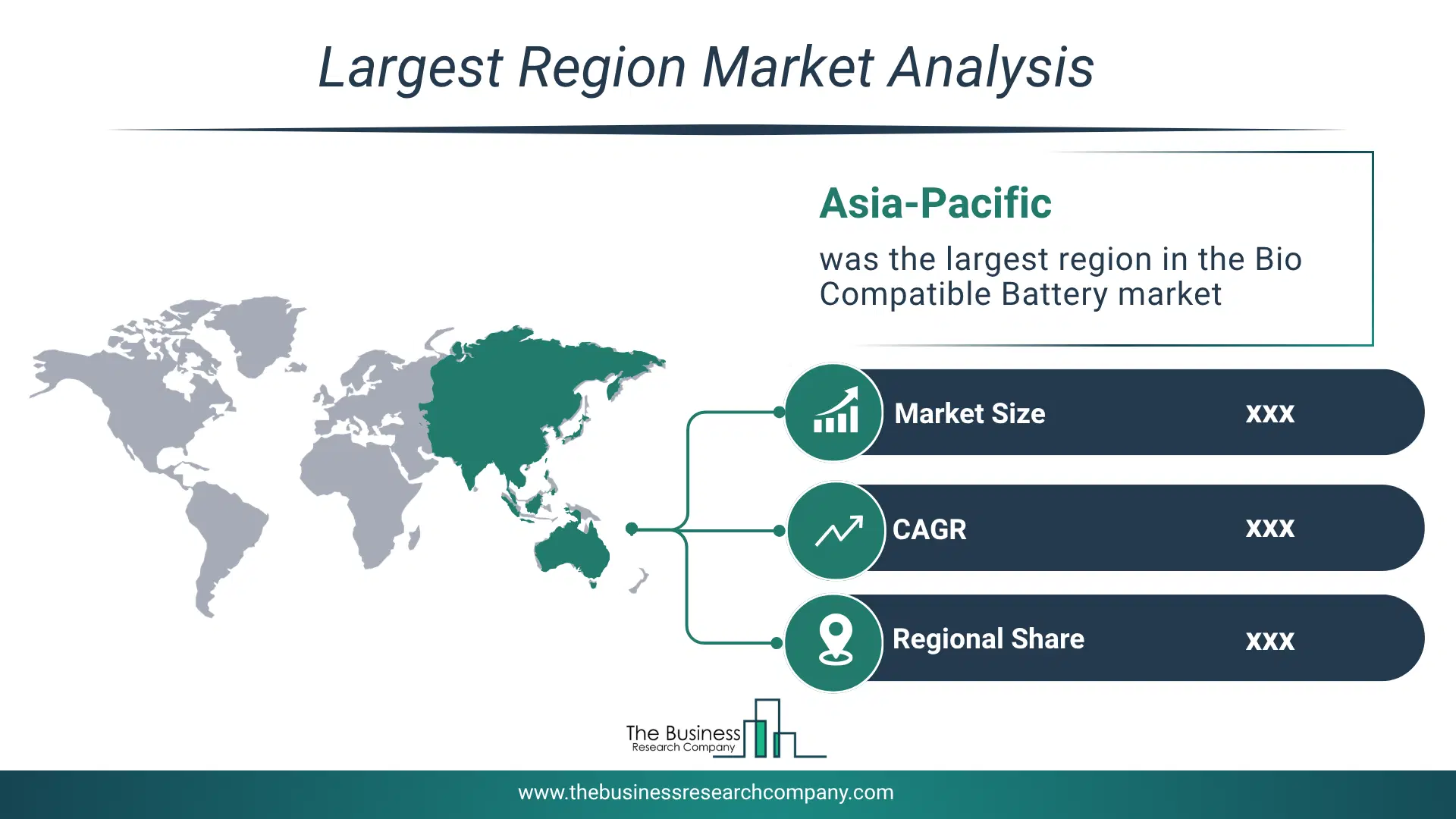
Regional Outlook
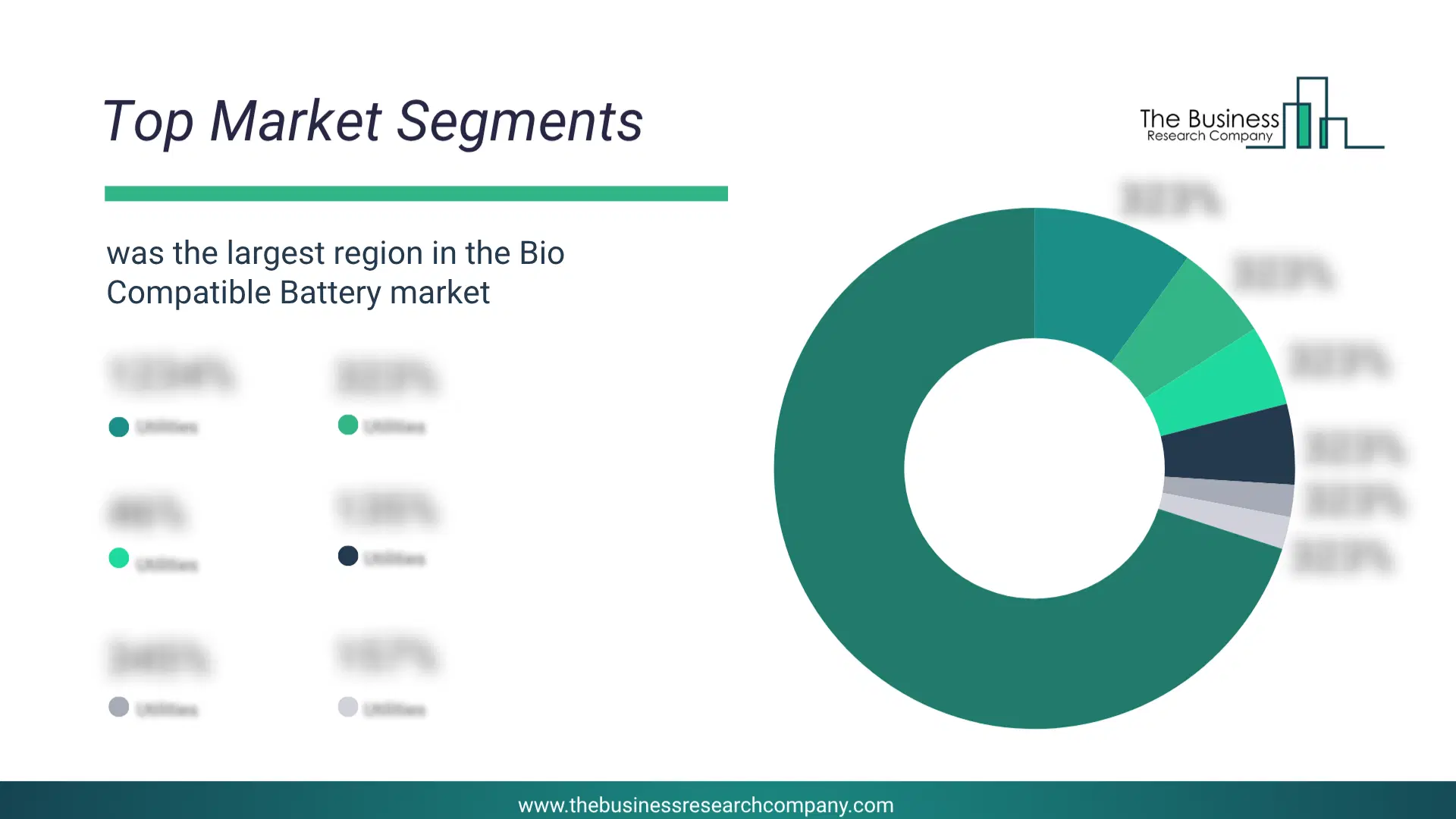
Asia-Pacific was the largest region in the bio-compatible battery market in 2025. Asia-Pacific is expected to be the fastest-growing region in the forecast period. The regions covered in this market report are Asia-Pacific, South East Asia, Western Europe, Eastern Europe, North America, South America, Middle East, Africa. The countries covered in this market report are Australia, Brazil, China, France, Germany, India, Indonesia, Japan, Taiwan, Russia, South Korea, UK, USA, Canada, Italy, Spain.What Defines the Bio Compatible Battery Market?
The bio-compatible battery market consists of sales of products such as bio-compatible batteries for neural stimulators, flexible bio-compatible batteries for wearable medical devices, and micro bio-compatible batteries for drug delivery systems. Values in this market are ‘factory gate’ values, that is, the value of goods sold by the manufacturers or creators of the goods, whether to other entities (including downstream manufacturers, wholesalers, distributors, and retailers) or directly to end customers. The value of goods in this market includes related services sold by the creators of the goods.How is Market Value Defined and Measured?
The market value is defined as the revenues that enterprises gain from the sale of goods and/or services within the specified market and geography through sales, grants, or donations in terms of the currency (in USD unless otherwise specified). The revenues for a specified geography are consumption values that are revenues generated by organizations in the specified geography within the market, irrespective of where they are produced. It does not include revenues from resales along the supply chain, either further along the supply chain or as part of other products.
This chart presents market attractiveness based on a quantitative evaluation of growth, competition, strategic alignment, and risk, offering a clear view of opportunity areas for decision-making. This chart is for illustrative purposes; the full report contains the complete analysis.

This chart highlights the Total Addressable Market (TAM) by estimating the maximum revenue opportunity using an assumption-driven approach, supporting strategic planning and opportunity sizing across markets. The chart is illustrative; the full report provides a more comprehensive analysis.
What Key Data and Analysis Are Included in the Bio Compatible Battery Market Report 2026?
The bio compatible battery market research report is one of a series of new reports from The Business Research Company that provides market statistics, including industry global market size, regional shares, competitors with the market share, detailed market segments, market trends and opportunities, and any further data you may need to thrive in the bio compatible battery industry. The market research report delivers a complete perspective of everything you need, with an in-depth analysis of the current and future state of the industry.Bio Compatible Battery Market Report Forecast Analysis
| Report Attribute | Details |
|---|---|
| Market Size Value In 2026 | $1.55 billion |
| Revenue Forecast In 2030 | $2.58 billion |
| Growth Rate | CAGR of 13.6% from 2026 to 2030 |
| Base Year For Estimation | 2025 |
| Actual Estimates/Historical Data | 2020-2025 |
| Forecast Period | 2026 - 2030 |
| Market Representation | Revenue in USD Billion and CAGR from 2026 to 2030 |
| Segments Covered | Type, Material, Application, End User |
| Regional Scope | Asia-Pacific, Western Europe, Eastern Europe, North America, South America, Middle East, Africa |
| Country Scope | The countries covered in the report are Australia, Brazil, China, France, Germany, India, Indonesia, Japan, Taiwan, Russia, South Korea, UK, USA, Canada, Italy, Spain. |
| Key Companies Profiled | Jenax Inc., BeFC Bioenzymatic Fuel Cells, Enfucell Oy, Ilika plc, Blue Spark Technologies Inc., Murata Manufacturing Co. Ltd., Ultralife Corporation, Stora Enso Oyj, Nexus Power Pvt. Ltd., Integer Holdings Corporation, EaglePicher Technologies LLC, Resonetics LLC, City Labs Inc., Better Battery Co. Ltd., KEMIWATT SAS, CMBlu Energy AG, ZincFive Inc., Cymbet Corporation, BioVolt Ltd., EcoCell Inc., Medtronic plc, Abbott Laboratories, Boston Scientific Corporation |
| Customization Scope | Request for Customization |
| Pricing And Purchase Options | Explore Purchase Options |