
Bio Methanol Market Report 2026
Global Outlook – By Type ( Biogas Sourced, Waste Sourced), By Production Technology ( Biomass Gasification, Catalytic Synthesis, Carbon Capture And Utilization Based Methanol Production, Power To Methanol Technology), By Application ( Heat, Transportation, Electricity, Chemical Feedstock, Other Applications), By End User ( Chemical And Petrochemical Industry, Energy And Power, Industrial Manufacturing, Utilities) – Market Size, Trends, Strategies, and Forecast to 2030
Bio Methanol Market Report 2026 Market Overview
• Bio Methanol Market Report 2026 market size has reached to $3 billion in 2025 • Expected to grow to $5.79 billion in 2030 at a compound annual growth rate (CAGR) of 13.9% • Growth Driver: Rising Demand For Sustainable Fuels Fueling the Growth Of The Market Due To Increasing Adoption Of Low-Carbon Alternative Energy Sources • Market Trend: Advancements In Methanol-Powered Shipping Accelerating Bio Methanol Adoption • Europe was the largest region in 2025 and Asia-Pacific is the fastest growing region.What Is Covered Under Bio Methanol Market?
Bio methanol is a renewable form of methanol produced from sustainable feedstocks such as biomass, agricultural residues, municipal solid waste, biogas, or captured carbon dioxide combined with green hydrogen. Its primary use is as a low-carbon fuel and chemical feedstock, helping reduce greenhouse gas emissions in industries such as shipping, transportation, power generation, and chemical manufacturing. The main types of bio methanol include biogas sourced, and waste sourced. Biogas sourced refers to methanol produced from biogas feedstocks derived from organic waste decomposition processes. These products are produced using technologies such as biomass gasification, catalytic synthesis, carbon capture and utilization based methanol production, and power to methanol technology. They are used in applications including heat, transportation, electricity, chemical feedstock, and others and serve end users such as chemical and petrochemical industry, energy and power, industrial manufacturing, and utilities.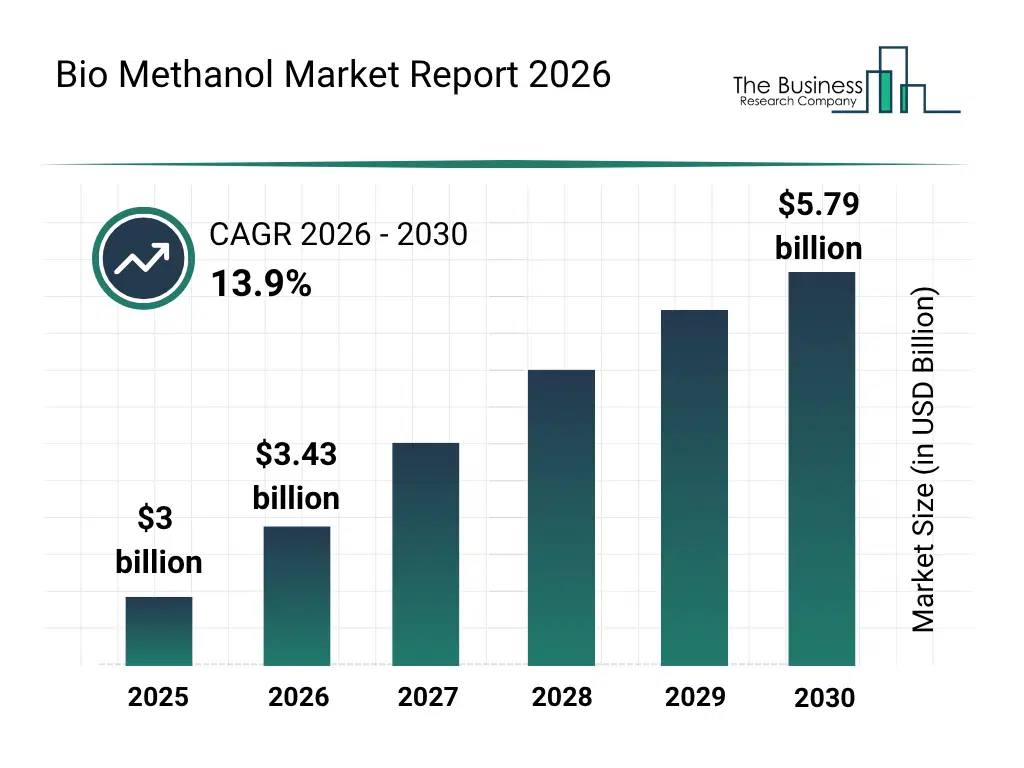
What Is The Bio Methanol Market Size and Share 2026?
The bio methanol market size has grown rapidly in recent years. It will grow from $3 billion in 2025 to $3.43 billion in 2026 at a compound annual growth rate (CAGR) of 14.4%. The growth in the historic period can be attributed to availability of biomass feedstock and agricultural residues, early adoption of biofuels in transportation sector, increasing regulatory pressure on carbon emissions reduction, growth of waste management and recycling initiatives, development of first generation biofuel production technologies.What Is The Bio Methanol Market Growth Forecast?
The bio methanol market size is expected to see rapid growth in the next few years. It will grow to $5.79 billion in 2030 at a compound annual growth rate (CAGR) of 13.9%. The growth in the forecast period can be attributed to rising demand for low carbon shipping fuels in maritime industry, increasing investments in carbon capture and utilization infrastructure, expansion of green hydrogen production capacity, growing industrial decarbonization mandates across regions, advancements in catalytic synthesis and power to methanol technologies. Major trends in the forecast period include green hydrogen based bio methanol production expansion, carbon capture utilization methanol synthesis adoption, waste to fuel bio methanol conversion technologies, maritime decarbonization fuel switching to bio methanol, circular economy based bio methanol supply chains.
Global Bio Methanol Market Segmentation
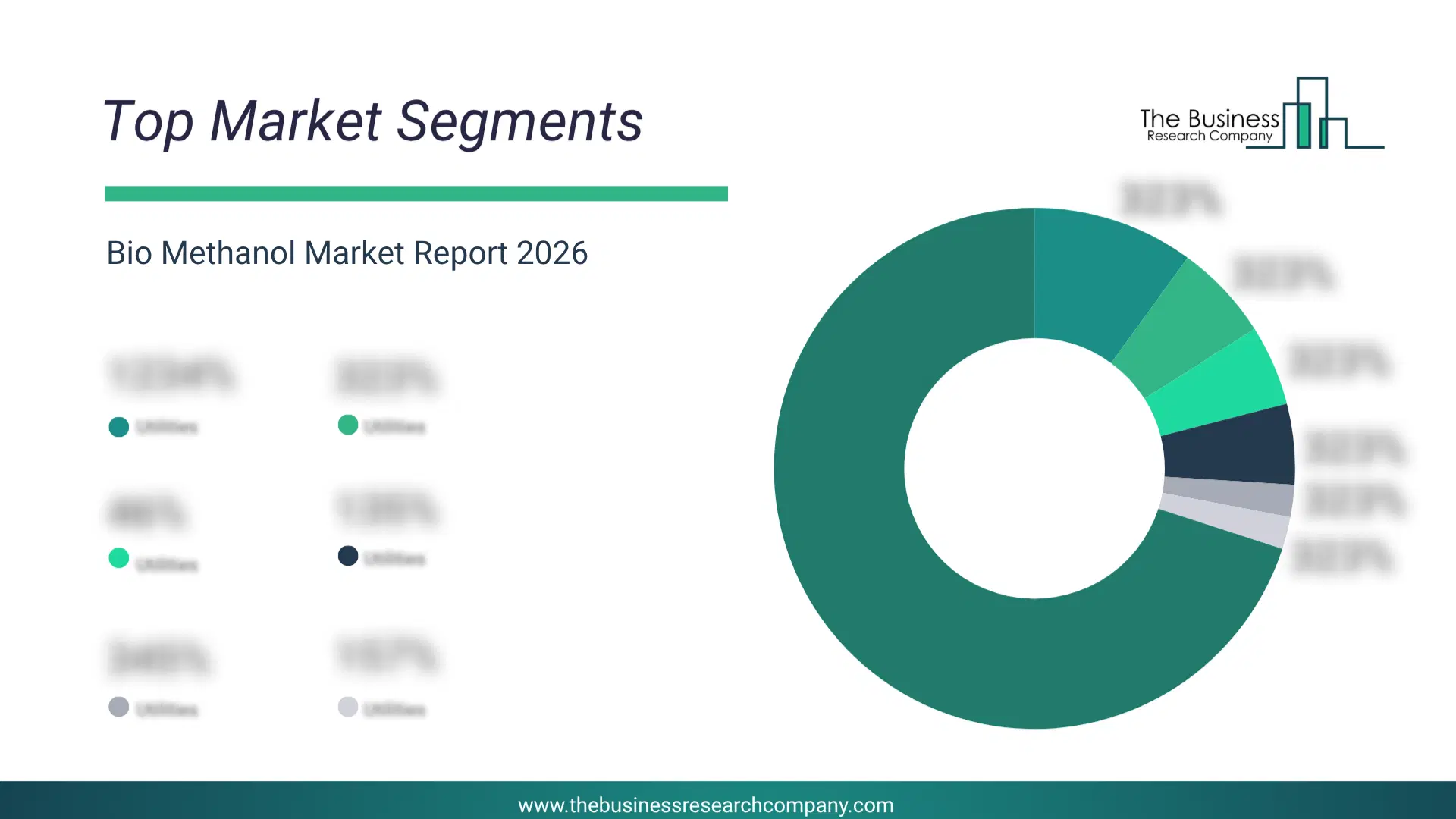
1) By Type: Biogas Sourced, Waste Sourced 2) By Production Technology: Biomass Gasification, Catalytic Synthesis, Carbon Capture And Utilization Based Methanol Production, Power To Methanol Technology 3) By Application: Heat, Transportation, Electricity, Chemical Feedstock, Other Applications 4) By End User: Chemical And Petrochemical Industry, Energy And Power, Industrial Manufacturing, Utilities Subsegments: 1) By Biogas Sourced: Carbon Dioxide Hydrogenation, Biogas Upgrading, Methane Reforming 2) By Waste Sourced: Agricultural Waste, Municipal Waste, Organic Waste, Industrial WasteWhat Is The Driver Of The Bio Methanol Market?
The rising demand for sustainable fuels is expected to propel the growth of the bio methanol market going forward. Sustainable fuels refer to fuels produced from renewable, low-carbon, or waste-based feedstocks that reduce greenhouse gas emissions and environmental impact compared to conventional fossil fuels. The rising demand for sustainable fuels is due to increasing global decarbonization targets, as governments and industries seek to reduce greenhouse gas emissions and achieve net-zero goals. The use of bio methanol in sustainable fuels is to provide a renewable, low-carbon alternative to conventional fossil fuels, helping reduce greenhouse gas emissions in transportation, shipping, and industrial energy applications. For instance, in February 2026, according to the Department of Energy, a US-based government department, estimated U.S. sustainable aviation fuel consumption increased from 26.3 million gallons in 2023 to 111.86 million gallons in 2024, representing an increase of approximately 325% year-over-year. Therefore, the rising demand for sustainable fuels is driving the growth of the bio methanol industry.Key Players In The Global Bio Methanol Market
Major companies operating in the bio methanol market report are TotalEnergies SE, Equinor ASA, ENGIE SA, BASF SE, Iberdrola S.A., Air Liquide S.A., Yara International ASA, Ørsted A/S, Mitsubishi Gas Chemical Company Inc., Clariant AG, Methanex Corporation, Topsoe A/S, Södra Skogsägarna Ekonomisk Förening, Liquid Wind AB, Proman AG, Abel Energy Pty Ltd, European Energy A/S, Carbon Recycling International hf., VärmlandsMetanol AB, WasteFuel Global LLC, Uniper SE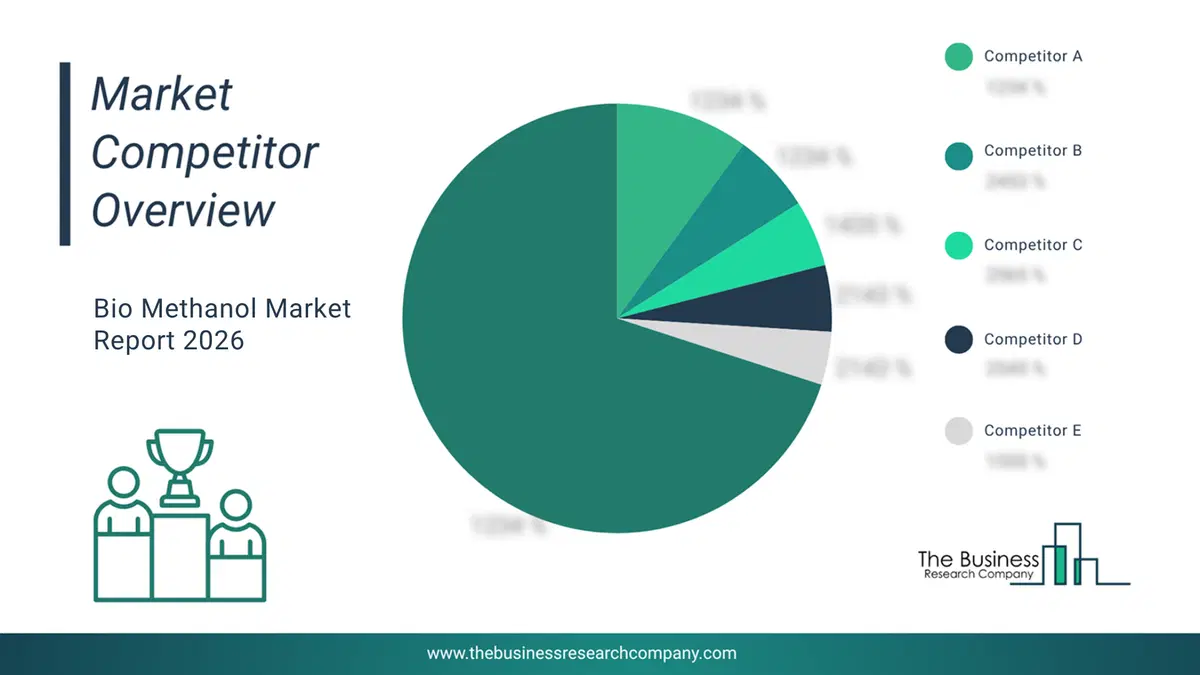
This chart is for illustrative purposes; the full report includes a detailed competitor analysis and comprehensive overview of the top 10 companies in the market.
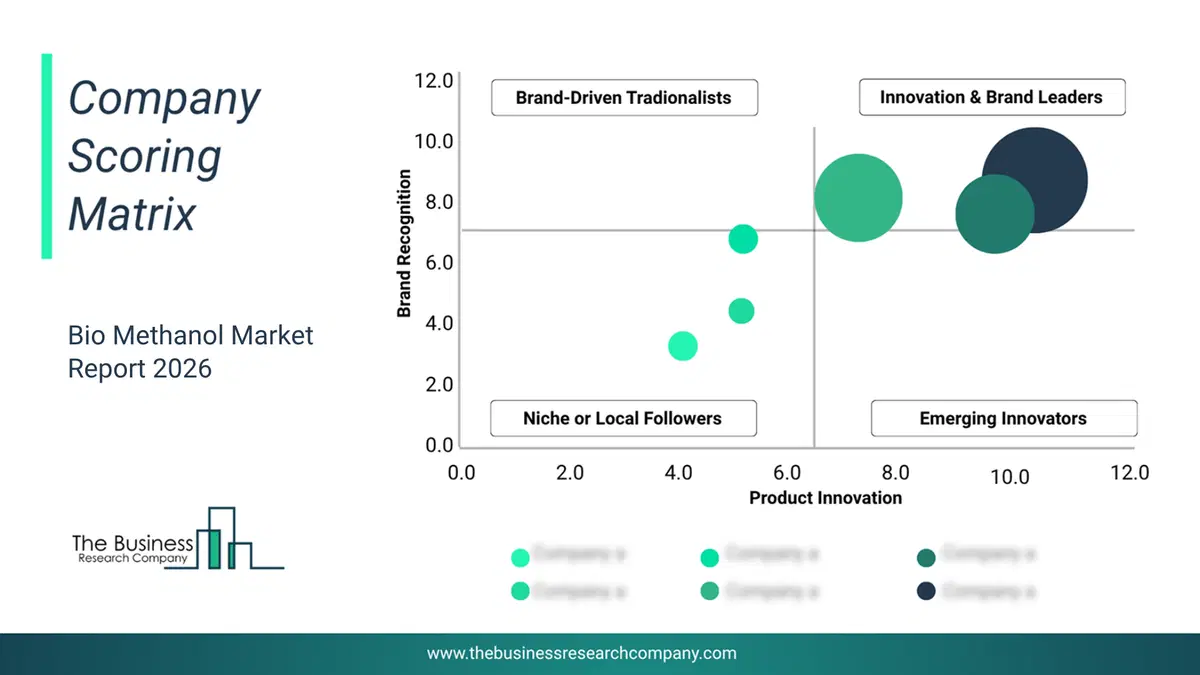
This chart maps companies by product innovation and brand strength, with bubble size indicating relative revenue, helping identify market leaders, challengers, and niche players. This is an illustrative chart; the full report provides a complete and accurate competitive analysis.
Global Bio Methanol Market Trends and Insights
Major companies operating in the bio methanol market are focusing on developing advanced sustainable maritime transportation solutions, such as methanol-powered container vessels, to accelerate decarbonization in the shipping industry and expand the adoption of renewable marine fuels. Methanol-powered container vessels refer to ships equipped with dual-fuel engines capable of operating on bio methanol or green methanol, enabling significant reductions in greenhouse gas emissions compared to conventional marine fuels. For instance, in September 2023, A.P. Moller - Maersk, a Denmark-based shipping and logistics company, unveiled Laura Maersk, the first methanol-enabled container vessel. The vessel is designed to operate on green methanol and serves as a key milestone in the maritime industry's transition toward low-carbon fuels, supporting the commercialization and large-scale adoption of bio methanol across global shipping networks.What Are Latest Mergers And Acquisitions In The Bio Methanol Market?
In June 2025, Methanex Corporation, a Canada-based producer and supplier of methanol, acquired Methanol Business of OCI Global N.V. for an undisclosed amount. Through this acquisition, Methanex expanded its global methanol production footprint, strengthened its low-carbon and renewable methanol portfolio through the addition of OCI's low-carbon methanol production and marketing business, and enhanced its position in the growing bio methanol and sustainable fuels market. OCI Global N.V. is a Netherlands-based chemical and industrial company supporting the production and supply of bio methanol for sustainable fuel applications.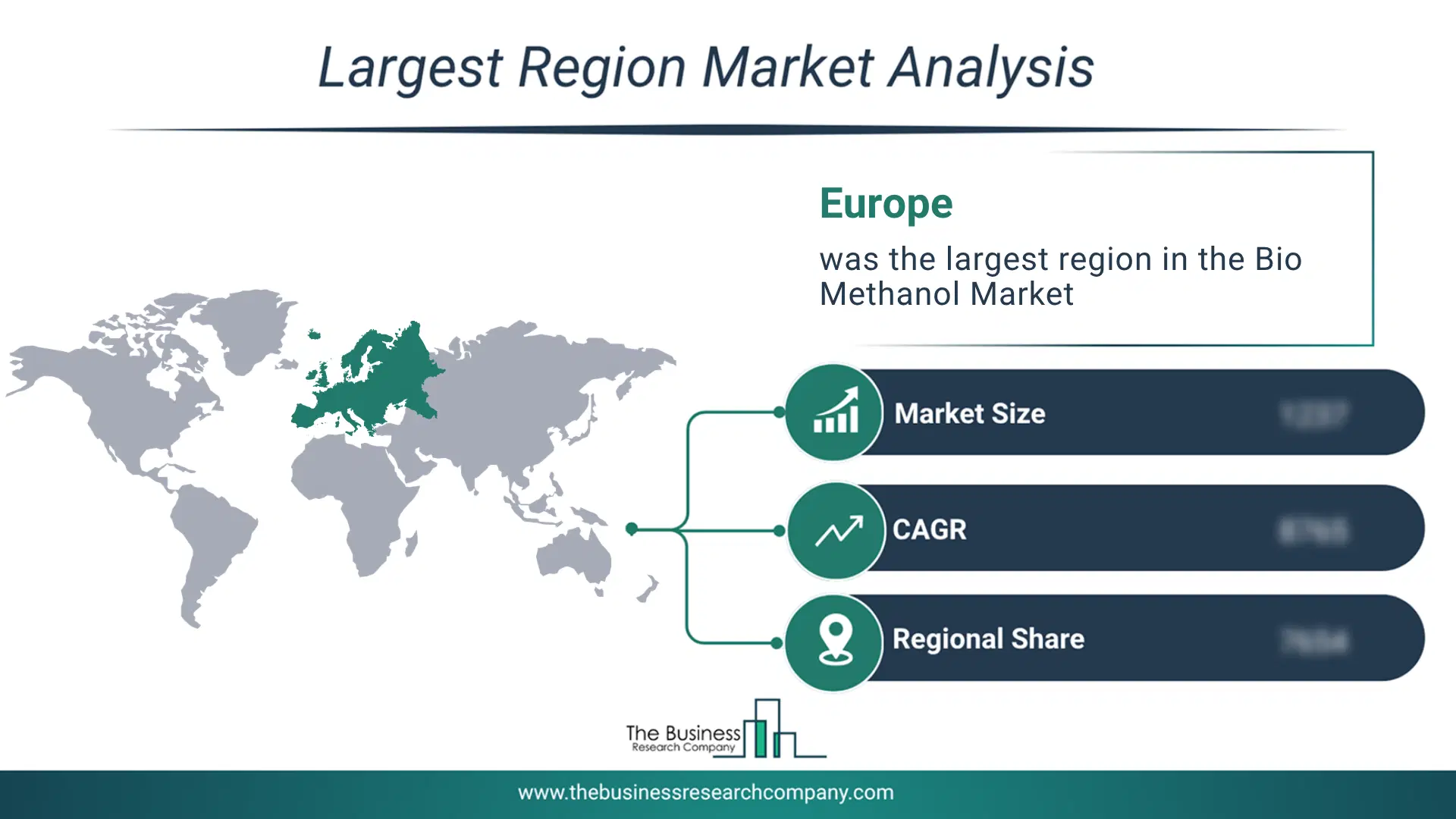
Regional Outlook
Europe was the largest region in the bio methanol market in 2025. Asia-Pacific is expected to be the fastest-growing region in the forecast period. The regions covered in this market report are Asia-Pacific, South East Asia, Western Europe, Eastern Europe, North America, South America, Middle East, Africa. The countries covered in this market report are Australia, Brazil, China, France, Germany, India, Indonesia, Japan, Taiwan, Russia, South Korea, UK, USA, Canada, Italy, Spain.What Defines the Bio Methanol Market?
The bio methanol market consists of sales of renewable methanol, biomethanol, e-methanol, biomass-derived methanol, green methanol, and low-carbon methanol products. Values in this market are ‘factory gate’ values, that is the value of goods sold by the manufacturers or creators of the goods, whether to other entities (including downstream manufacturers, wholesalers, distributors and retailers) or directly to end customers. The value of goods in this market includes related services sold by the creators of the goods.How is Market Value Defined and Measured?
The market value is defined as the revenues that enterprises gain from the sale of goods and/or services within the specified market and geography through sales, grants, or donations in terms of the currency (in USD unless otherwise specified). The revenues for a specified geography are consumption values that are revenues generated by organizations in the specified geography within the market, irrespective of where they are produced. It does not include revenues from resales along the supply chain, either further along the supply chain or as part of other products.
This chart presents market attractiveness based on a quantitative evaluation of growth, competition, strategic alignment, and risk, offering a clear view of opportunity areas for decision-making. This chart is for illustrative purposes; the full report contains the complete analysis.

This chart highlights the Total Addressable Market (TAM) by estimating the maximum revenue opportunity using an assumption-driven approach, supporting strategic planning and opportunity sizing across markets. The chart is illustrative; the full report provides a more comprehensive analysis.
What Key Data and Analysis Are Included in the Bio Methanol Market Report 2026?
The bio methanol market research report is one of a series of new reports from The Business Research Company that provides market statistics, including industry global market size, regional shares, competitors with the market share, detailed market segments, market trends and opportunities, and any further data you may need to thrive in the bio methanol industry. The market research report delivers a complete perspective of everything you need, with an in-depth analysis of the current and future state of the industry.Bio Methanol Market Report Forecast Analysis
| Report Attribute | Details |
|---|---|
| Market Size Value In 2026 | $3.43 billion |
| Revenue Forecast In 2030 | $5.79 billion |
| Growth Rate | CAGR of 13.9% from 2026 to 2030 |
| Base Year For Estimation | 2025 |
| Actual Estimates/Historical Data | 2020-2025 |
| Forecast Period | 2026 - 2030 |
| Market Representation | Revenue in USD Billion and CAGR from 2026 to 2030 |
| Segments Covered | Type, Production Technology, Application, End User |
| Regional Scope | Asia-Pacific, Western Europe, Eastern Europe, North America, South America, Middle East, Africa |
| Country Scope | The countries covered in the report are Australia, Brazil, China, France, Germany, India, Indonesia, Japan, Taiwan, Russia, South Korea, UK, USA, Canada, Italy, Spain. |
| Key Companies Profiled | TotalEnergies SE, Equinor ASA, ENGIE SA, BASF SE, Iberdrola S.A., Air Liquide S.A., Yara International ASA, Ørsted A/S, Mitsubishi Gas Chemical Company Inc., Clariant AG, Methanex Corporation, Topsoe A/S, Södra Skogsägarna Ekonomisk Förening, Liquid Wind AB, Proman AG, Abel Energy Pty Ltd, European Energy A/S, Carbon Recycling International hf., VärmlandsMetanol AB, WasteFuel Global LLC, Uniper SE |
| Customization Scope | Request for Customization |
| Pricing And Purchase Options | Explore Purchase Options |