

Bio Plasticizers Market Report 2026
Global Outlook – By Type (Sebacates, Citrates, Glycerol Esters, Epoxides, Other Types), By Application (Flooring And Walls, Film And Sheet Coverings, Coated Fabrics, Consumer Goods, Other Applications), By End-Use (Packaging, Textiles, Building And Construction, Medical And Healthcare, Other End Uses) – Market Size, Trends, Strategies, and Forecast to 2030
Bio Plasticizers Market Overview
• Bio Plasticizers market size has reached to $1.79 billion in 2025 • Expected to grow to $2.6 billion in 2030 at a compound annual growth rate (CAGR) of 7.8% • Growth Driver: Thriving Construction Industry Fuels Growth In The Bio-Plasticizer Market • Market Trend: Bio-Sourced Admixture Solutions Transforming The Bio Plasticizer Market • Asia-Pacific was the largest region in 2025 and Europe is the fastest growing region.What Is Covered Under Bio Plasticizers Market?
Bio plasticizers are environmentally sustainable compounds added to polymers to enhance their flexibility and usability. Sourced from renewable materials like vegetable oils, they serve as a greener alternative to conventional plasticizers produced from petroleum-based resources. The main types of bio plasticizers include sebacates, succinic acid, citrates, glycerol esters, epoxides, and others. Succinic acid refers to a dicarboxylic acid that is created by live cells during the anaerobic digestion of various carbon sources. They are used in applications including flooring and walls, film and sheet coverings, wires and cables, coated fabrics, consumer goods and others, that are used by end-user industries such as automobile, packaging, electrical and electronics, textiles, building and construction, medical and healthcare and others.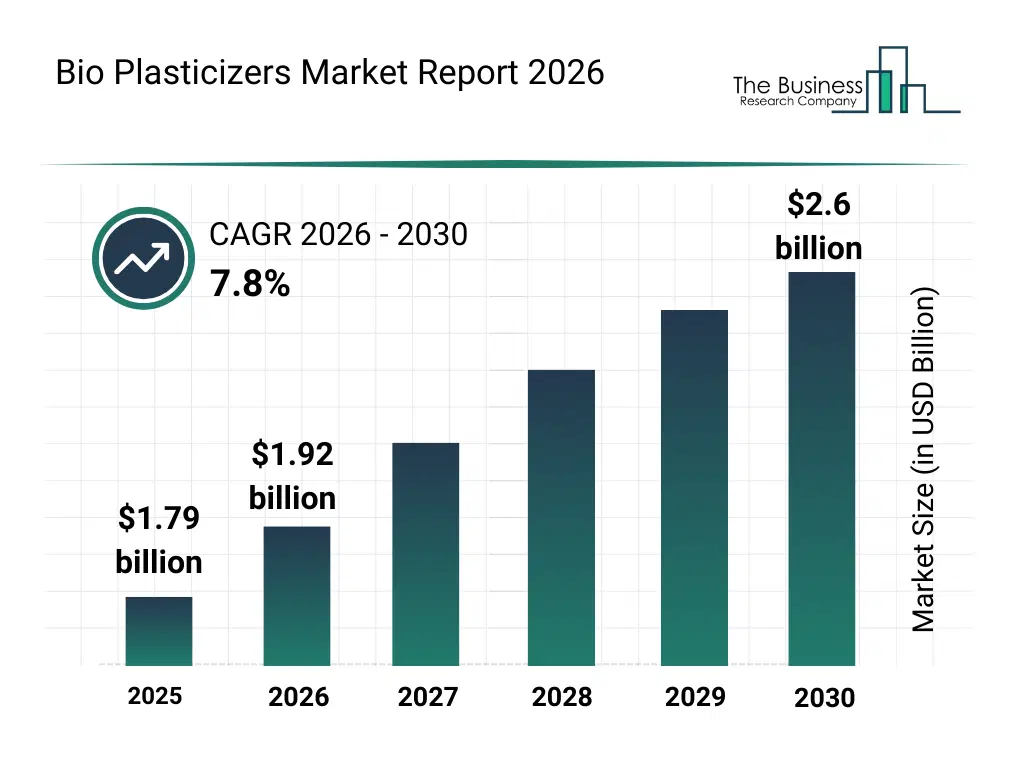
What Is The Bio Plasticizers Market Size and Share 2026?
The bio plasticizers market size has grown strongly in recent years. It will grow from $1.79 billion in 2025 to $1.92 billion in 2026 at a compound annual growth rate (CAGR) of 7.7%. The growth in the historic period can be attributed to regulatory restrictions on conventional plasticizers, growing environmental awareness, expansion of packaging and consumer goods industries, increasing availability of bio-based feedstocks, growth of polymer processing activities.What Is The Bio Plasticizers Market Growth Forecast?
The bio plasticizers market size is expected to see strong growth in the next few years. It will grow to $2.6 billion in 2030 at a compound annual growth rate (CAGR) of 7.8%. The growth in the forecast period can be attributed to increasing adoption of sustainable polymers, rising demand from medical and healthcare applications, expansion of green building materials, growing investments in bio-refinery technologies, increasing focus on circular economy materials. Major trends in the forecast period include rising adoption of bio-based plastic additives, growing demand for non-toxic and phthalate-free plasticizers, expansion of renewable feedstock utilization, increased use in flexible packaging applications, innovation in high-performance bio plasticizers.
Global Bio Plasticizers Market Segmentation
1) By Type: Sebacates, Citrates, Glycerol Esters, Epoxides, Other Types 2) By Application: Flooring And Walls, Film And Sheet Coverings, Coated Fabrics, Consumer Goods, Other Applications 3) By End-Use: Packaging, Textiles, Building And Construction, Medical And Healthcare, Other End Uses Subsegments: 1) By Sebacates: Di-2-ethylhexyl Sebacate (DEHS), Other Sebacate Variants 2) By Citrates: Triethyl Citrate (TEC), Tributyl Citrate (TBC), Other Citrate Variants 3) By Glycerol Esters: Glycerol Monoesters, Glycerol Diesters 4) By Epoxides: Epoxidized Soybean Oil (ESBO), Other Epoxidized Oils 5) By Other Types: Starch-based Plasticizers, Lactic Acid-based Plasticizers, Other Novel Bio PlasticizersWhat Is The Driver Of The Bio Plasticizers Market?
The flourishing construction industry is expected to boost the growth of the bioplasticizer market going forward. The construction industry is the commercial manufacturing and trade sector that develops, preserves, and repairs infrastructure. In the construction sector, bioplasticizers are used for wire insulation and jacketing, which reduce water requirements and make concrete strong and workable. For instance, in July 2024, according to the reports published by the Committee on Statistics of the Ministry of National Economy of the Republic of Kazakhstan, in 2023 the volume of construction work (services) amounted to 7,612.8 billion tenge and increased by 15.1% compared to 2022. Therefore, the flourishing construction industry is driving the growth of the bioplasticizer market.Key Players In The Global Bio Plasticizers Market
Major companies operating in the bio plasticizers market are Arkema, BASF, Evonik Industries, Emery Oleochemicals, Cargill, Croda International, Jungbunzlauer, Corbion, Polynt, Vertellus, Matrica, Valtris Specialty Chemicals, KLJ Group, Payal Polyplast, BioAmber, Oan Industries, ADEKA Corporation, LANXESS, Mitsubishi Chemical Group, Kao Corporation, Stepan Company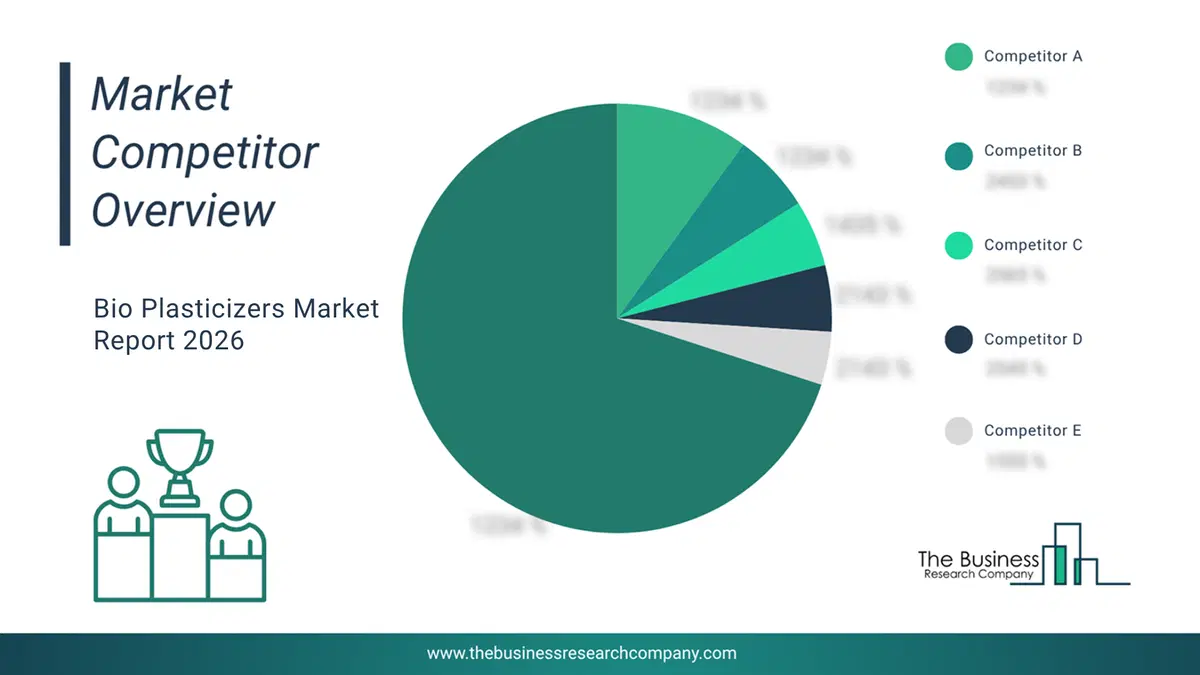
This chart is for illustrative purposes; the full report includes a detailed competitor analysis and comprehensive overview of the top 10 companies in the market.
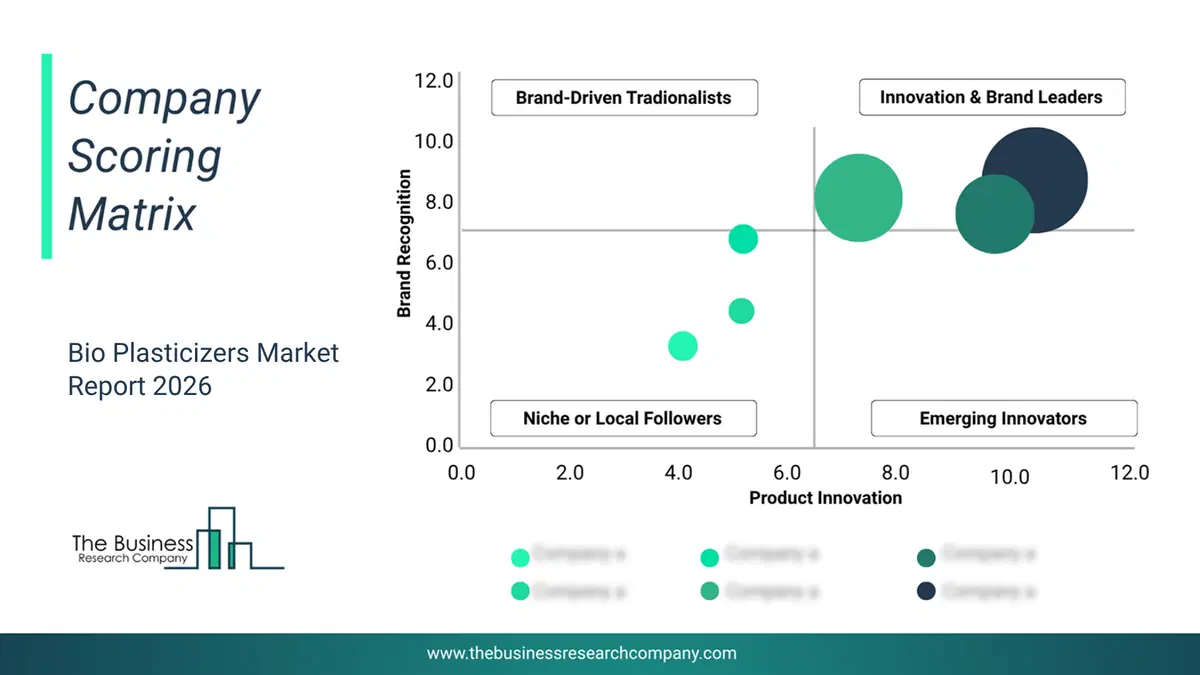
This chart maps companies by product innovation and brand strength, with bubble size indicating relative revenue, helping identify market leaders, challengers, and niche players. This is an illustrative chart; the full report provides a complete and accurate competitive analysis.
Global Bio Plasticizers Market Trends and Insights
Major companies operating in the bioplasticizer market are focusing on developing new products, such as bio-sourced admixture solutions, to sustain their position in the market. Bio-sourced admixtures are a new and exciting development in the construction industry, offering a more sustainable alternative to traditional, oil-based admixtures. For instance, in January 2023, CEMEX, a US-based building materials company, launched ISOFLOW BIO. It is a high-performance superplasticizer technology made from bio-based raw materials, which can significantly reduce the carbon footprint of concrete production compared to traditional admixtures. ISOFLOW BIO makes concrete more workable, which means it's easier to mix, pump, and place. This can lead to faster construction times and reduced labor costs.What Are Latest Mergers And Acquisitions In The Bio Plasticizers Market?
In March 2024, Baerlocher USA, a U.S.-based specialty chemicals company focusing on additives for plastics, partnered with Innoleics to distribute non-phthalate bio-plasticizers in the United States. Through this partnership, Baerlocher aims to expand access to sustainable and renewable plasticizer products for flexible PVC applications by leveraging Innoleics’ portfolio of bio-based plasticizers, which enhance the flexibility and performance of polymers while reducing reliance on fossil-based additives. Innoleics is a U.S.-based chemical company specializing in sustainable plasticizer solutions.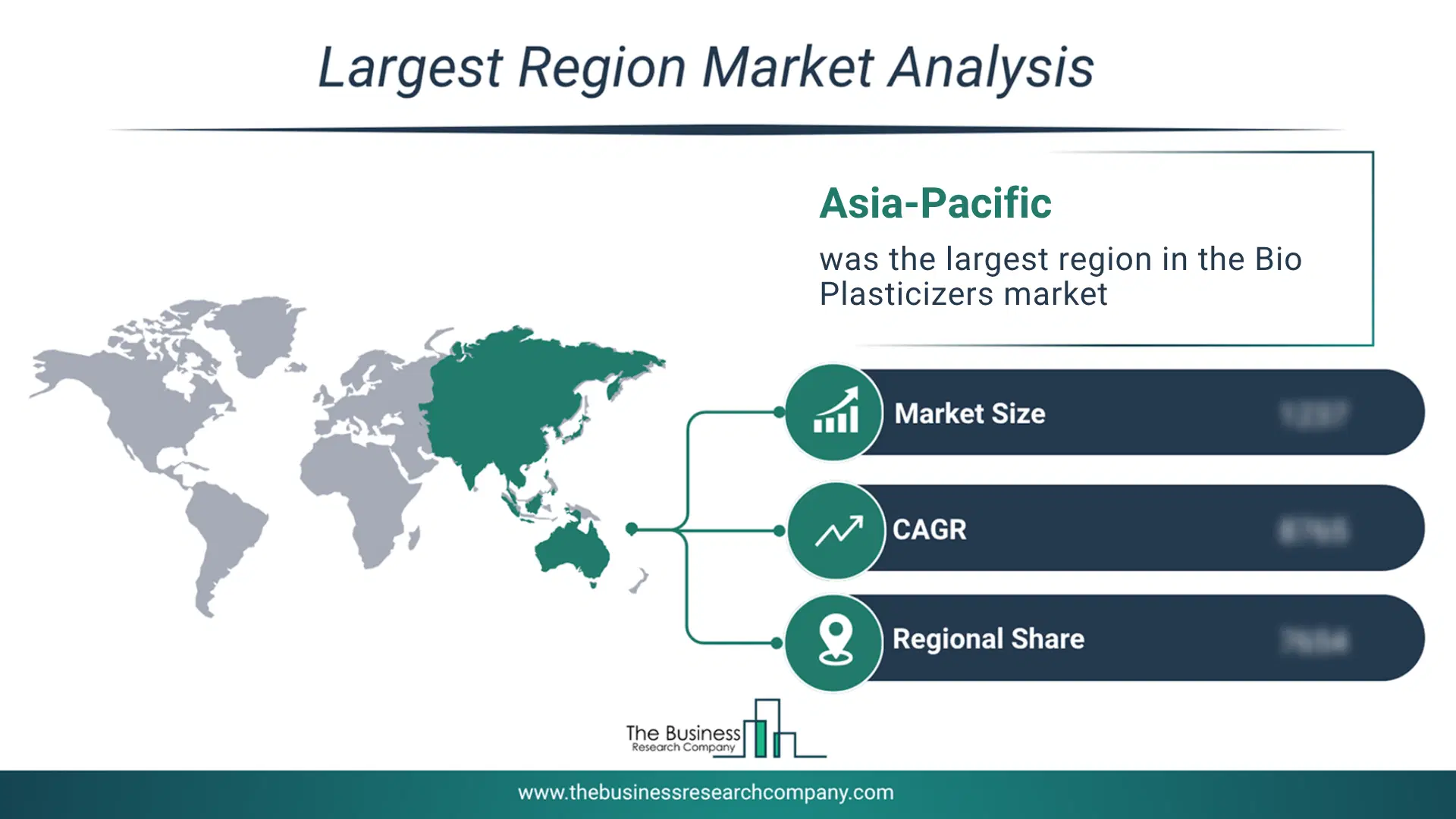
Regional Insights
Asia-Pacific was the largest region in the bio plasticizers market in 2025. Europe is expected to be the fastest-growing region in the forecast period. The regions covered in this market report are Asia-Pacific, South East Asia, Western Europe, Eastern Europe, North America, South America, Middle East, Africa The countries covered in this market report are Australia, Brazil, China, France, Germany, India, Indonesia, Japan, Taiwan, Russia, South Korea, UK, USA, Canada, Italy, SpainWhat Defines the Bio Plasticizers Market?
The bio plasticizer market consists of sales of fast-fusing plasticizers, flame retardant plasticizers, and specialty esters. Values in this market are ‘factory gate’ values, that is the value of goods sold by the manufacturers or creators of the goods, whether to other entities (including downstream manufacturers, wholesalers, distributors and retailers) or directly to end customers. The value of goods in this market includes related services sold by the creators of the goods.How is Market Value Defined and Measured?
The market value is defined as the revenues that enterprises gain from the sale of goods and/or services within the specified market and geography through sales, grants, or donations in terms of the currency (in USD unless otherwise specified). The revenues for a specified geography are consumption values that are revenues generated by organizations in the specified geography within the market, irrespective of where they are produced. It does not include revenues from resales along the supply chain, either further along the supply chain or as part of other products.
This chart presents market attractiveness based on a quantitative evaluation of growth, competition, strategic alignment, and risk, offering a clear view of opportunity areas for decision-making. This chart is for illustrative purposes; the full report contains the complete analysis.

This chart highlights the Total Addressable Market (TAM) by estimating the maximum revenue opportunity using an assumption-driven approach, supporting strategic planning and opportunity sizing across markets. The chart is illustrative; the full report provides a more comprehensive analysis.
What Key Data and Analysis Are Included in the Bio Plasticizers Market Report 2026?
The bio plasticizers market research report is one of a series of new reports from The Business Research Company that provides market statistics, including industry global market size, regional shares, competitors with the market share, detailed market segments, market trends and opportunities, and any further data you may need to thrive in the bio plasticizers industry. The market research report delivers a complete perspective of everything you need, with an in-depth analysis of the current and future state of the industry.Bio Plasticizers Market Report Forecast Analysis
| Report Attribute | Details |
|---|---|
| Market Size Value In 2026 | $1.92 billion |
| Revenue Forecast In 2030 | $2.6 billion |
| Growth Rate | CAGR of 7.7% from 2026 to 2030 |
| Base Year For Estimation | 2025 |
| Actual Estimates/Historical Data | 2020-2025 |
| Forecast Period | 2026 - 2030 |
| Market Representation | Revenue in USD Billion and CAGR from 2026 to 2030 |
| Segments Covered | Type, Application, End-Use |
| Regional Scope | Asia-Pacific, Western Europe, Eastern Europe, North America, South America, Middle East, Africa |
| Country Scope | The countries covered in this market report are Australia, Brazil, China, France, Germany, India, Indonesia, Japan, Taiwan, Russia, South Korea, UK, USA, Canada, Italy, Spain |
| Key Companies Profiled | Arkema, BASF, Evonik Industries, Emery Oleochemicals, Cargill, Croda International, Jungbunzlauer, Corbion, Polynt, Vertellus, Matrica, Valtris Specialty Chemicals, KLJ Group, Payal Polyplast, BioAmber, Oan Industries, ADEKA Corporation, LANXESS, Mitsubishi Chemical Group, Kao Corporation, Stepan Company |
| Customization Scope | Request for Customization |
| Pricing And Purchase Options | Explore Purchase Options |