

Biocides Specialty Oilfield Chemicals Market Report 2026
Global Outlook – By Product Type ( Inhibitors, Friction Reducers, Surfactants, Biocides, Demulsifiers, Other Products), By Location ( Onshore, Offshore), By Distribution Channel ( Direct Sales, Distributor Networks, Oilfield Service Company Bundles, Integrated Chemical Management Programs), By Application ( Production, Drilling Fluids, Oil Recovery, Cementing, Other Applications), By End Use Industry ( Upstream, Midstream, Downstream) – Market Size, Trends, Strategies, and Forecast to 2030
Biocides Specialty Oilfield Chemicals Market Report 2026 Market Overview
• Biocides Specialty Oilfield Chemicals Market Report 2026 market size has reached to $1.81 billion in 2025 • Expected to grow to $2.59 billion in 2030 at a compound annual growth rate (CAGR) of 7.4% • Growth Driver: Growing Oil And Gas Exploration Activities Growth Of The Market Due To Rising Global Energy Demand • Market Trend: New Water-Treatment Microbiocide Improves Operational Reliability In Oilfield Systems • North America was the largest region in 2025 and Asia-Pacific is the fastest growing region.What Is Covered Under Biocides Specialty Oilfield Chemicals Market?
Biocides specialty oilfield chemicals are chemical agents used in oil and gas operations to control or eliminate harmful microorganisms such as bacteria, fungi, and algae that can cause corrosion, reservoir souring, and equipment damage. These chemicals help maintain operational efficiency, protect infrastructure, and improve the safety and longevity of oilfield production systems. The main product types of biocides specialty oilfield chemicals include inhibitors, friction reducers, surfactants, biocides, demulsifiers, and other products. Inhibitors refer to chemical agents used to prevent corrosion, scaling, or other undesirable reactions during oilfield operations and production processes. These products are utilized across onshore and offshore locations and are distributed through direct sales, distributor networks, oilfield service company bundles, and integrated chemical management programs. They are applied in production, drilling fluids, oil recovery, cementing, and others and serve end use industries including upstream, midstream, and downstream.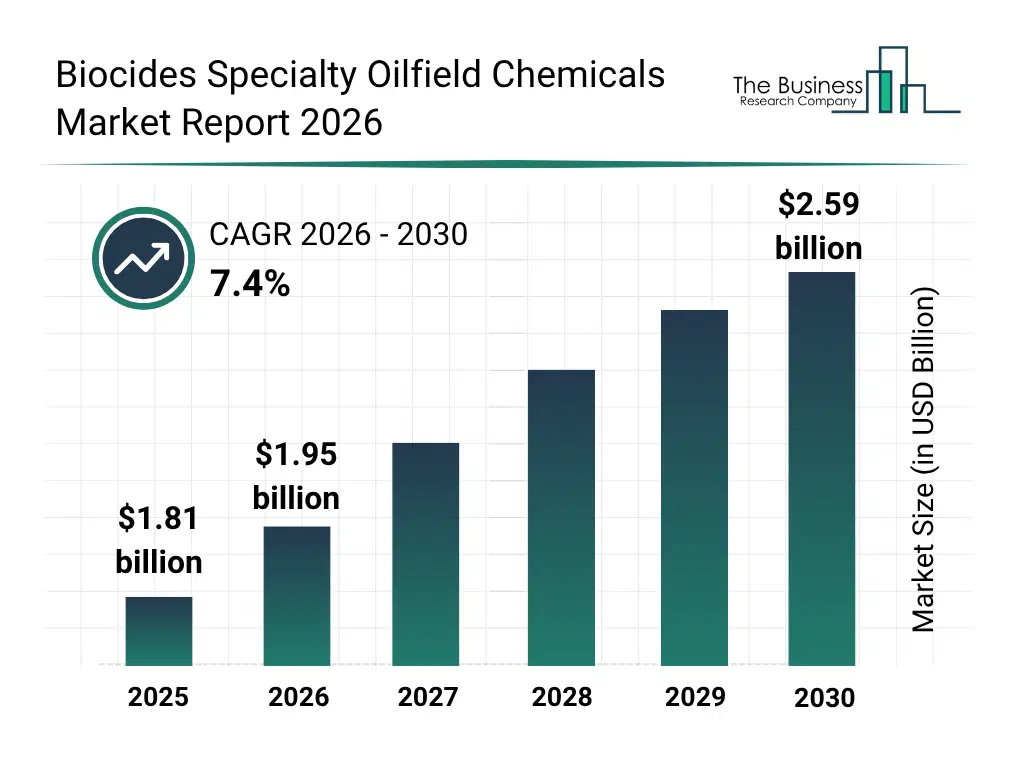
What Is The Biocides Specialty Oilfield Chemicals Market Size and Share 2026?
The biocides specialty oilfield chemicals market size has grown strongly in recent years. It will grow from $1.81 billion in 2025 to $1.95 billion in 2026 at a compound annual growth rate (CAGR) of 7.8%. The growth in the historic period can be attributed to rising oil and gas exploration and production activities, increasing issues of microbial induced corrosion in pipelines and equipment, traditional reliance on chemical based oilfield treatment solutions, expansion of offshore drilling operations, growing need for operational efficiency and asset protection in oilfields.What Is The Biocides Specialty Oilfield Chemicals Market Growth Forecast?
The biocides specialty oilfield chemicals market size is expected to see strong growth in the next few years. It will grow to $2.59 billion in 2030 at a compound annual growth rate (CAGR) of 7.4%. The growth in the forecast period can be attributed to increasing adoption of intelligent chemical monitoring and automation systems, rising demand for environmentally compliant and low toxicity biocides, expansion of deepwater and unconventional oil extraction activities, growing integration of digital oilfield technologies and analytics, increasing focus on asset longevity and operational sustainability in oil and gas sector. Major trends in the forecast period include ai enabled microbial corrosion monitoring systems, smart chemical dosing and injection automation in oilfields, predictive analytics for reservoir souring prevention, digital twin based oilfield chemical optimization, eco friendly and low toxicity biocide formulations.
Global Biocides Specialty Oilfield Chemicals Market Segmentation
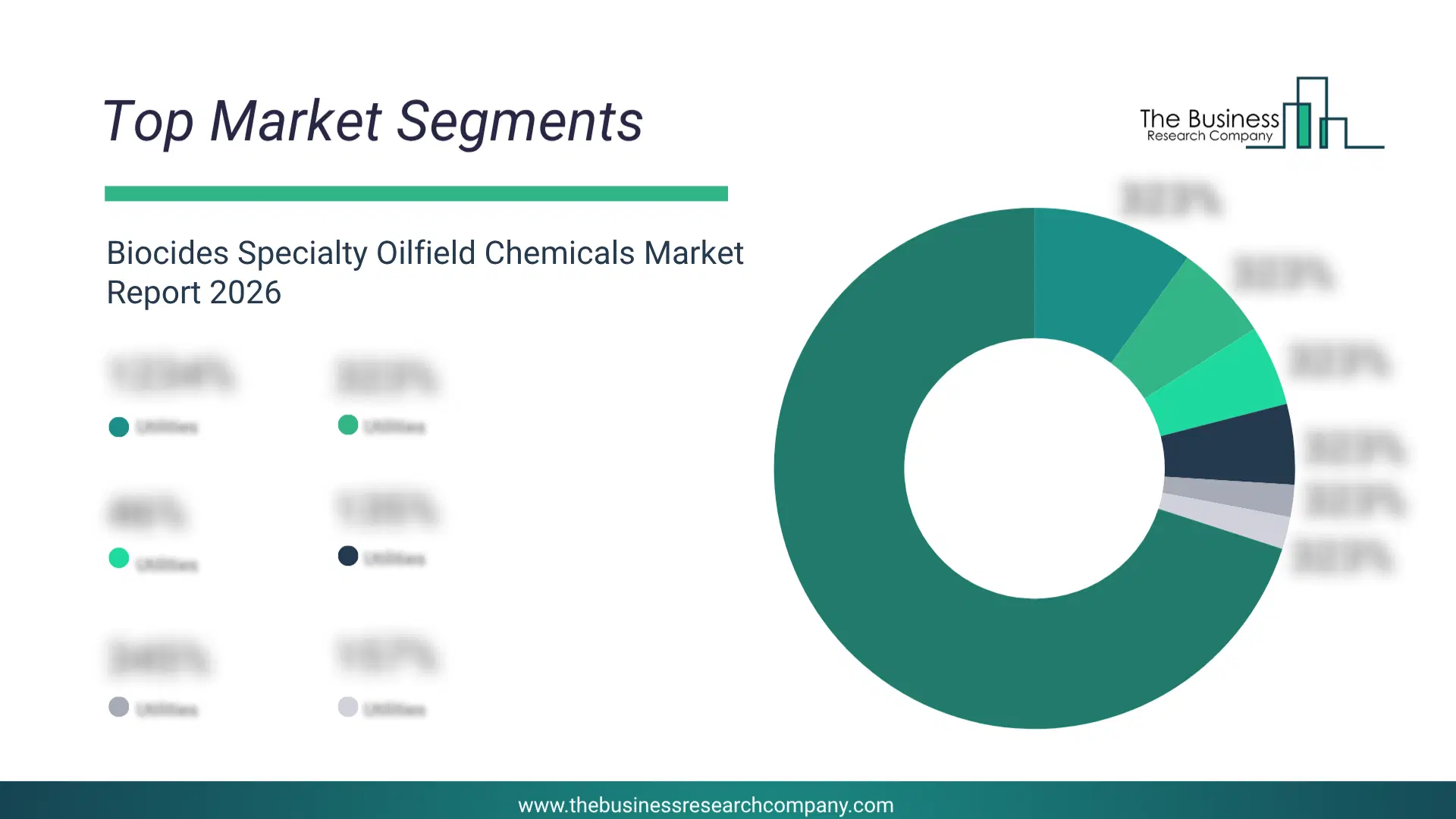
1) By Product Type: Inhibitors, Friction Reducers, Surfactants, Biocides, Demulsifiers, Other Products 2) By Location: Onshore, Offshore 3) By Distribution Channel: Direct Sales, Distributor Networks, Oilfield Service Company Bundles, Integrated Chemical Management Programs 4) By Application: Production, Drilling Fluids, Oil Recovery, Cementing, Other Applications 5) By End Use Industry: Upstream, Midstream, Downstream Subsegments: 1) By Inhibitors: Corrosion Inhibitors, Scale Inhibitors, Paraffin Inhibitors, Asphaltene Inhibitors, Hydrate Inhibitors, Wax Inhibitors 2) By Friction Reducers: Polyacrylamide Based Friction Reducers, Petroleum Based Friction Reducers, Water Based Friction Reducers, Emulsion Friction Reducers, Powder Friction Reducers, High Viscosity Friction Reducers 3) By Surfactants: Anionic Surfactants, Cationic Surfactants, Nonionic Surfactants, Amphoteric Surfactants, Silicone Surfactants, Fluorinated Surfactants 4) By Biocides: Oxidizing Biocides, Non Oxidizing Biocides, Glutaraldehyde Based Biocides, Quaternary Ammonium Biocides, Bromine Based Biocides, Chlorine Based Biocides 5) By Demulsifiers: Oil Soluble Demulsifiers, Water Soluble Demulsifiers, Polymeric Demulsifiers, Nonionic Demulsifiers, Resin Based Demulsifiers, Silicone Based Demulsifiers 6) By Other Products: Pour Point Depressants, Foam Control Agents, Hydrogen Sulfide Scavengers, Clay Stabilizers, Iron Control Agents, Water ClarifiersWhat Is The Driver Of The Biocides Specialty Oilfield Chemicals Market?
The growing oil and gas exploration activities are expected to propel the growth of the biocides specialty oilfield chemicals market going forward. Oil and gas exploration activities refer to the process of identifying, evaluating, and developing underground hydrocarbon reserves through geological surveys, drilling operations, and reservoir assessment. The growth in oil and gas exploration activities is due to rising energy demand, which increases the need to discover and develop new oil and gas reserves to meet consumption requirements. Biocides, specialty oilfield chemicals, help oil and gas exploration activities by controlling harmful microbial growth in drilling fluids, produced water, and equipment, thereby reducing corrosion, preventing biofouling, and ensuring efficient and uninterrupted operations. For instance, in June 2023, according to the data published by the Energy Information Administration, a US-based federal statistical and analytical agency, global oil demand is expected to rise by 6% between 2022 and 2028, reaching 105.7 million barrels per day, while global upstream investments in oil and gas exploration, extraction, and production are set to grow 11% year-on-year to a record $528 billion in 2023. Therefore, the growing oil and gas exploration activities are driving the growth of the biocides specialty oilfield chemicals industry.Key Players In The Global Biocides Specialty Oilfield Chemicals Market
Major companies operating in the biocides specialty oilfield chemicals market report are BASF SE, Dow Inc., SLB, Baker Hughes Company, Halliburton Company, Evonik Industries AG, Ecolab Inc., Thor Group Limited, Albemarle Corporation, Solenis LLC, LANXESS AG, Huntsman Corporation, Nouryon Chemicals Holding B.V., Clariant AG, Stepan Company, Innospec Inc., CES Energy Solutions Corp., Italmatch Chemicals S.p.A., Imperial Oilfield Chemicals Private Limited, Weatherford International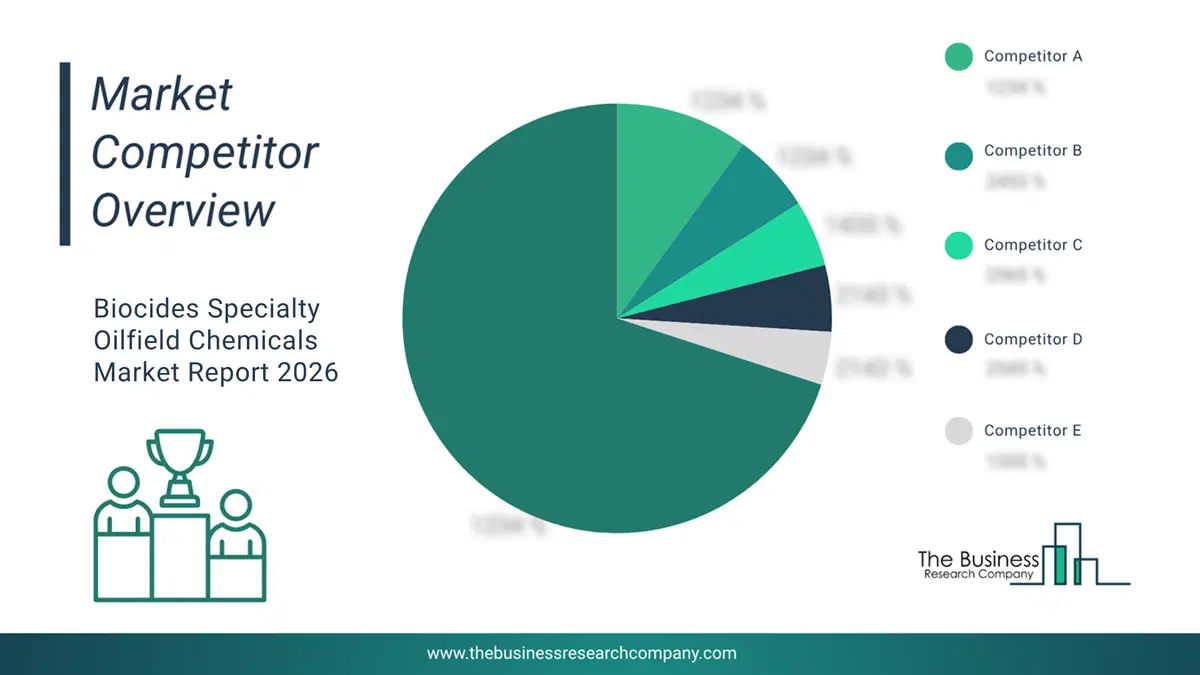
This chart is for illustrative purposes; the full report includes a detailed competitor analysis and comprehensive overview of the top 10 companies in the market.
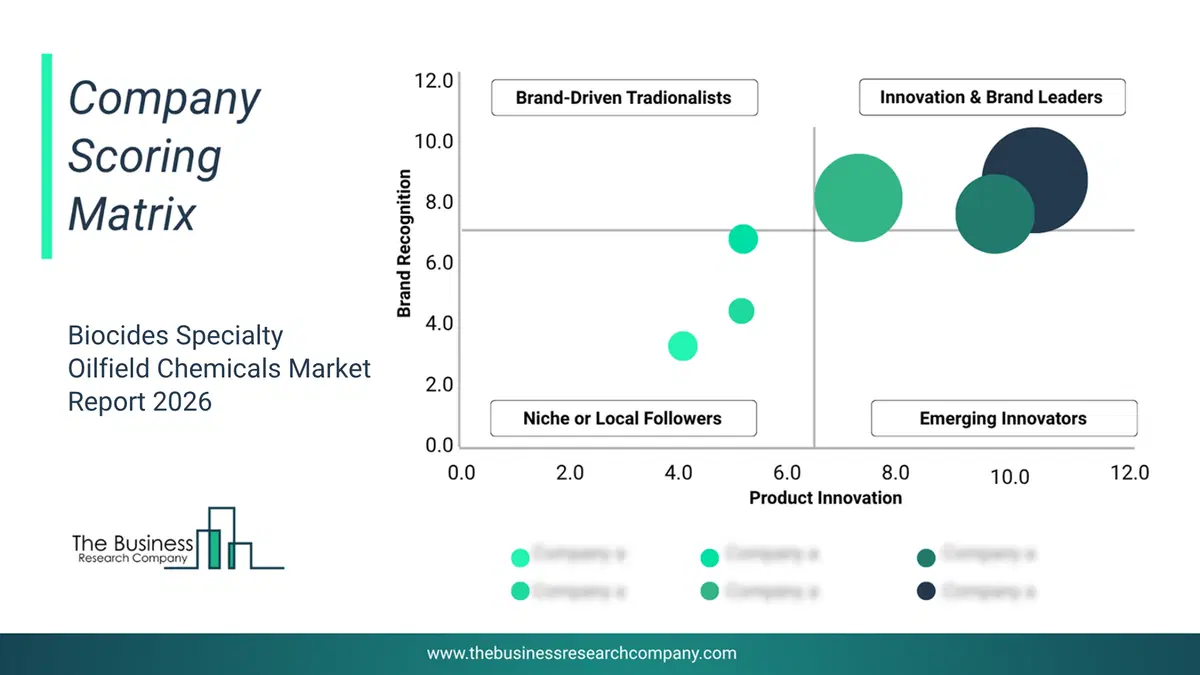
This chart maps companies by product innovation and brand strength, with bubble size indicating relative revenue, helping identify market leaders, challengers, and niche players. This is an illustrative chart; the full report provides a complete and accurate competitive analysis.
Global Biocides Specialty Oilfield Chemicals Market Trends and Insights
Major companies operating in the biocides specialty oilfield chemicals market are focusing on developing innovative solutions such as advanced water-treatment microbiocides to enhance microbial control, reduce corrosion risks, and improve operational efficiency in oil and gas production systems. Major companies operating in the biocides specialty oilfield chemicals market are focusing on developing innovative solutions such as advanced water-treatment microbiocides to enhance microbial control, reduce corrosion risks, and improve operational efficiency in oil and gas production systems. For instance, in April 2024, LANXESS AG, a Germany-based specialty chemicals company, launched Aqucar A 20, an advanced water-treatment microbiocide for oil and gas applications. The product contains 20% Dimethyloxazolidine (DMO) and is approved by the U.S. Environmental Protection Agency for use in oilfield reservoirs and production systems. Aqucar A 20 is designed to control microbial growth, mitigate reservoir souring, reduce biofilm formation, and minimize microbiologically influenced corrosion. The formulation provides long-lasting preservation, supports operational reliability, and helps maintain production efficiency in challenging oilfield environments.What Are Latest Mergers And Acquisitions In The Biocides Specialty Oilfield Chemicals Market?
In December 2025, Fineotex Chemical Limited, an India-based specialty chemical manufacturing company acquired CrudeChem Technologies Group for $11.5 billion. With this acquisition, Fineotex aims to strengthen its presence in the North American oilfield chemicals market, expand its specialty chemicals portfolio, and enhance its technological capabilities and customer reach in the global oil and gas sector. CrudeChem Technologies Group is a US-based provider of specialty oilfield chemicals, including formulated biocides used in hydraulic fracturing, water treatment, and pipeline applications.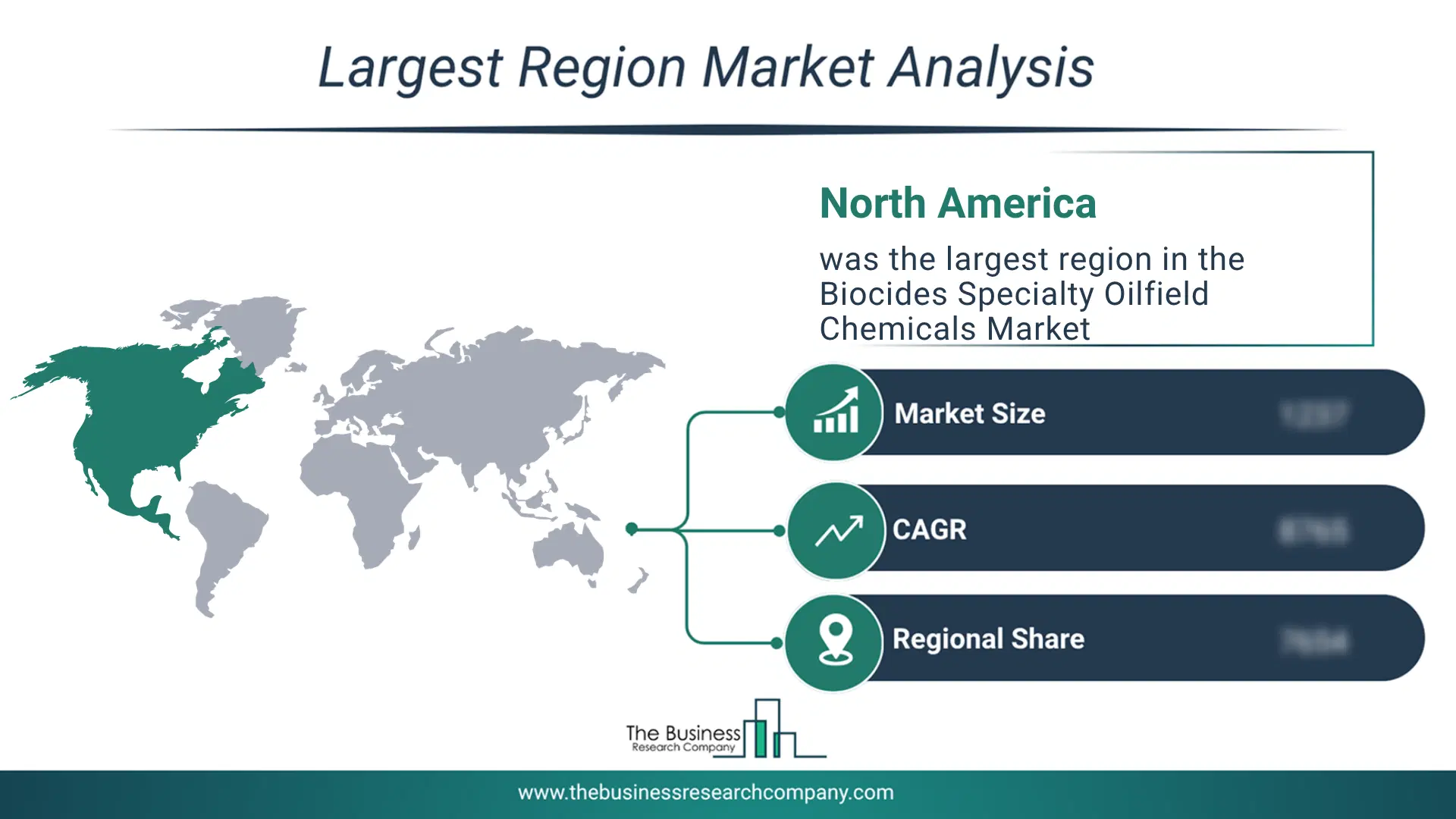
Regional Outlook
North America was the largest region in the biocides specialty oilfield chemicals market in 2025. Asia-Pacific is expected to be the fastest-growing region in the forecast period. The regions covered in this market report are Asia-Pacific, South East Asia, Western Europe, Eastern Europe, North America, South America, Middle East, Africa. The countries covered in this market report are Australia, Brazil, China, France, Germany, India, Indonesia, Japan, Taiwan, Russia, South Korea, UK, USA, Canada, Italy, Spain.What Defines the Biocides Specialty Oilfield Chemicals Market?
The biocides specialty oilfield chemicals market consists of sales of oxidizing biocides, non-oxidizing biocides, glutaraldehyde, tetrakis hydroxymethyl phosphonium sulfate (THPS), and quaternary ammonium compounds (QACs). Values in this market are ‘factory gate’ values, that is, the value of goods sold by the manufacturers or creators of the goods, whether to other entities (including oilfield service providers, distributors, pipeline operators, refinery operators, and energy companies) or directly to end customers. The value of goods in this market includes related services sold by the creators of the goods.How is Market Value Defined and Measured?
The market value is defined as the revenues that enterprises gain from the sale of goods and/or services within the specified market and geography through sales, grants, or donations in terms of the currency (in USD unless otherwise specified). The revenues for a specified geography are consumption values that are revenues generated by organizations in the specified geography within the market, irrespective of where they are produced. It does not include revenues from resales along the supply chain, either further along the supply chain or as part of other products.
This chart presents market attractiveness based on a quantitative evaluation of growth, competition, strategic alignment, and risk, offering a clear view of opportunity areas for decision-making. This chart is for illustrative purposes; the full report contains the complete analysis.

This chart highlights the Total Addressable Market (TAM) by estimating the maximum revenue opportunity using an assumption-driven approach, supporting strategic planning and opportunity sizing across markets. The chart is illustrative; the full report provides a more comprehensive analysis.
What Key Data and Analysis Are Included in the Biocides Specialty Oilfield Chemicals Market Report 2026?
The biocides specialty oilfield chemicals market research report is one of a series of new reports from The Business Research Company that provides market statistics, including industry global market size, regional shares, competitors with the market share, detailed market segments, market trends and opportunities, and any further data you may need to thrive in the biocides specialty oilfield chemicals industry. The market research report delivers a complete perspective of everything you need, with an in-depth analysis of the current and future state of the industry.Biocides Specialty Oilfield Chemicals Market Report Forecast Analysis
| Report Attribute | Details |
|---|---|
| Market Size Value In 2026 | $1.95 billion |
| Revenue Forecast In 2030 | $2.59 billion |
| Growth Rate | CAGR of 7.4% from 2026 to 2030 |
| Base Year For Estimation | 2025 |
| Actual Estimates/Historical Data | 2020-2025 |
| Forecast Period | 2026 - 2030 |
| Market Representation | Revenue in USD Billion and CAGR from 2026 to 2030 |
| Segments Covered | Product Type, Location, Distribution Channel, Application, End Use Industry |
| Regional Scope | Asia-Pacific, Western Europe, Eastern Europe, North America, South America, Middle East, Africa |
| Country Scope | The countries covered in the report are Australia, Brazil, China, France, Germany, India, Indonesia, Japan, Taiwan, Russia, South Korea, UK, USA, Canada, Italy, Spain. |
| Key Companies Profiled | BASF SE, Dow Inc., SLB, Baker Hughes Company, Halliburton Company, Evonik Industries AG, Ecolab Inc., Thor Group Limited, Albemarle Corporation, Solenis LLC, LANXESS AG, Huntsman Corporation, Nouryon Chemicals Holding B.V., Clariant AG, Stepan Company, Innospec Inc., CES Energy Solutions Corp., Italmatch Chemicals S.p.A., Imperial Oilfield Chemicals Private Limited, Weatherford International |
| Customization Scope | Request for Customization |
| Pricing And Purchase Options | Explore Purchase Options |