
Biocompatible 3D Printing Materials Market Report 2026
Global Outlook – By Product Type (Polymer, Metal, Other Product Types), By Printing Technology (Fused Deposition Modeling (FDM), Selective Laser Sintering (SLS), Stereolithography (SLA), Multi-Jet Modeling (MJM)), By Property (Biocompatibility, Strength, Durability, Porosity, Flexibility), By Form (Powder, Liquid, Other Forms) - Market Size, Trends, Strategies, and Forecast to 2030
Biocompatible 3D Printing Materials Market Overview
• Biocompatible 3D Printing Materials market size has reached to $1.12 billion in 2025 • Expected to grow to $2.73 billion in 2030 at a compound annual growth rate (CAGR) of 19.4% • Growth Driver: Rising Demand For Personalized Medicine Fuels Growth In The Market With Advances In Genomics And Targeted Therapies • Market Trend: Technological Advancements In Biodegradable Resins For Medical Implants And Devices • North America was the largest region in 2025 and Asia-Pacific is the fastest growing region.What Is Covered Under Biocompatible 3D Printing Materials Market?
Biocompatible 3D printing materials refer to substances that are safe for use in medical applications and can interact with biological systems without causing harm. These materials are designed to integrate with the human body, promoting healing and tissue regeneration. They are primarily used in creating medical implants, prosthetics, and scaffolds for tissue engineering. The main product types in biocompatible 3D printing materials include polymers, metals, and other product types. A polymer is a material composed of long molecular chains, widely used in 3D printing for medical applications, including biocompatible options such as PLA and PCL for tissue engineering and implants. The printing technologies include fused deposition modeling (FDM), selective laser sintering (SLS), stereolithography (SLA), and multi-jet modeling (MJM). These materials are categorized by properties such as biocompatibility, strength, durability, porosity, and flexibility and are available as powders, liquids, and other forms. The key end-use applications include medical and dental, aerospace and defense, automotive, consumer products, and electronics.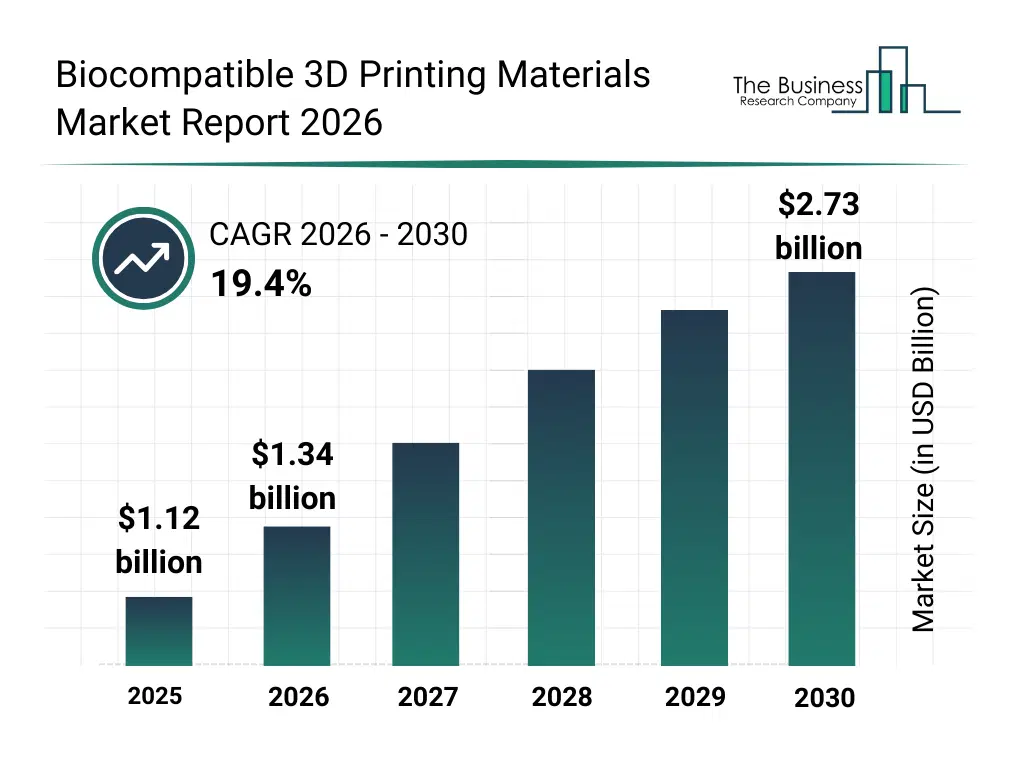
What Is The Biocompatible 3D Printing Materials Market Size and Share 2026?
The biocompatible 3d printing materials market size has grown rapidly in recent years. It will grow from $1.12 billion in 2025 to $1.34 billion in 2026 at a compound annual growth rate (CAGR) of 19.7%. The growth in the historic period can be attributed to advancements in additive manufacturing technologies, growing use of 3d printed medical devices, expansion of research in tissue engineering, availability of medical-grade polymers, increasing adoption of customized implants.What Is The Biocompatible 3D Printing Materials Market Growth Forecast?
The biocompatible 3d printing materials market size is expected to see rapid growth in the next few years. It will grow to $2.73 billion in 2030 at a compound annual growth rate (CAGR) of 19.4%. The growth in the forecast period can be attributed to increasing investments in regenerative medicine, rising demand for personalized healthcare solutions, expansion of hospital-based 3d printing labs, growing adoption of bio-inks and hydrogels, technological improvements in multi-material printing. Major trends in the forecast period include increasing adoption of biodegradable printing materials, rising use of patient-specific implant printing, growing demand for tissue engineering scaffolds, expansion of medical 3d printing applications, enhanced focus on material biocompatibility.
Global Biocompatible 3D Printing Materials Market Segmentation
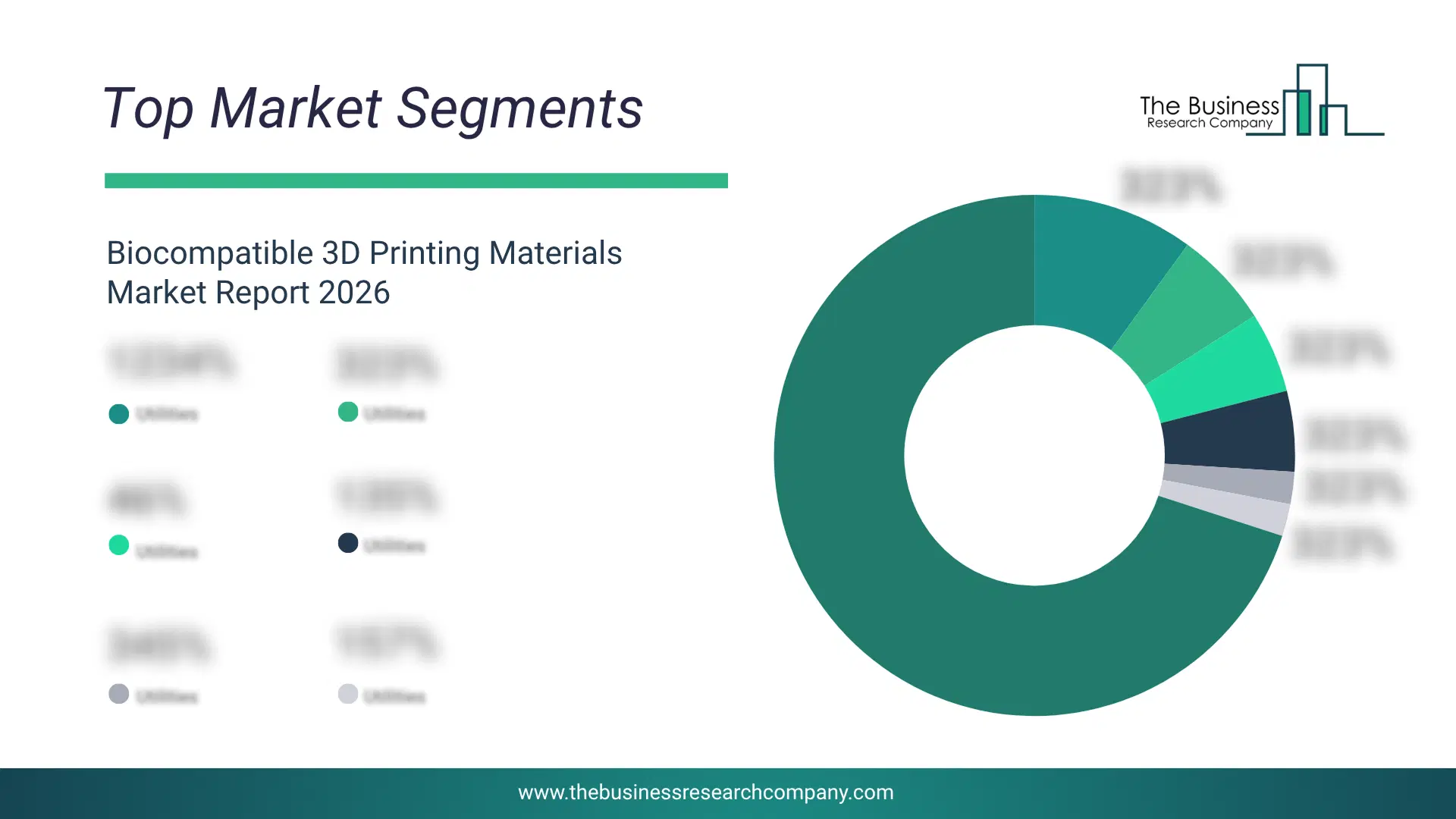
1) By Product Type: Polymer, Metal, Other Product Types 2) By Printing Technology: Fused Deposition Modeling (FDM), Selective Laser Sintering (SLS), Stereolithography (SLA), Multi-Jet Modeling (MJM) 3) By Property: Biocompatibility, Strength, Durability, Porosity, Flexibility 4) By Form: Powder, Liquid, Other Forms Subsegments: 1) By Polymer: Biodegradable Polymers, Photopolymer Resins, Thermoplastic Polymers 2) By Metal: Titanium And Titanium Alloys, Stainless Steel, Cobalt-Chrome Alloys 3) By Other Product Types: Ceramic-Based Materials, Bio-Ink And Hydrogels, Composite MaterialsWhat Is The Driver Of The Biocompatible 3D Printing Materials Market?
The increasing demand for personalized medicine is expected to propel the growth of the biocompatible 3D printing materials market going forward. Personalized medicine refers to a medical approach that tailors treatments and therapies to an individual's genetic, environmental, and lifestyle factors to improve healthcare outcomes. The increasing demand for personalized medicine is attributed to advancements in genomics, molecular diagnostics, and AI-driven data analysis, enabling tailored treatments based on individual genetic profiles, improving efficacy, and reducing adverse effects. Biocompatible 3D printing materials enable personalized medicine by allowing the fabrication of patient-specific implants, prosthetics, and tissue scaffolds that enhance treatment precision, biocompatibility, and overall patient outcomes. For instance, in February 2024, the Personalized Medicine Coalition, a US-based non-profit organization, reported that in 2023, the FDA approved 16 new personalized treatments for rare disease patients, an increase from six in 2022. Among these approvals, seven were cancer drugs, while three targeted other diseases and conditions. Therefore, the increasing demand for personalized medicine is driving the growth of the biocompatible 3D printing materials industry.Key Players In The Global Biocompatible 3D Printing Materials Market
Major companies operating in the biocompatible 3d printing materials market are 3D Systems, Stratasys, EOS GmbH, Formlabs, Carbon Inc., Materialise NV, Lithoz GmbH, SINTX Technologies Inc., UpNano GmbH, Liqcreate, Boston Micro Fabrication, Organovo Holdings Inc., Aspect Biosystems, Poietis SA, Advanced BioMatrix Inc., BioInk Solutions Inc., Markforged Inc., Detax GmbH Co KG, RegenHU, Nanoscribe GmbH, Regemat 3D, Xilloc Medical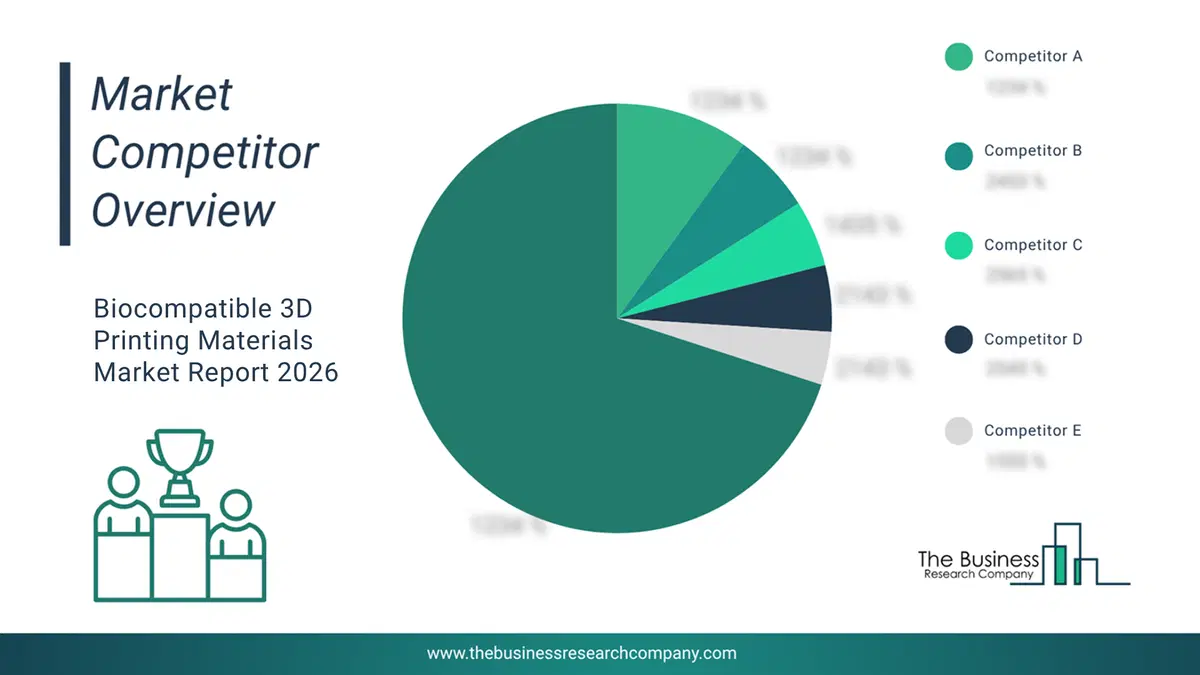
This chart is for illustrative purposes; the full report includes a detailed competitor analysis and comprehensive overview of the top 10 companies in the market.
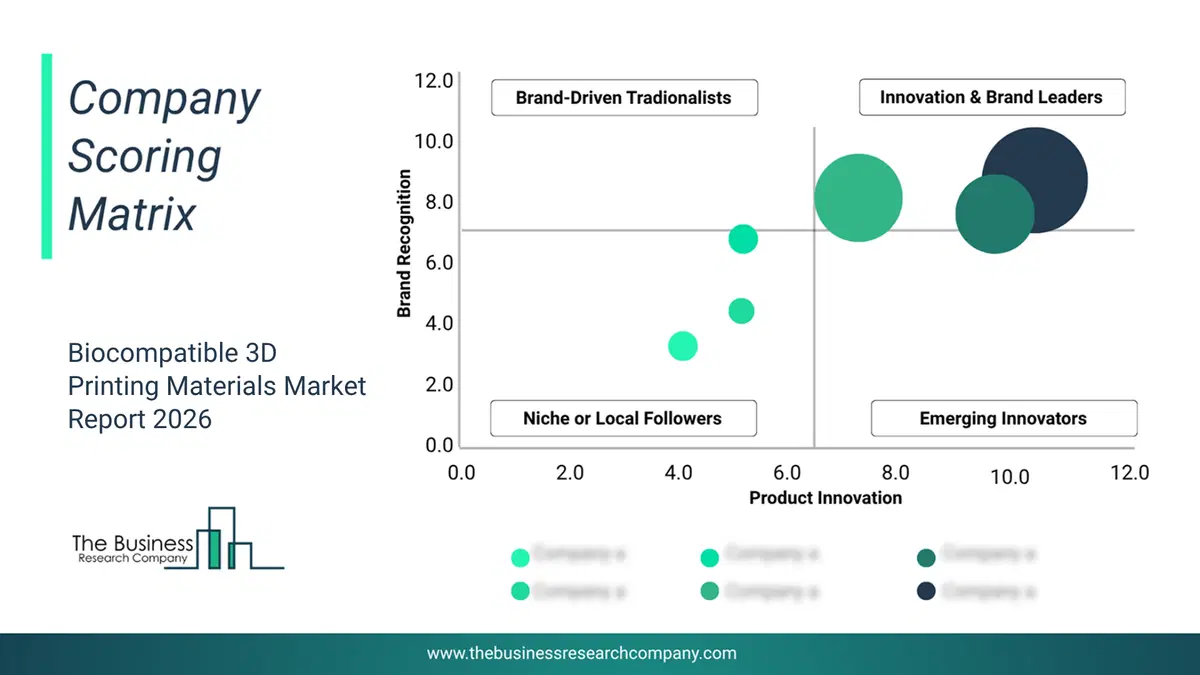
This chart maps companies by product innovation and brand strength, with bubble size indicating relative revenue, helping identify market leaders, challengers, and niche players. This is an illustrative chart; the full report provides a complete and accurate competitive analysis.
Global Biocompatible 3D Printing Materials Market Trends and Insights
Major companies operating in the biocompatible 3D printing materials market are focusing on developing innovative products such as biodegradable resin for light-based (bio) printing to enhance sustainability and expand applications in medical and tissue engineering. Biodegradable resin for light-based (bio)printing is a photocurable material used in 3D printing techniques such as stereolithography (SLA), digital light processing (DLP), or two-photon polymerization (TPP). For instance, in June 2024, BIO INX BV, a Belgium-based bioprinting materials company, launched DEGRES INX, the first biodegradable and biocompatible resin with shape memory properties for light-based (bio)printing. This advanced material allows deformation into a temporary shape after 3D printing and reverts to its original form when exposed to body temperature, enabling innovative applications in biomedical engineering. This breakthrough supports the development of smart medical implants and tissue scaffolds, paving the way for next-generation bioprinting applications.What Are Latest Mergers And Acquisitions In The Biocompatible 3D Printing Materials Market?
In April 2023, Stratasys Ltd., an Israel-based technology company that provides 3D printers, materials, and software, acquired the additive manufacturing materials business of Covestro AG for an undisclosed amount. With this acquisition, Stratasys Ltd. aims to expand its portfolio of high-performance 3D printing materials and strengthen its position in the additive manufacturing industry. Covestro AG is a Germany-based chemical company that specializes in providing biocompatible 3D printing materials.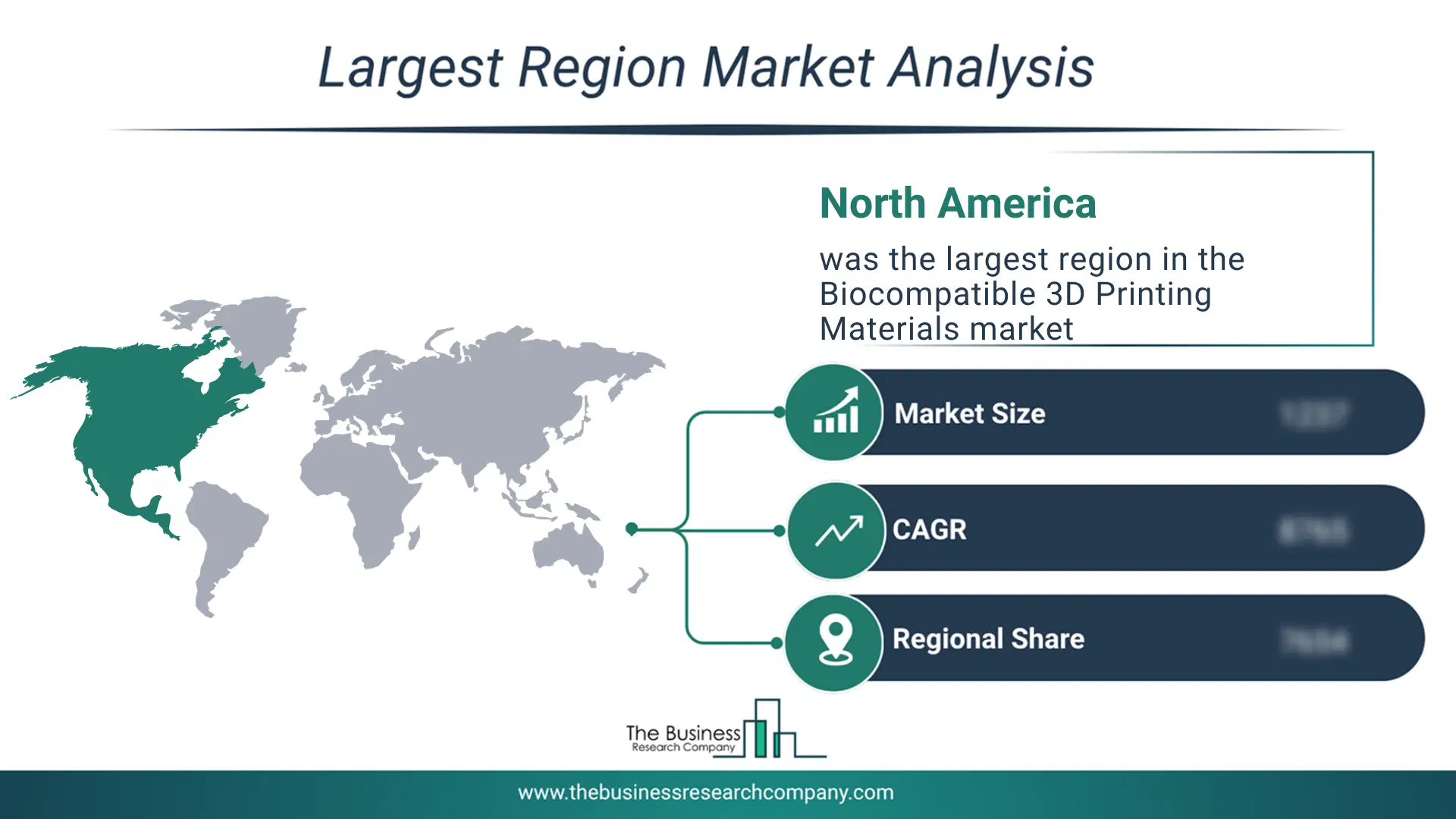
Regional Outlook
North America was the largest region in the biocompatible 3D printing materials market in 2025. Asia-Pacific is expected to be the fastest-growing region in the forecast period. The regions covered in this market report are Asia-Pacific, South East Asia, Western Europe, Eastern Europe, North America, South America, Middle East, Africa. The countries covered in this market report are Australia, Brazil, China, France, Germany, India, Indonesia, Japan, Taiwan, Russia, South Korea, UK, USA, Canada, Italy, Spain.What Defines the Biocompatible 3D Printing Materials Market?
The biocompatible 3D printing materials market consists of sales of biodegradable resins, hydroxyapatite-based filaments, titanium alloys, silicone-based materials, and bioinks. Values in this market are ‘factory gate’ values, that is the value of goods sold by the manufacturers or creators of the goods, whether to other entities (including downstream manufacturers, wholesalers, distributors and retailers) or directly to end customers. The value of goods in this market includes related services sold by the creators of the goods.How is Market Value Defined and Measured?
The market value is defined as the revenues that enterprises gain from the sale of goods and/or services within the specified market and geography through sales, grants, or donations in terms of the currency (in USD unless otherwise specified). The revenues for a specified geography are consumption values that are revenues generated by organizations in the specified geography within the market, irrespective of where they are produced. It does not include revenues from resales along the supply chain, either further along the supply chain or as part of other products.
This chart presents market attractiveness based on a quantitative evaluation of growth, competition, strategic alignment, and risk, offering a clear view of opportunity areas for decision-making. This chart is for illustrative purposes; the full report contains the complete analysis.

This chart highlights the Total Addressable Market (TAM) by estimating the maximum revenue opportunity using an assumption-driven approach, supporting strategic planning and opportunity sizing across markets. The chart is illustrative; the full report provides a more comprehensive analysis.
What Key Data and Analysis Are Included in the Biocompatible 3D Printing Materials Market Report 2026?
The biocompatible 3d printing materials market research report is one of a series of new reports from The Business Research Company that provides market statistics, including industry global market size, regional shares, competitors with the market share, detailed market segments, market trends and opportunities, and any further data you may need to thrive in the biocompatible 3d printing materials industry. The market research report delivers a complete perspective of everything you need, with an in-depth analysis of the current and future state of the industry.Biocompatible 3D Printing Materials Market Report Forecast Analysis
| Report Attribute | Details |
|---|---|
| Market Size Value In 2026 | $1.34 billion |
| Revenue Forecast In 2030 | $2.73 billion |
| Growth Rate | CAGR of 19.4% from 2026 to 2030 |
| Base Year For Estimation | 2025 |
| Actual Estimates/Historical Data | 2020-2025 |
| Forecast Period | 2026 - 2030 |
| Market Representation | Revenue in USD Billion and CAGR from 2026 to 2030 |
| Segments Covered | Product Type, Printing Technology, Property, Form |
| Regional Scope | Asia-Pacific, Western Europe, Eastern Europe, North America, South America, Middle East, Africa |
| Country Scope | The countries covered in the report are Australia, Brazil, China, France, Germany, India, Indonesia, Japan, Taiwan, Russia, South Korea, UK, USA, Canada, Italy, Spain |
| Key Companies Profiled | 3D Systems, Stratasys, EOS GmbH, Formlabs, Carbon Inc., Materialise NV, Lithoz GmbH, SINTX Technologies Inc., UpNano GmbH, Liqcreate, Boston Micro Fabrication, Organovo Holdings Inc., Aspect Biosystems, Poietis SA, Advanced BioMatrix Inc., BioInk Solutions Inc., Markforged Inc., Detax GmbH Co KG, RegenHU, Nanoscribe GmbH, Regemat 3D, Xilloc Medical |
| Customization Scope | Request for Customization |
| Pricing And Purchase Options | Explore Purchase Options |