
Biodegradable Fabrics Market Report 2026
Global Outlook – By Type (Natural Fibers, Regenerated Fibers, Synthetic Fibers), By Technology (Weaving, Knitting, Non-Woven, Dyeing And Finishing), By Functionality (Moisture Absorbent, Antimicrobial, Ultraviolet (UV) Resistant, Thermal Regulation, Biodegradable), By Application (Apparel, Home Textiles, Medical Textiles, Industrial And Agricultural Textiles, Packaging Materials), By End User (Retailers, Textile Manufacturers, Fashion Designers, Automobile Manufacturers, Healthcare Providers) – Market Size, Trends, Strategies, and Forecast to 2030
Biodegradable Fabrics Market Overview
• Biodegradable Fabrics market size has reached to $7.99 billion in 2025 • Expected to grow to $14.02 billion in 2030 at a compound annual growth rate (CAGR) of 11.8% • Growth Driver: Growing Adoption Of Sustainable Materials In The Fashion Industry Driving The Market Growth Due To Rising Environmental Concerns Over Textile Waste • Market Trend: Innovations In Textile Technology Promote Environmental Responsibility • North America was the largest region in 2025 and Asia-Pacific is the fastest growing region.What Is Covered Under Biodegradable Fabrics Market?
Biodegradable fabrics are materials made from natural fibers that can break down and decompose through the action of microorganisms over time. They return to the environment without leaving harmful residues or pollutants. These fabrics are derived from renewable and sustainable sources, allowing them to naturally reintegrate into soil or compost while reducing waste, conserving resources, and supporting overall environmental health. The main types of biodegradable fabrics are natural fibers, regenerated fibers, and synthetic fibers. Natural fibers are organic materials derived from plants or animals, processed physically into fabrics that are biodegradable. These fabrics are manufactured using technologies such as weaving, knitting, non-woven processes, and dyeing and finishing, and offer functionalities including moisture absorption, antimicrobial properties, ultraviolet (UV) resistance, thermal regulation, and biodegradability. They are used for various applications, including apparel, home textiles, medical textiles, industrial and agricultural textiles, and packaging materials, and are utilized by end-users such as retailers, textile manufacturers, fashion designers, automobile manufacturers, and healthcare providers.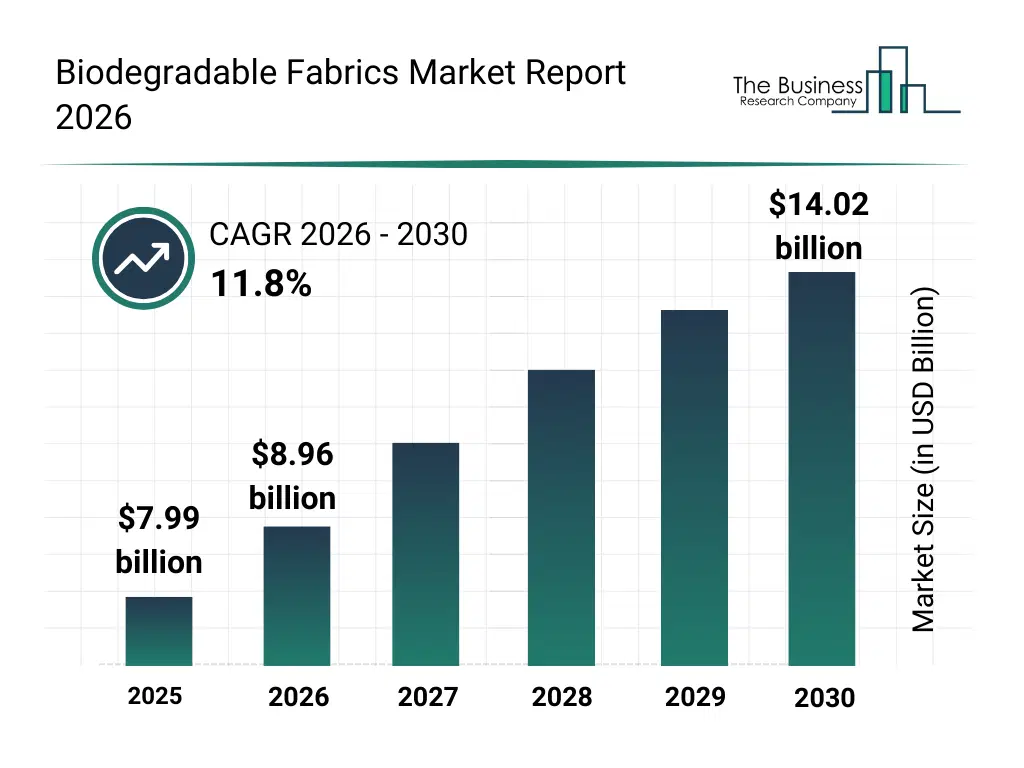
What Is The Biodegradable Fabrics Market Size and Share 2026?
The biodegradable fabrics market size has grown rapidly in recent years. It will grow from $7.99 billion in 2025 to $8.96 billion in 2026 at a compound annual growth rate (CAGR) of 12.1%. The growth in the historic period can be attributed to increasing environmental awareness in textile production, growth of sustainable fashion brands, rising demand for natural fiber textiles, expansion of renewable raw material usage, availability of biodegradable fiber technologies.What Is The Biodegradable Fabrics Market Growth Forecast?
The biodegradable fabrics market size is expected to see rapid growth in the next few years. It will grow to $14.02 billion in 2030 at a compound annual growth rate (CAGR) of 11.8%. The growth in the forecast period can be attributed to growing adoption of circular textile models, rising demand from apparel and home textile industries, expansion of biodegradable fabrics in medical applications, increasing investments in green textile manufacturing, growing focus on textile waste reduction. Major trends in the forecast period include increasing adoption of natural and regenerated fibers, rising demand for eco-friendly textile processing, growing use of plant-based fiber sources, expansion of functional biodegradable fabrics, enhanced focus on low-impact dyeing techniques.
Global Biodegradable Fabrics Market Segmentation
1) By Type: Natural Fibers, Regenerated Fibers, Synthetic Fibers 2) By Technology: Weaving, Knitting, Non-Woven, Dyeing And Finishing 3) By Functionality: Moisture Absorbent, Antimicrobial, Ultraviolet (UV) Resistant, Thermal Regulation, Biodegradable 4) By Application: Apparel, Home Textiles, Medical Textiles, Industrial And Agricultural Textiles, Packaging Materials 5) By End User: Retailers, Textile Manufacturers, Fashion Designers, Automobile Manufacturers, Healthcare Providers Subsegments: 1) By Natural Fibers: Cotton Fibers, Wool Fibers, Silk Fibers, Hemp Fibers 2) By Regenerated Fibers: Viscose Rayon Fibers, Lyocell Fibers, Modal Fibers, Bamboo Fibers 3) By Synthetic Fibers: Polylactic Acid (PLA) Fibers, Polyhydroxyalkanoates (PHA) Fibers, Polycaprolactone (PCL) Fibers, Other Biodegradable Synthetic FibersWhat Is The Driver Of The Biodegradable Fabrics Market?
The growing adoption of sustainable materials in the fashion industry is expected to propel the growth of the biodegradable fabrics market going forward. The adoption of sustainable materials is rising due to increasing environmental concerns over textile waste, as fast fashion has led to massive volumes of discarded clothing ending up in landfills, where they release harmful greenhouse gases and contaminants. The adoption of sustainable materials in the fashion industry promotes the use of biodegradable fabrics by increasing demand for eco-friendly textiles that decompose naturally without leaving harmful residues. As fashion brands and manufacturers increasingly replace conventional synthetic materials with biodegradable alternatives, they reduce their environmental impact while meeting growing consumer demand for sustainable products. For instance, in September 2025, according to Textile Exchange, a US-based nonprofit organization focused on advancing sustainable practices in the textile industry, the share of raw materials under sustainability programs used by reporting brands increased from 58% in 2023 to 67% in 2024. Therefore, the growing adoption of sustainable materials in the fashion industry is driving the growth of the biodegradable fabrics industry.Key Players In The Global Biodegradable Fabrics Market
Major companies operating in the biodegradable fabrics market are H & M Hennes & Mauritz AB, Eastman Chemical Company, Teijin Limited, Lenzing AG, Sateri Holdings Limited, PANGAIA Materials Science Ltd., Sinosilk Co. Ltd., Ecovative Design LLC, Renewcell AB, Kelheim Fibres GmbH, Amour Vert Inc., Apex Mills Inc., Greenfibres Ltd., EnviroTextiles LLC, Bast Fibre Technologies Inc., Orange Fiber S.r.l., Toad & Co. Inc., Bolt Threads Inc., Ananas Anam Ltd., Natural Fiber Welding Inc.
This chart is for illustrative purposes; the full report includes a detailed competitor analysis and comprehensive overview of the top 10 companies in the market.
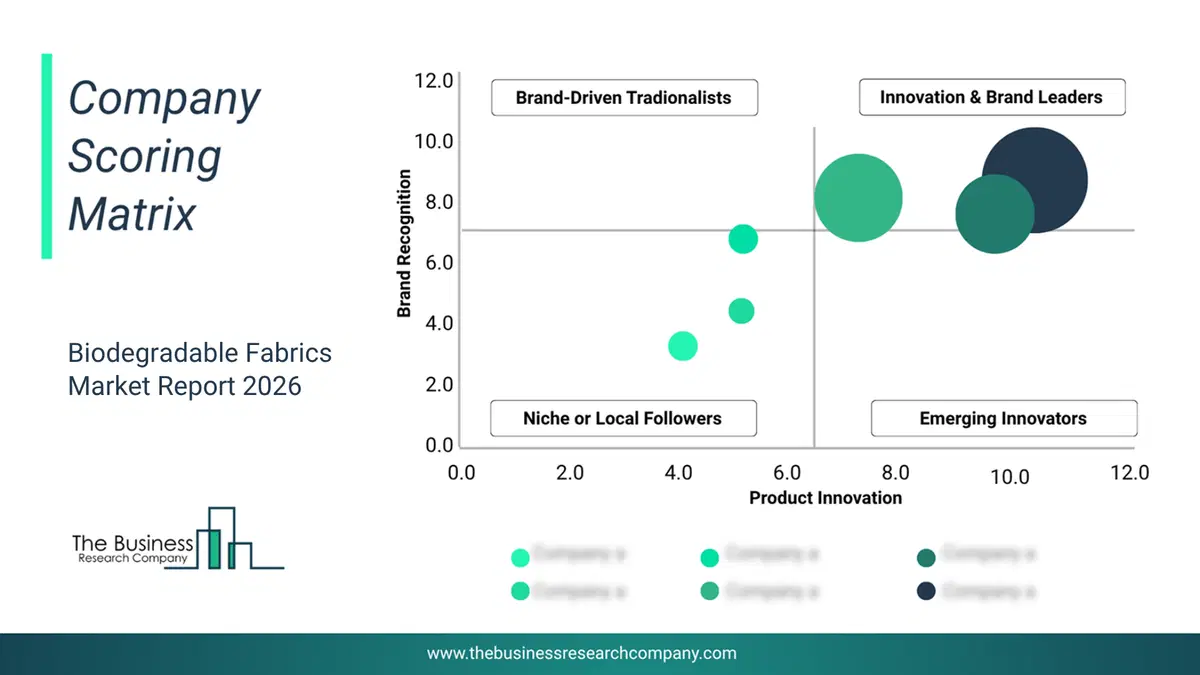
This chart maps companies by product innovation and brand strength, with bubble size indicating relative revenue, helping identify market leaders, challengers, and niche players. This is an illustrative chart; the full report provides a complete and accurate competitive analysis.
Global Biodegradable Fabrics Market Trends and Insights
Major companies operating in the biodegradable fabrics market are focusing on leveraging innovative technologies such as biodegradable synthetic yarn technology to reduce environmental impact and microplastic pollution. Biodegradable synthetic yarn technology is a method of producing synthetic fibers, such as polyester and nylon, with additives that enable them to naturally break down in soil or water over time, helping to reduce microplastic pollution and minimize the environmental impact of synthetic textiles. For instance, in April 2025, Unifi Inc., a US-based manufacturing company, launched Repreve with Ciclo technology, a line of recycled polyester and nylon fibers enhanced with a biodegradable additive that enables synthetic fabrics to naturally degrade in soil and seawater. The innovation reduces microplastic pollution while maintaining durability, performance, and dyeability. By combining recycled content with biodegradable technology, Repreve with Ciclo allows brands, mills, and retailers to offer high-performance, eco-friendly textiles for applications ranging from sportswear and fashion to home textiles and outdoor gear, reflecting the industry’s shift toward circular economy principles and sustainable production.What Are Latest Mergers And Acquisitions In The Biodegradable Fabrics Market?
In December 2023, Algaeing, an Israel-based textile manufacturing company, partnered with Birla Cellulose to integrate Birla Cellulose’s expertise in man-made cellulosic fibers with Algaeing’s algae-powered fiber technology. The collaboration aims to develop sustainable, biodegradable, algae-based cellulosic fibers that reduce environmental impact and offer innovative, eco-friendly solutions for the textile industry. Birla Cellulose is an India-based textile manufacturing company that specializes in providing sustainable, biodegradable man-made cellulosic fibers.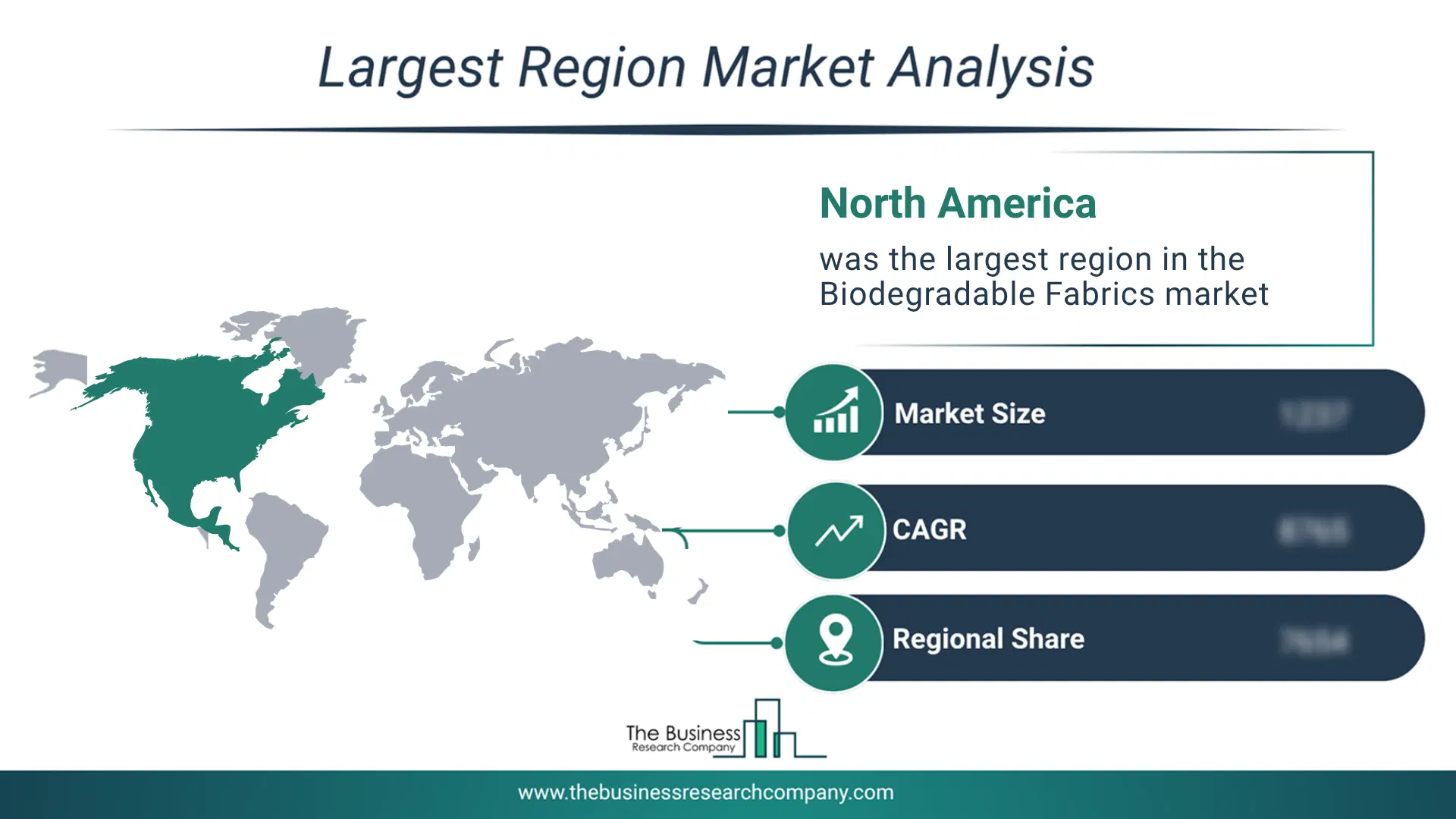
Regional Outlook
North America was the largest region in the biodegradable fabrics market in 2025. Asia-Pacific is expected to be the fastest-growing region in the forecast period. The regions covered in this market report are Asia-Pacific, South East Asia, Western Europe, Eastern Europe, North America, South America, Middle East, Africa. The countries covered in this market report are Australia, Brazil, China, France, Germany, India, Indonesia, Japan, Taiwan, Russia, South Korea, UK, USA, Canada, Italy, Spain.What Defines the Biodegradable Fabrics Market?
The biodegradable fabrics market consists of sales of linen, hemp, jute, ramie, kapok, coir, lyocell (tencel), modal, viscose, and rayon. Values in this market are ‘factory gate’ values, that is the value of goods sold by the manufacturers or creators of the goods, whether to other entities (including downstream manufacturers, wholesalers, distributors and retailers) or directly to end customers. The value of goods in this market includes related services sold by the creators of the goods.How is Market Value Defined and Measured?
The market value is defined as the revenues that enterprises gain from the sale of goods and/or services within the specified market and geography through sales, grants, or donations in terms of the currency (in USD unless otherwise specified). The revenues for a specified geography are consumption values that are revenues generated by organizations in the specified geography within the market, irrespective of where they are produced. It does not include revenues from resales along the supply chain, either further along the supply chain or as part of other products.
This chart presents market attractiveness based on a quantitative evaluation of growth, competition, strategic alignment, and risk, offering a clear view of opportunity areas for decision-making. This chart is for illustrative purposes; the full report contains the complete analysis.

This chart highlights the Total Addressable Market (TAM) by estimating the maximum revenue opportunity using an assumption-driven approach, supporting strategic planning and opportunity sizing across markets. The chart is illustrative; the full report provides a more comprehensive analysis.
What Key Data and Analysis Are Included in the Biodegradable Fabrics Market Report 2026?
The biodegradable fabrics market research report is one of a series of new reports from The Business Research Company that provides market statistics, including Market Report 2026?global market size, regional shares, competitors with the market share, detailed market segments, market trends and opportunities, and any further data you may need to thrive in the biodegradable fabrics Market Report 2026? The market research report delivers a complete perspective of everything you need, with an in-depth analysis of the current and future state of the Market Report 2026?Biodegradable Fabrics Market Report Forecast Analysis
| Report Attribute | Details |
|---|---|
| Market Size Value In 2026 | $8.96 billion |
| Revenue Forecast In 2030 | $14.02 billion |
| Growth Rate | CAGR of 12.1% from 2026 to 2030 |
| Base Year For Estimation | 2025 |
| Actual Estimates/Historical Data | 2020-2025 |
| Forecast Period | 2026 - 2030 |
| Market Representation | Revenue in USD Billion and CAGR from 2026 to 2030 |
| Segments Covered | Type, Technology, Functionality, Application, End User |
| Regional Scope | Asia-Pacific, Western Europe, Eastern Europe, North America, South America, Middle East, Africa |
| Country Scope | The countries covered in the report are Australia, Brazil, China, France, Germany, India, Indonesia, Japan, Taiwan, Russia, South Korea, UK, USA, Canada, Italy, Spain. |
| Key Companies Profiled | H & M Hennes & Mauritz AB, Eastman Chemical Company, Teijin Limited, Lenzing AG, Sateri Holdings Limited, PANGAIA Materials Science Ltd., Sinosilk Co. Ltd., Ecovative Design LLC, Renewcell AB, Kelheim Fibres GmbH, Amour Vert Inc., Apex Mills Inc., Greenfibres Ltd., EnviroTextiles LLC, Bast Fibre Technologies Inc., Orange Fiber S.r.l., Toad & Co. Inc., Bolt Threads Inc., Ananas Anam Ltd., Natural Fiber Welding Inc. |
| Customization Scope | Request for Customization |
| Pricing And Purchase Options | Explore Purchase Options |