
Biodegradable Textiles Market Report 2026
Global Outlook – By Type (Non-Woven, Woven, Other Types), By Raw Material (Natural Fibers, Regenerated Cellulose Fibers, Synthetic Biodegradable Fibers), By Distribution Channel (Online Stores, Offline Stores), By Application (Apparel, Home Textiles, Industrial Textiles, Medical Textiles, Other Applications), By End-Use Industry (Fashion And Apparel, Home Furnishing, Automotive, Healthcare, Agriculture) – Market Size, Trends, Strategies, and Forecast to 2030
Biodegradable Textiles Market Overview
• Biodegradable Textiles market size has reached to $6.35 billion in 2025 • Expected to grow to $12.06 billion in 2030 at a compound annual growth rate (CAGR) of 13.7% • Growth Driver: Rising Consumer Awareness Of Environmental Sustainability Drives Growth In The Market Due To Increasing Media And Social Media Exposure • Market Trend: Innovative Biodegradable Fusible Cotton Textiles For Sustainable Apparel • Asia-Pacific was the largest region in 2025.What Is Covered Under Biodegradable Textiles Market?
Biodegradable textiles refer to fabrics that have the ability to naturally decompose into non-toxic elements such as water, carbon dioxide, and biomass through the action of microorganisms under suitable environmental conditions. These textiles are usually made from natural fibers or bio-based polymers, providing a sustainable alternative that helps minimize long-term waste accumulation and environmental pollution caused by conventional synthetic fabrics. The main types of biodegradable textiles are non-woven, woven, and others. Nonwoven refers to fabrics made by bonding or felting separate fibers together through mechanical, thermal, or chemical means instead of weaving or knitting. These fabrics are composed of a variety of raw materials, including natural fibers, regenerated cellulose fibers, and synthetic biodegradable fibers, and are distributed through online stores and offline stores. They are utilized across applications such as apparel, home textiles, industrial textiles, medical textiles, and others, serving end-user industries such as fashion and apparel, home furnishing, automotive, healthcare, and agriculture.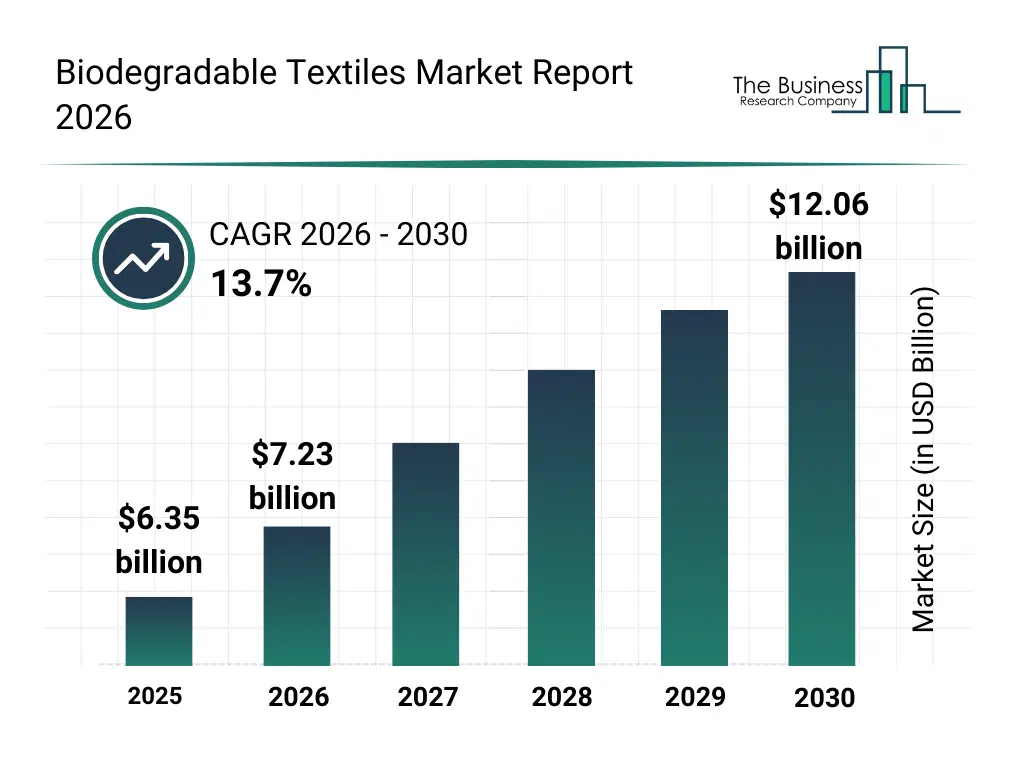
What Is The Biodegradable Textiles Market Size and Share 2026?
The biodegradable textiles market size has grown rapidly in recent years. It will grow from $6.35 billion in 2025 to $7.23 billion in 2026 at a compound annual growth rate (CAGR) of 13.8%. The growth in the historic period can be attributed to increasing environmental concerns over synthetic textiles, growth of sustainable fashion movements, expansion of natural fiber textile production, rising awareness of textile waste impact, early adoption of biodegradable fibers.What Is The Biodegradable Textiles Market Growth Forecast?
The biodegradable textiles market size is expected to see rapid growth in the next few years. It will grow to $12.06 billion in 2030 at a compound annual growth rate (CAGR) of 13.7%. The growth in the forecast period can be attributed to expansion of biodegradable textiles in industrial applications, rising investments in bio-based fiber innovation, growing demand from fashion and home furnishing sectors, increasing regulatory support for sustainable textiles, advancement in biodegradable fiber performance. Major trends in the forecast period include increasing use of bio-based textile materials, rising demand for sustainable apparel fabrics, growing adoption of non-toxic textile treatments, expansion of biodegradable textile applications, enhanced focus on end-of-life textile management.
Global Biodegradable Textiles Market Segmentation
1) By Type: Non-Woven, Woven, Other Types 2) By Raw Material: Natural Fibers, Regenerated Cellulose Fibers, Synthetic Biodegradable Fibers 3) By Distribution Channel: Online Stores, Offline Stores 4) By Application: Apparel, Home Textiles, Industrial Textiles, Medical Textiles, Other Applications 5) By End-Use Industry: Fashion And Apparel, Home Furnishing, Automotive, Healthcare, Agriculture Subsegments: 1) By Non-Woven: Meltblown Fabric, Spunbond Fabric, Needle-Punched Fabric, Airlaid Fabric 2) By Woven: Plain Weave, Twill Weave, Satin Weave, Basket Weave 3) By Other Types: Knitted Fabric, Braided Fabric, Laminated Fabric, Composite FabricWhat Is The Driver Of The Biodegradable Textiles Market?
The increasing consumer awareness about environmental sustainability is expected to propel the growth of the biodegradable textiles market going forward. Environmental sustainability refers to managing natural resources and ecosystems in a way that meets current human needs without compromising the ability of future generations to do the same. Consumer awareness is rising due to greater media exposure and increasing concern over pollution and waste from traditional fabrics. Biodegradable textiles support environmental sustainability by providing eco-friendly alternatives that align with these concerns. For instance, in November 2023, according to the World Business Council for Sustainable Development, a Switzerland-based non-profit organization, in the United States, 96% of consumers acknowledge that the climate is changing. Among environmentally concerned Americans, 85% of self-identified liberal voters are very or extremely worried about climate change, whereas only 39% of conservative voters share the same level of concern. Therefore, the increasing consumer awareness about environmental sustainability is driving the growth of the biodegradable textiles industry.Key Players In The Global Biodegradable Textiles Market
Major companies operating in the biodegradable textiles market are Asahi Kasei Corporation, Toray Industries Inc., Grasim Industries Limited, Eastman Chemical Company, Teijin Limited, Elevate Textiles Inc., Milliken & Company, Lenzing AG, Sateri Holdings Limited, Unifi Inc., Fulgar S.p.A., Kelheim Fibres GmbH, NatureWorks LLC, Schoeller Textil AG, Rajshree Fabrics Pvt. Ltd., Vivify Textiles Pty Ltd., Ecological Textiles BV, Paul Hartmann AG, U‑Long High‑Tech Textile Co. Ltd., Linwood Fabric Company Limited
This chart is for illustrative purposes; the full report includes a detailed competitor analysis and comprehensive overview of the top 10 companies in the market.
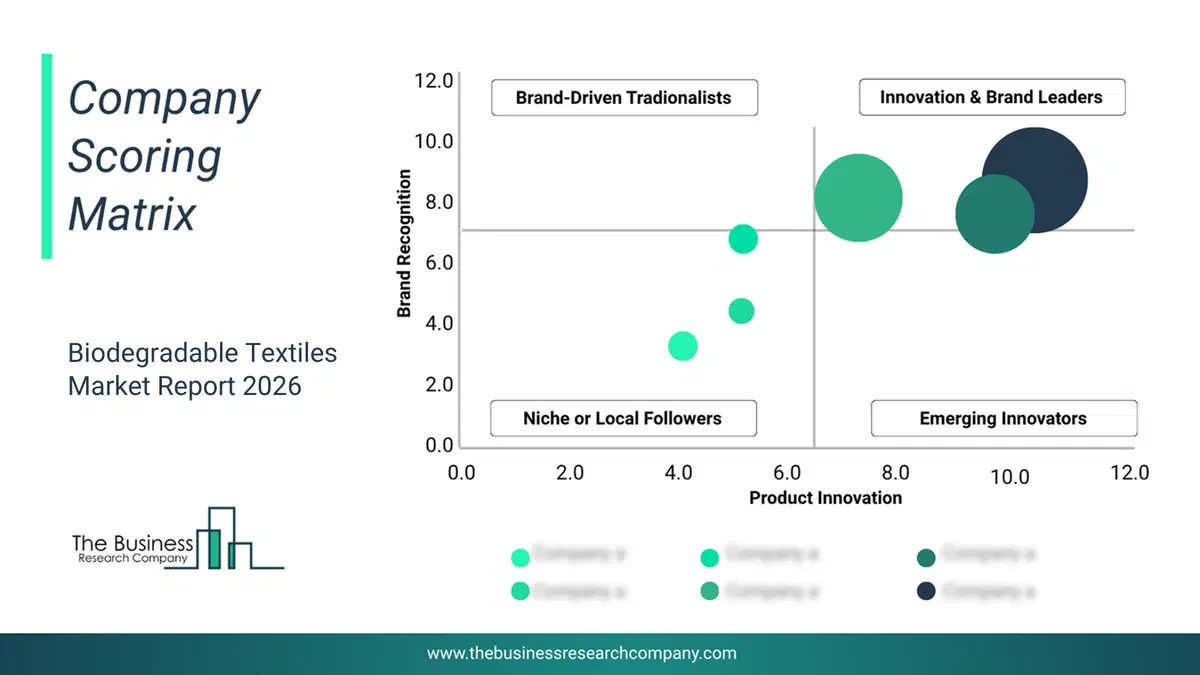
This chart maps companies by product innovation and brand strength, with bubble size indicating relative revenue, helping identify market leaders, challengers, and niche players. This is an illustrative chart; the full report provides a complete and accurate competitive analysis.
Global Biodegradable Textiles Market Trends and Insights
Major companies operating in the biodegradable textiles market are focusing on developing innovative solutions, such as biodegradable fusible cotton textiles, to meet the growing consumer demand for eco-friendly products. Biodegradable fusible cotton textiles refer to eco-friendly cotton fabrics that can bond with other materials using heat and naturally decompose without harming the environment. For instance, in April 2023, Freudenberg Group, a Germany-based manufacturing company, launched the apparel industry’s first biodegradable fusible cotton shirt interlining range, known as the 46xx series. This innovative product is certified biodegradable and non-toxic by Germany’s Hohenstein Laboratories and complies with recognized biodegradation standards. The interlining uses a 100% degradable bio-polymer adhesive and can be fused at a lower temperature of 127°C, offering energy savings compared to conventional interlinings. It is certified OEKO-TEX STANDARD 100 Class II, washable at up to 40°C, and resistant to dry cleaning. Designed to reinforce collars, cuffs, and plackets in shirts and blouses, this eco-friendly interlining supports sustainable fashion and business apparel with significant environmental benefits.What Are Latest Mergers And Acquisitions In The Biodegradable Textiles Market?
In July 2025, Altri SGPS S.A., a Portugal-based industrial company specializing in sustainable cellulosic pulp production, acquired majority share of AeoniQ for an undisclosed amount. With this acquisition, Altri aims to expand its presence in the sustainable textiles sector by integrating AeoniQ’s biodegradable and climate-positive filament yarn technology into industrial-scale production. AeoniQ is a Switzerland-based cleantech company providing biodegradable cellulosic filament yarn engineered to replace polyester and nylon in high-performance textile applications.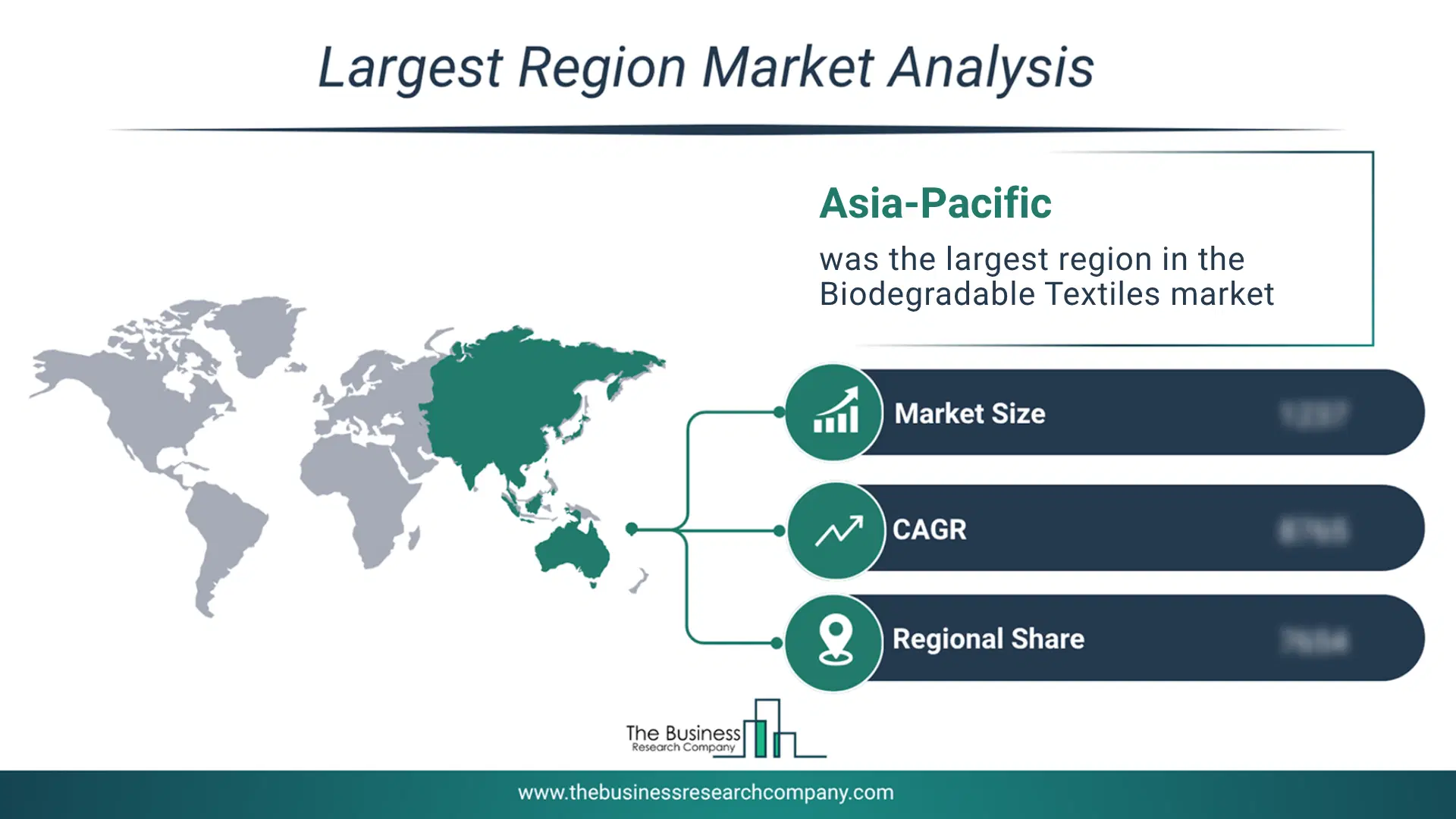
Regional Outlook
Asia-Pacific was the largest region in the biodegradable textiles market in 2025. The regions covered in this market report are Asia-Pacific, South East Asia, Western Europe, Eastern Europe, North America, South America, Middle East, Africa. The countries covered in this market report are Australia, Brazil, China, France, Germany, India, Indonesia, Japan, Taiwan, Russia, South Korea, UK, USA, Canada, Italy, Spain.What Defines the Biodegradable Textiles Market?
The biodegradable textiles market consists of sales of clothing and apparel, home textiles, nonwoven textiles, medical textiles, and footwear and accessories. Values in this market are ‘factory gate’ values, that is, the value of goods sold by the manufacturers or creators of the goods, whether to other entities (including downstream manufacturers, wholesalers, distributors, and retailers) or directly to end customers. The value of goods in this market includes related services sold by the creators of the goods.How is Market Value Defined and Measured?
The market value is defined as the revenues that enterprises gain from the sale of goods and/or services within the specified market and geography through sales, grants, or donations in terms of the currency (in USD unless otherwise specified). The revenues for a specified geography are consumption values that are revenues generated by organizations in the specified geography within the market, irrespective of where they are produced. It does not include revenues from resales along the supply chain, either further along the supply chain or as part of other products.
This chart presents market attractiveness based on a quantitative evaluation of growth, competition, strategic alignment, and risk, offering a clear view of opportunity areas for decision-making. This chart is for illustrative purposes; the full report contains the complete analysis.

This chart highlights the Total Addressable Market (TAM) by estimating the maximum revenue opportunity using an assumption-driven approach, supporting strategic planning and opportunity sizing across markets. The chart is illustrative; the full report provides a more comprehensive analysis.
What Key Data and Analysis Are Included in the Biodegradable Textiles Market Report 2026?
The biodegradable textiles market research report is one of a series of new reports from The Business Research Company that provides market statistics, including Market Report 2026?global market size, regional shares, competitors with the market share, detailed market segments, market trends and opportunities, and any further data you may need to thrive in the biodegradable textiles Market Report 2026? The market research report delivers a complete perspective of everything you need, with an in-depth analysis of the current and future state of the Market Report 2026?Biodegradable Textiles Market Report Forecast Analysis
| Report Attribute | Details |
|---|---|
| Market Size Value In 2026 | $7.23 billion |
| Revenue Forecast In 2030 | $12.06 billion |
| Growth Rate | CAGR of 13.8% from 2026 to 2030 |
| Base Year For Estimation | 2025 |
| Actual Estimates/Historical Data | 2020-2025 |
| Forecast Period | 2026 - 2030 |
| Market Representation | Revenue in USD Billion and CAGR from 2026 to 2030 |
| Segments Covered | Type, Raw Material, Distribution Channel, Application, End-Use Industry |
| Regional Scope | Asia-Pacific, Western Europe, Eastern Europe, North America, South America, Middle East, Africa |
| Country Scope | The countries covered in the report are Australia, Brazil, China, France, Germany, India, Indonesia, Japan, Taiwan, Russia, South Korea, UK, USA, Canada, Italy, Spain. |
| Key Companies Profiled | Asahi Kasei Corporation, Toray Industries Inc., Grasim Industries Limited, Eastman Chemical Company, Teijin Limited, Elevate Textiles Inc., Milliken & Company, Lenzing AG, Sateri Holdings Limited, Unifi Inc., Fulgar S.p.A., Kelheim Fibres GmbH, NatureWorks LLC, Schoeller Textil AG, Rajshree Fabrics Pvt. Ltd., Vivify Textiles Pty Ltd., Ecological Textiles BV, Paul Hartmann AG, U‑Long High‑Tech Textile Co. Ltd., Linwood Fabric Company Limited |
| Customization Scope | Request for Customization |
| Pricing And Purchase Options | Explore Purchase Options |