

Biodiesel Market Report 2026
Global Outlook – By Feedstock (Vegetable Oil, Animal Fats ), By Production Process (Alcohol Trans Esterification, Hydro-Heating ), By Application (Fuel, Power Generation, Agriculture) – Market Size, Trends, Strategies, and Forecast to 2030
Biodiesel Market Overview
• Biodiesel market size has reached to $61.01 billion in 2025 • Expected to grow to $81.84 billion in 2030 at a compound annual growth rate (CAGR) of 6.1% • Growth Driver: Biodiesel Market Surges In Response To Escalating Global Energy Demand • Market Trend: Indian Oil Corporation's Strategic Partnership With Praj Industries Expands Biofuel Production Horizon • Western Europe was the largest region in 2025 and Asia-Pacific is the fastest growing region.Market Gains By 2030 – Top Opportunities By Segment
Market Gain identifies the most promising market opportunities by highlighting the segments or products expected to generate the highest incremental revenue growth over the next five years.
What Is Covered Under Biodiesel Market?
Biodiesel is a sustainable, biodegradable fuel produced domestically from vegetable oils, animal fats, or used restaurant grease. Biodiesel is used as a source of power for automobiles, home appliances and others. The main feedstock involved in biodiesel is vegetable oil and animal fats. Vegetable oils refer to edible and non-edible oils that are extracted from various types of fruits, seeds, grains, and nuts. It is produced by transesterification and hydro-heating. It is used in several applications, such as, fuel, power generation, and agriculture.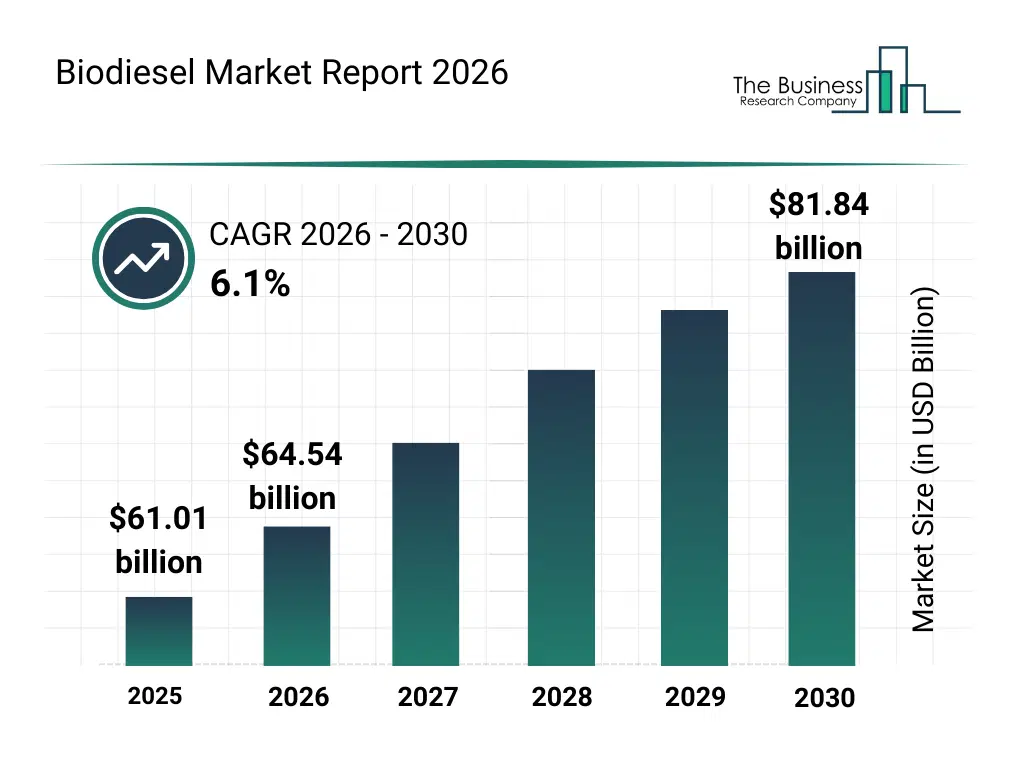
What Is The Biodiesel Market Size and Share 2026?
The biodiesel market size has grown strongly in recent years. It will grow from $61.01 billion in 2025 to $64.54 billion in 2026 at a compound annual growth rate (CAGR) of 5.8%. The growth in the historic period can be attributed to government support for renewable fuels, expansion of agricultural feedstock availability, growth of diesel-powered vehicle fleets, increasing fuel diversification efforts, development of biodiesel production facilities.What Is The Biodiesel Market Growth Forecast?
The biodiesel market size is expected to see strong growth in the next few years. It will grow to $81.84 billion in 2030 at a compound annual growth rate (CAGR) of 6.1%. The growth in the forecast period can be attributed to increasing decarbonization targets, rising demand for sustainable transportation fuels, expansion of renewable energy policies, growing investment in advanced biodiesel technologies, increasing adoption of biodiesel in power generation. Major trends in the forecast period include increasing adoption of bio-based fuels, rising use of waste and residue feedstocks, expansion of biodiesel blending mandates, growing focus on low-carbon fuel production, enhanced process efficiency in biodiesel plants.
Global Biodiesel Market Segmentation
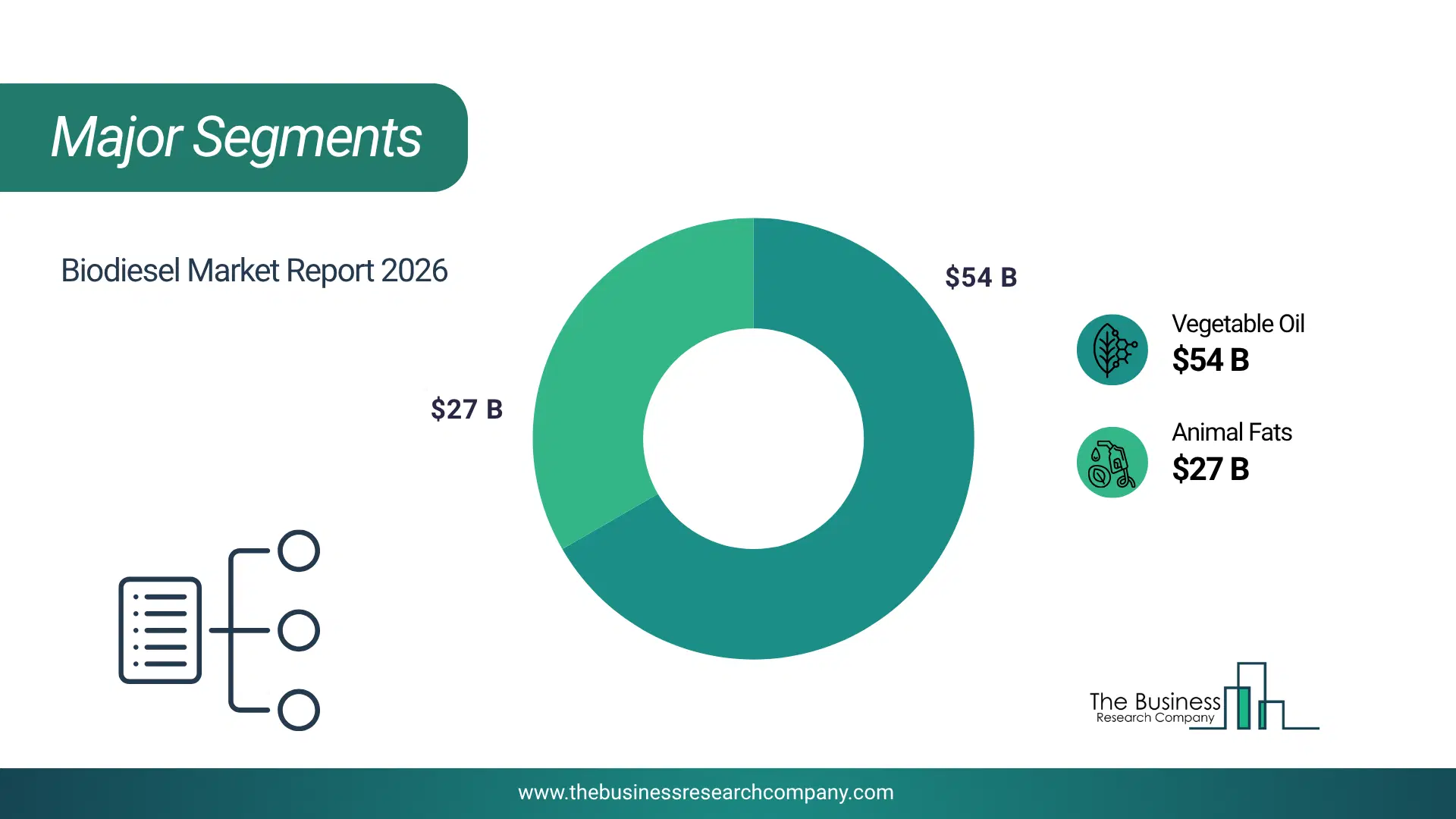
1) By Feedstock: Vegetable Oil, Animal Fats 2) By Production Process: Alcohol Trans Esterification, Hydro-Heating 3) By Application: Fuel, Power Generation, Agriculture Subsegments: 1) By Vegetable Oil: Soybean Oil, Canola Oil, Palm Oil, Sunflower Oil, Other Vegetable Oils 2) By Animal Fats: Tallow, Poultry Fat, Fish Oil, Other Animal Fats The top segments in the biodiesel market will be: • Vegetable Oil will reach $54.46 Billion by 2030. • Animal Fats will reach $27.05 Billion by 2030.What Is The Driver Of The Biodiesel Market?
An increase in the energy demand is expected to propel the biodiesel market going forward. Energy demand refers to the total amount of energy needed, consumed, or requested within a specific period in each geographical area. Biodiesel plays a crucial role in meeting energy demand while addressing environmental sustainability. As a renewable and cleaner-burning alternative to traditional fossil fuels, biodiesel contributes to reducing greenhouse gas emissions and mitigating the impact of transportation on the environment. Its utilization in various sectors, particularly in the transportation industry, helps diversify the energy mix and decreases dependence on conventional fuels. For instance, in March 2025, according to the International Energy Agency, a Austria-based global energy demand rose by 2.2% in 2024, substantially above the decade average of 1.3%, driven by surging electricity consumption, industrial growth and expanding energy use in emerging economies. Therefore, an increase in the energy demand is driving the biodiesel industry.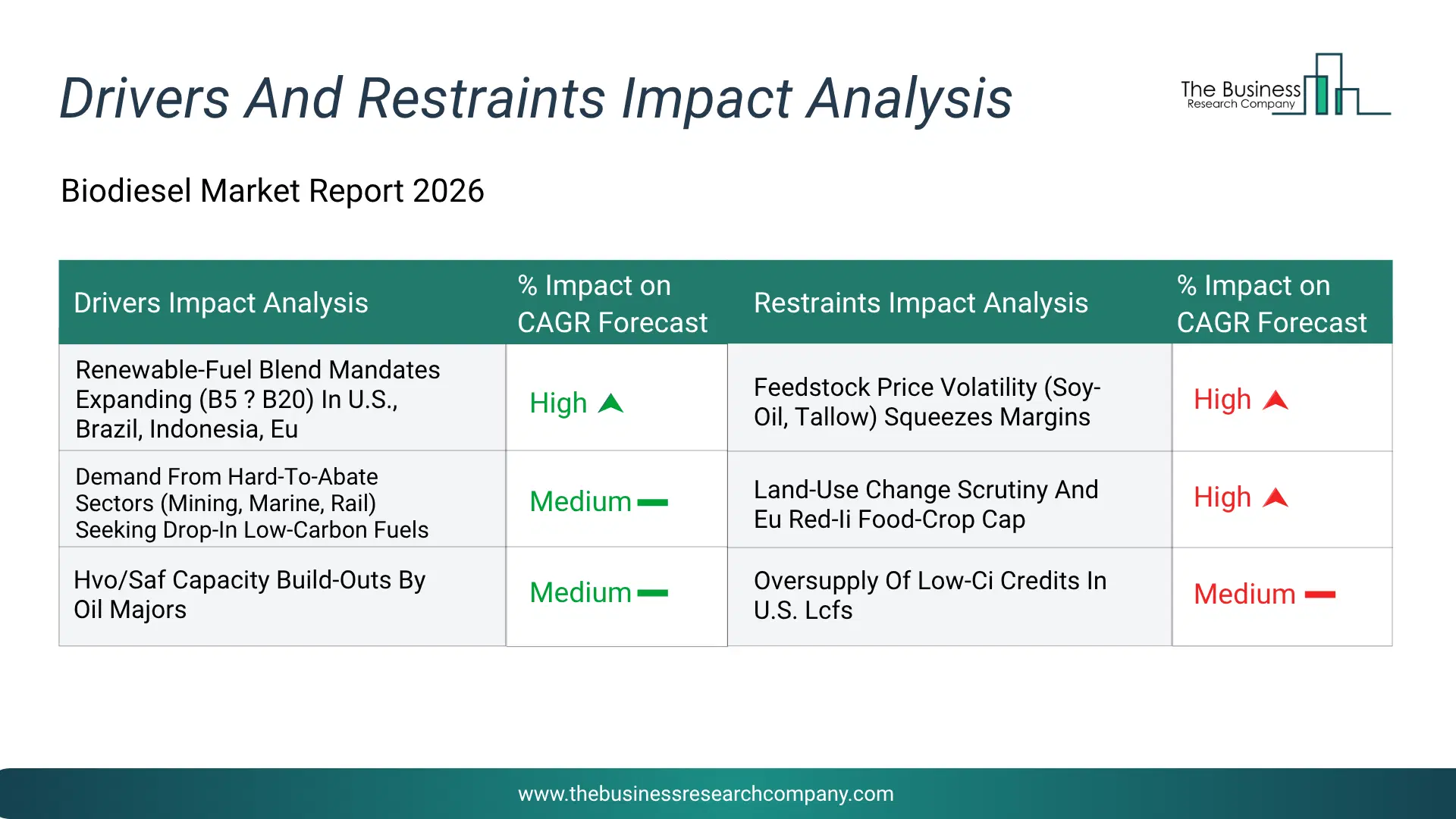
Infographic Chart Showing Key Market Drivers Analysis And Restraints For Biodiesel Market
The chart presents an impact analysis of key drivers and restraints, quantifying their relative influence on the market's growth rate and helping assess the balance between growth enablers and limiting factors. This chart offers a high-level perspective; the full report contains more detailed insights.
How Will The Drivers Impact Growth In The Global Biodiesel Market?
• Renewable-Fuel Blend Mandates Expanding (B5 → B20) In U.S., Brazil, Indonesia, Eu (High) – During the forecast period, the renewable-fuel blend mandates expanding (B5 → B20) In U.S., Brazil, Indonesia, Eu is expected to become a key growth driver for the biodiesel market by 2030. Renewable-fuel blending mandates are acting as a strong demand-side push for bio-based fuel components and their by-products. As countries progressively move from lower blends like B5 to higher blends such as B20, the consumption of biodiesel increases significantly. This expansion directly boosts the production volumes of biodiesel, which in turn increases glycerin output as a co-product. Regulatory enforcement in major economies ensures sustained and predictable demand, reducing market uncertainty. • Demand From Hard-To-Abate Sectors (Mining, Marine, Rail) Seeking Drop-In Low-Carbon Fuels (Medium) – During the forecast period, the demand from hard-to-abate sectors (Mining, Marine, Rail) seeking drop-in low-carbon fuels is expected to emerge as a major factor driving the expansion of the biodiesel market by 2030. Hard-to-abate sectors such as mining, marine, and rail are increasingly adopting low-carbon fuel alternatives to reduce emissions without overhauling existing infrastructure. These sectors rely on drop-in fuels like biodiesel and renewable diesel, which are compatible with current engines. As adoption rises, fuel producers scale up output, leading to higher glycerin generation. This demand is less sensitive to price fluctuations due to regulatory and sustainability pressures. • Hvo/Saf Capacity Build-Outs By Oil Majors (Medium) – During the forecast period, the HVO/SAF capacity build-outs by oil majors are expected to act as a key growth catalyst for the biodiesel market by 2030. HVO/SAF capacity build-outs by oil majors act as a major driver for the biodiesel market because increasing investments in renewable fuel production facilities are expanding the processing capacity for sustainable feedstocks such as vegetable oils, animal fats, and waste oils. Major energy companies are accelerating the development of integrated biorefineries to meet growing demand for low-carbon transportation fuels and comply with global decarbonization targets. These investments improve production efficiency, strengthen feedstock utilization, and enhance the availability of renewable fuels across aviation, road transport, and industrial sectors. In addition, expanding refining capacity encourages technological advancements and economies of scale, making biodiesel production more cost-effective.How Will The Restraints Impact Growth In The Global Biodiesel Market?
• Feedstock Price Volatility (Soy-Oil, Tallow) Squeezes Margins (High) – During the forecast period, the fluctuations in feedstock prices such as soy oil and tallow significantly impact the cost structure of biodiesel production. Since these feedstocks constitute a major portion of production costs, volatility can compress profit margins for producers. When prices rise sharply, producers may reduce output or delay expansion plans. This directly affects glycerin supply, as it is a by-product of biodiesel manufacturing. Additionally, unpredictable pricing creates challenges in long-term contract negotiations and financial planning. Market participants may face difficulties in maintaining stable pricing for downstream products. Smaller producers are particularly vulnerable to these fluctuations. Overall, feedstock volatility introduces uncertainty and limits consistent market growth. • Land-Use Change Scrutiny And Eu Red-Ii Food-Crop Cap (Medium) – During the forecast period, the regulatory scrutiny over land-use changes and sustainability concerns has intensified, particularly in the European Union under RED-II directives. The cap on food-crop-based biofuels restricts the use of certain feedstocks like palm and soy oil. This limits the expansion potential of biodiesel production, thereby constraining glycerin output. Compliance requirements increase operational complexity and costs for producers. Companies must invest in traceability and certification systems to meet regulatory standards. Additionally, public and environmental pressure discourages reliance on conventional feedstocks. This shift may slow down production growth in the short term. As a result, glycerin supply growth becomes constrained by policy limitations. • Oversupply Of Low-Ci Credits In U.S. Lcfs (Medium) – During the forecast period, the oversupply of low carbon intensity (CI) credits under the U.S. Low Carbon Fuel Standard (LCFS) has reduced credit prices significantly. Lower credit values weaken the financial incentives for producing low-carbon fuels like biodiesel and renewable diesel. This reduces profitability and may discourage further investment in biofuel production capacity. As production slows or stabilizes, glycerin output also faces limitations. Additionally, market participants may delay expansion projects due to uncertain returns. The imbalance between credit supply and demand creates market inefficiencies. Over time, this could reduce the pace of decarbonization efforts in the fuel sector. Consequently, the glycerin market experiences indirect pressure from weakened economic incentives.Key Players In The Global Biodiesel Market
Major companies operating in the biodiesel market are Archer-Daniels-Midland Company, Cargill Incorporated, Renewable Energy Group Inc., Wilmar International Limited, Bunge Limited, Neste Corporation, BIOX Corporation, Munzer Bioindustrie GmbH, Emami Agrotech Limited, Louis Dreyfus Company B.V., Crimson Renewable Energy L.P., Green Energy Biofuel LLC, FutureFuel Corp., Delta American Fuel LLC, HERO BX LLC, Western Dubuque Biodiesel LLC, Iowa Renewable Energy LLC, Flint Hills Resources LLC, World Energy Alternatives LLC, Lake Erie Biofuels LLC, Pacific Biodiesel Technologies LLC, SeQuential LLC, White Mountain Biodiesel LLC, Blue Sun Biodiesel LLC, Community Fuels Inc., Newport Biodiesel LLC, Piedmont Biofuels Industrial LLC, Verbio Vereinigte BioEnergie AG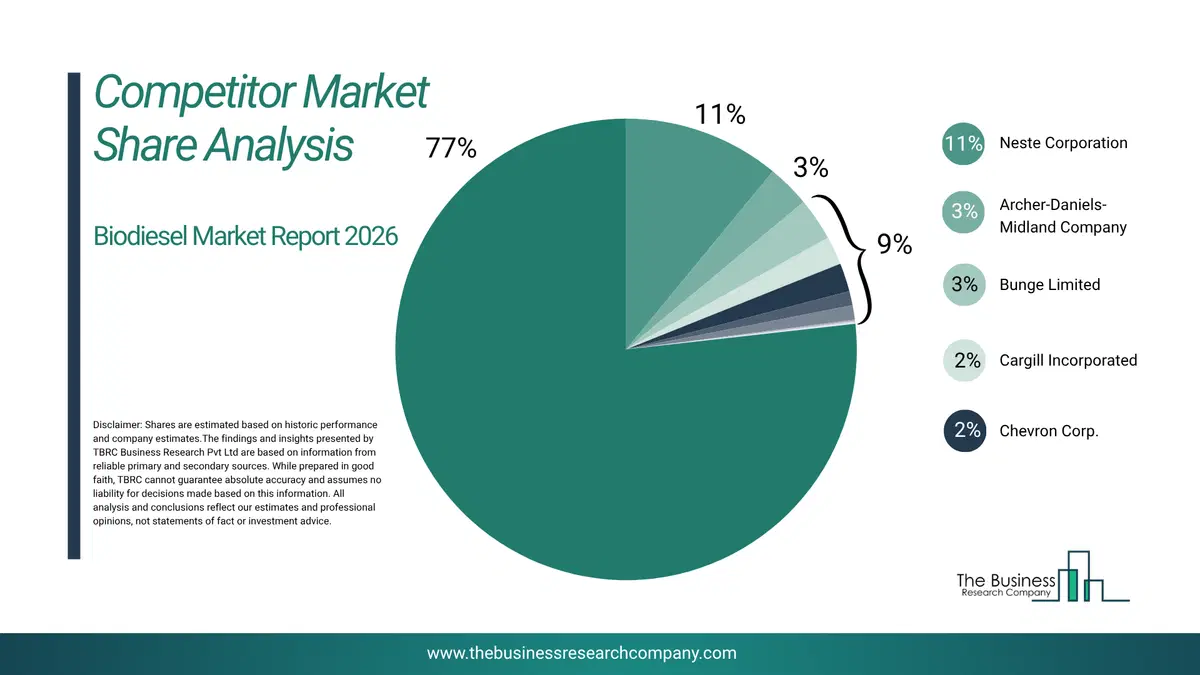
This chart is for illustrative purposes; the full report includes a detailed competitor analysis and comprehensive overview of the top 10 companies in the market.
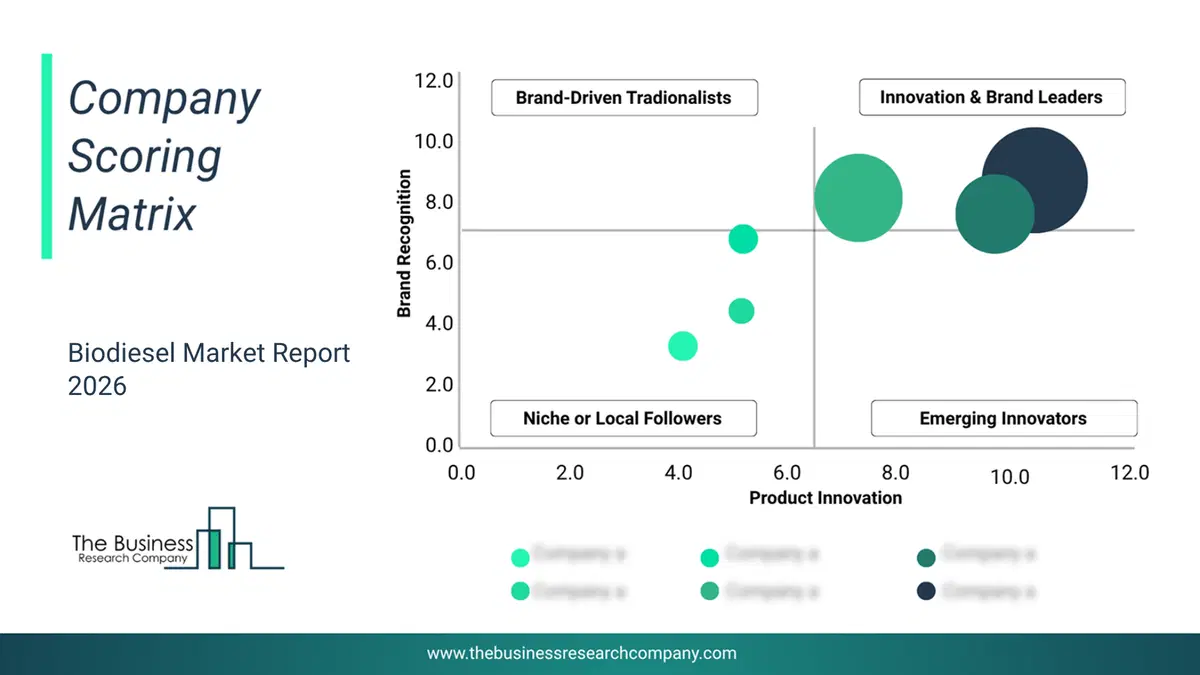
This chart maps companies by product innovation and brand strength, with bubble size indicating relative revenue, helping identify market leaders, challengers, and niche players. This is an illustrative chart; the full report provides a complete and accurate competitive analysis.
Global Biodiesel Market Trends and Insights
Major companies operating in biodiesel market are into partnerships to strengthen their position in the market. A business strategic partnership refers to a structured affiliation between two or more commercial enterprises, typically established via one or more business agreements or contracts. For instance, in July 2023, Indian Oil Corporation Limited, an India-based oil and gas company partnered with Praj Industries Limited. The collaboration aims to produce biofuels such as Sustainable Aviation Fuel (SAF), Ethanol, Compressed Bio-Gas (CBG), Biodiesel and Bio-bitumen, and others. Praj Industries Limited is an India-based process and project engineering company.What Are Latest Mergers And Acquisitions In The Biodiesel Market?
In February 2025, Sasol, a South Africa-based provider of integrated energy and chemical solutions, partnered with Anglo American to accelerate South Africa’s sustainable energy transition through renewable feedstock innovation. The acquisition aims to expand renewable diesel production by evaluating the technical and commercial feasibility of vegetable oil-based feedstock, leveraging land, resources, and expertise for sustainable cultivation. Anglo American is a UK-based mining company that is involved in biodiesel.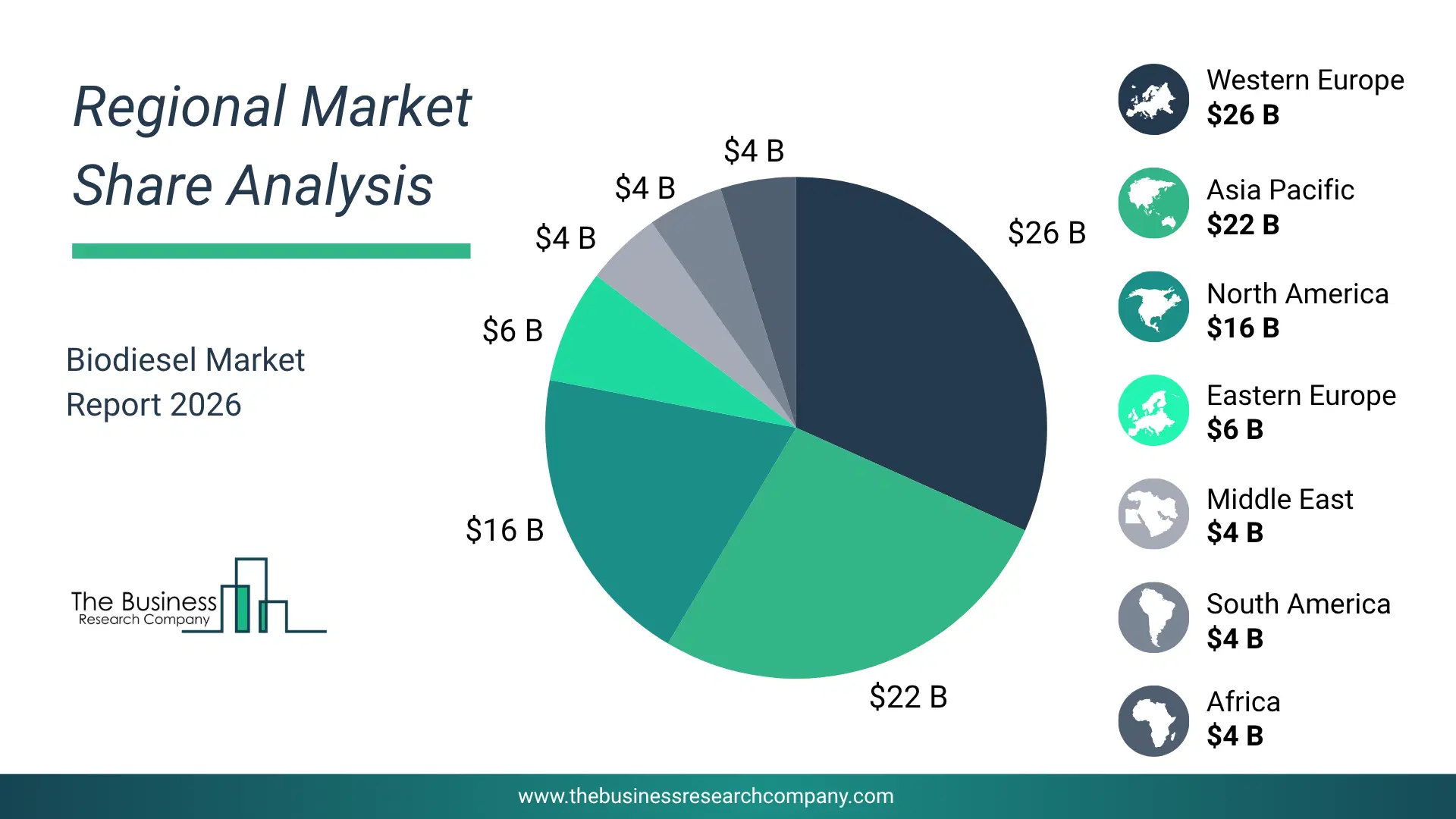
Regional Insights
Western Europe was the largest region in the biodiesel market share in 2025. Asia-Pacific is expected to be the fastest-growing region in the forecast period. The regions covered in this market report are Asia-Pacific, South East Asia, Western Europe, Eastern Europe, North America, South America, Middle East, Africa The countries covered in this market report are Australia, Brazil, China, France, Germany, India, Indonesia, Japan, Taiwan, Russia, South Korea, UK, USA, Canada, Italy, SpainWhat Defines the Biodiesel Market?
The biodiesel market consists of sales of biodiesel produced from canola oil, soybean oil, palm oil, and corn oil. Values in this market are ‘factory gate’ values, that is the value of goods sold by the manufacturers or creators of the goods, whether to other entities (including downstream manufacturers, wholesalers, distributors, and retailers) or directly to end customers. The value of goods in this market includes related services sold by the creators of the goods.How is Market Value Defined and Measured?
The market value is defined as the revenues that enterprises gain from the sale of goods and/or services within the specified market and geography through sales, grants, or donations in terms of the currency (in USD unless otherwise specified). The revenues for a specified geography are consumption values that are revenues generated by organizations in the specified geography within the market, irrespective of where they are produced. It does not include revenues from resales along the supply chain, either further along the supply chain or as part of other products.
This chart presents market attractiveness based on a quantitative evaluation of growth, competition, strategic alignment, and risk, offering a clear view of opportunity areas for decision-making. This chart is for illustrative purposes; the full report contains the complete analysis.

This chart highlights the Total Addressable Market (TAM) by estimating the maximum revenue opportunity using an assumption-driven approach, supporting strategic planning and opportunity sizing across markets. The chart is illustrative; the full report provides a more comprehensive analysis.
What Key Data and Analysis Are Included in the Biodiesel Market Report 2026?
The biodiesel market research report is one of a series of new reports from The Business Research Company that provides market statistics, including industry global market size, regional shares, competitors with the market share, detailed market segments, market trends and opportunities, and any further data you may need to thrive in the biodiesel industry. The market research report delivers a complete perspective of everything you need, with an in-depth analysis of the current and future state of the industry.Biodiesel Market Report Forecast Analysis
| Report Attribute | Details |
|---|---|
| Market Size Value In 2026 | $64.54 billion |
| Revenue Forecast In 2030 | $81.84 billion |
| Growth Rate | CAGR of 5.8% from 2026 to 2030 |
| Base Year For Estimation | 2025 |
| Actual Estimates/Historical Data | 2020-2025 |
| Forecast Period | 2026 - 2030 |
| Market Representation | Revenue in USD Billion and CAGR from 2026 to 2030 |
| Segments Covered | Feedstock, Production Process, Application |
| Regional Scope | Asia-Pacific, Western Europe, Eastern Europe, North America, South America, Middle East, Africa |
| Country Scope | The countries covered in the report are Australia, Brazil, China, France, Germany, India, Indonesia, Japan, Taiwan, Russia, South Korea, UK, USA, Canada, Italy, Spain. |
| Key Companies Profiled | Archer-Daniels-Midland Company, Cargill Incorporated, Renewable Energy Group Inc., Wilmar International Limited, Bunge Limited, Neste Corporation, BIOX Corporation, Munzer Bioindustrie GmbH, Emami Agrotech Limited, Louis Dreyfus Company B.V., Crimson Renewable Energy L.P., Green Energy Biofuel LLC, FutureFuel Corp., Delta American Fuel LLC, HERO BX LLC, Western Dubuque Biodiesel LLC, Iowa Renewable Energy LLC, Flint Hills Resources LLC, World Energy Alternatives LLC, Lake Erie Biofuels LLC, Pacific Biodiesel Technologies LLC, SeQuential LLC, White Mountain Biodiesel LLC, Blue Sun Biodiesel LLC, Community Fuels Inc., Newport Biodiesel LLC, Piedmont Biofuels Industrial LLC, Verbio Vereinigte BioEnergie AG |
| Customization Scope | Request for Customization |
| Pricing And Purchase Options | Explore Purchase Options |