
Bioelectronic Medicine And Neural Interface Devices Market Report 2026
Global Outlook – By Component (Electrodes And Cuffs, Leads And Neuroprosthetic Interfaces, Pulse Generators And Stimulators, Processors And Control Units, Power Sources And Energy Harvesting Modules, Software Platforms And Data Analytics Tools), By Device Type (Implantable Nerve Stimulators, Closed Loop Neural Interfaces, Non Invasive Bioelectronic Patches, Brain Computer Interface Devices), By Connectivity Type (Wireless Neural Interface Systems, Wired Neural Interface Systems), By Therapeutic Area (Chronic Pain Management, Inflammatory And Autoimmune Diseases, Epilepsy And Neurological Disorders, Cardiac Arrhythmia, Mental Health And Depression), By End User (Hospitals And Neurology Centers, Ambulatory Surgical Centers, Research Institutes, Home Care Patients) – Market Size, Trends, Strategies, and Forecast to 2030
Bioelectronic Medicine And Neural Interface Devices Market Report 2026 Market Overview
• Bioelectronic Medicine And Neural Interface Devices Market Report 2026 market size has reached to $2.02 billion in 2025 • Expected to grow to $5.25 billion in 2030 at a compound annual growth rate (CAGR) of 20.9% • Growth Driver: Surge In Neurological Disorders And Paralysis Fueling Market Growth Due To Rising Disease Burden And Aging Population • Market Trend: Advanced Neurostimulator Innovation Supports Personalized Treatment For Neurological Disorders • North America was the largest region in 2025 and Asia-Pacific is the fastest growing region.What Is Covered Under Bioelectronic Medicine And Neural Interface Devices Market?
Bioelectronic medicine and neural interface devices are advanced medical technologies that use targeted electrical stimulation, recording, or modulation of neural signals to diagnose, monitor, and treat a wide range of health conditions. These technologies establish direct communication pathways between the nervous system and external devices, enabling precise regulation of physiological functions and restoration of impaired neural activity. Bioelectronic medicine and neural interface devices support innovative therapeutic and diagnostic approaches by integrating neuroscience, biomedical engineering, and digital technologies to improve patient outcomes and functional performance. The main components of bioelectronic medicine and neural interface devices include electrodes and cuffs, leads and neuroprosthetic interfaces, pulse generators and stimulators, processors and control units, power sources and energy harvesting modules, and software platforms and data analytics tools. Electrodes and cuffs refer to specialized components designed to detect, stimulate, and modulate neural activity within the nervous system. These devices are available in types such as implantable nerve stimulators, closed loop neural interfaces, non invasive bioelectronic patches, and brain computer interface devices and are categorized by connectivity types including wireless neural interface systems and wired neural interface systems. The various therapeutic areas involved are chronic pain management, inflammatory and autoimmune diseases, epilepsy and neurological disorders, cardiac arrhythmia, and mental health and depression and they are utilized by end users including hospitals and neurology centers, ambulatory surgical centers, research institutes, and home care patients.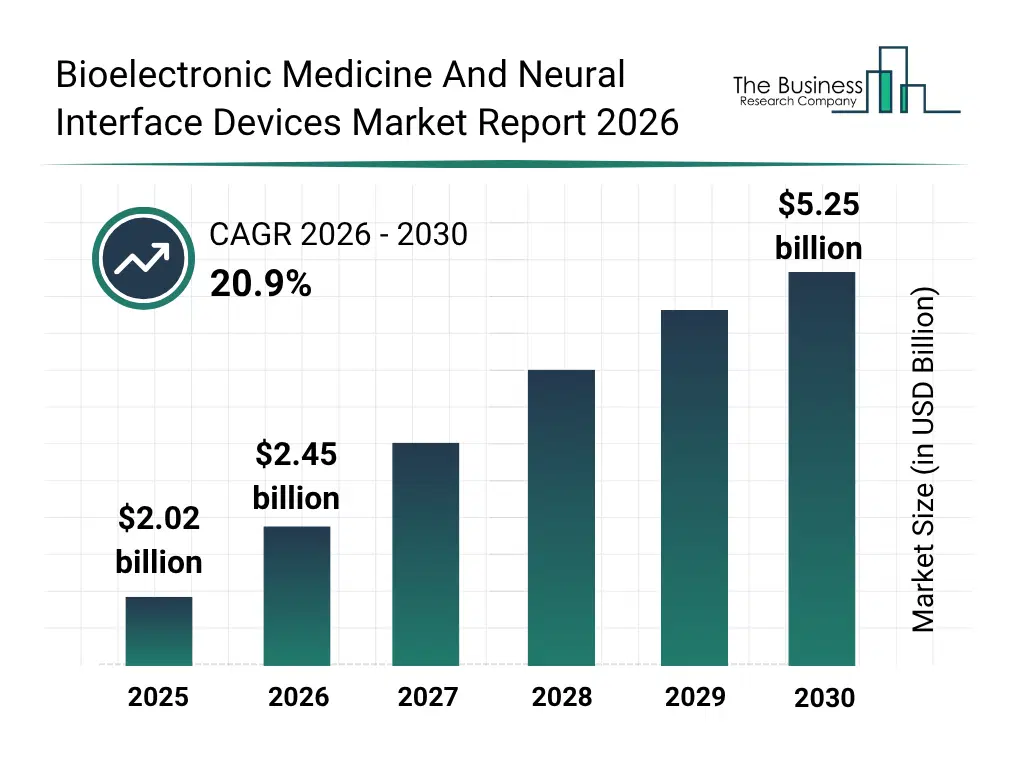
What Is The Bioelectronic Medicine And Neural Interface Devices Market Size and Share 2026?
The bioelectronic medicine and neural interface devices market size has grown exponentially in recent years. It will grow from $2.02 billion in 2025 to $2.45 billion in 2026 at a compound annual growth rate (CAGR) of 21.4%. The growth in the historic period can be attributed to growth in neuroscience research activities, increasing prevalence of neurological disorders, rising investments in medical device innovations, advancements in implantable device technologies, increasing adoption of neurostimulation therapies.What Is The Bioelectronic Medicine And Neural Interface Devices Market Growth Forecast?
The bioelectronic medicine and neural interface devices market size is expected to see exponential growth in the next few years. It will grow to $5.25 billion in 2030 at a compound annual growth rate (CAGR) of 20.9%. The growth in the forecast period can be attributed to growing demand for personalized neurotherapeutics, increasing development of advanced neural signal processing systems, rising adoption of home based neuro-monitoring solutions, expansion of next generation implantable devices, increasing investments in bioelectronic medicine research and development. Major trends in the forecast period include increasing adoption of minimally invasive neural interface technologies, growing development of implantable bioelectronic therapeutic devices, rising focus on precision neural signal modulation approaches, expansion of closed loop neurostimulation systems, increasing demand for long-term neural monitoring capabilities.
Global Bioelectronic Medicine And Neural Interface Devices Market Segmentation
1) By Component: Electrodes And Cuffs, Leads And Neuroprosthetic Interfaces, Pulse Generators And Stimulators, Processors And Control Units, Power Sources And Energy Harvesting Modules, Software Platforms And Data Analytics Tools 2) By Device Type: Implantable Nerve Stimulators, Closed Loop Neural Interfaces, Non Invasive Bioelectronic Patches, Brain Computer Interface Devices 3) By Connectivity Type: Wireless Neural Interface Systems, Wired Neural Interface Systems 4) By Therapeutic Area: Chronic Pain Management, Inflammatory And Autoimmune Diseases, Epilepsy And Neurological Disorders, Cardiac Arrhythmia, Mental Health And Depression 5) By End User: Hospitals And Neurology Centers, Ambulatory Surgical Centers, Research Institutes, Home Care Patients Subsegments: 1) By Electrodes And Cuffs: Surface Electrodes, Intracortical Electrodes, Epineural Cuffs, Perineural Cuffs, Deep Brain Stimulation Electrodes 2) By Leads And Neuroprosthetic Interfaces: Percutaneous Leads, Implantable Leads, Flexible Polymer Leads, Peripheral Nerve Interfaces, Spinal Cord Interfaces, Bidirectional Neural Interfaces 3) By Pulse Generators And Stimulators: Implantable Pulse Generators, External Neurostimulators, Closed Loop Stimulators, Programmable Pulse Generators, Wireless Stimulators 4) By Processors And Control Units: Signal Processing Units, Implantable Control Modules, External Control Consoles, Closed Loop Feedback Controllers, Neural Decoding And Encoding Processors 5) By Power Sources And Energy Harvesting Modules: Lithium Ion Implantable Batteries, Rechargeable Implantable Batteries, Inductive Charging Systems, Wireless Power Transfer Modules, Bioenergy Harvesting Units 6) By Software Platforms And Data Analytics Tools: Neural Signal Processing Software, Device Programming Platforms, Clinical Data Management Systems, Machine Learning Analytics Platforms, Remote Monitoring SoftwareWhat Is The Driver Of The Bioelectronic Medicine And Neural Interface Devices Market?
The growing prevalence of neurological disorders and paralysis is expected to propel the growth of the bioelectronic medicine and neural interface device market going forward. Neurological disorder and paralysis refer to medical conditions affecting the brain, spinal cord, or nerves that lead to impaired movement, sensation, or loss of motor control. The growing prevalence of neurological disorders and paralysis is driven by aging populations and increasing exposure to risk factors such as stroke, trauma, and chronic diseases, which collectively contribute to a higher incidence of long-term neurological impairments. Bioelectronic medicine and neural interface devices help in managing neurological disorder and paralysis by directly stimulating or modulating neural activity to restore communication between the brain, spinal cord, and muscles, thereby improving motor function, reducing symptoms, and enhancing patient rehabilitation outcomes. For instance, in December 2025, according to the Australian Institute of Health and Welfare, an Australia-based government department, neurological conditions caused over 486,000 DALYs in Australia, ranking 5th in disease burden and accounting for 8.4% overall (10.1% in females and 6.8% in males), with females contributing 57% and males 43% of the total burden. Therefore, the growing prevalence of neurological disorders and paralysis is driving the growth of the bioelectronic medicine and neural interface devices industry.Key Players In The Global Bioelectronic Medicine And Neural Interface Devices Market
Major companies operating in the bioelectronic medicine and neural interface devices market report are Abbott Laboratories, Boston Scientific Corporation, BrainsWay Ltd., Cala Health Inc., CorTec GmbH, electroCore Inc., Galvani Bioelectronics Limited, LivaNova PLC, MicroTransponder Inc., Nalu Medical Inc., Neurable Inc., Neuralink Corporation, Neuroelectrics Barcelona S.L.U., NeuroPace Inc., NeuroSky Inc., NeuroSigma Inc., Neuspera Medical Inc., Paradromics Inc., Saluda Medical Pty Ltd, Science Corporation, SetPoint Medical Corporation, Spark Biomedical, Zimmer Biomet
This chart is for illustrative purposes; the full report includes a detailed competitor analysis and comprehensive overview of the top 10 companies in the market.
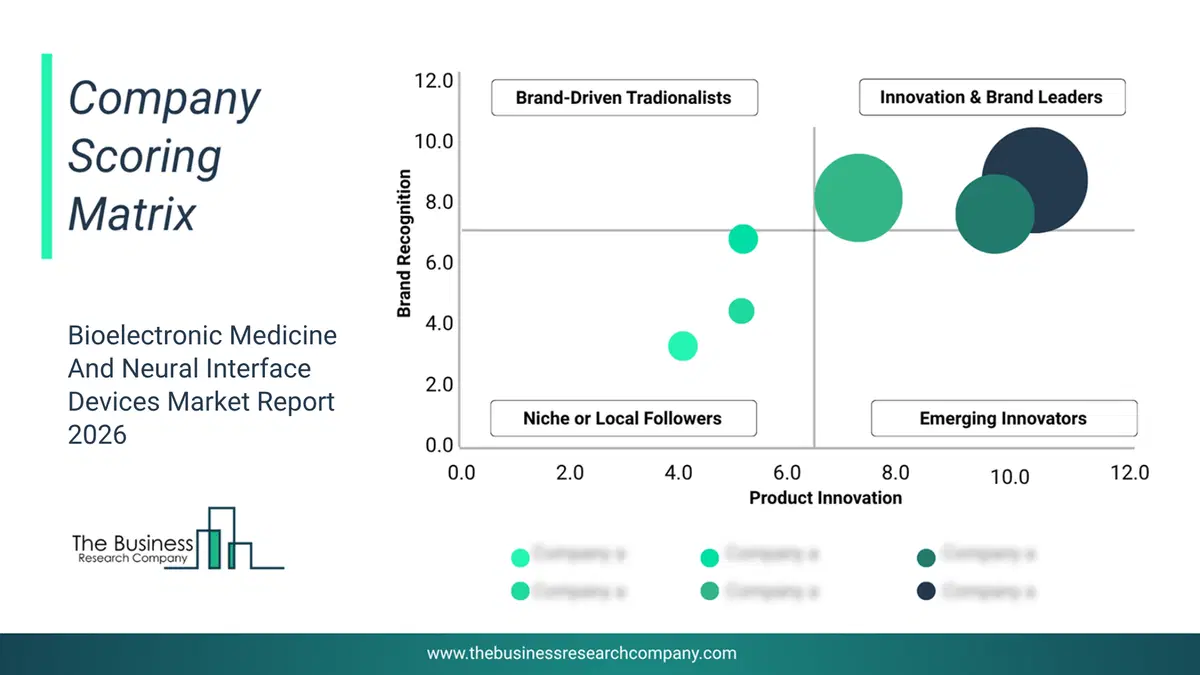
This chart maps companies by product innovation and brand strength, with bubble size indicating relative revenue, helping identify market leaders, challengers, and niche players. This is an illustrative chart; the full report provides a complete and accurate competitive analysis.
Global Bioelectronic Medicine And Neural Interface Devices Market Trends and Insights
Major companies operating in the bioelectronic medicine and neural interface devices market are focusing on developing advanced neuromodulation and brain-computer interface technologies, such as sensing-enabled neurostimulators, to enhance therapeutic outcomes, improve neurological monitoring, and deliver optimized personalized treatment across movement disorders and other neurological conditions. Sensing-enabled neurostimulators refer to advanced implantable devices that combine electrical stimulation with real-time neural signal sensing capabilities, enabling clinicians to monitor brain activity and tailor therapy based on patient-specific neurological responses. For instance, in January 2024, Medtronic plc, an Ireland-based medical technology company, received US Food and Drug Administration approval for its Percept RC Deep Brain Stimulation (DBS) system. It is designed to support improved neurological therapy and enhanced patient management. The solution enables continuous brain-signal sensing alongside therapeutic stimulation, supporting personalized treatment adjustments. It also improves monitoring of disease progression and therapy effectiveness, enhancing bioelectronic medicine and neural interface applications for neurological disorders.What Are Latest Mergers And Acquisitions In The Bioelectronic Medicine And Neural Interface Devices Market?
In February 2026, Science Corporation, a US-based neural engineering company, partnered with Neurosoft Bioelectronics to accelerate the development of next-generation neural interface and bioelectronic medicine technologies. Through this partnership, Science Corporation and Neurosoft Bioelectronics aim to integrate clinical-grade brain-computer interface systems with soft, stretchable neural electrodes to accelerate the development of safer, more effective implantable neurotechnology for medical and therapeutic use. Neurosoft Bioelectronics is a Switzerland-based neurotechnology company developing highly compliant, stretchable brain-computer interfaces (BCIs) and soft implantable electrodes.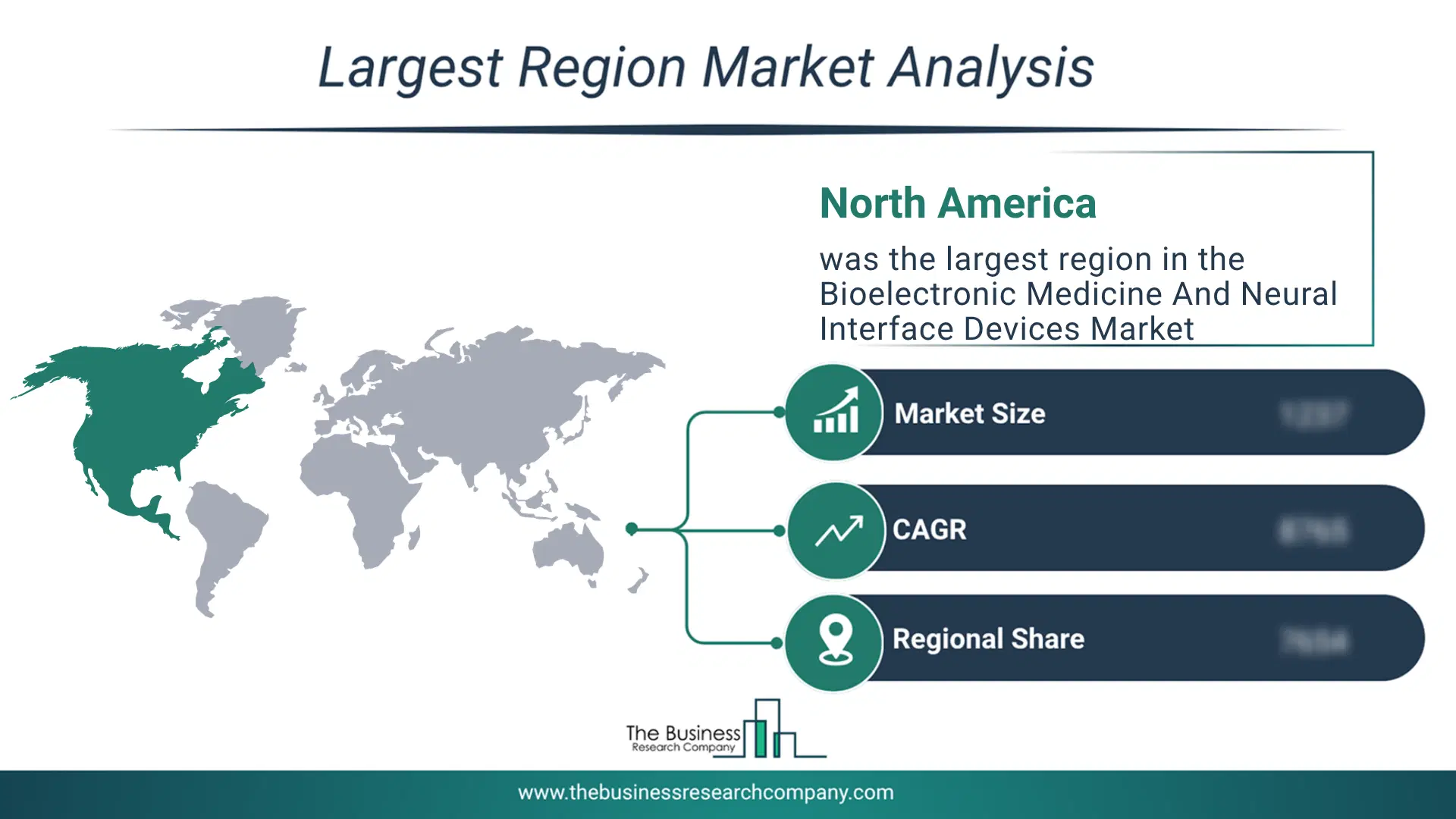
Regional Outlook
North America was the largest region in the bioelectronic medicine and neural interface devices market in 2025. Asia-Pacific is expected to be the fastest-growing region in the forecast period. The regions covered in this market report are Asia-Pacific, South East Asia, Western Europe, Eastern Europe, North America, South America, Middle East, Africa. The countries covered in this market report are Australia, Brazil, China, France, Germany, India, Indonesia, Japan, Taiwan, Russia, South Korea, UK, USA, Canada, Italy, Spain.What Defines the Bioelectronic Medicine And Neural Interface Devices Market?
The bioelectronic medicine and neural interface devices market consists of revenues earned by entities by providing services such as data management, patient follow-up, and custom neural mapping. The market value includes the value of related goods sold by the service provider or included within the service offering. The bioelectronic medicine and neural interface devices market also includes sales of implantable neurostimulators, brain-computer interfaces, cochlear implants, and vagus nerve stimulation devices. Values in this market are ‘factory gate’ values, that is, the value of goods sold by the manufacturers or creators of the goods, whether to other entities (including downstream manufacturers, wholesalers, distributors, and retailers) or directly to end customers. The value of goods in this market includes related services sold by the creators of the goods.How is Market Value Defined and Measured?
The market value is defined as the revenues that enterprises gain from the sale of goods and/or services within the specified market and geography through sales, grants, or donations in terms of the currency (in USD unless otherwise specified). The revenues for a specified geography are consumption values that are revenues generated by organizations in the specified geography within the market, irrespective of where they are produced. It does not include revenues from resales along the supply chain, either further along the supply chain or as part of other products.
This chart presents market attractiveness based on a quantitative evaluation of growth, competition, strategic alignment, and risk, offering a clear view of opportunity areas for decision-making. This chart is for illustrative purposes; the full report contains the complete analysis.

This chart highlights the Total Addressable Market (TAM) by estimating the maximum revenue opportunity using an assumption-driven approach, supporting strategic planning and opportunity sizing across markets. The chart is illustrative; the full report provides a more comprehensive analysis.
What Key Data and Analysis Are Included in the Bioelectronic Medicine And Neural Interface Devices Market Report 2026?
The bioelectronic medicine and neural interface devices market research report is one of a series of new reports from The Business Research Company that provides market statistics, including industry global market size, regional shares, competitors with the market share, detailed market segments, market trends and opportunities, and any further data you may need to thrive in the bioelectronic medicine and neural interface devices industry. The market research report delivers a complete perspective of everything you need, with an in-depth analysis of the current and future state of the industry.Bioelectronic Medicine And Neural Interface Devices Market Report Forecast Analysis
| Report Attribute | Details |
|---|---|
| Market Size Value In 2026 | $2.45 billion |
| Revenue Forecast In 2030 | $5.25 billion |
| Growth Rate | CAGR of 20.9% from 2026 to 2030 |
| Base Year For Estimation | 2025 |
| Actual Estimates/Historical Data | 2020-2025 |
| Forecast Period | 2026 - 2030 |
| Market Representation | Revenue in USD Billion and CAGR from 2026 to 2030 |
| Segments Covered | Component, Device Type, Connectivity Type, Therapeutic Area, End User |
| Regional Scope | Asia-Pacific, Western Europe, Eastern Europe, North America, South America, Middle East, Africa |
| Country Scope | The countries covered in the report are Australia, Brazil, China, France, Germany, India, Indonesia, Japan, Taiwan, Russia, South Korea, UK, USA, Canada, Italy, Spain. |
| Key Companies Profiled | Abbott Laboratories, Boston Scientific Corporation, BrainsWay Ltd., Cala Health Inc., CorTec GmbH, electroCore Inc., Galvani Bioelectronics Limited, LivaNova PLC, MicroTransponder Inc., Nalu Medical Inc., Neurable Inc., Neuralink Corporation, Neuroelectrics Barcelona S.L.U., NeuroPace Inc., NeuroSky Inc., NeuroSigma Inc., Neuspera Medical Inc., Paradromics Inc., Saluda Medical Pty Ltd, Science Corporation, SetPoint Medical Corporation, Spark Biomedical, Zimmer Biomet |
| Customization Scope | Request for Customization |
| Pricing And Purchase Options | Explore Purchase Options |