

Bioenergy Market 2026
By Type (Biomass And Renewable Municipal Waste, Biogas, Liquid Biofuels), By Technology (Gasification, Fast Pyrolysis, Fermentation, Other Technologies), By Application (Power Generation, Heat Generation, Transportation, Other Applications), And By Region, Opportunities And Strategies – Global Forecast To 2035
Bioenergy Market Definition
Bioenergy is renewable energy derived from organic materials such as plants, agricultural residues, and waste. It can be converted into solid, liquid, or gaseous fuels to produce electricity, heat, and transportation fuels. The main aim of bioenergy is to reduce dependence on fossil fuels and lower greenhouse gas emissions by promoting sustainable energy use. The bioenergy market consists of sales, by entities (organizations, sole traders, or partnerships), of bioenergy that is used by power producers, industrial facilities, transportation companies, and residential consumers for generating electricity, heat, and fuel. The energy is produced from renewable biological sources such as agricultural residues, forest biomass, organic waste, and energy crops through processes such as combustion, anaerobic digestion, or fermentation. Bioenergy offerings serve utilities, industries, and communities seeking sustainable energy solutions to reduce carbon emissions and dependence on fossil fuels.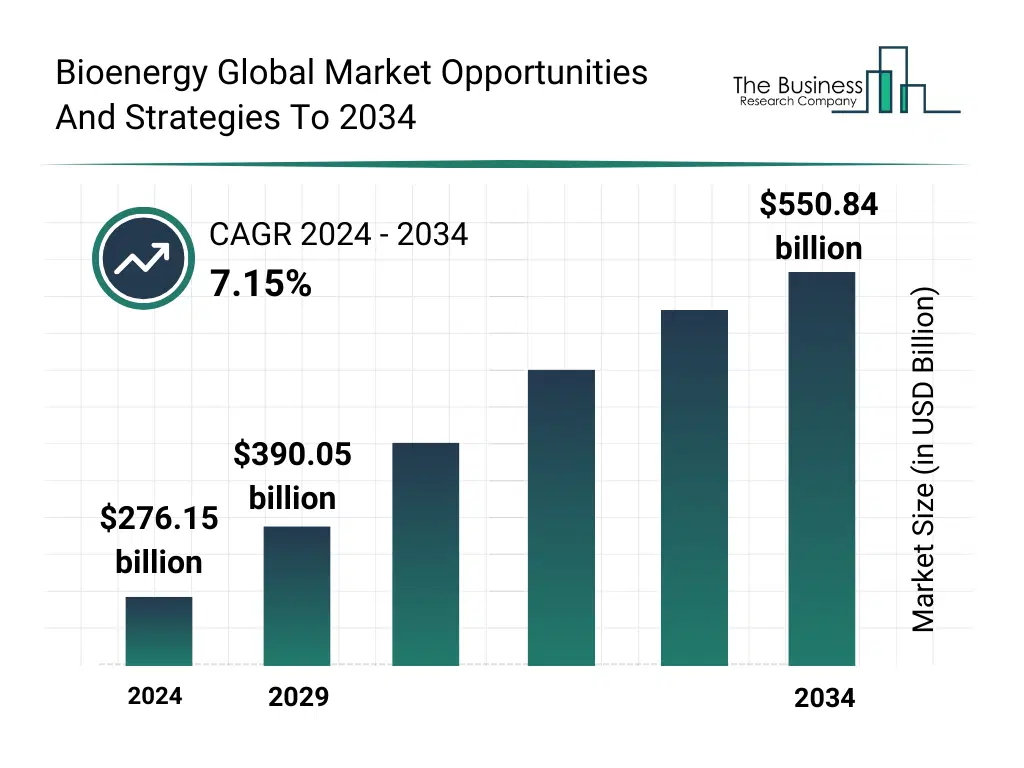
Bioenergy Market Size
The global bioenergy market reached a value of nearly $276,146.23 million in 2024, having grown at a compound annual growth rate (CAGR) of 5.41% since 2019. The market is expected to grow from $276,146.23 million in 2024 to $390,049.65 million in 2029 at a rate of 7.15%. The market is then expected to grow at a CAGR of 7.15% from 2029 and reach $550,836.94 million in 2034. Growth in the historic period resulted from rising global energy demand, rising waste-to-energy initiatives, corporate renewable energy commitments and rising demand for biofuels. Factors that negatively affected growth in the historic period were competing renewable options and high initial capital investment. Going forward, growing industrial adoption of biomass-based energy, government incentives and subsidies, circular economy and resource recovery focus and growing demand for renewable electricity will drive the growth. Factors that could hinder the growth of the bioenergy market in the future include impact of trade war and tariff, policy and regulatory uncertainty and land availability limits.Bioenergy Market Drivers
The key drivers of the bioenergy market include: Growing Industrial Adoption Of Biomass-Based Energy During the forecast period, the bioenergy market is expected to experience strong growth, driven by the increasing industrial adoption of biomass-based energy solutions. Across the globe, industries are incorporating biomass into their energy mix to improve sustainability, lower carbon emissions, and achieve a more reliable and secure energy supply. Biomass energy’s versatility—using feedstocks such as agricultural residues, forestry byproducts, and organic waste—makes it suitable for a wide range of industrial uses. This trend is further reinforced by technological advancements in biomass conversion, improved supply chain infrastructure, and supportive government policies promoting renewable energy. As more companies focus on decarbonization and energy efficiency, industrial demand for biomass is anticipated to rise significantly, fueling the expansion of the bioenergy market. The growing industrial adoption of biomass-based energy growth contribution during the forecast period in 2024 is 1.50%.Bioenergy Market Restraints
The key restraints on the bioenergy market include: Land Availability Limits During the forecast period, the growth of the bioenergy market is expected to be constrained by limitations in land availability. Expanding bioenergy production often competes with other land uses, including food cultivation, forestry, and conservation areas, leading to potential land-use conflicts—especially in regions with high population density or limited arable land. Moreover, converting land for bioenergy purposes can cause biodiversity loss and other environmental impacts, further complicating land-use decisions. Consequently, the limited availability of suitable land may restrict the expansion of bioenergy projects and the sector’s overall growth during the forecast period. Growth affected by land availability limits during the forecast period in 2024 is -3.04%.Bioenergy Market Trends
Major trends shaping the bioenergy market include: Waste-To-Energy Initiatives Boost Brazil’s Decarbonization Goals Major companies operating in the bioenergy market are focusing on adopting waste-to-energy solutions and biomethane production to diversify renewable energy portfolios, reduce dependency on fossil fuels, and support decarbonization goals. For example, in October 2025, Minas Gerais inaugurated its first biomethane plant in Tupaciguara, located in the Triângulo Mineiro region. The facility, developed jointly by Zeg Biogás, a Brazil-based biotechnology company, and Bioenergética Aroeira, a Brazil-based sugar factory, uses vinasse, a byproduct of sugarcane processing, as its primary feedstock to produce renewable fuel. This project advances the state’s transition to sustainable energy, reduces reliance on fossil fuels, and aligns with Brazil’s broader energy diversification and decarbonization objectives. Sustainable Aviation Fuel (SAF) Development Through Advanced Biomass Conversion Major companies operating in the bioenergy market are focusing on developing sustainable aviation fuel (SAF) through advanced biomass conversion technologies. These innovations aim to enhance the scalability, efficiency, and sustainability of SAF production, supporting the aviation industry's decarbonization goals and reducing greenhouse gas emissions. For instance, in October 2025, Houston American Energy Corp. (HUSA), a US-based energy company, partnered with BTG Bioliquids B.V., a Netherlands-based fast pyrolysis technology provider, to develop biomass-to-liquid fuels and SAF projects. The collaboration utilizes BTG Bioliquids’ proprietary fast pyrolysis technology to convert woody biomass waste streams into Fast Pyrolysis Bio-Oil (FPBO), which HUSA plans to further upgrade into high-value biofuels and SAF at its Cedar Port site in Baytown, Texas. By leveraging advanced biomass conversion technologies and extensive industry expertise, the company aims to deliver sustainable aviation fuels that meet the evolving demand for low-carbon energy solutions while promoting a circular economy.Opportunities And Recommendations In The Bioenergy Market
Opportunities – The top opportunities in the bioenergy market segmented by type will arise in the biomass and renewable municipal waste segment, which will gain $59,609.20 million of global annual sales by 2029. The top opportunities in the bioenergy market segmented by technology will arise in the fermentation segment, which will gain $60,620.75 million of global annual sales by 2029. The top opportunities in the bioenergy market segmented by application will arise in the power generation segment, which will gain $70,250.13 million of global annual sales by 2029. The bioenergy market size will gain the most in Brazil at $22,738.10 million. Recommendations- To take advantage of the opportunities, The Business Research Company recommends the bioenergy companies to focus on waste-to-biomethane fuel expansion, focus on bioethanol and compressed biogas production growth, focus on advanced waste conversion systems, focus on liquid biofuel and green hydrogen integration, focus on liquid biofuels to accelerate decarbonization growth, focus on fermentation to strengthen high-growth biofuel production, expand in emerging markets, focus on sustainable aviation fuel scale-up, focus on plant-based chemical pathways, focus on adaptive value-based pricing to support competitiveness and margin stability, focus on performance-based promotion to increase stakeholder confidence and project uptake, focus on digital education and collaborative outreach to expand market readiness and accelerate evaluation cycles and focus on transportation fuels to capture high-growth decarbonization demand.
Bioenergy Market Segmentation
The bioenergy market is segmented by type, by technology and by application.By Type –
The bioenergy market is segmented by type into:
- a) Renewable Municipal Waste
- b) Biogas
- c) Liquid Biofuels
By Technology –
The bioenergy market is segmented by technology into:
- a) Gasification
- b) Fast Pyrolysis
- c) Fermentation
- d) Other Technologies
By Application –
The bioenergy market is segmented by application into:
- a) Power Generation
- b) Heat Generation
- c) Transportation
- d) Other Applications
By Geography - The bioenergy market is segmented by geography into:
- • China
- • India
- • Japan
- • Australia
- • Indonesia
- • South Korea
- • USA
- • Canada
- • Brazil
- • France
- • Germany
- • UK
- • Italy
- • Spain
- • Russia
-
o Asia Pacific
o Africa