
Bioengineering Technology Market 2025
By Product (Biomedical Engineering, Genetic Engineering, Tissue Engineering, Biomaterial, Biomechanical Engineering, Nano-Biotechnology, Other Products), By Technology (Nanobiotechnology, Tissue Engineering And Regeneration, DNA Sequencing, Cell-Based Assays, Fermentation, Chromatography, PCR Technology, Other Technologies), By Application (Health, Food And Agriculture, Natural Resources And Environment, Industrial Processing, Bioinformatics, Other Applications), And By Region, Opportunities And Strategies – Global Forecast To 2035
Bioengineering Technology Market Definition
Bioengineering technology is the application of engineering principles and techniques to biological systems and living organisms for the development of innovative products, processes and solutions in healthcare, agriculture and industry. It integrates disciplines such as biotechnology, materials science, electronics and computational modeling to address challenges in medicine, genetics, environmental sustainability and bio-manufacturing. The primary purpose of bioengineering technology is to improve human health, enhance quality of life and promote sustainability. The bioengineering technology market consists of sales by entities (organizations, sole traders and partnerships) of bioengineering technology products that are used across a variety of scenarios such as diagnosing and treating diseases, enhancing crop production, monitoring environmental conditions and developing sustainable energy sources. It enables advancements such as medical devices, tissue engineering, synthetic biology, genetically modified crops and bioprocess optimization, bridging the gap between engineering and life sciences.
Bioengineering Technology Market Size
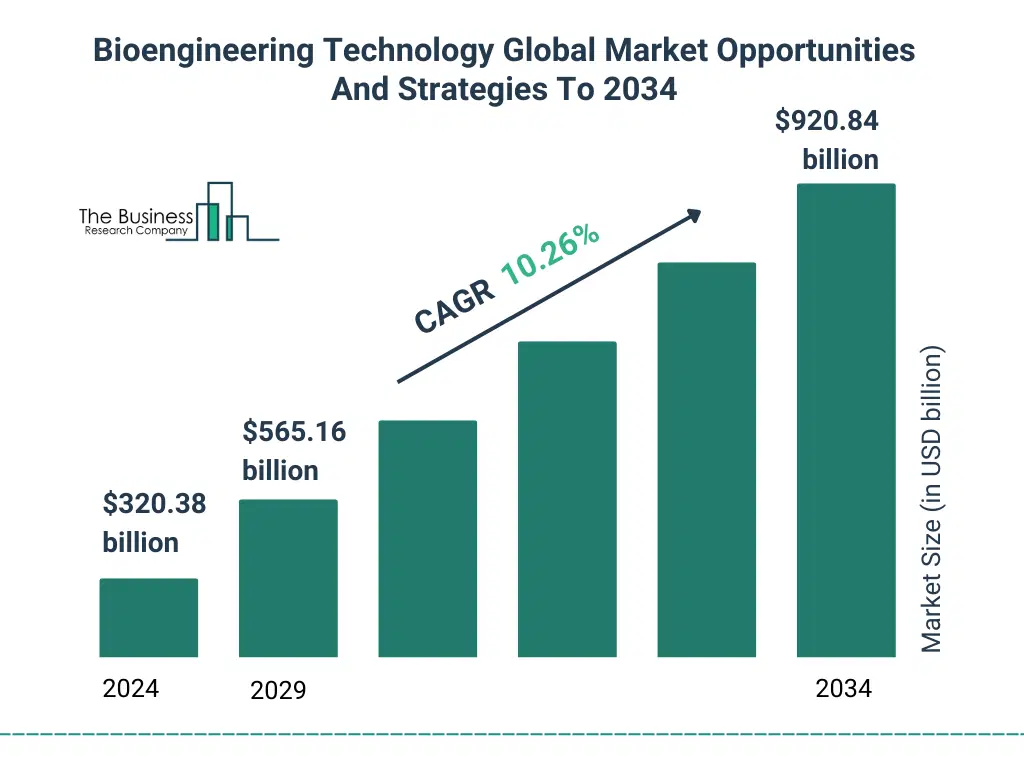
The global bioengineering technology market reached a value of nearly $320,380.84 million in 2024, having grown at a compound annual growth rate (CAGR) of 13.45% since 2019. The market is expected to grow from $320,380.84 million in 2024 to $565,164.47 million in 2029 at a rate of 12.02%. The market is then expected to grow at a CAGR of 10.26% from 2029 and reach $920,838.80 million in 2034. Growth in the historic period resulted from the increasing healthcare expenditure, increasing focus on cell therapies, rising demand for personalized medicine and rising consumer awareness and acceptance of biotech solutions. Factors that negatively affected growth in the historic period were strict regulatory approvals and ethical and social concerns. Going forward, rising prevalence of chronic diseases, rising investments in biotechnology and healthcare R&D, demand for sustainable and eco-friendly solutions and rising awareness and adoption of bio-based materials and products will drive the growth. Factors that could hinder the growth of the bioengineering technology market in the future include high research and development costs, workforce and infrastructure limitations and impact of trade war and tariffs.Bioengineering Technology Market Drivers
The key drivers of the bioengineering technology market include: Rising Awareness And Adoption Of Bio-Based Materials And Products Rising awareness and adoption of bio-based materials and products are expected to propel the growth of the bioengineering technology market going forward. As demand for eco-friendly and renewable products grows, companies are investing in bioengineering technologies to develop such solutions efficiently. Bio-based products often offer benefits like biodegradability, lower carbon footprint and reduced reliance on fossil fuels, which align with regulatory and consumer expectations. This rising adoption encourages innovation in bioengineering processes, including enzyme engineering, microbial fermentation and plant-based bioproducts. The rising awareness and adoption of bio-based materials and products growth contribution during the forecast period in 2024 is 0.50%.Bioengineering Technology Market Restraints
The key restraints on the bioengineering technology market include: High Research And Development Costs High research and development costs are expected to restrain the growth of the bioengineering technology market during the forecast period by limiting the entry of smaller firms and startups. These substantial investments increase financial risk and extend the timeline for product commercialization. As a result, companies may prioritize only high-return projects, slowing innovation. Overall, the cost barrier can reduce the pace and diversity of technological advancements in the sector. Growth affected by high research and development costs during the forecast period in 2024 is -2.02%.Bioengineering Technology Market Trends
Major trends shaping the bioengineering technology market include: AI-Powered Omics Integration Sets New Benchmark In Biomedical Innovation Major companies in the bioengineering technology market are increasingly focused on developing AI-powered omics integration, which sets a new benchmark in biomedical innovation. Genomics, proteomics, metabolomics and transcriptomics generate vast and fragmented datasets that are difficult to interpret using conventional methods. AI-driven integration helps unify these layers of data, uncovering hidden patterns, predictive biomarkers and therapeutic targets with greater speed and accuracy. For instance, in April 2025, Signios Bio (Signios Biosciences), a US-based multiomics and bioinformatics company, launched as a pioneering biotechnology company focused on advancing precision medicine and drug discovery through AI-driven bioinformatics and an integrated multiomics platform. The platform offers comprehensive capabilities spanning genomics, transcriptomics, proteomics, epigenomics, metabolomics, microbiomics and spatial biology, all powered by proprietary AI algorithms that help decode complex disease biology and identify novel biomarkers. Signios Bio works as a scientific partner, collaborating closely with pharmaceutical companies, biotech firms and academic institutions to accelerate research timelines and deliver actionable insights for targeted therapies and diagnostics. Next-Generation Rice Crops Deliver Efficiency And Resilience Major companies in the bioengineering technology market are increasingly focused on developing next-generation rice crops to deliver efficiency and resilience, as rice is a staple food for over half the global population and highly vulnerable to climate stressors. By applying advanced bioengineering techniques such as genome editing and precision breeding, these companies aim to create rice varieties that require less water, use nutrients more efficiently and withstand extreme conditions like drought, salinity and pests. This focus not only ensures stable yields amid growing food security challenges but also reduces input costs for farmers and promotes sustainable agriculture practices. For instance, in May 2025, the Indian Council of Agricultural Research (ICAR), an autonomous body responsible for coordinating agricultural education and research in India, launched the world’s first genome-edited rice varieties, DRR Dhan 100 (Kamala) and Pusa DST Rice 1, marking a major milestone in climate-resilient agriculture. Developed using CRISPR-Cas genome editing technology that makes precise, non-transgenic changes without adding foreign DNA, these varieties offer significantly higher yield, drought and salinity tolerance, as well as improved nitrogen-use efficiency and early maturity. These innovations promise to enhance food security, reduce greenhouse gas emissions and support sustainable farming practices across major rice-growing regions in India and potentially worldwide.Opportunities And Recommendations In The bioengineering technology Market
Opportunities: - The top opportunities in the bioengineering technology market segmented by product will arise in the genetic engineering segment, which will gain $78,660.25 million of global annual sales by 2029. The top opportunities in the bioengineering technology market segmented by technology will arise in the DNA sequencing segment, which will gain $65,298.22 million of global annual sales by 2029. The top opportunities in the bioengineering technology market segmented by application will arise in the health segment, which will gain $136,096.87 million of global annual sales by 2029. The bioengineering technology market size will gain the most in the USA at $71,223.37 million. Recommendations- To take advantage of the opportunities, The Business Research Company recommends the bioengineering technology companies to focus on advancing cell processing efficiency, focus on developing climate-resilient rice varieties, focus on adopting simulation-based regulatory tools, focus on developing sustainable high-performance ptmeg, focus on developing affordable high-performance prosthetics, focus on advancing consistent nanoparticle analysis, focus on ai-powered multiomics integration, focus on ai-enhanced rna sequencing analysis, focus on advancing genomic profiling for precision medicine, focus on accelerating genetic data analysis, focus on optical electrophysiology and tissue stimulation, focus on genetic engineering for growth, focus on dna sequencing for market expansion, expand in emerging markets, focus on expanding and diversifying distribution channels, focus on competitive and value-based pricing strategies, focus on targeted educational and thought leadership campaigns, focus on integrated multi-channel awareness and engagement, focus on bioinformatics for strategic growth.Bioengineering Technology Market Segmentation
The bioengineering technology market is segmented by type, by enterprise size, and by industry vertical.By Type –
The Bioengineering Technology market is segmented by type into:
- a) Biomedical Engineering
- b) Genetic Engineering
- c) Tissue Engineering
- d) Biomaterial
- e) Biomechanical Engineering
- f) Nano-Biotechnology
- g) Other Products
By Technology –
The bioengineering technology market is segmented by technology into:
- a) Nanobiotechnology
- b) Tissue Engineering And Regeneration
- c) DNA Sequencing
- d) Cell-Based Assays
- e) Fermentation
- f) Chromatography
- g) PCR Technology
- h) Other Technologies
By Industry Vertical –
The bioengineering technology market is segmented by industry vertical into:
By Geography - The bioengineering technology market is segmented by geography into:
- • China
- • India
- • Japan
- • Australia
- • Indonesia
- • South Korea
- • USA
- • Canada
- • Brazil
- • France
- • Germany
- • UK
- • Italy
- • Spain
- • Russia
-
o Asia Pacific
o Africa