Contact Us
  Search
The Business Research Company Logo
Biogas Market 2025
Published :May 2025
Pages :350
Format :PDF
Delivery Time :2-3 Business Days
Why 2-3 days? We update the report with the latest data and news before delivery. Let us know if you need us to expedite.
Report Price :$4,490.00

Biogas Market 2025

By Source (Municipal Waste, Industrial Waste, Agricultural Waste, Other Sources), By Application (Residential, Commercial, Industrial), By End User (Power Generation, Heat Generation, Cogeneration, Other End-Users), And By Region, Opportunities And Strategies – Global Forecast To 2035

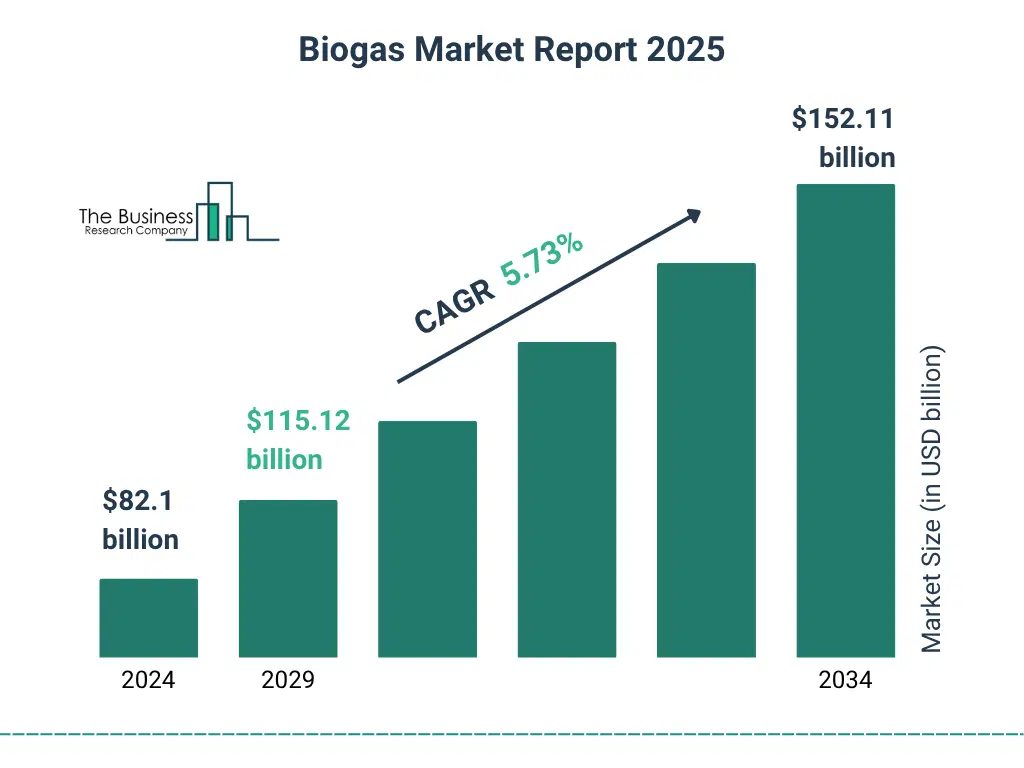
Biogas Market Size and growth rate 2025 to 2029: Graph

Biogas Market Definition

Biogas refers to a form of biofuel that is created spontaneously when organic waste decomposes. Biogas is a renewable energy source produced from the breakdown of organic matter. It is a mixture of gases, primarily consisting of methane, carbon dioxide and hydrogen sulfide. The biogas market consists of sales, by entities (organizations, sole traders, or partnerships), of biogas that is used as a source of energy to fuel vehicles, heat homes and generate electricity. Biogas is produced by digestion with anaerobic microorganisms, known as methanogens, that produce methane as a product inside an anaerobic digester, biodigester, or bioreactor. Biogas is a naturally occurring and renewable source of energy, resulting from the breakdown of organic matter.

Research Expert

Book your 30 minutes free consultation with our research experts

Biogas Market Size

The global biogas market reached a value of nearly $82,101.28 million in 2024, having grown at a compound annual growth rate (CAGR) of 5.09% since 2019. The market is expected to grow from $82,101.28 million in 2024 to $115,116.73 million in 2029 at a rate of 6.99%. The market is then expected to grow at a CAGR of 5.73% from 2029 and reach $152,111.02 million in 2034. Growth in the historic period resulted from increasing industrialization, increasing research and development (R&D) activities, increasing global awareness to reduce greenhouse gas emissions and rising energy prices. Factors that negatively affected growth in the historic period were high capital investments and health concerns. Going forward, increasing fuel costs, increased demand for clean energy sources, growing demand from the automotive and transportation sectors and rising demand for renewable energy support will drive the growth. Factor that could hinder the growth of the biogas market in the future include high cost of biogas production and stricter environmental regulations.

Biogas Market Drivers

The key drivers of the biogas market include: Increasing Fuel Costs During the forecast period, the increasing fuel costs are expected to propel the growth of the biogas market. As fossil fuel prices rise, businesses and households seek cost-effective alternatives. Biogas, made from organic waste, offers a cheaper and cleaner option than gasoline, diesel, or natural gas. Higher fuel costs also raise carbon emission concerns, making biogas an attractive solution that cuts greenhouse gases and supports global sustainability goals, driving its growing adoption. . For example, in June 2024, according to The Australian Competition and Consumer Commission (ACCC), an independent Commonwealth statutory authority, in the March quarter of 2024, average retail petrol prices in Canberra rose by 0.3 Cents per litre (cpl). At 202.0 cpl, Canberra recorded the highest quarterly average retail petrol price among the eight capital cities for the second consecutive quarter. Additionally, in 2024, according to Trading Economics, a US-based company that provides a variety of economic indicators, gasoline prices in South Korea rose to 1.20 USD per liter in February 2025, up from 1.18 USD per liter in January. Therefore, the increasing fuel costs will drive the growth of the biogas market.

Biogas Market Restraints

The key restraints on the biogas market include: High Cost Of Biogas Production The high cost of biogas production is expected to restrict the growth of the biogas market during the forecast period. Biogas production faces high costs due to feedstock collection, transport and processing, alongside ensuring a steady supply. Operational expenses include skilled labor, maintenance and continuous monitoring for efficiency. Additionally, upgrading raw biogas to biomethane requires costly purification technologies to remove impurities like hydrogen sulfide (H2S) and carbon dioxide (CO2), further driving up investment and operational costs. For example, in July 2024, according to Chemistry Europe, a Germany-based publisher of peer-reviewed scientific journals, the current average global cost of producing biomethane via biogas upgrading is estimated to be around $19 per MBtu (Million British Thermal Units). Therefore, the high cost of biogas production will restrain the growth of the biogas market.

Need data on a specific region in this market?

Opportunities And Recommendations In The Biogas Market

Opportunities – The top opportunities in the biogas market segmented by source will arise in the agricultural waste segment, which will gain $19,670.86 million of global annual sales by 2029. The top opportunities in the biogas market segmented by applications will arise in the residential segment, which will gain $20,973.20 million of global annual sales by 2029. The top opportunities in the biogas market segmented by end user will arise in the heat generation segment, which will gain $11,096.61 million of global annual sales by 2029. The biogas market size will gain the most in Germany at $6,814.05 million. Recommendations- To take advantage of the opportunities, The Business Research Company recommends the biogas companies to focus on innovative, unsubsidized biomethane plants for growth, focus on zeolite-based biogas purification for enhanced biomethane production, focus on developing advanced biogas generation systems for industrial applications, focus on advancing scalable and environmentally responsible biogas treatment solutions, focus on the industrial waste segment to maximize growth potential, expand in emerging markets, continue to focus on developed markets, focus on strengthening partnerships to enhance distribution networks, focus on optimizing pricing through differentiated value and market segmentation, focus on educating industrial and agricultural stakeholders, focus on partnerships with local governments and utilities and focus on training and equipping power sector stakeholders.
Chat with us