
Biohacking Wearable And Consumer Longevity Device Market Report 2026
Global Outlook – By Product Type (Smart Wearables, Wearable Biosensors, Smart Clothing, Neurostimulation Devices, Metabolic Monitoring Devices, Sleep And Recovery Devices, Portable Health Assessment Devices, Hormone And Fertility Tracking Devices, Respiration And Oxygen Monitoring Devices), By Price Range (Premium, Mid Range, Economy), By Distribution Channel (Direct-to-Consumer Online, Longevity Clinics, Specialty Wellness Retailers, Corporate Wellness Programs), By End User (Individual Consumers, Fitness Enthusiasts, Athletes And Sports Professionals, Healthcare And Wellness Centers, Research Organizations) – Market Size, Trends, Strategies, and Forecast to 2030
Biohacking Wearable And Consumer Longevity Device Market Overview
• Biohacking Wearable And Consumer Longevity Device market size has reached to $23.22 billion in 2025 • Expected to grow to $45.03 billion in 2030 at a compound annual growth rate (CAGR) of 14.1% • Growth Driver: Increasing Prevalence Of Lifestyle Disorders Fueling The Growth Of The Market Due To Rising Demand For Continuous Health Monitoring And Personalized Wellness Optimization Solutions • Market Trend: Advancements In Fingertip Biometric Sensing Smartwatches For Continuous Preventive Health Monitoring • North America was the largest region in 2025 and Asia-Pacific is the fastest growing region.What Is Covered Under Biohacking Wearable And Consumer Longevity Device Market?
A biohacking wearable and consumer longevity device is a technology product designed to monitor, optimize, and improve human health, performance, and lifespan through continuous personal data tracking. These devices collect biometric signals such as heart rate, sleep quality, stress levels, glucose patterns, body temperature, and activity to provide actionable health insights. They are commonly used by consumers to enhance recovery, fitness, cognitive performance, metabolic health, and healthy aging. The main product types of biohacking wearable and consumer longevity device include smart wearables, wearable biosensors, smart clothing, neurostimulation devices, metabolic monitoring devices, sleep and recovery devices, portable health assessment devices, hormone and fertility tracking devices, and respiration and oxygen monitoring devices. Smart wearables refer to connected electronic devices worn on the body that track health, fitness, and physiological metrics to support wellness and longevity goals. These products are available in premium, mid range, and economy price ranges. They are distributed through direct-to-consumer online, longevity clinics, specialty wellness retailers, and corporate wellness programs and are used by several end users such as individual consumers, fitness enthusiasts, athletes and sports professionals, healthcare and wellness centers, and research organizations.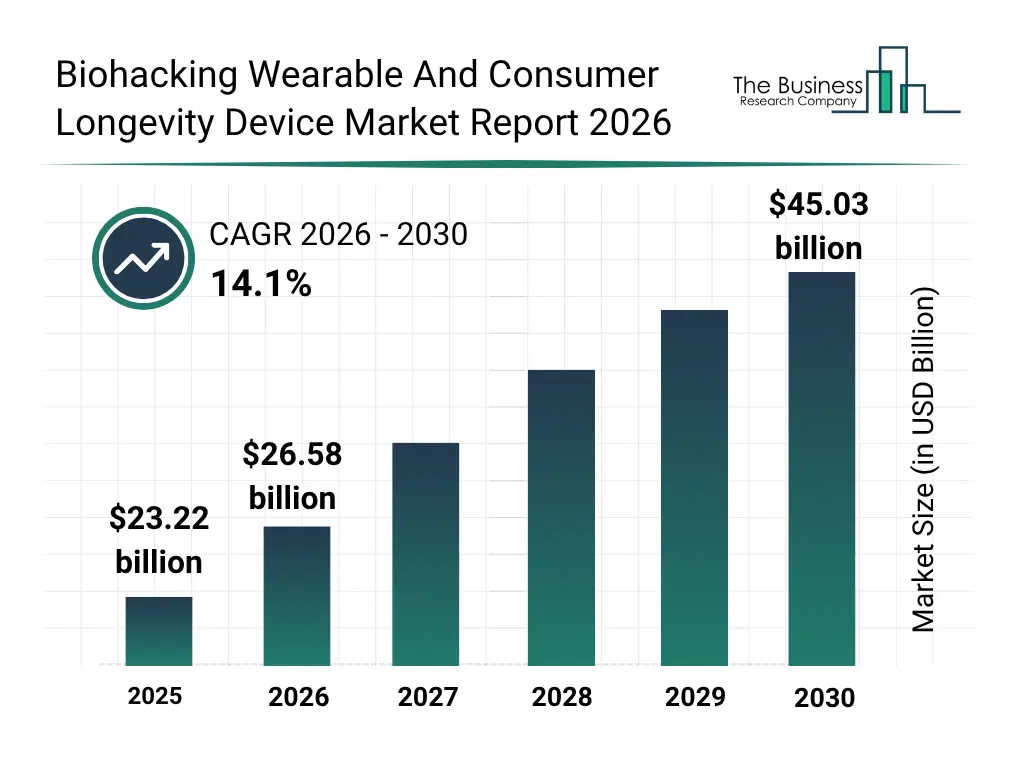
What Is The Biohacking Wearable And Consumer Longevity Device Market Size and Share 2026?
The biohacking wearable and consumer longevity device market size has grown rapidly in recent years. It will grow from $23.22 billion in 2025 to $26.58 billion in 2026 at a compound annual growth rate (CAGR) of 14.5%. The growth in the historic period can be attributed to basic fitness tracking adoption through early wearables, rising awareness of preventive healthcare practices, growth in smartphone-based health monitoring apps, increasing participation in fitness and wellness activities, development of first-generation heart rate and step tracking devices.What Is The Biohacking Wearable And Consumer Longevity Device Market Growth Forecast?
The biohacking wearable and consumer longevity device market size is expected to see rapid growth in the next few years. It will grow to $45.03 billion in 2030 at a compound annual growth rate (CAGR) of 14.1%. The growth in the forecast period can be attributed to rising demand for personalized longevity and anti-aging solutions, increasing integration of AI-driven predictive health insights, growth in remote patient monitoring and home-based healthcare adoption, expansion of biohacking and quantified self-movement globally, increasing focus on metabolic and cognitive performance optimization. Major trends in the forecast period include rising adoption of continuous biometric monitoring for real-time health optimization and preventive care, increasing demand for personalized longevity insights driven by AI-based health analytics platforms, growing integration of multi-sensor wearable ecosystems combining sleep, glucose, stress, and activity tracking, expansion of consumer interest in metabolic health optimization and biofeedback-driven lifestyle adjustments, increasing use of subscription-based biohacking platforms offering data-driven fitness and cognitive performance enhancement.
Global Biohacking Wearable And Consumer Longevity Device Market Segmentation
1) By Product Type: Smart Wearables; Wearable Biosensors; Smart Clothing; Neurostimulation Devices; Metabolic Monitoring Devices; Sleep And Recovery Devices; Portable Health Assessment Devices; Hormone And Fertility Tracking Devices; Respiration And Oxygen Monitoring Devices 2) By Price Range: Premium; Mid Range; Economy 3) By Distribution Channel: Direct-to-Consumer Online; Longevity Clinics; Specialty Wellness Retailers; Corporate Wellness Programs 4) By End User: Individual Consumers; Fitness Enthusiasts; Athletes And Sports Professionals; Healthcare And Wellness Centers; Research Organizations Subsegments: 1) By Smart Wearables: Smart Rings; Smart Watches; Fitness Bands; Smart Glasses; Smart Earwear; Smart Pendants 2) By Wearable Biosensors: Hydration Monitoring Sensors; Temperature Monitoring Sensors; Heart Rate Sensors; Sweat Analysis Sensors; Blood Oxygen Sensors 3) By Smart Clothing: Smart Shirts; Smart Socks; Smart Jackets; Smart Sportswear; Posture Monitoring Apparel; Compression Wear With Sensors 4) By Neurostimulation Devices: Transcranial Stimulation Devices; Vagus Nerve Stimulation Devices; Electrical Muscle Stimulation Devices; Cognitive Enhancement Devices; Stress Relief Stimulation Devices 5) By Metabolic Monitoring Devices: Calorie Expenditure Monitors; Nutrition Tracking Devices; Respiration Analysis Devices; Ketone Monitoring Devices; Metabolic Rate Analyzers 6) By Sleep And Recovery Devices: Sleep Tracking Devices; Recovery Monitoring Wearables; Fatigue Monitoring Devices; Snore Detection Devices; Circadian Rhythm Monitoring Devices; Stress Recovery Devices 7) By Portable Health Assessment Devices: Portable Heart Monitoring Devices; Portable Blood Pressure Monitors; Portable Oxygen Saturation Monitors; Portable Body Composition Analyzers; Portable Wellness Assessment Devices 8) By Hormone And Fertility Tracking Devices: Ovulation Tracking Devices; Hormone Monitoring Wearables; Fertility Prediction Devices; Menstrual Cycle Tracking Devices; Reproductive Wellness Monitors; Basal Temperature Tracking Devices 9) By Respiration And Oxygen Monitoring Devices: Breathing Pattern Monitoring Devices; Lung Function Monitoring Devices; Respiratory Rate Monitoring Devices; Altitude Oxygen Monitoring Devices; Sleep Respiration Monitoring DevicesWhat Is The Driver Of The Biohacking Wearable And Consumer Longevity Device Market?
The increasing prevalence of lifestyle disorders is expected to propel the growth of the biohacking wearable and consumer longevity device market going forward. Lifestyle disorders refer to health conditions primarily associated with unhealthy habits, including physical inactivity, poor dietary patterns, stress, inadequate sleep, and excessive consumption of harmful substances. The increasing prevalence of lifestyle disorders is due to sedentary lifestyles, as prolonged sitting, reduced physical activity, and increased screen time contribute to obesity, cardiovascular diseases, diabetes, and other chronic health conditions. Biohacking wearable and consumer longevity devices help manage lifestyle disorders by enabling continuous monitoring of vital health metrics, personalized wellness tracking, behavioral optimization, and early identification of potential health risks. For instance, in May 2025, according to the Office for Health Improvement and Disparities (OHID), a UK-based government public health organization, between 2023 and 2024, an estimated 64.5% of adults aged 18 years and older in England were classified as overweight or obese. Therefore, the increasing prevalence of lifestyle disorders is driving the growth of the biohacking wearable and consumer longevity device industry.Key Players In The Global Biohacking Wearable And Consumer Longevity Device Market
Major companies operating in the biohacking wearable and consumer longevity device market are Apple Inc.; Samsung Electronics Co. Ltd.; Huawei Technologies Co. Ltd.; Abbott Laboratories; ASUSTeK Computer Inc.; Garmin Ltd.; DexCom Inc.; Withings; Oura Health Oy; WHOOP Inc.; Polar Electro Oy; Levels Health Inc.; Muse (Interaxon Inc.); Ultrahuman Healthcare Private Limited; Apollo Neuroscience Inc.; RingConn; Empatica Inc.; COROS Wearables Inc.; Circular; Sensio (Sensio-AI); Biostrap USA LLC; Neurable Inc.Global Biohacking Wearable And Consumer Longevity Device Market Trends and Insights
Major companies operating in the biohacking wearable and consumer longevity device market are focusing on developing advanced solutions, such as fingertip biometric sensing smartwatches, to improve real-time health monitoring, biometric accuracy, and preventive wellness management. Fingertip biometric sensing smartwatches refer to wearable devices equipped with integrated fingertip sensors that measure physiological indicators such as blood pressure and electrocardiogram readings for continuous health assessment and wellness tracking. For instance, in June 2024, ASUS, a Taiwan-based consumer electronics company, launched the VivoWatch 6 smartwatch featuring fingertip-based blood pressure and electrocardiogram monitoring capabilities. The smartwatch also includes advanced health tracking functions such as heart rate monitoring, blood oxygen measurement, sleep tracking, and activity analysis to support personalized wellness management and preventive healthcare. Designed with lightweight construction and extended battery performance, the device aims to improve user convenience while delivering continuous biometric monitoring for health-conscious consumers.What Are Latest Mergers And Acquisitions In The Biohacking Wearable And Consumer Longevity Device Market?
In May 2023, Oura Health Ltd., a Finland-based wearable technology company, acquired Proxy Inc. for $165 million. Through this acquisition, Oura aims to strengthen its smart wearable ecosystem by integrating Proxy’s digital identity and secure contactless authentication technology into its health-focused wearable devices. Proxy Inc. is a US-based technology company that provides digital identification and contactless access solutions for mobile and wearable devices.Regional Outlook
North America was the largest region in the biohacking wearable and consumer longevity device market in 2025. Asia-Pacific is expected to be the fastest-growing region in the forecast period. The regions covered in this market report are Asia-Pacific, South East Asia, Western Europe, Eastern Europe, North America, South America, Middle East, Africa. The countries covered in this market report are Australia, Brazil, China, France, Germany, India, Indonesia, Japan, Taiwan, Russia, South Korea, UK, USA, Canada, Italy, Spain.What Defines the Biohacking Wearable And Consumer Longevity Device Market?
The biohacking wearable and consumer longevity device market consists of sales of metabolic analyzers, smart clothing with embedded sensors, portable genetic testing kits, wearable ECG monitors, and cognitive performance tracking devices. Values in this market are ‘factory gate’ values, that is the value of goods sold by the manufacturers or creators of the goods, whether to other entities (including downstream manufacturers, wholesalers, distributors and retailers) or directly to end customers. The value of goods in this market includes related services sold by the creators of the goods.How is Market Value Defined and Measured?
The market value is defined as the revenues that enterprises gain from the sale of goods and/or services within the specified market and geography through sales, grants, or donations in terms of the currency (in USD unless otherwise specified). The revenues for a specified geography are consumption values that are revenues generated by organizations in the specified geography within the market, irrespective of where they are produced. It does not include revenues from resales along the supply chain, either further along the supply chain or as part of other products.What Key Data and Analysis Are Included in the Biohacking Wearable And Consumer Longevity Device Market Report 2026?
The biohacking wearable and consumer longevity device market research report is one of a series of new reports from The Business Research Company that provides market statistics, including industry global market size, regional shares, competitors with the market share, detailed market segments, market trends and opportunities, and any further data you may need to thrive in the biohacking wearable and consumer longevity device industry. The market research report delivers a complete perspective of everything you need, with an in-depth analysis of the current and future state of the industry.Biohacking Wearable and Consumer Longevity Device Market Report Forecast Analysis
| Report Attribute | Details |
|---|---|
| Market Size Value In 2026 | $26.58 billion |
| Revenue Forecast In 2030 | $45.03 billion |
| Growth Rate | CAGR of 14.1% from 2026 to 2030 |
| Base Year For Estimation | 2025 |
| Actual Estimates/Historical Data | 2020-2025 |
| Forecast Period | 2026 - 2030 |
| Market Representation | Revenue in USD Billion and CAGR from 2026 to 2030 |
| Segments Covered | Product Type, Price Range, Distribution Channel, End User |
| Regional Scope | Asia-Pacific, Western Europe, Eastern Europe, North America, South America, Middle East, Africa |
| Country Scope | The countries covered in the report are Australia, Brazil, China, France, Germany, India, ... |
| Key Companies Profiled | Apple Inc.; Samsung Electronics Co. Ltd.; Huawei Technologies Co. Ltd.; Abbott Laboratories; ASUSTeK Computer Inc.; Garmin Ltd.; DexCom Inc.; Withings; Oura Health Oy; WHOOP Inc.; Polar Electro Oy; Levels Health Inc.; Muse (Interaxon Inc.); Ultrahuman Healthcare Private Limited; Apollo Neuroscience Inc.; RingConn; Empatica Inc.; COROS Wearables Inc.; Circular; Sensio (Sensio-AI); Biostrap USA LLC; Neurable Inc. |
| Customization Scope | Request for Customization |
| Pricing And Purchase Options | Explore Purchase Options |