
Biological Computing Market Report 2026
Global Outlook – By Component (Hardware And Devices, Consumables, Software, Services), By Technology (Deoxyribonucleic Acid (DNA)-Based Computing, Cell-Based Computing, Protein-Based Computing, Molecular Or Biochemical Computing), By Deployment (Biocomputing-As-A-Service (BaaS), On-Premise Wet Kits), By Application (Data Storage And Archiving, Drug Discovery And Bioinformatics, Biosensing And Diagnostics, Complex Optimization), By End-User (Pharmaceuticals And Biotechnology, Academic And Research Institutes, Information Technology And Data Storage Providers, Healthcare And Diagnostics, Environmental And Industrial Applications) – Market Size, Trends, Strategies, and Forecast to 2030
Biological Computing Market Overview
• Biological Computing market size has reached to $2.21 billion in 2025 • Expected to grow to $2.9 billion in 2030 at a compound annual growth rate (CAGR) of 31.4% • Growth Driver: Increasing Adoption Of Synthetic Biology Technologies Driving Market Growth Due To Advancements In Genetic Engineering And Biotechnology • Market Trend: Advancements In Cloud-Based Biocomputing Platforms Enabling Remote Neural Experimentation • North America was the largest region in 2025 and Asia-Pacific is the fastest growing region.What Is Covered Under Biological Computing Market?
Biological computing is a computational paradigm that uses biological materials such as deoxyribonucleic acid (DNA), proteins, and living cells to perform data processing, storage, and problem-solving functions. It enables computation by leveraging biochemical reactions and molecular interactions instead of traditional silicon-based electronic systems, offering high parallelism and energy-efficient processing capabilities. The main component types of biological computing include hardware and devices, consumables, software and services. Hardware refers to physical components such as bio-compatible sensors, processing units, and lab-on-chip devices that enable the capture, processing, and execution of biological computations. The deployment modes include biocomputing-as-a-service (BaaS) and on-premise wet kits, with key applications spanning data storage and archiving, drug discovery and bioinformatics, biosensing and diagnostics, and complex optimization, while the primary end users comprise pharmaceuticals and biotechnology companies, academic and research institutes, information technology and data storage providers, healthcare and diagnostics organizations, as well as environmental and industrial sectors.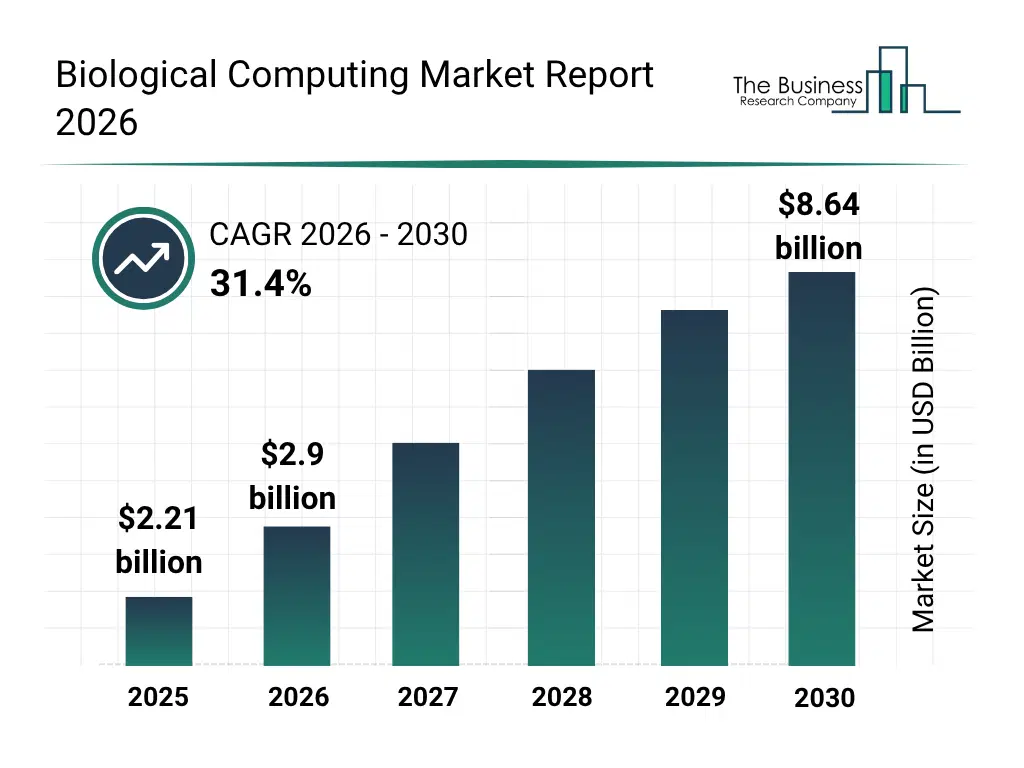
What Is The Biological Computing Market Size and Share 2026?
The biological computing market size has grown exponentially in recent years. It will grow from $2.21 billion in 2025 to $2.9 billion in 2026 at a compound annual growth rate (CAGR) of 31.2%. The growth in the historic period can be attributed to advancements in dna sequencing technologies, growth in genomics research funding, development of synthetic biology techniques, increasing demand for high performance computing alternatives, expansion of bioinformatics research ecosystems.What Is The Biological Computing Market Growth Forecast?
The biological computing market size is expected to see exponential growth in the next few years. It will grow to $8.64 billion by 2030 at a compound annual growth rate (CAGR) of 31.4%. The growth in the forecast period can be attributed to rising demand for ultra energy efficient computing systems, increasing adoption of personalized medicine applications, breakthroughs in dna data storage technologies, expansion of hybrid biological-digital computing models, growing investments in biotech computing startups. Major trends in the forecast period include dna-based computational architecture scaling, synthetic biology driven computing systems, bio-integrated hybrid computing platforms, molecular data storage and retrieval systems, laboratory automation for biocomputing workflows.
Global Biological Computing Market Segmentation
1) By Component: Hardware And Devices, Consumables, Software, Services 2) By Technology: Deoxyribonucleic Acid (DNA)-Based Computing, Cell-Based Computing, Protein-Based Computing, Molecular Or Biochemical Computing 3) By Deployment: Biocomputing-As-A-Service (BaaS), On-Premise Wet Kits 4) By Application: Data Storage And Archiving, Drug Discovery And Bioinformatics, Biosensing And Diagnostics, Complex Optimization 5) By End-User: Pharmaceuticals And Biotechnology, Academic And Research Institutes, Information Technology And Data Storage Providers, Healthcare And Diagnostics, Environmental And Industrial Applications Subsegments: 1) By Hardware And Devices: Biological Computing Hardware Platforms, Biosensors, Microfluidic Chips, Deoxyribonucleic Acid Sequencers, Laboratory Automation Systems, Biological Processing Units 2) By Consumables: Reagents, Enzymes, Nucleotides, Biological Samples, Assay Kits, Cell Culture Media 3) By Software: Bioinformatics Software, Computational Biology Platforms, Molecular Modeling Software, Biological Data Analysis Software, Workflow Management Software, Simulation And Modeling Software 4) By Services: Contract Research Services, Deoxyribonucleic Acid Sequencing Services, Biological Data Analysis Services, Cloud Based Computing Services, Biotechnology Consulting Services, Laboratory Outsourcing ServicesWhat Is The Driver Of The Biological Computing Market?
The growing adoption of synthetic biology technologies is expected to propel the growth of the biological computing market going forward. Synthetic biology technologies refer to the set of engineering and biotechnology tools and methods used to design or construct biological systems for creating or modifying genetic code. The rise of synthetic biology technologies is due to people advancing genetic engineering and biotechnology to design and modify living organisms for useful applications in medicine. Biological computing help synthetic biology technologies by allowing living cells to be engineered to process information and perform logical operations by enabling precise control of biological functions. For instance, the GenBank, a US-based public genetic sequence repository maintained by the National Centre for Biotechnology Information, reported that the database contained approximately 25 trillion base pairs and about 3.7 billion sequences in 2024, compared with around 34 trillion base pairs and 4.7 billion sequences in 2025, reflecting substantial year-over-year growth in global genomic data accumulation and sequencing output. Therefore, the growing adoption of synthetic biology technologies is driving the growth of biological computing industry.Key Players In The Global Biological Computing Market
Major companies operating in the biological computing market are Thermo Fisher Scientific Inc.; Illumina Inc.; Ginkgo Bioworks Inc.; Twist Bioscience Corporation; Oxford Nanopore Technologies plc; Synthego Corporation; Touchlight Genetics Ltd.; Arzeda Corporation; Asimov Inc.; LabGenius Ltd.; ProteinQure Inc.; Molecular Assemblies Inc.; Catalog Technologies Inc.; Iridia Inc.; Helixworks Technologies Ltd.; FinalSpark AG; Cortical Labs Pty Ltd.; Biomemory SA; DNAli Data Technologies Inc.; Atlas Data Storage Inc.
This chart is for illustrative purposes; the full report includes a detailed competitor analysis and comprehensive overview of the top 10 companies in the market.
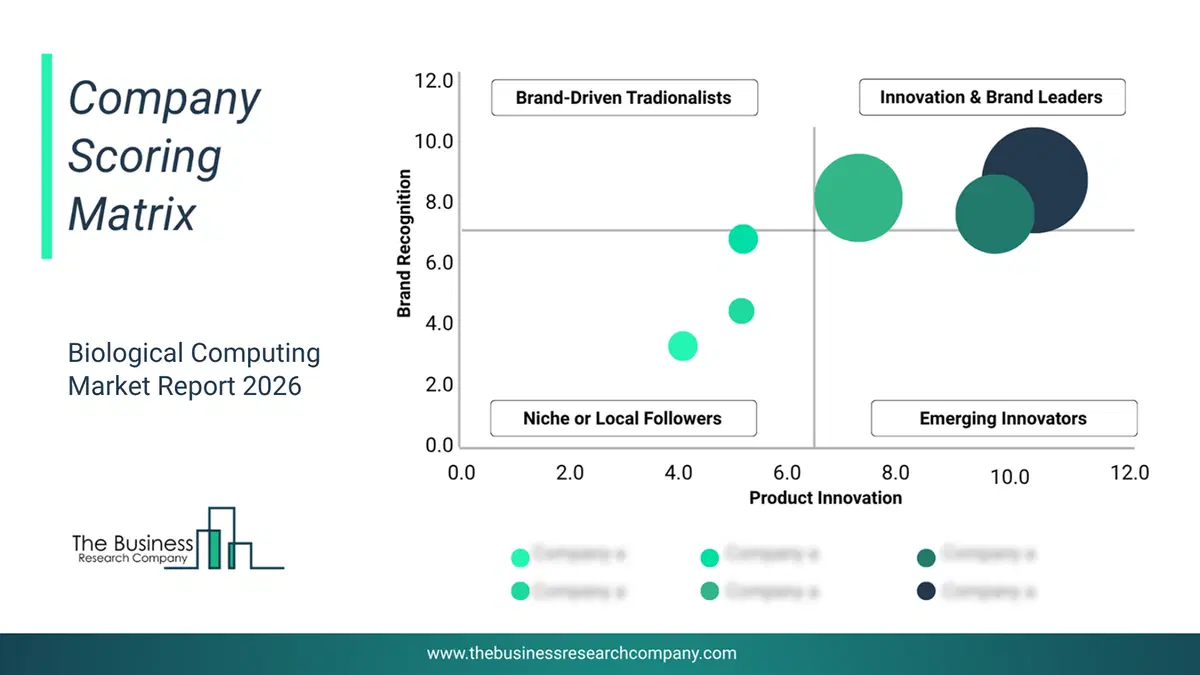
This chart maps companies by product innovation and brand strength, with bubble size indicating relative revenue, helping identify market leaders, challengers, and niche players. This is an illustrative chart; the full report provides a complete and accurate competitive analysis.
Global Biological Computing Market Trends and Insights
Major companies operating in the biological computing market are increasingly focusing on developing innovative solutions, such as biocomputing online research platforms, to enable remote experimentation on living neural systems, accelerate brain-inspired computing research, and enhance the development of energy-efficient, adaptive computing technologies. Biocomputing online research platforms are cloud-based systems that allow researchers to remotely access and experiment on biological components, such as living neurons, to study and develop brain-inspired computing technologies. For instance, in May 2024, FinalSpark SA, a Switzerland-based biotechnology research company, launches the Neuroplatform, the first remote research platform for biocomputing using human brain organoids by enabling scientists to access living neuron-based systems over the cloud, apply real-time electrical stimulation and record electrophysiological responses through multi-electrode arrays for continuous experimentation in organoid-based neural computation. Additionally, it also offers researchers a cloud-based interface for remote experiment control, real-time electrophysiological monitoring and data acquisition from living neuronal networks and long-duration biological system maintenance enabling continuous experimentation on human brain organoids under controlled laboratory conditions.What Are Latest Mergers And Acquisitions In The Biological Computing Market?
In November 2023, VERSES Technologies Inc, a Canada-based artificial intelligence company specializing in cognitive computing and adaptive intelligence systems, entered a beta partnership with Cortical Labs Pty Ltd to research and evaluate living neuronal networks. Through this collaboration, VERSES Technologies aims to explore and develop novel approaches to biological computing by integrating its artificial intelligence frameworks with living neural networks grown in laboratory conditions by enabling experiments in hybrid intelligence systems that combine silicon-based computation with biological neurons. Cortical Labs Pty Ltd is an Australia-based neurotechnology company specializing in biological computing systems using cultured neurons and hybrid neural-silicon platforms.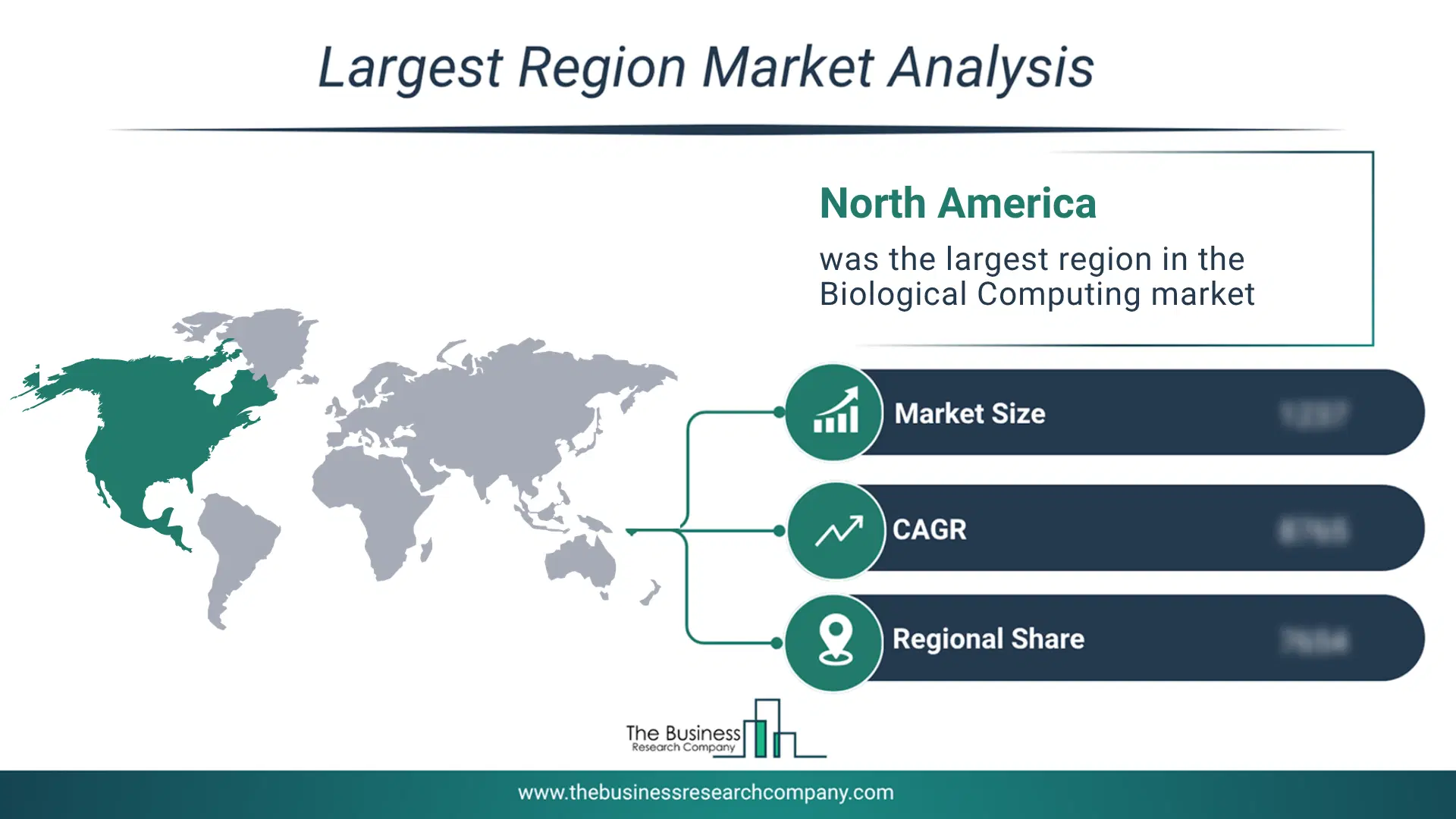
Regional Insights
North America was the largest region in the biological computing market in 2025. Asia-Pacific is expected to be the fastest-growing region in the forecast period. The regions covered in this market report are Asia-Pacific, South East Asia, Western Europe, Eastern Europe, North America, South America, Middle East, Africa. The countries covered in this market report are Australia, Brazil, China, France, Germany, India, Indonesia, Japan, Taiwan, Russia, South Korea, UK, USA, Canada, Italy, Spain.What Defines the Biological Computing Market?
The biological computing market consists of revenues earned by entities by providing services such as bio-computational system design, synthetic biology-based computing solutions, biochip development, molecular data storage solutions, and system integration for hybrid biological-digital platforms. The market value includes the value of related goods sold by the service provider or included within the service offering. The biological computing market also includes sales of DNA synthesis tools, biochips, laboratory automation systems, microfluidic devices, sequencing platforms, and molecular computing kits. Values in this market are ‘factory gate’ values, that is, the value of goods sold by the manufacturers or creators of the goods, whether to other entities (including downstream manufacturers, wholesalers, distributors, and retailers) or directly to end customers. The value of goods in this market includes related services sold by the creators of the goods.How is Market Value Defined and Measured?
The market value is defined as the revenues that enterprises gain from the sale of goods and/or services within the specified market and geography through sales, grants, or donations in terms of the currency (in USD unless otherwise specified). The revenues for a specified geography are consumption values that are revenues generated by organizations in the specified geography within the market, irrespective of where they are produced. It does not include revenues from resales along the supply chain, either further along the supply chain or as part of other products.
This chart presents market attractiveness based on a quantitative evaluation of growth, competition, strategic alignment, and risk, offering a clear view of opportunity areas for decision-making. This chart is for illustrative purposes; the full report contains the complete analysis.

This chart highlights the Total Addressable Market (TAM) by estimating the maximum revenue opportunity using an assumption-driven approach, supporting strategic planning and opportunity sizing across markets. The chart is illustrative; the full report provides a more comprehensive analysis.
What Key Data and Analysis Are Included in the Biological Computing Market Report 2026?
The biological computing market research report is one of a series of new reports from The Business Research Company that provides market statistics, including industry global market size, regional shares, competitors with the market share, detailed market segments, market trends and opportunities, and any further data you may need to thrive in the biological computing industry. The market research report delivers a complete perspective of everything you need, with an in-depth analysis of the current and future state of the industry.Biological Computing Market Report Forecast Analysis
| Report Attribute | Details |
|---|---|
| Market Size Value In 2026 | $2.9 billion |
| Revenue Forecast In 2030 | $8.64 billion |
| Growth Rate | CAGR of 31.4% from 2026 to 2030 |
| Base Year For Estimation | 2025 |
| Actual Estimates/Historical Data | 2020-2025 |
| Forecast Period | 2026 - 2030 |
| Market Representation | Revenue in USD Billion and CAGR from 2026 to 2030 |
| Segments Covered | Component, Technology, Deployment, Application, End-User |
| Regional Scope | Asia-Pacific, Western Europe, Eastern Europe, North America, South America, Middle East, Africa |
| Country Scope | The Countries Covered In This Market Report Are Australia, Brazil, China, France, Germany, India, Indonesia, Japan, Taiwan, Russia, South Korea, Uk, Usa, Canada, Italy, Spain. |
| Key Companies Profiled | Thermo Fisher Scientific Inc., Illumina Inc., Ginkgo Bioworks Inc., Twist Bioscience Corporation, Oxford Nanopore Technologies plc, Synthego Corporation, Touchlight Genetics Ltd., Arzeda Corporation, Asimov Inc., LabGenius Ltd., ProteinQure Inc., Molecular Assemblies Inc., Catalog Technologies Inc., Iridia Inc., Helixworks Technologies Ltd., FinalSpark AG, Cortical Labs Pty Ltd., Biomemory SA, DNAli Data Technologies Inc., Atlas Data Storage Inc. |
| Customization Scope | Request for Customization |
| Pricing And Purchase Options | Explore Purchase Options |