
Biological Crop Protection Market 2026
By Product Type (Microbial Pesticides, Plant-Incorporated Protectants, Biochemical Pesticides), By Crop Type (Grains, Oilseeds And Pulses, Fruits And Vegetables, Other Crop Types), By Formulation (Liquid, Dry), By Application (Foliar Spray, Seed Treatment, Soil Treatment, Post-Harvest), And By Region, Opportunities And Strategies – Global Forecast To 2035
Biological Crop Protection Market Definition
Biological crop protection refers to the use of natural organisms, substances, or biological processes to protect plants against pests, diseases, and weeds. It includes biopesticides, beneficial insects, microorganisms (such as bacteria, fungi, and viruses), and plant extracts that work by enhancing plant resistance or directly targeting harmful organisms in an eco-friendly way. The primary purpose of biological crop protection is to promote sustainable and environmentally safe agriculture by reducing reliance on synthetic chemical pesticides. The biological crop protection market consists of sales by entities (organizations, sole traders and partnerships) of biological crop protection products that are applied across a wide range of crops including fruits, vegetables, cereals, and specialty crops primarily by growers, agribusinesses, and organic producers seeking alternatives to conventional chemical pesticides, particularly in regions with stringent regulatory environments or resistance concerns.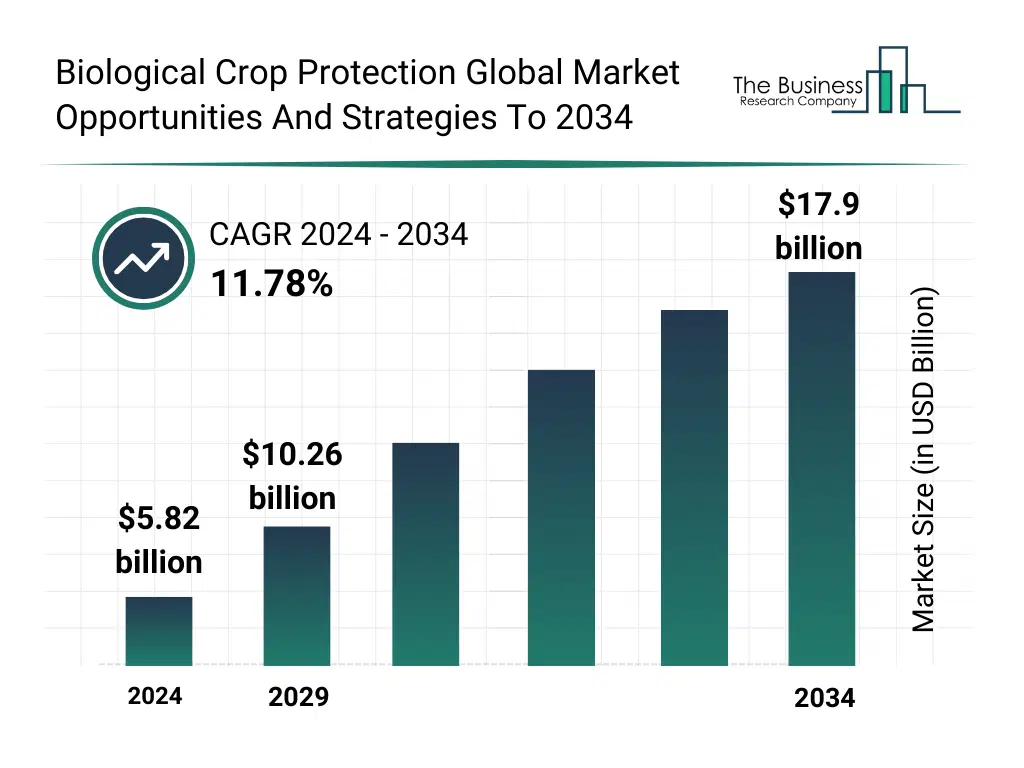
Biological Crop Protection Market Size
The global biological crop protection market reached a value of nearly $5,821.07 million in 2024, having grown at a compound annual growth rate (CAGR) of 8.75% since 2019. The market is expected to grow from $5,821.07 million in 2024 to $10,256.47 million in 2029 at a rate of 12.00%. The market is then expected to grow at a CAGR of 11.78% from 2029 and reach $17,895.04 million in 2034. Growth in the historic period resulted from increasing food security concerns, increasing regulatory restrictions on synthetic pesticides, expansion in horticulture crops and increased incidence of pest and disease outbreaks. Factors that negatively affected growth in the historic period was high production and development costs and competition from conventional synthetic pesticides. Going forward, growing consumer demand for organic and sustainable food, governmental support and subsidies for improved crop yields, rising awareness of sustainable farming practices and increasing demand for resilient and climate-adaptive biological solutions will drive the growth. Factor that could hinder the growth of the biological crop protection market in the future include short shelf life and strict storage requirements, limited farmer awareness and confidence and impact of trade war and tariffs.Biological Crop Protection Market Drivers
The key drivers of the biological crop protection market include: Growing Consumer Demand For Organic And Sustainable Food During the forecast period, the growing consumer demand for organic and sustainable food will significantly propel the growth of the biological crop protection market. Organic and sustainable food refers to products grown and produced using environmentally friendly methods that avoid synthetic chemicals, promote biodiversity, and support long-term ecological and human health. Consumer demand for organic and sustainable food is rising as more people seek healthier diets free from synthetic pesticides and chemical residues. Biological crop protection uses naturally derived solutions such as beneficial microbes, plant extracts, and pheromones to manage pests and diseases in a safe and eco-friendly way, reducing dependence on synthetic chemicals. This approach supports organic and sustainable food production by maintaining soil fertility, protecting biodiversity, minimizing chemical residues, and promoting healthier, more environmentally responsible farming practices. The growing consumer demand for organic and sustainable food growth during the forecast period in 2024 is 2.00%.Biological Crop Protection Market Restraints
The key restraints on the biological crop protection market include: Short Shelf Life And Strict Storage Requirements During the forecast period, the short shelf life and strict storage requirements will restrain the growth of the biological crop protection market. Short shelf life and strict storage requirements refers to the limited duration a product remains effective and the need for precise storage conditions to maintain its quality and safety. Short shelf life and strict storage requirements hindered the growth of the biological crop protection as these products lose effectiveness quickly and require precise storage conditions, making distribution, handling, and on-farm application more challenging for farmers. This increases operational costs and limits widespread adoption, especially in regions with inadequate cold chain or storage infrastructure. Growth affected by short shelf life and strict storage requirements during the forecast period in 2024 is -2.00%.Biological Crop Protection Market Trends
Major trends shaping the biological crop protection market include: Strategic Collaborations And Partnership Driving Sustainable Biological Crop Protection Major companies in the biological crop protection market are increasingly focusing on introducing innovative solutions through strategic collaborations to boost crop yield, enhance disease resistance, and support sustainable agricultural practices. Strategic collaborations involve partnerships that leverage combined expertise, resources, and technology to develop advanced solutions and expand market presence. For example, in July 2025, Bayer AG, a Germany-based pharmaceutical and biotechnology company, strengthened its partnership with M2i Group, a France-based biotechnology firm, to distribute M2i’s pheromone-based biological crop protection solutions worldwide. This collaboration aligns with Bayer’s commitment to sustainable farming by offering farmers effective, low-residue pest management options for crops such as grapes, tomatoes, and various fruits. M2i’s patented Press technology delivers long-lasting pheromone gels through reusable, pressurized dispensers, supporting eco-friendly pest control with minimal chemical residues and reduced plastic waste. Furthermore, Bayer integrates these pheromone solutions into its digital pest management systems to optimize application timing and effectiveness, strengthening its biologics portfolio and open innovation strategy. Additionally, in February 2024, Syngenta Crop Protection, a Switzerland-based agricultural technology company, and Israel’s Lavie Bio Ltd., a firm focused on enhancing food quality and agricultural sustainability, announced a strategic partnership to develop novel biological insecticidal solutions. The collaboration leverages Lavie Bio’s advanced computational platform, which accelerates the discovery and optimization of bio-insecticide candidates, alongside Syngenta’s global expertise in research, development, and commercialization. Insects threaten global crop health by causing direct damage and spreading diseases, resulting in estimated annual losses of $70 billion—a problem worsened by climate change and growing resistance to existing insecticides. By combining AI-driven discovery capabilities with sustainable agriculture innovation, the partnership seeks to introduce new modes of action in insect control. Innovative Biofungicide Solutions Boost Crop Health And Yield Companies in the biological crop protection market are prioritizing the development of innovative solutions, such as biofungicide crop protection solutions, to enhance crop yield, improve disease resistance, and promote sustainable farming practices. Biofungicide crop protection solutions are biological products that use beneficial microorganisms to control fungal diseases and promote healthy crop growth. For instance, in January 2024, Certis Biologicals, a US-based biotechnology company, launched Convergence Biofungicide, a powerful, EPA-approved biological crop protection product designed for corn, soybeans, and peanuts. It combines superior disease control and plant health benefits in one convenient solution. The biofungicide uses Bacillus amyloliquefaciens strain D747 to form a living protective shield around roots, combating soilborne diseases like Pythium, Rhizoctonia, Fusarium, and Phytophthora, as well as foliar diseases such as tar spot, rusts, and leaf spots. It can be applied in-furrow or foliar, tank-mixed with most synthetic products, and supports sustainability by preserving beneficial insects and soil health. Field trials show it enhances crop yields and provides flexible application options for farmers managing disease resistance and improving plant health.Opportunities And Recommendations In The Biological Crop Protection Market
Opportunities – The top opportunities in the biological crop protection market segmented by product type will arise in the microbial pesticides segment, which will gain $2,766.81 million of global annual sales by 2029. The top opportunities in the biological crop protection market segmented by crop type will arise in the fruits and vegetables segment, which will gain $2,079.44 million of global annual sales by 2029. The top opportunities in the biological crop protection market segmented by formulation will arise in the liquid segment, which will gain $3,082.93 million of global annual sales by 2029. The top opportunities in the biological crop protection market segmented by application will arise in the foliar spray segment, which will gain $2,508.81 million of global annual sales by 2029. The biological crop protection market size will gain the most in the USA at $1,011.34 million. Recommendations- To take advantage of the opportunities, The Business Research Company recommends the biological crop protection companies to focus on developing advanced biofungicide portfolios, focus on expanding eco-friendly biopesticide solutions for thrips control, focus on advancing biofungicide innovation for sustainable disease control, focus on expanding biochemical pesticide portfolios for resilient crop systems, focus on advancing microbial inoculant solutions for crop productivity, focus on building integrated biological crop protection platforms, focus on scaling microbial pesticide solutions for faster market growth, focus on expanding biological solutions in fruits and vegetables, expand in emerging markets, continue to focus on developed markets, focus on strategic collaborations to scale biologics, provide competitively priced offerings, continue to use B2B promotions, participate in trade shows and events and focus on the high-growth foliar spray segment.
Biological Crop Protection Market Segmentation
The biological crop protection market is segmented by product type, by crop type, by formulation and by application.By Product Type –
The biological crop protection market is segmented by product type into:
- a) Microbial Pesticides
- b) Plant-Incorporated Protectants
- c) Biochemical Pesticides
By Crop Type –
The biological crop protection market is segmented by crop type into:
- a) Cereals And Grains
- b) Oilseeds And Pulses
- c) Fruits And Vegetables
- d) Other Crop Types
By Formulation –
The biological crop protection market is segmented by formulation into:
- a) Liquid
- b) Dry
By Application –
The biological crop protection market is segmented by Application into:
- a) Foliar Spray
- b) Seed Treatment
- c) Soil Treatment
- d) Post-Harvest
By Geography - The biological crop protection market is segmented by geography into:
- • China
- • India
- • Japan
- • Australia
- • Indonesia
- • South Korea
- • USA
- • Canada
- • Panama
- • Guatemala
- • Brazil
- • France
- • Germany
- • UK
- • Italy
- • Spain
- • Russia
-
o Asia Pacific
o Africa