
Biological Data Visualization Market Report 2026
Global Outlook – By Technique (Microscopy, Magnetic Resonance Imaging, Sequencing, X-Ray Crystallography, Other Techniques), By Platform (Windows, Mac Operating System, Linux, Other Platforms), By Application (Cell And Organism Imaging, Structural Biology And Molecular Modeling, Genomic Analysis, Alignments, Phylogeny, And Evolution, Systems Biology), By End Use (Academic Research, Pharmaceutical And Biological Centers, Hospitals And Clinics, Other End Uses) – Market Size, Trends, Strategies, and Forecast to 2030
Biological Data Visualization Market Overview
• Biological Data Visualization market size has reached to $0.81 billion in 2025 • Expected to grow to $1.54 billion in 2030 at a compound annual growth rate (CAGR) of 13.5% • Growth Driver: Personalized Medicine Driving Biological Data Visualization Market Growth • Market Trend: Technological Advancements In Data Visualization Methods for Enhanced Single-Cell Analysis • North America was the largest region in 2025 and Asia-Pacific is the fastest growing region.What Is Covered Under Biological Data Visualization Market?
Biological data visualization refers to the graphical representation of complex biological data to facilitate understanding, interpretation, and communication of biological phenomena and relationships. This field combines biology, computer science, and graphic design principles to create visual tools that help researchers, clinicians, and educators analyze and comprehend large datasets generated from various biological studies. The main techniques of biological data visualization are microscopy, magnetic resonance imaging, sequencing, X-ray crystallography, and others. Microscopy is the technique of using microscopes to visualize objects that are too small to be seen with the naked eye. It includes platforms such as Windows, Mac operating system, Linux, and others, for application in cell and organism imaging, structural biology and molecular modeling, genomic analysis, alignments, phylogeny, and evolution, and systems biology. It is used for end-use in academic research, pharmaceutical and biological centers, hospitals and clinics, and others.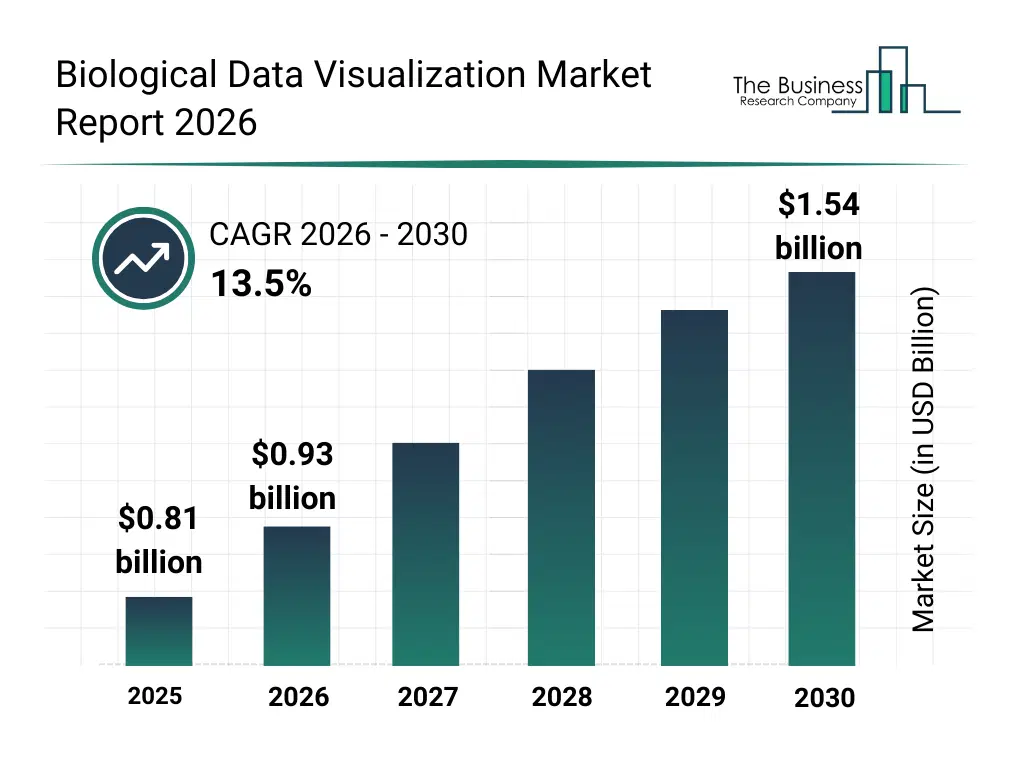
What Is The Biological Data Visualization Market Size and Share 2026?
The biological data visualization market size has grown rapidly in recent years. It will grow from $0.81 billion in 2025 to $0.93 billion in 2026 at a compound annual growth rate (CAGR) of 15.2%. The growth in the historic period can be attributed to growth in biological data generation, expansion of genomic and proteomic research, rising use of imaging technologies, increasing adoption of computational biology tools, availability of advanced research datasets.What Is The Biological Data Visualization Market Growth Forecast?
The biological data visualization market size is expected to see rapid growth in the next few years. It will grow to $1.54 billion in 2030 at a compound annual growth rate (CAGR) of 13.5%. The growth in the forecast period can be attributed to increasing investments in precision medicine research, rising demand for advanced visualization in drug discovery, expansion of multi-omics analysis, growing integration of visualization with AI analytics, increasing collaboration across digital research platforms. Major trends in the forecast period include increasing adoption of interactive biological visualization tools, rising use of multi-dimensional data representation, growing integration of AI-assisted data interpretation, expansion of cloud-based visualization platforms, enhanced focus on user-friendly scientific interfaces.
Global Biological Data Visualization Market Segmentation
1) By Technique: Microscopy, Magnetic Resonance Imaging, Sequencing, X-Ray Crystallography, Other Techniques 2) By Platform: Windows, Mac Operating System, Linux, Other Platforms 3) By Application: Cell And Organism Imaging, Structural Biology And Molecular Modeling, Genomic Analysis, Alignments, Phylogeny, And Evolution, Systems Biology 4) By End Use: Academic Research, Pharmaceutical And Biological Centers, Hospitals And Clinics, Other End Uses Subsegments: 1) By Microscopy: Fluorescence Microscopy, Electron Microscopy, Confocal Microscopy 2) By Magnetic Resonance Imaging (Mri): Functional Mri (Fmri), Structural Mri, Diffusion Tensor Imaging (DTI) 3) By Sequencing: Next-Generation Sequencing (Ngs), Sanger Sequencing 4) By X-ray Crystallography: Protein Crystallography, Dna Or Rna Crystallography 5) By Other Techniques: Mass Spectrometry Imaging, Cryo-Electron Microscopy (Cryo-Em), Surface Plasmon Resonance (SPR)What Is The Driver Of The Biological Data Visualization Market?
The rising demand for personalized medicine is expected to propel the growth of the biological data visualization market going forward. Personalized medicine refers to tailoring medical treatment and healthcare interventions to individual patients based on their unique characteristics, including genetic makeup, lifestyle, and preferences. The demand for personalized medicine is due to advancements in genomics, increasing patient empowerment, and the growing recognition of the importance of individualized treatment approaches. Biological data visualization aids in personalized medicine by visually representing patient-specific genetic, molecular, and clinical data to inform tailored treatment strategies. For instance, in February 2024, according to the Personalized Medicine Coalition, a US-based non-profit organization, in 2023, FDA approved 16 new personalized treatments for rare disease patients, up from six in 2022. The newly approved personalized treatments for 2023 also include seven cancer drugs and three for other diseases and conditions. Therefore, the rising demand for personalized medicine is driving the growth of the biological data visualization industry.Key Players In The Global Biological Data Visualization Market
Major companies operating in the biological data visualization market are Thermo Fisher Scientific Inc., Danaher Corporation, Becton Dickinson and Company (BD), GE HealthCare Technologies Inc., Agilent Technologies Inc., PerkinElmer Inc., Illumina Inc., Sartorius AG, Nikon Corporation, Waters Corporation, Bio-Rad Laboratories Inc., Bruker Corporation, Carl Zeiss Meditec AG, QIAGEN N.V., Bio-Techne Corporation, Leica Microsystems, Promega Corporation, 10x Genomic Inc., Luminex Corporation, Abcam plc, Oxford Nanopore Technologies Ltd., Cell Signaling Technology Inc., Pacific Biosciences of California Inc., NanoString Technologies Inc., Fluidigm Corporation
This chart is for illustrative purposes; the full report includes a detailed competitor analysis and comprehensive overview of the top 10 companies in the market.
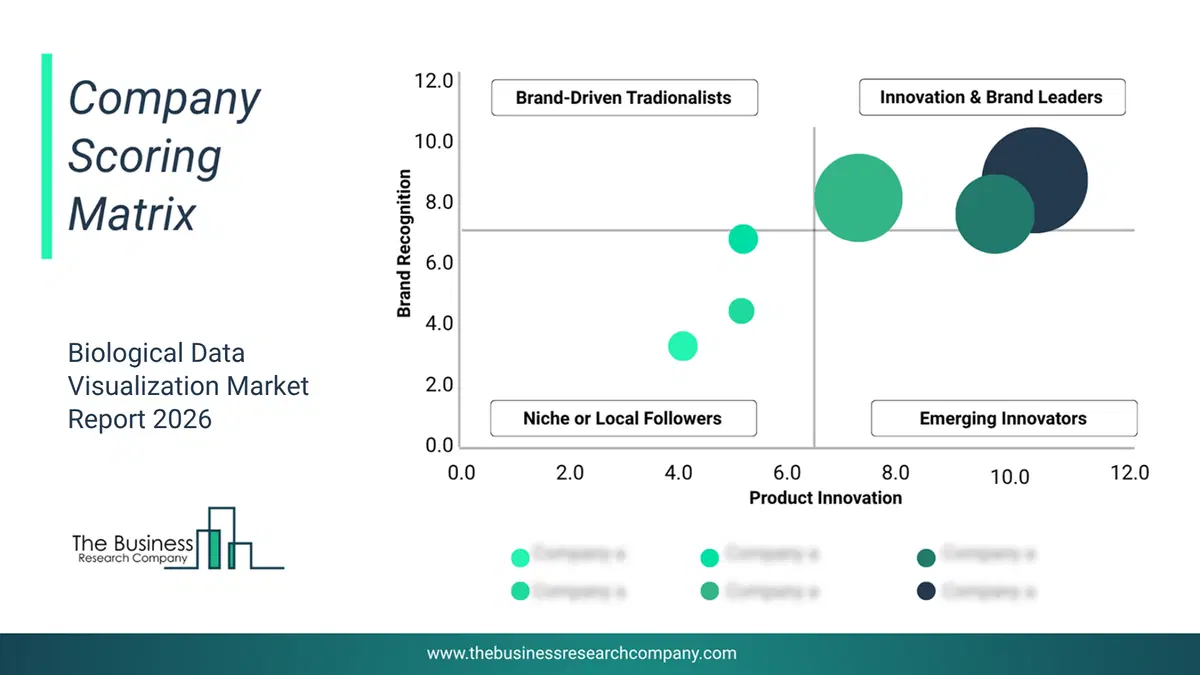
This chart maps companies by product innovation and brand strength, with bubble size indicating relative revenue, helping identify market leaders, challengers, and niche players. This is an illustrative chart; the full report provides a complete and accurate competitive analysis.
Global Biological Data Visualization Market Trends and Insights
Major companies operating in the biological data visualization market are focusing on developing advanced solutions, such as AI-powered single-cell analysis systems, to address limitations in existing tools and gain a competitive edge in the market. An AI-powered single-cell analysis system is an advanced technology that integrates artificial intelligence (AI) and machine learning (ML) with single-cell sequencing and analysis techniques. This system is designed to analyze data from individual cells at a high resolution, providing insights into cellular heterogeneity, gene expression, and cellular interactions within complex biological systems. For instance, in May 2023, Deepcell, a US-based biotechnology company, launched the REM-I Platform, an AI-powered single-cell analysis system designed to revolutionize biological research by offering scalable single-cell imaging, high-dimensional analysis, and cell sorting capabilities. This platform provides unique features, such as the ability to classify and sort cells based on morphological and phenotypic data without labeling and real-time, high-resolution visualization of cellular heterogeneity. This is expected to accelerate cell biology discovery and catalyze the field of morpholomics, offering researchers a powerful tool for unlocking the mysteries of individual cells.What Are Latest Mergers And Acquisitions In The Biological Data Visualization Market?
In April 2023, Excelra Knowledge Solutions Private Limited, a India-based, global bioinformatics company, acquired BISC Global for an undisclosed amount. With this acquisition, Excelra aims to strengthen its international presence, expand its bioinformatics platform and service offerings, enhance data-driven drug discovery capabilities, and provide comprehensive solutions to life sciences clients worldwide. BISC Global is a Belgium-based, an international bioinformatics services company that offers biological data visualization.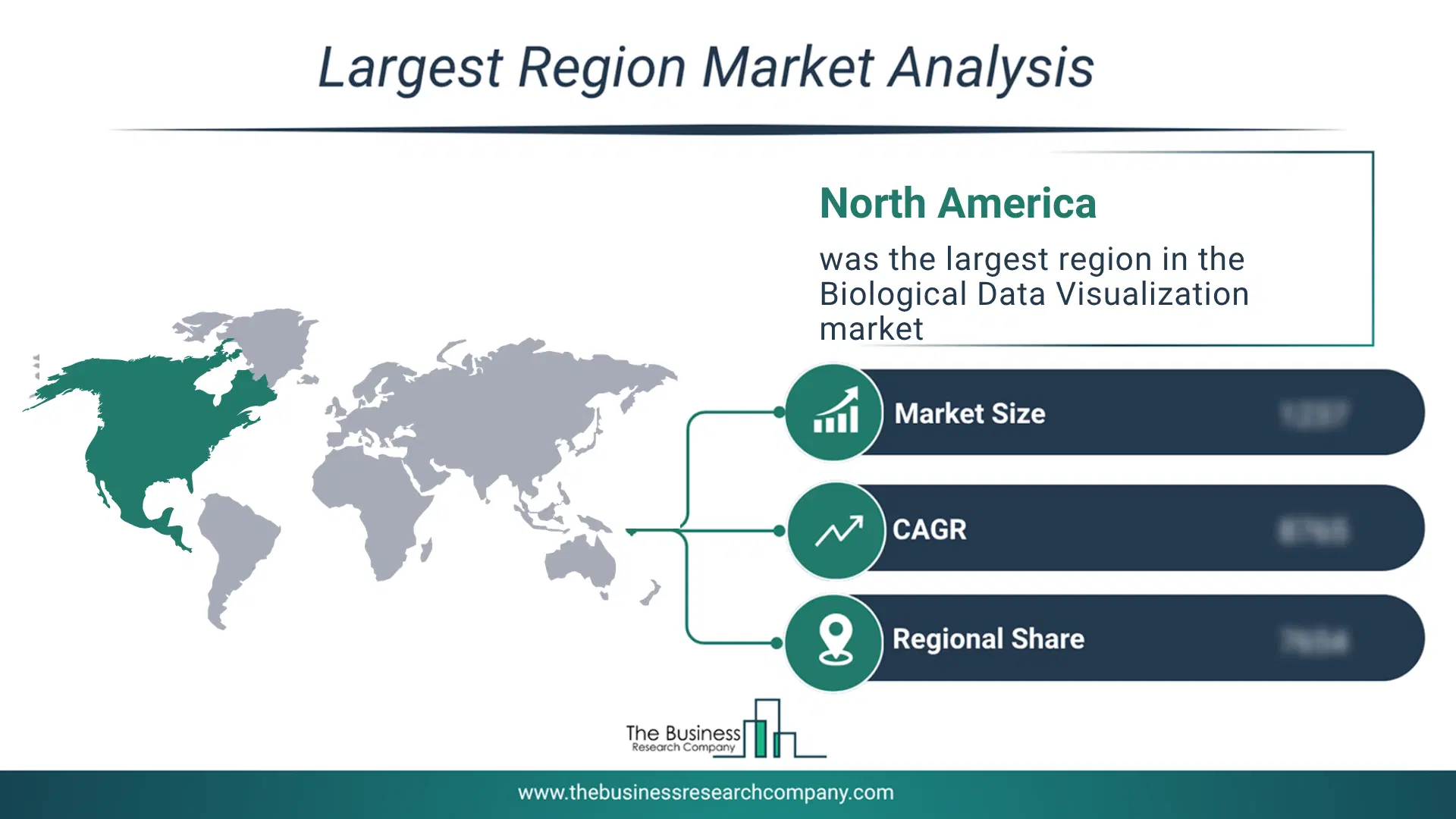
Regional Insights
North America was the largest region in the biological data visualization market in 2025. Asia-Pacific is expected to be the fastest-growing region in the forecast period. The regions covered in this market report are Asia-Pacific, South East Asia, Western Europe, Eastern Europe, North America, South America, Middle East, Africa. The countries covered in this market report are Australia, Brazil, China, France, Germany, India, Indonesia, Japan, Taiwan, Russia, South Korea, UK, USA, Canada, Italy, Spain.What Defines the Biological Data Visualization Market?
The biological data visualization market consists of revenues earned by entities by providing services such as genetic data visualization, transcriptomic data visualization, metabolomic data visualization, evolutionary data visualization, and structural biology visualization. The market value includes the value of related goods sold by the service provider or included within the service offering. The biological data visualization market also includes sales of genome browsers, protein structure visualization software and heatmap generators. Values in this market are ‘factory gate’ values, that is, the value of goods sold by the developers or creators of these visualization tools, whether to other entities (including research institutions, biotechnology companies, healthcare providers, and educational organizations) or directly to end users. The value of goods in this market includes related services provided by the creators of these tools.How is Market Value Defined and Measured?
The market value is defined as the revenues that enterprises gain from the sale of goods and/or services within the specified market and geography through sales, grants, or donations in terms of the currency (in USD unless otherwise specified). The revenues for a specified geography are consumption values that are revenues generated by organizations in the specified geography within the market, irrespective of where they are produced. It does not include revenues from resales along the supply chain, either further along the supply chain or as part of other products.
This chart presents market attractiveness based on a quantitative evaluation of growth, competition, strategic alignment, and risk, offering a clear view of opportunity areas for decision-making. This chart is for illustrative purposes; the full report contains the complete analysis.

This chart highlights the Total Addressable Market (TAM) by estimating the maximum revenue opportunity using an assumption-driven approach, supporting strategic planning and opportunity sizing across markets. The chart is illustrative; the full report provides a more comprehensive analysis.
What Key Data and Analysis Are Included in the Biological Data Visualization Market Report 2026?
The biological data visualization market research report is one of a series of new reports from The Business Research Company that provides market statistics, including industry global market size, regional shares, competitors with the market share, detailed market segments, market trends and opportunities, and any further data you may need to thrive in the biological data visualization industry. The market research report delivers a complete perspective of everything you need, with an in-depth analysis of the current and future state of the industry.Biological Data Visualization Market Report Forecast Analysis
| Report Attribute | Details |
|---|---|
| Market Size Value In 2026 | $0.93 billion |
| Revenue Forecast In 2030 | $1.54 billion |
| Growth Rate | CAGR of 13.5% from 2026 to 2030 |
| Base Year For Estimation | 2025 |
| Actual Estimates/Historical Data | 2020-2025 |
| Forecast Period | 2026 - 2030 |
| Market Representation | Revenue in USD Billion and CAGR from 2026 to 2030 |
| Segments Covered | Technique, Platform, Application, End Use |
| Regional Scope | Asia-Pacific, Western Europe, Eastern Europe, North America, South America, Middle East, Africa |
| Country Scope | The Countries Covered In This Market Report Are Australia, Brazil, China, France, Germany, India, Indonesia, Japan, Taiwan, Russia, South Korea, Uk, Usa, Canada, Italy, Spain. |
| Key Companies Profiled | Thermo Fisher Scientific Inc., Danaher Corporation, Becton Dickinson and Company (BD), GE HealthCare Technologies Inc., Agilent Technologies Inc., PerkinElmer Inc., Illumina Inc., Sartorius AG, Nikon Corporation, Waters Corporation, Bio-Rad Laboratories Inc., Bruker Corporation, Carl Zeiss Meditec AG, QIAGEN N.V., Bio-Techne Corporation, Leica Microsystems, Promega Corporation, 10x Genomic Inc., Luminex Corporation, Abcam plc, Oxford Nanopore Technologies Ltd., Cell Signaling Technology Inc., Pacific Biosciences of California Inc., NanoString Technologies Inc., Fluidigm Corporation |
| Customization Scope | Request for Customization |
| Pricing And Purchase Options | Explore Purchase Options |