
Biological Seed Treatment Market Report 2026
Global Outlook – By Crop Type (Corn, Wheat, Soybean, Cotton, Sunflower, Vegetable Crops, Other Crops), By Type (Microbials, Botanical, Other Types), By Function (Seed Enhancements, Seed Protection), By Formulation (Liquid Formulation, Dry Formulation) – Market Size, Trends, Strategies, and Forecast to 2030
Biological Seed Treatment Market Overview
• Biological Seed Treatment market size has reached to $4.3 billion in 2025 • Expected to grow to $6.82 billion in 2030 at a compound annual growth rate (CAGR) of 9.7% • Growth Driver: Surge In Biological Seed Treatment Market Fueled By Growing Demand For Agricultural Products • Market Trend: Enriching Biological Seed Treatment Market By Innovative Products And Revolutionizing Technologies • North America was the largest region in 2025 and Asia-Pacific is the fastest growing region.What Is Covered Under Biological Seed Treatment Market?
Biological seed treatment includes substances such as active ingredients, microbes, or plant extracts that are applied to the seed in powder or liquid form. Biological seed treatments are used for treating seeds while reducing the grower’s exposure to chemicals and reducing the impact of the chemical on the environment. The main crop types In biological seed treatment are corn, wheat, soybean, cotton, sunflower, vegetable crops, and others. Corn can be defined as a plant that produces yellow seeds known as kernels. The types of biological seed treatment are microbials, botanical, and others. The various functions are seed enhancements, and seed protection formulated by liquid formulation and dry formulation.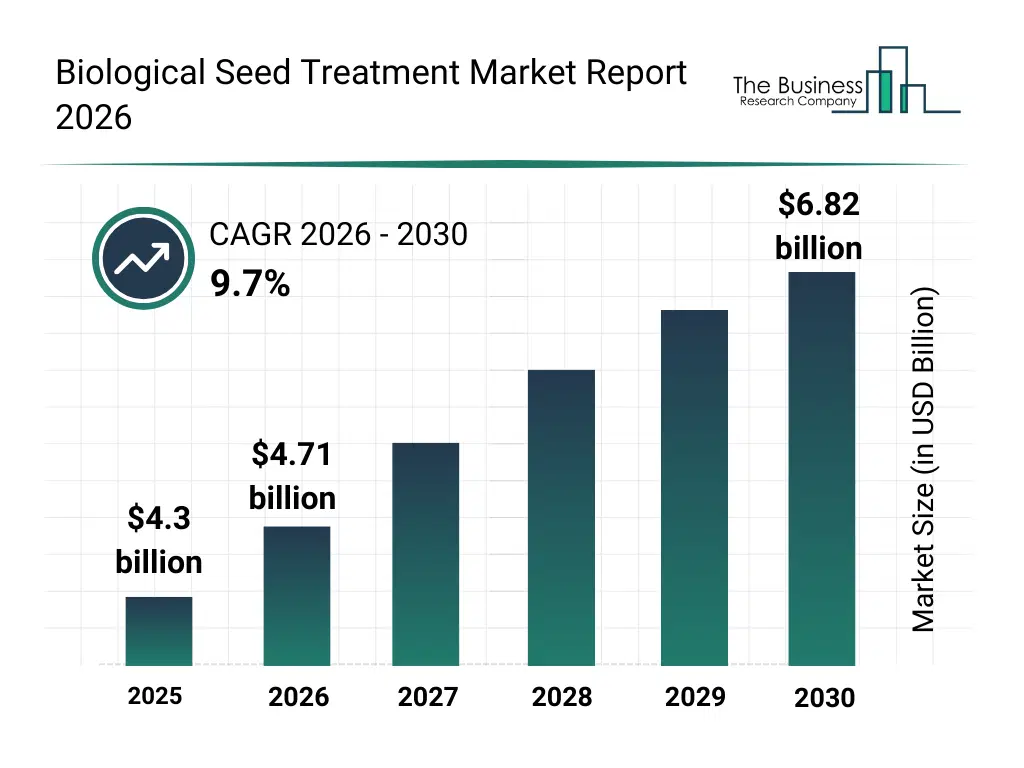
What Is The Biological Seed Treatment Market Size and Share 2026?
The biological seed treatment market size has grown strongly in recent years. It will grow from $4.3 billion in 2025 to $4.71 billion in 2026 at a compound annual growth rate (CAGR) of 9.6%. The growth in the historic period can be attributed to increasing awareness of chemical pesticide risks, early adoption of microbial inoculant technologies, growing shift toward sustainable agriculture, regulatory pressure on chemical seed treatments, initial development of botanical seed protection.What Is The Biological Seed Treatment Market Growth Forecast?
The biological seed treatment market size is expected to see strong growth in the next few years. It will grow to $6.82 billion in 2030 at a compound annual growth rate (CAGR) of 9.7%. The growth in the forecast period can be attributed to rising demand for residue-free crop inputs, expansion of precision seed application technologies, increasing investment in microbial strain innovation, growth in organic and non-gmo farming, technological improvements in biological formulation stability. Major trends in the forecast period include growing adoption of microbial seed treatment solutions, increased use of botanical and natural extract-based treatments, rising demand for crop-specific biological seed protection, expansion of liquid and dry bio-formulation technologies, advancements in seed enhancement for germination and early vigour.
Global Biological Seed Treatment Market Segmentation
1) By Crop Type: Corn, Wheat, Soybean, Cotton, Sunflower, Vegetable Crops, Other Crops 2) By Type: Microbials, Botanical, Other Types 3) By Function: Seed Enhancements, Seed Protection 4) By Formulation: Liquid Formulation, Dry Formulation Subsegments: 1) By Corn: Field Corn, Sweet Corn, Popcorn 2) By Wheat: Hard Red Wheat, Soft Red Wheat, Durum Wheat 3) By Soybean: Conventional Soybean, Non-GMO Soybean, GMO Soybean 4) By Cotton: Upland Cotton, Pima Cotton 5) By Sunflower: Oilseed Sunflower, Confectionery Sunflower 6) By Vegetable Crops: Tomatoes, Cucumbers, Lettuce, Bell Peppers 7) By Other Crops: Barley, Rice, Peanuts, PulsesWhat Is Driver Of The Biological Seed Treatment Market?
The growing demand for agriculture products will fuel the growth of the biological seed treatment market going forward. Agricultural products refer to goods produced through farming, including crops, cereals, fruits, and vegetables intended for human consumption, industrial use, or further processing. Biological seed treatment is used in agriculture goods production to enhance plant growth, protect plants from pests and diseases, enhance root development, and improve soil health. For instance, in June 2024, according to the Department for Environment Food & Rural Affairs a UK-based government Department, In 2023, the largest value increase in a crop item was in potatoes, which saw an increase of £237 million ($296.25 million), or 30.8%, from 2022, bringing the total to £1,005 million ($1.26 billion) in 2023. Therefore, the growing demand for agriculture products is driving the growth of the biological seed treatment industry.Key Players In The Global Biological Seed Treatment Market
Major companies operating in the biological seed treatment market are BASF SE, Bayer AG, Syngenta AG, Novozymes, Valent BioSciences, Corteva Inc., Precision Laboratories LLC, Koppert Global, Hello Nature International Srl, Monsanto Company, DuPont, Verdesian Life Sciences, Croda International Plc, BioWorks Inc., Germains Seed Technology, Plant Health Care, Italpollina Usa Inc., FMC Corporation, Isagro S.p.A., Marrone Bio Innovations, Certis USA LLC, Terramera Inc., Andermatt Biocontrol AG, Symborg Corporate SL., Lallemand Plant Care, XiteBio Technologies Inc., Intrachem Bio Italia S.r.l., Bioiberica S.A.U., Rizobacter Argentina S.A., Agrinos AS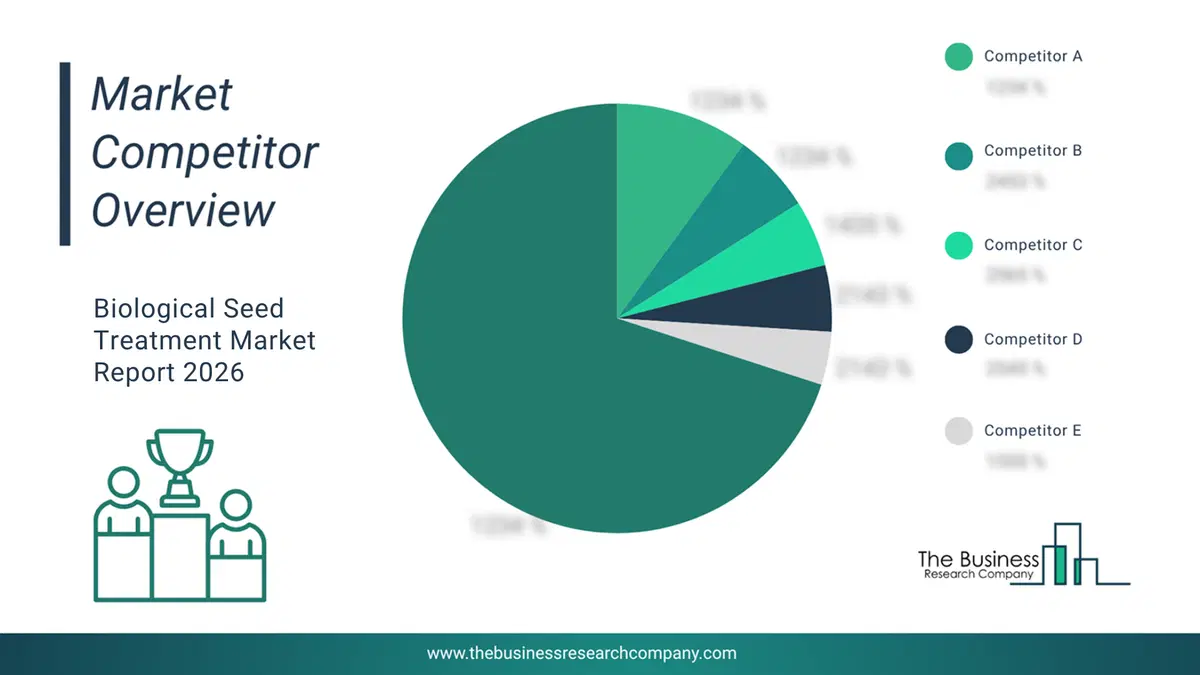
This chart is for illustrative purposes; the full report includes a detailed competitor analysis and comprehensive overview of the top 10 companies in the market.
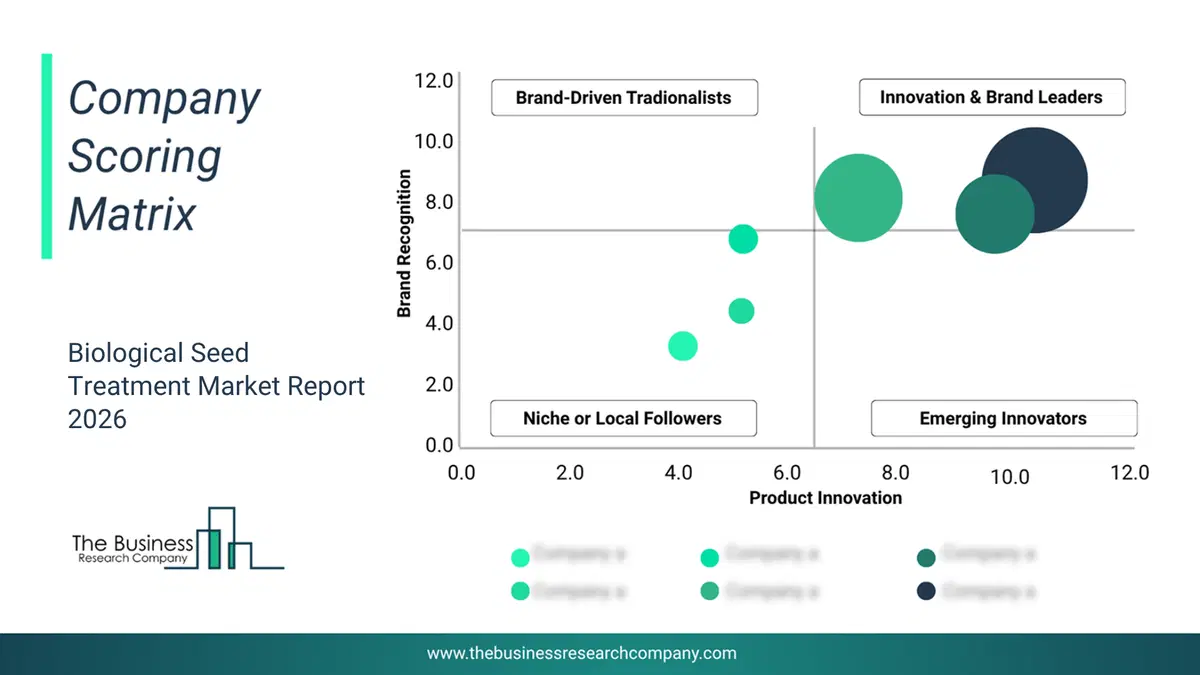
This chart maps companies by product innovation and brand strength, with bubble size indicating relative revenue, helping identify market leaders, challengers, and niche players. This is an illustrative chart; the full report provides a complete and accurate competitive analysis.
Global Biological Seed Treatment Market Trends and Insights
Major companies operating in the biological seed treatment market are focused on integrating their efforts into introducing innovative soyabean seed treatment solutions to gain a competitive edge in the market. Soybean seed treatment solutions refer to various methods and products employed to treat soybean seeds before planting. For instance, in October 2023, Helena Agri-Enterprises, a US-based seed treatment formulator, launched its two exclusive soybean seed treatments ‘Seed Shield Select and Enertia. Seed Shield Select seed treatment includes five fungicide active ingredients that help to protect soya seeds from insects and major seedling diseases. It is a combination of multi-fungicide and insecticide integrated with Asset Formulation Technology that helps to optimize plant vigor and root health. Enertia is an enzyme-based, biological soybean seed treatment that is integrated with the VersaShield Formulation Technology which helps to improve nutrient availability and enhance the soil health. The VersaShield technology helps in the stabilizing of the enzymes in Enertia for long-lasting activity, consistency, and ease of use.What Are Latest Mergers And Acquisitions In The Biological Seed Treatment Market? Syngenta Acquires Intrinsyx Bio To Strengthen Biologicals And Sustainable Agriculture Solutions
In May 2025, Syngenta AG, a Switzerland-based agriculture technology company, acquired Intrinsyx Bio for an undisclosed amount. With this acquisition, Syngenta aims to reinforce its leadership in biologicals and accelerate the development of sustainable, nutrient-use-efficiency solutions by integrating Intrinsyx Bio’s innovative pipeline and technology to provide farmers with more effective tools for crop management while reducing environmental impact. Intrinsyx Bio is a US-based biotechnology company that offers biological seed treatment.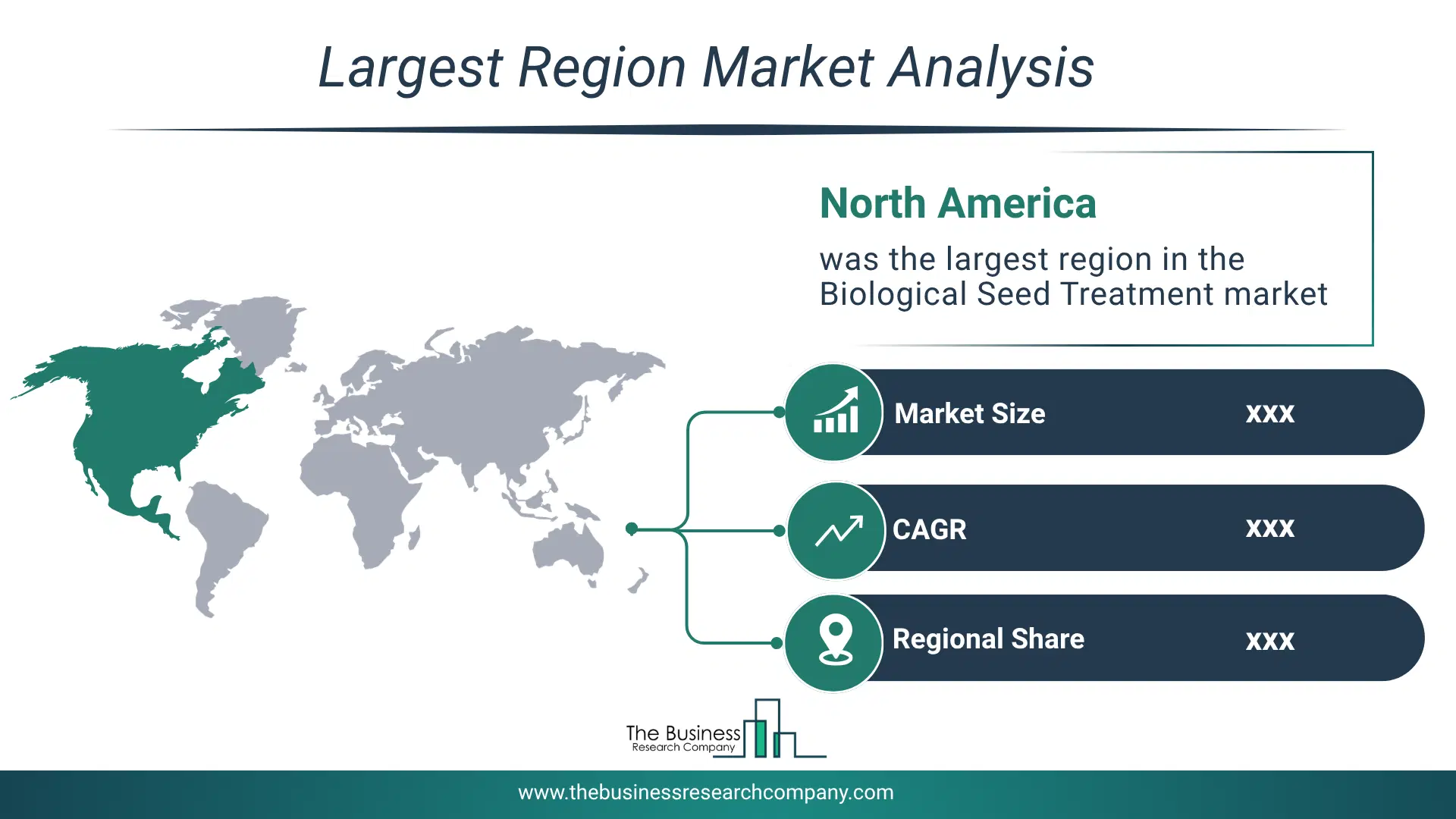
Regional Outlook
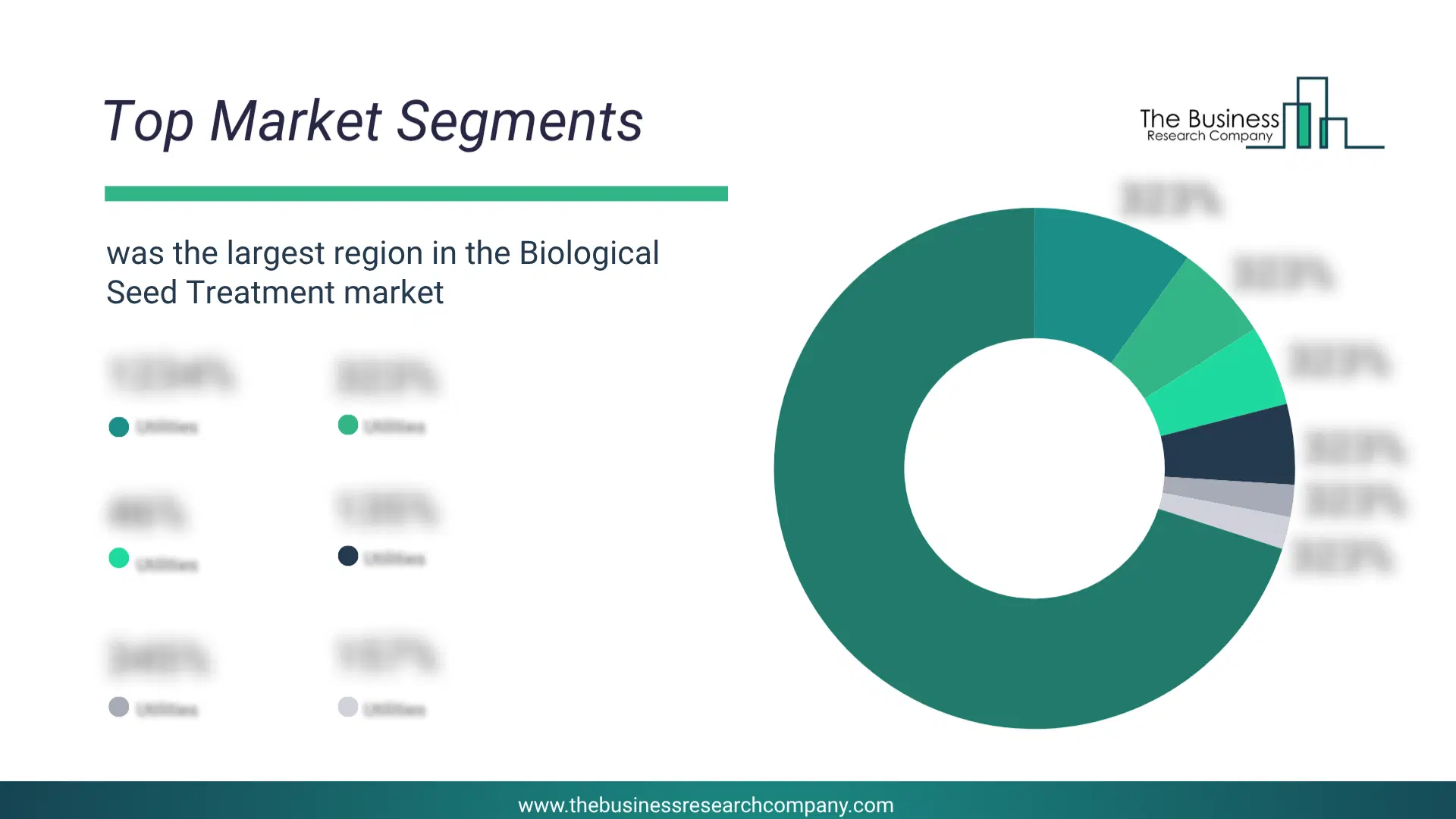
North America was the largest region in the biological seed treatment market in 2025.Asia-Pacific is expected to be the fastest-growing region in the global biological seed treatment market report during the forecast period. The regions covered in this market report are Asia-Pacific, South East Asia, Western Europe, Eastern Europe, North America, South America, Middle East, Africa. The countries covered in this market report are Australia, Brazil, China, France, Germany, India, Indonesia, Japan, Taiwan, Russia, South Korea, UK, USA, Canada, Italy, SpainWhat Defines the Biological Seed Treatment Market?
The biological seed treatment market consists of sales of seed disinfestation products and bio-stimulants. Values in this market are ‘factory gate’ values, that is the value of goods sold by the manufacturers or creators of the goods, whether to other entities (including downstream manufacturers, wholesalers, distributors, and retailers) or directly to end customers. The value of goods in this market includes related services sold by the creators of the goods.How is Market Value Defined and Measured?
The market value is defined as the revenues that enterprises gain from the sale of goods and/or services within the specified market and geography through sales, grants, or donations in terms of the currency (in USD unless otherwise specified). The revenues for a specified geography are consumption values that are revenues generated by organizations in the specified geography within the market, irrespective of where they are produced. It does not include revenues from resales along the supply chain, either further along the supply chain or as part of other products.
This chart presents market attractiveness based on a quantitative evaluation of growth, competition, strategic alignment, and risk, offering a clear view of opportunity areas for decision-making. This chart is for illustrative purposes; the full report contains the complete analysis.

This chart highlights the Total Addressable Market (TAM) by estimating the maximum revenue opportunity using an assumption-driven approach, supporting strategic planning and opportunity sizing across markets. The chart is illustrative; the full report provides a more comprehensive analysis.
What Key Data and Analysis Are Included in the Biological Seed Treatment Market Report 2026?
The biological seed treatment market research report is one of a series of new reports from The Business Research Company that provides market statistics, including industry global market size, regional shares, competitors with the market share, detailed market segments, market trends and opportunities, and any further data you may need to thrive in the biological seed treatment industry. The market research report delivers a complete perspective of everything you need, with an in-depth analysis of the current and future state of the industry.Biological Seed Treatment Market Report Forecast Analysis
| Report Attribute | Details |
|---|---|
| Market Size Value In 2026 | $4.71 billion |
| Revenue Forecast In 2030 | $6.82 billion |
| Growth Rate | CAGR of 9.7% from 2026 to 2030 |
| Base Year For Estimation | 2025 |
| Actual Estimates/Historical Data | 2020-2025 |
| Forecast Period | 2026 - 2030 |
| Market Representation | Revenue in USD Billion and CAGR from 2026 to 2030 |
| Segments Covered | Crop Type, Type, Function, Formulation |
| Regional Scope | Asia-Pacific, Western Europe, Eastern Europe, North America, South America, Middle East, Africa |
| Country Scope | The countries covered in the report are Australia, Brazil, China, France, Germany, India, Indonesia, Japan, Taiwan, Russia, South Korea, UK, USA, Canada, Italy, Spain |
| Key Companies Profiled | BASF SE, Bayer AG, Syngenta AG, Novozymes, Valent BioSciences, Corteva Inc., Precision Laboratories LLC, Koppert Global, Hello Nature International Srl, Monsanto Company, DuPont, Verdesian Life Sciences, Croda International Plc, BioWorks Inc., Germains Seed Technology, Plant Health Care, Italpollina Usa Inc., FMC Corporation, Isagro S.p.A., Marrone Bio Innovations, Certis USA LLC, Terramera Inc., Andermatt Biocontrol AG, Symborg Corporate SL., Lallemand Plant Care, XiteBio Technologies Inc., Intrachem Bio Italia S.r.l., Bioiberica S.A.U., Rizobacter Argentina S.A., Agrinos AS |
| Customization Scope | Request for Customization |
| Pricing And Purchase Options | Explore Purchase Options |