

Biologics Market Report 2026
Global Outlook – By Type (Monoclonal Antibodies (MAbS), Therapeutic Proteins, Vaccines), By Drug Classification (Branded Drugs, Generic Drugs), By Route Of Administration (Oral, Other Route Of Administration), By Mode Of Purchase (Prescription-Based Drugs, Over-The-Counter Drugs), By Distribution Channel (Hospital Pharmacies, Retail Pharmacies Or Drug Stores, Other Distribution Channels) – Market Size, Trends, Strategies, and Forecast to 2035
Biologics Market Overview
• Biologics market size has reached to $495.56 billion in 2025 • Expected to grow to $827.24 billion in 2030 at a compound annual growth rate (CAGR) of 11.2% • Growth Driver: Personalized Medicine Fueling Growth In The Biologics Market • Market Trend: Advancing Efficiency Through Next-Generation Biomanufacturing • North America was the largest region in 2025 and Middle East is the fastest growing region.What Is Covered Under Biologics Market?
Biologics are medications made from organic materials that can be used to treat a wide range of illnesses, and they are frequently used to treat immune-related illnesses. The interesting aspect is that biologics are separated from various natural sources, whether they be carbohydrates, proteins, nucleic acids, or a complex mixture of these materials. The main types of biologics are monoclonal antibodies (MAbs), therapeutic proteins, and vaccines. Monoclonal antibodies, or mAbs, are created in a laboratory to combat a specific infection. The various routes of administration include oral, parenteral, and others that are distributed by hospital pharmacies, retail pharmacies or drug stores, and others.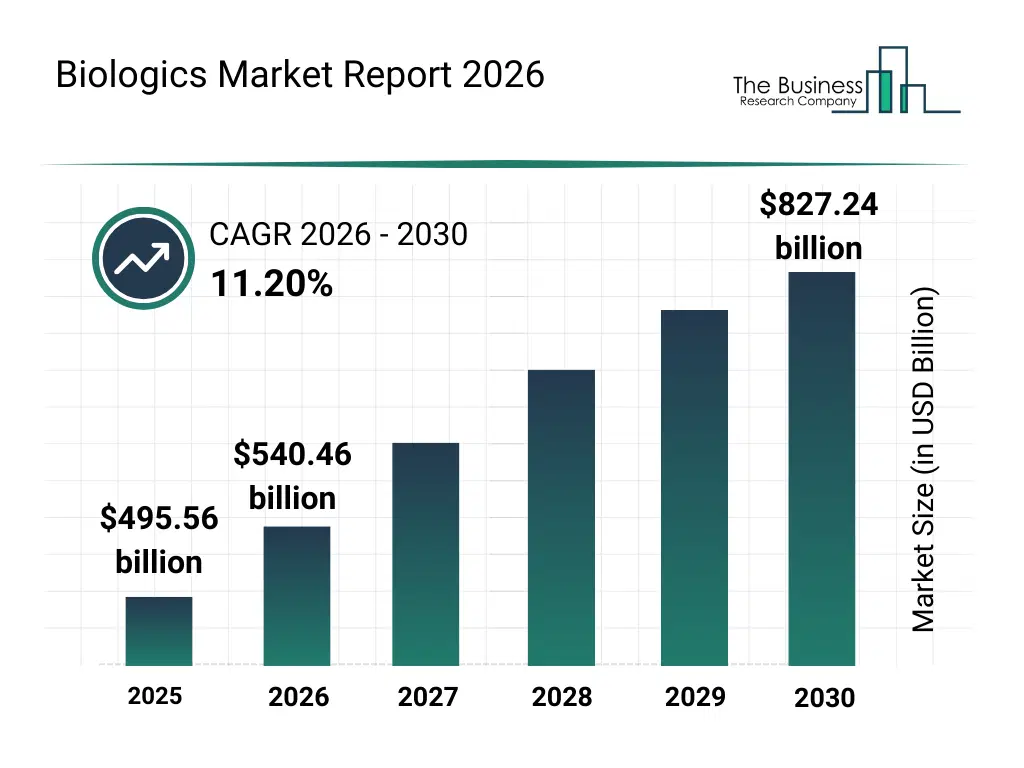
What Is The Biologics Market Size and Share 2026?
The biologics market size has grown strongly in recent years. It will grow from $495.56 billion in 2025 to $540.46 billion in 2026 at a compound annual growth rate (CAGR) of 9.1%. The growth in the historic period can be attributed to limited biologics availability, reliance on traditional therapies, growing prevalence of immune-related disorders, increasing healthcare infrastructure, rising physician awareness and prescriptions.What Is The Biologics Market Growth Forecast?
The biologics market size is expected to see rapid growth in the next few years. It will grow to $827.24 billion in 2030 at a compound annual growth rate (CAGR) of 11.2%. The growth in the forecast period can be attributed to development of novel monoclonal antibodies, expansion of mRNA and viral vector vaccines, increasing adoption of personalized biologic therapies, growing government support and funding for biologics, integration of digital health and patient monitoring platforms. Major trends in the forecast period include rising adoption of monoclonal antibodies and therapeutic proteins, growth in vaccine development including mrna and viral vector vaccines, expansion of prescription-based biologics and hospital pharmacy distribution, increasing focus on personalized medicine and targeted biologic therapies, integration of biologics with advanced healthcare solutions and patient monitoring.
Global Biologics Market Segmentation
1) By Type: Monoclonal Antibodies (MAbS), Therapeutic Proteins, Vaccines 2) By Drug Classification: Branded Drugs, Generic Drugs 3) By Route Of Administration: Oral, Other Route Of Administration 4) By Mode Of Purchase: Prescription-Based Drugs, Over-The-Counter Drugs 5) By Distribution Channel: Hospital Pharmacies, Retail Pharmacies Or Drug Stores, Other Distribution Channels Subsegments: 1) By Monoclonal Antibodies (MAbs): Naked Monoclonal Antibodies, Conjugated Monoclonal Antibodies, Bispecific Monoclonal Antibodies 2) By Therapeutic Proteins: Hormones, Enzymes, Cytokines, Fusion Proteins 3) By Vaccines: Live Attenuated Vaccines, Inactivated Vaccines, Subunit Vaccines, mRNA Vaccines, Viral Vector VaccinesWhat Is The Driver Of The Biologics Market?
The increasing demand for personalized medicine is driving significant growth in the global biologics market. Personalized medicine, also known as precision medicine, is a medical approach that tailors healthcare and medical treatment to the individual characteristics of each patient. Personalized medicine offers the ability to customize biological treatments to a patient's specific genetic and clinical profile transforming the healthcare landscape. For instance, in February 2024, according to the Personalized Medicine Coalition, a US-based hospital and health care organization, in 2023, the FDA approved 16 new personalized treatments for rare disease patients, up from six in 2022. Therefore, the increasing demand for personalized medicine is driving the growth of the biologics industry going forward.Key Players In The Global Biologics Market
Major companies operating in the biologics market are Merck & Co. Inc., AbbVie Inc., F. Hoffmann-La Roche AG, Johnson & Johnson, Pfizer Inc., Bristol Myers Squibb Company, Sanofi S.A., GlaxoSmithKline Plc., Eli Lilly and Company, Amgen Inc., Shanghai Fosun Pharmaceuticals, Bayer AG, Novartis AG, BiosanaPharma, WuXi, Teva UK Limited, AstraZeneca, Abbott Laboratories, Vectura Group, Fujifilm, Lonza, Seqens, Piramal Pharma Solutions, Corden Pharma, Procos SpA and BSP Pharmaceuticals., Microgen, Geropharm, Valenta, NovaMedica, SynBi, Rani Therapeutics, Enteris BioPharma, Allena Pharmaceuticals, Biogen Inc., Emisphere Technologies Inc., Apotex, Gilead SciencesGlobal Biologics Market Trends and Insights
Major companies operating in the biologics market are focusing on developing innovative products such as biosimilars to provide cost-effective alternatives to original biologic therapies. Biosimilars are biologic products highly similar to an already approved reference biologic, with no significant differences in safety, efficacy, or quality, helping reduce treatment costs and increase patient access to advanced therapies. For instance, in July 2025, Biocon Biologics, a subsidiary of Biocon Limited, an India-based biopharmaceutical company, launched Nepexto, a biosimilar to Enbrel (etanercept), in Australia. Nepexto is a fusion-protein biologic designed to inhibit tumor necrosis factor-alpha (TNF-α), a key inflammatory mediator in autoimmune conditions. It is composed of recombinant DNA-derived protein that mimics the binding activity of the original etanercept molecule, delivering comparable efficacy and safety while making treatment more accessible. Its unique features include high biosimilarity backed by robust clinical data, regulatory approvals, and an established supply chain via its local partner Generic Health making it a strong option for long-term management of diseases such as rheumatoid arthritis, psoriasis, and ankylosing spondylitis.What Are Latest Mergers And Acquisitions In The Biologics Market?
In October 2025, Terumo Corporation, a Japan-based healthcare technology company, acquired the drug-product plant and quality-control laboratory operations of WuXi Biologics in Leverkusen, Germany for an undisclosed amount. With this acquisition, Terumo Corporation aims to expand its contract-development and manufacturing organization (CDMO) footprint in Europe, enhance its integrated services for injectable therapeutics, and improve global responsiveness for biopharmaceutical clients. WuXi Biologics GmbH is a Germany-based life-sciences company that specializes in providing biopharmaceutical contract development and manufacturing services for biologics and advanced therapies.Regional Insights
North America was the largest region in the biologics market in 2025. Middle East is expected to be the fastest growing region in the forecast period. The regions covered in this market report are Asia-Pacific, South East Asia, Western Europe, Eastern Europe, North America, South America, Middle East, Africa. The countries covered in this market report are China, India, Japan, Australia, Indonesia, South Korea, Bangladesh, Thailand, Vietnam, Malaysia, Singapore, Philippines, Hong Kong, Taiwan, New Zealand, UK, Germany, France, Italy, Spain, Austria, Belgium, Denmark, Finland, Ireland, Netherlands, Norway, Portugal, Sweden, Switzerland, Russia, Czech Republic, Poland, Romania, Ukraine, USA, Canada, Mexico, Brazil, Chile, Argentina, Colombia, Peru, Saudi Arabia, Israel, Iran, Turkey, UAE, Egypt, Nigeria, South Africa.What Defines the Biologics Market?
The biologics market consists of sales of tumor necrosis factor inhibitors, Interleukin inhibitors, B-cells inhibitors, and T-cells inhibitors. Values in this market are ‘factory gate’ values, that is the value of goods sold by the manufacturers or creators of the goods, whether to other entities (including downstream manufacturers, wholesalers, distributors and retailers) or directly to end customers. The value of goods in this market includes related services sold by the creators of the goods.How is Market Value Defined and Measured?
The market value is defined as the revenues that enterprises gain from the sale of goods and/or services within the specified market and geography through sales, grants, or donations in terms of the currency (in USD unless otherwise specified). The revenues for a specified geography are consumption values that are revenues generated by organizations in the specified geography within the market, irrespective of where they are produced. It does not include revenues from resales along the supply chain, either further along the supply chain or as part of other products.What Key Data and Analysis Are Included in the Biologics Market Report 2026?
The biologics market research report is one of a series of new reports from The Business Research Company that provides market statistics, including industry global market size, regional shares, competitors with the market share, detailed market segments, market trends and opportunities, and any further data you may need to thrive in the biologics industry. The market research report delivers a complete perspective of everything you need, with an in-depth analysis of the current and future state of the industry.Biologics Market Report Forecast Analysis
| Report Attribute | Details |
|---|---|
| Market Size Value In 2026 | $540.46 billion |
| Revenue Forecast In 2035 | $827.24 billion |
| Growth Rate | CAGR of 9.1% from 2026 to 2035 |
| Base Year For Estimation | 2025 |
| Actual Estimates/Historical Data | 2020-2025 |
| Forecast Period | 2026 - 2030 - 2035 |
| Market Representation | Revenue in USD Billion and CAGR from 2026 to 2035 |
| Segments Covered | Type, Drug Classification, Route Of Administration, Mode Of Purchase, Distribution Channel |
| Regional Scope | Asia-Pacific, Western Europe, Eastern Europe, North America, South America, Middle East, Africa |
| Country Scope | The countries covered in the report are Australia, Brazil, China, France, Germany, India, ... |
| Key Companies Profiled | Merck & Co. Inc., AbbVie Inc., F. Hoffmann-La Roche AG, Johnson & Johnson, Pfizer Inc., Bristol Myers Squibb Company, Sanofi S.A., GlaxoSmithKline Plc., Eli Lilly and Company, Amgen Inc., Shanghai Fosun Pharmaceuticals, Bayer AG, Novartis AG, BiosanaPharma, WuXi, Teva UK Limited, AstraZeneca, Abbott Laboratories, Vectura Group, Fujifilm, Lonza, Seqens, Piramal Pharma Solutions, Corden Pharma, Procos SpA and BSP Pharmaceuticals., Microgen, Geropharm, Valenta, NovaMedica, SynBi, Rani Therapeutics, Enteris BioPharma, Allena Pharmaceuticals, Biogen Inc., Emisphere Technologies Inc., Apotex, Gilead Sciences |
| Customization Scope | Request for Customization |
| Pricing And Purchase Options | Explore Purchase Options |