
Biomedical Textiles Market Report 2026
Global Outlook – By Product Type (Non Implantable, Implantable), By Fabric (Non-Woven Biomedical Textiles, Woven Biomedical Textiles, Knitted Biomedical Textiles), By Fiber Type (Non Biodegradable, Biodegradable), By Applications (Ophthalmology, Neurology, Cardiology, Dentistry, Orthopedics, General Surgery And Treatment, Other Applications), By End Users (Hospitals, Ambulatory Centers, Clinics, Community Healthcare, Other End Users) - Market Size, Trends, Strategies, and Forecast to 2030
Biomedical Textiles Market Overview
• Biomedical Textiles market size has reached to $17.69 billion in 2025 • Expected to grow to $27.74 billion in 2030 at a compound annual growth rate (CAGR) of 9.4% • Growth Driver: Rising Healthcare Expenditure Boosts Demand For Biomedical Textiles • Market Trend: Smart-Textile Platform In Biomedical Textiles Market • North America was the largest region in 2025 and Asia-Pacific is the fastest growing region.What Is Covered Under Biomedical Textiles Market?
Biomedical textiles are fibrous textile constructions made from synthetic or natural materials. These advanced materials resist various fungi, fire, bacteria, dirt, and water. Biomedical textiles are used as a medical device inside or outside the biological environment to improve the patient's health. The main product types in biomedical textiles are non-implantable and implantable. The non-implantable biomedical textiles are used for external wound dressings. Non-implantable biomedical textiles are substances applied externally to the body that may or may not come into contact with the skin. These are made using various fabrics such as non-woven biomedical textiles, woven biomedical textiles, and knitted biomedical textiles and fiber type includes non-biodegradable and biodegradable. The main applications include ophthalmology, neurology, cardiology, dentistry, orthopedics, general surgery and treatment, and other applications that are used by hospitals, ambulatory centers, clinics, community healthcare, and other end users.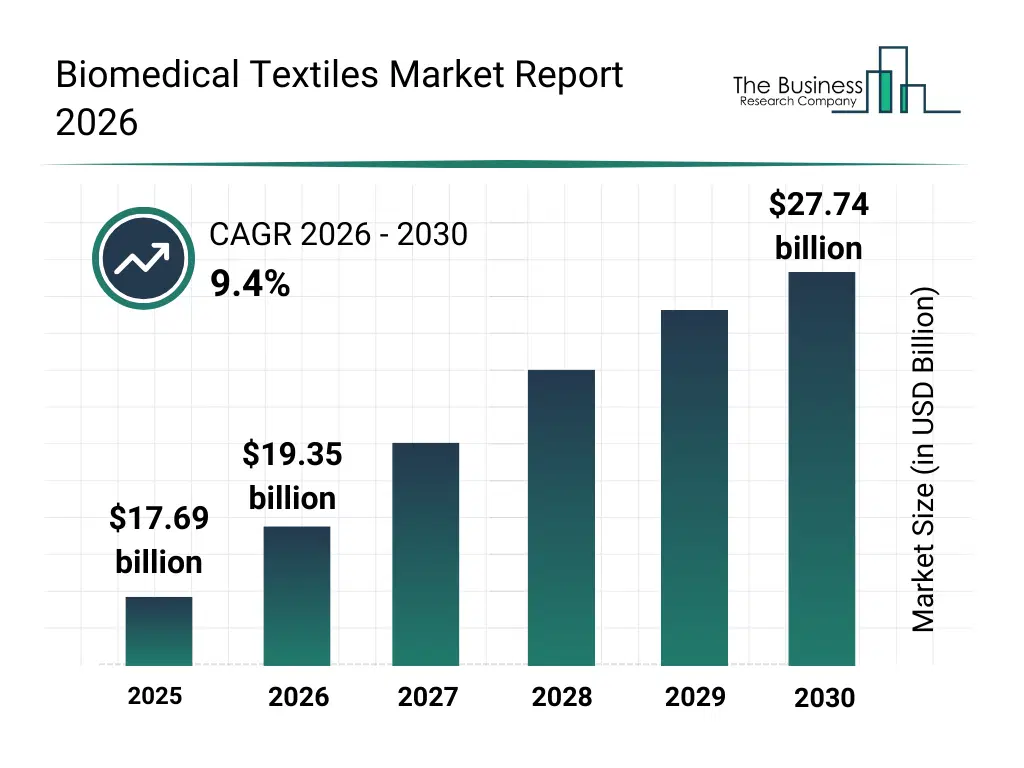
What Is The Biomedical Textiles Market Size and Share 2026?
The biomedical textiles market size has grown strongly in recent years. It will grow from $17.69 billion in 2025 to $19.35 billion in 2026 at a compound annual growth rate (CAGR) of 9.4%. The growth in the historic period can be attributed to rising surgical procedure volumes, increasing prevalence of chronic diseases, expansion of hospital infrastructure, growing use of wound care products, advancements in textile manufacturing technologies.What Is The Biomedical Textiles Market Growth Forecast?
The biomedical textiles market size is expected to see strong growth in the next few years. It will grow to $27.74 billion in 2030 at a compound annual growth rate (CAGR) of 9.4%. The growth in the forecast period can be attributed to increasing adoption of bioresorbable materials, rising demand for minimally invasive surgical solutions, expansion of smart healthcare textiles, growing investments in medical device innovation, increasing focus on infection prevention. Major trends in the forecast period include increasing adoption of advanced implantable textile materials, rising demand for antimicrobial medical fabrics, growing use of biodegradable biomedical fibers, expansion of smart and functional medical textiles, enhanced focus on patient comfort and safety.
Global Biomedical Textiles Market Segmentation
1) By Product Type: Non Implantable, Implantable 2) By Fabric: Non-Woven Biomedical Textiles, Woven Biomedical Textiles, Knitted Biomedical Textiles 3) By Fiber Type: Non Biodegradable, Biodegradable 4) By Applications: Ophthalmology, Neurology, Cardiology, Dentistry, Orthopedics, General Surgery And Treatment, Other Applications 5) By End Users: Hospitals, Ambulatory Centers, Clinics, Community Healthcare, Other End Users Subsegments: 1) By Non-Implantable: Surgical Textiles, Wound Dressings, Bandages And Plasters, Compression Garments 2) By Implantable: Sutures, Mesh Materials, Tissue Engineering Scaffolds, Vascular GraftsWhat Is The Driver Of The Biomedical Textiles Market?
The rising healthcare expenditure is expected to propel the growth of the biomedical textiles market going forward. Healthcare expenditure refers to the amount of money spent on healthcare goods and services, including medical equipment, pharmaceuticals, hospital care, physician services, and other healthcare-related expenses. It directly influences investment in advanced medical treatments, technologies, and healthcare infrastructure. The rising healthcare expenditure led to investments in advanced medical treatments and technologies, which has further contributed to the demand for specialized biomedical textile materials. For instance, in November 2025, according to Organisation for Economic Co-operation and Development, a France-based intergovernmental economic organization, reported that in 2024, average health spending in OECD countries was estimated to stand at nearly USD 6000 per capita (when adjusted for differences in purchasing power). The United States was the highest spender. Therefore, rising healthcare expenditures are driving the growth of the biomedical textiles industry.Key Players In The Global Biomedical Textiles Market
Major companies operating in the biomedical textiles market are Confluent Medical Technologies, Cardinal Health Inc, Johnson & Johnson Services Inc, B. Braun Melsungen AG, Smith & Nephew PLC, Medline Industries Inc, 3M Company, ATEX Technologies, Integra Life Sciences Corporation, Paul Hartmann AG, BSN Medical GmbH, Bally Ribbon Mills, Asahi Kasei Corporation, Freudenberg Medical LLC, Halyard Health, Kimberly-Clark Corporation, Milliken & Company, Mölnlycke Health Care AB, Precision Fabrics Group Inc., Secant Group LLC, Stradis Healthcare, Tietex International Ltd., Trelleborg AB, Vestagen Protective Technologies Inc., W.L. Gore & Associates Inc., Welspun Group, Zimmer Biomet Holdings
This chart is for illustrative purposes; the full report includes a detailed competitor analysis and comprehensive overview of the top 10 companies in the market.
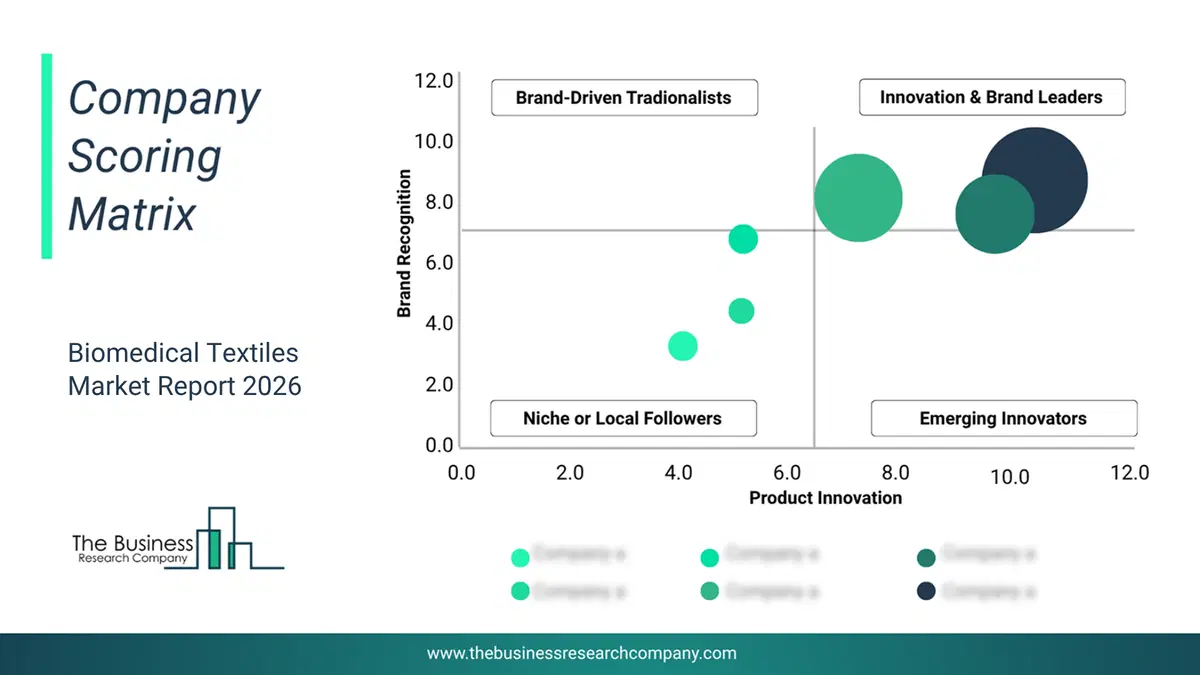
This chart maps companies by product innovation and brand strength, with bubble size indicating relative revenue, helping identify market leaders, challengers, and niche players. This is an illustrative chart; the full report provides a complete and accurate competitive analysis.
Global Biomedical Textiles Market Trends and Insights
Major companies operating in the biomedical textiles market are focused on adopting strategic collaborations with one another to introduce smart textile platforms for developing biomedical textiles. These partnerships allow companies to leverage each other's expertise in developing innovative platforms for integrating medicine, wellness, and health benefits into clothing. For instance, in August 2023, Nufabrx, a US-based biomedical textile company, partnered with Enventys Partners, a US-based vertically integrated product development, crowdfunding, and inbound marketing agency, to introduce HealthWear, a groundbreaking platform technology that integrates medicine, wellness, and health benefits into clothing. The active chemicals in textile goods are immediately included in this proprietary smart-textile platform. The final garments, when knitted into the composition of HealthWear, reliably apply topical medications in small amounts to the skin, which are activated by body heat and/or moisture. Even after multiple wears, uses, and laundries, garments constructed with HealthWear technology continue to administer a therapeutic level of care.What Are Latest Mergers And Acquisitions In The Biomedical Textiles Market?
In March 2023, Riverpoint Medical, a U.S.-based medical device company specializing in surgical scaffolds and textile-based implants, entered into an exclusive licensing agreement with DSM Biomedical to use its proprietary osteoconductive (OC) coating technology. With this partnership, Riverpoint aims to incorporate DSM’s OC coating into its implantable textile-based scaffolds and grafts to promote bone in-growth and enhance regenerative performance. DSM Biomedical, a Netherlands-based biomaterials company, provides advanced osteoconductive coating technologies tailored for medical implants and tissue engineering applications, enabling enhanced cellular integration and improved long-term stability for textile implants.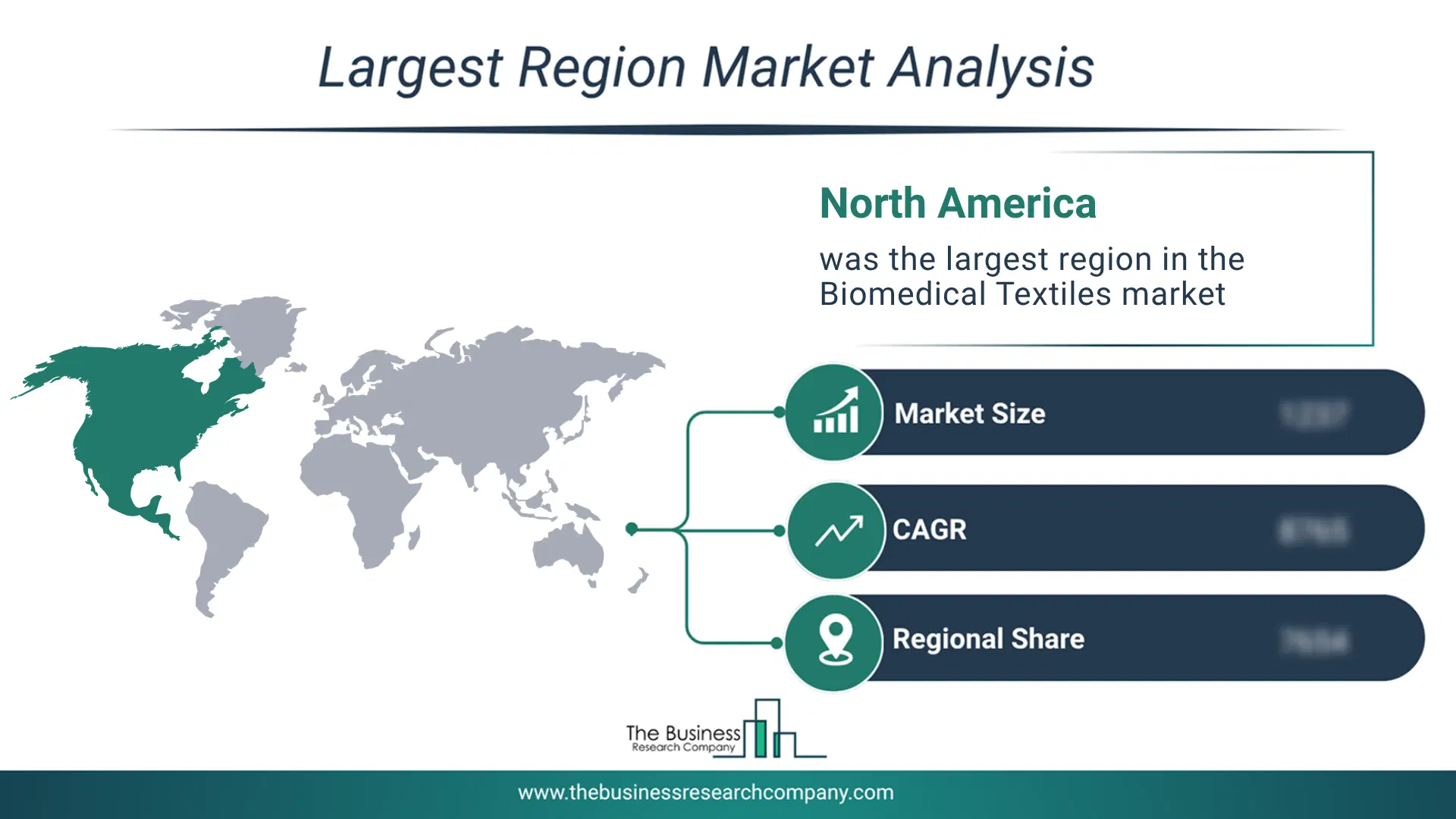
Regional Outlook
North America was the largest region in the biomedical textiles market in 2025. Asia-Pacific is expected to be the fastest-growing region in the forecast period. The regions covered in this market report are Asia-Pacific, South East Asia, Western Europe, Eastern Europe, North America, South America, Middle East, Africa. The countries covered in this market report are Australia, Brazil, China, France, Germany, India, Indonesia, Japan, Taiwan, Russia, South Korea, UK, USA, Canada, Italy, Spain.What Defines the Biomedical Textiles Market?
The biomedical textiles market consists of sales of textiles for sutures & ligatures, vascular implants, soft tissue implants, hard tissue implants and hernia repair. Values in this market are ‘factory gate’ values, that is the value of goods sold by the manufacturers or creators of the goods, whether to other entities (including downstream manufacturers, wholesalers, distributors and retailers) or directly to end customers. The value of goods in this market includes related services sold by the creators of the goods.How is Market Value Defined and Measured?
The market value is defined as the revenues that enterprises gain from the sale of goods and/or services within the specified market and geography through sales, grants, or donations in terms of the currency (in USD unless otherwise specified). The revenues for a specified geography are consumption values that are revenues generated by organizations in the specified geography within the market, irrespective of where they are produced. It does not include revenues from resales along the supply chain, either further along the supply chain or as part of other products.
This chart presents market attractiveness based on a quantitative evaluation of growth, competition, strategic alignment, and risk, offering a clear view of opportunity areas for decision-making. This chart is for illustrative purposes; the full report contains the complete analysis.

This chart highlights the Total Addressable Market (TAM) by estimating the maximum revenue opportunity using an assumption-driven approach, supporting strategic planning and opportunity sizing across markets. The chart is illustrative; the full report provides a more comprehensive analysis.
What Key Data and Analysis Are Included in the Biomedical Textiles Market Report 2026?
The biomedical textiles market research report is one of a series of new reports from The Business Research Company that provides market statistics, including industry global market size, regional shares, competitors with the market share, detailed market segments, market trends and opportunities, and any further data you may need to thrive in the biomedical textiles industry. The market research report delivers a complete perspective of everything you need, with an in-depth analysis of the current and future state of the industry.Biomedical Textiles Market Report Forecast Analysis
| Report Attribute | Details |
|---|---|
| Market Size Value In 2026 | $19.35 billion |
| Revenue Forecast In 2030 | $27.74 billion |
| Growth Rate | CAGR of 9.4% from 2026 to 2030 |
| Base Year For Estimation | 2025 |
| Actual Estimates/Historical Data | 2020-2025 |
| Forecast Period | 2026 - 2030 |
| Market Representation | Revenue in USD Billion and CAGR from 2026 to 2030 |
| Segments Covered | Product Type, Fabric, Fiber Type, Applications, End Users |
| Regional Scope | Asia-Pacific, Western Europe, Eastern Europe, North America, South America, Middle East, Africa |
| Country Scope | The countries covered in the report are Australia, Brazil, China, France, Germany, India, Indonesia, Japan, Taiwan, Russia, South Korea, UK, USA, Canada, Italy, Spain |
| Key Companies Profiled | Confluent Medical Technologies, Cardinal Health Inc, Johnson & Johnson Services Inc, B. Braun Melsungen AG, Smith & Nephew PLC, Medline Industries Inc, 3M Company, ATEX Technologies, Integra Life Sciences Corporation, Paul Hartmann AG, BSN Medical GmbH, Bally Ribbon Mills, Asahi Kasei Corporation, Freudenberg Medical LLC, Halyard Health, Kimberly-Clark Corporation, Milliken & Company, Mölnlycke Health Care AB, Precision Fabrics Group Inc., Secant Group LLC, Stradis Healthcare, Tietex International Ltd., Trelleborg AB, Vestagen Protective Technologies Inc., W.L. Gore & Associates Inc., Welspun Group, Zimmer Biomet Holdings |
| Customization Scope | Request for Customization |
| Pricing And Purchase Options | Explore Purchase Options |