
Biomethane Market Report 2026
Global Outlook – By Feedstock (Organic Household Waste, Animal Manure, Energy Crops, Agricultural Waste, Sewage Sludge, Industrial Food Processing Waste, Other Feedstocks), By Production Method (Anaerobic Digestion, Gasification, Fermentation, Other Production Methods), By End User (Automotive, Power Generation, Industrial, Other End Users) – Market Size, Trends, Strategies, and Forecast to 2030
Biomethane Market Overview
• Biomethane market size has reached to $4.04 billion in 2025 • Expected to grow to $5.33 billion in 2030 at a compound annual growth rate (CAGR) of 5.7% • Growth Driver: Rising Demand For Clean Fuel Boosts Biomethane Market Growth • Market Trend: Major Companies Invest In Biomethane Production Facilities For Sustainable Energy And Environmental Solutions • Europe was the largest region in 2025 and North America is the fastest growing region.Market Gains By 2030 – Top Opportunities By Segment
Market Gain identifies the most promising market opportunities by highlighting the segments or products expected to generate the highest incremental revenue growth over the next five years.
What Is Covered Under Biomethane Market?
Biomethane is a type of biogas that is produced from organic materials through a process called anaerobic digestion or other biological processes. It offers several environmental benefits, including reducing greenhouse gas emissions, improving hygienic conditions, and reducing the risk of water pollution. The main types of biomethane are organic household waste, animal manure, energy crops, agricultural waste, sewage sludge, industrial food processing waste, and others. Organic household waste refers to biodegradable waste generated in households that primarily consists of organic materials derived from plants or animals. These are produced by anaerobic digestion, gasification, fermentation, and others and these are used by various end users such as automotive, power generation, industrial, and others.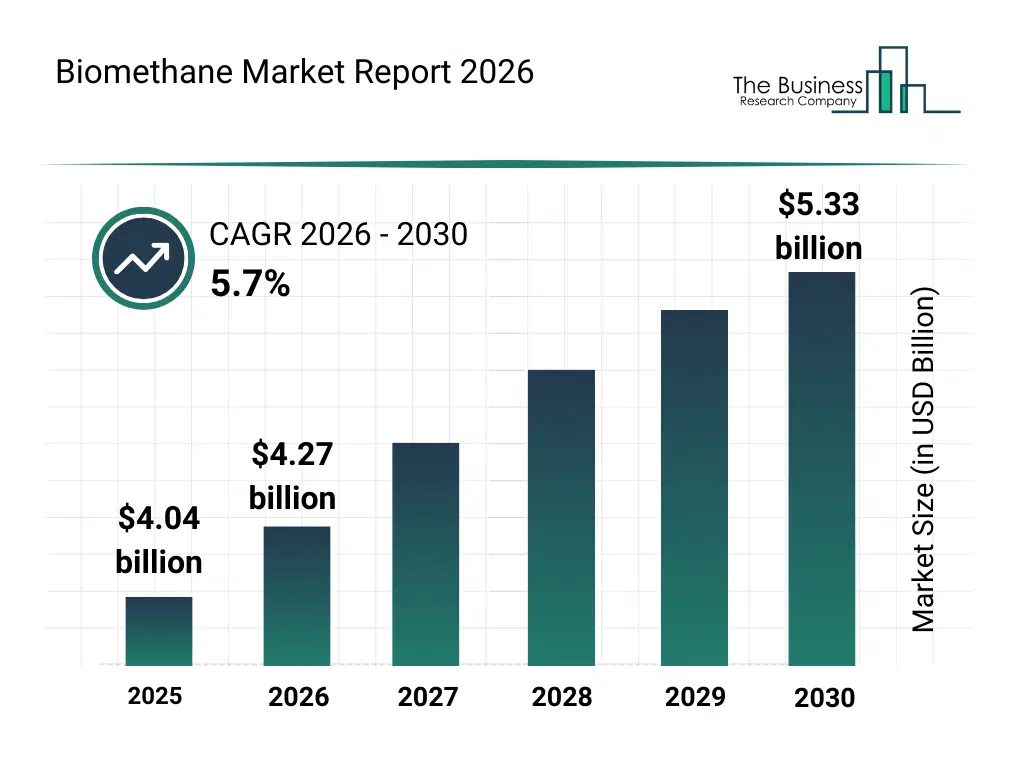
What Is The Biomethane Market Size and Share 2026?
The biomethane market size has grown strongly in recent years. It will grow from $4.04 billion in 2025 to $4.27 billion in 2026 at a compound annual growth rate (CAGR) of 5.7%. The growth in the historic period can be attributed to availability of organic waste, anaerobic digestion adoption, government renewable gas incentives, landfill gas recovery projects, agricultural waste management.What Is The Biomethane Market Growth Forecast?
The biomethane market size is expected to see strong growth in the next few years. It will grow to $5.33 billion in 2030 at a compound annual growth rate (CAGR) of 5.7%. The growth in the forecast period can be attributed to decarbonization targets, demand for renewable transport fuels, expansion of gas grid infrastructure, investments in bioenergy projects, stricter emission regulations. Major trends in the forecast period include rising use of biomethane as vehicle fuel, expansion of grid injection projects, growing adoption in industrial heating, increased utilization of agricultural waste feedstock, focus on carbon neutral energy solutions.
Global Biomethane Market Segmentation
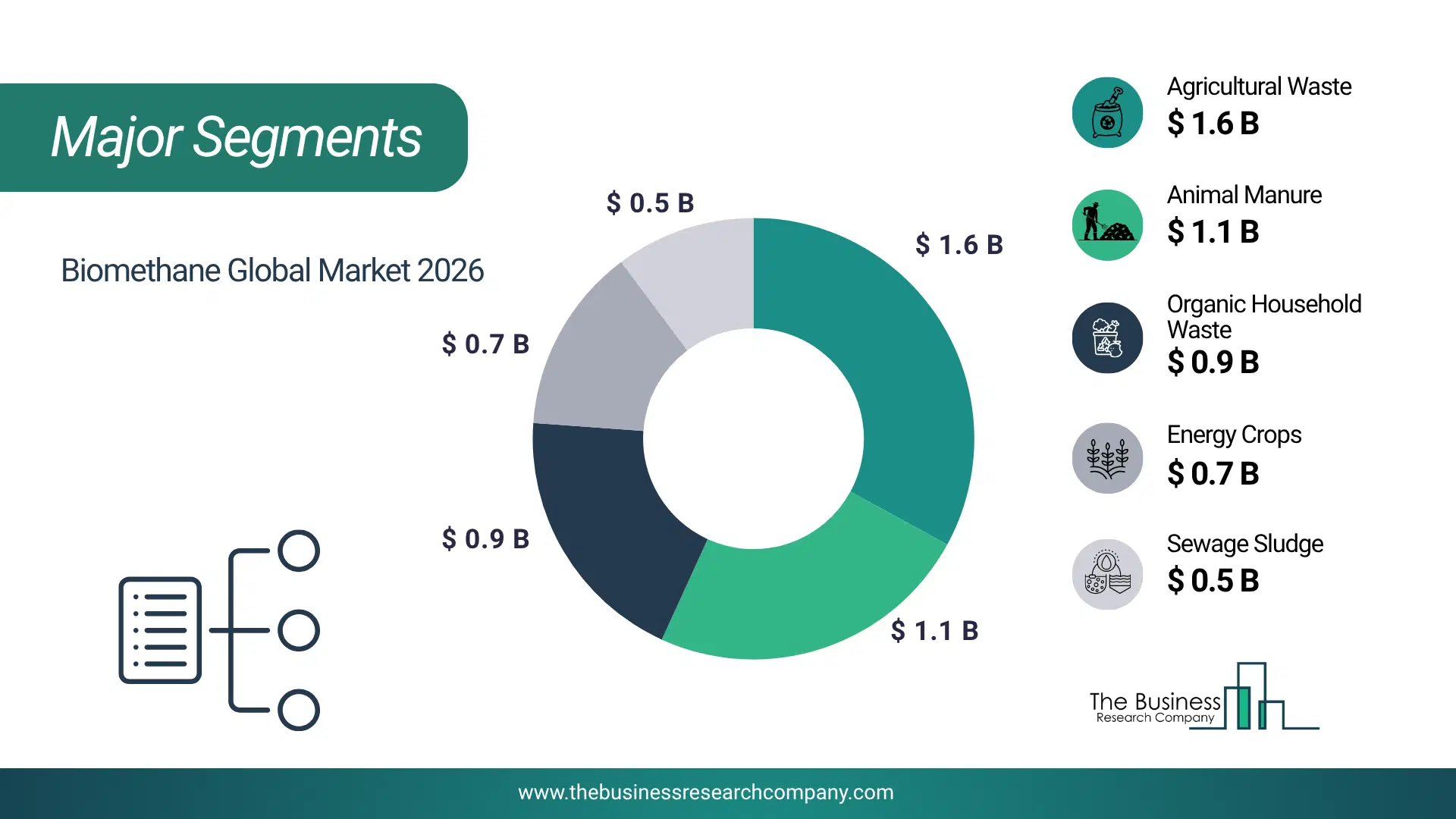
1) By Feedstock: Organic Household Waste, Animal Manure, Energy Crops, Agricultural Waste, Sewage Sludge, Industrial Food Processing Waste, Other Feedstocks 2) By Production Method: Anaerobic Digestion, Gasification, Fermentation, Other Production Methods 3) By End User: Automotive, Power Generation, Industrial, Other End Users Subsegments: 1) By Organic Household Waste: Kitchen Waste, Garden Waste, Organic Household Refuse 2) By Animal Manure: Cattle Manure, Poultry Manure, Pig Manure 3) By Energy Crops: Maize Silage, Grass Silage, Sorghum 4) By Agricultural Waste: Crop Residues (Straw, Husks), Fruit And Vegetable Waste, Agricultural Byproducts 5) By Sewage Sludge: Primary Sludge, Secondary Sludge, Tertiary Sludge 6) By Industrial Food Processing Waste: Food Processing Residues (Fruit And Vegetable Peels), Dairy Waste, Beverage Industry Waste 7) By Other Feedstocks: Green Waste, Wood Waste, Algae The top segments in the biomethane market will be: • Agricultural Waste will reach $1.58 billion by 2030. • Animal Manure will reach $1.14 billion by 2030. • Organic Household Waste will reach $0.91 billion by 2030. • Energy Crops will reach $0.66 billion by 2030. • Sewage Sludge will reach $0.5 billion by 2030.What Is The Driver Of The Biomethane Market?
The rising preference for clean and green fuels is expected to propel the growth of the biomethane market going forward. Clean and green fuel refers to energy sources that are environmentally friendly and sustainable, emitting minimal pollutants or greenhouse gases during their production and consumption. The demand for clean and green fuels is increasing as they serve as an environmentally friendly and sustainable alternative to conventional fossil fuels. Biomethane as a clean energy source offers a range of benefits that align with environmental sustainability, economic development, and social well-being. For instance, in June 2025, according to the Energy Information Administration (EIA), a US-based government agency, renewable energy consumption increased by 5% to hit a new record of 8.6 quads in 2024, largely due to growth in biofuels, wind, and solar. Therefore, the rising preference for clean and green fuel is driving the growth of the biomethane industry.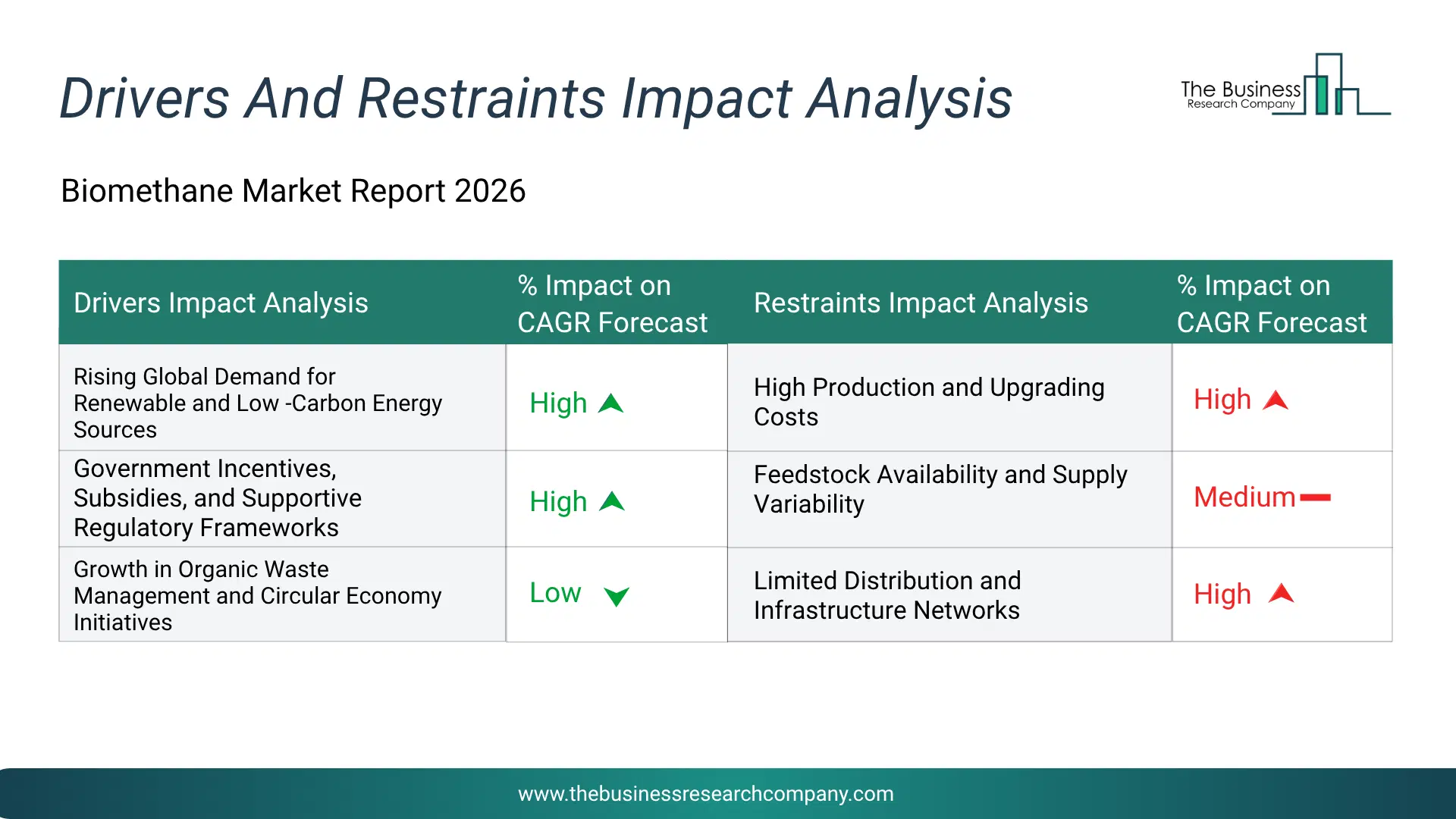
Infographic Chart Showing Key Market Drivers Analysis And Restraints For Biomethane Market
The chart presents an impact analysis of key drivers and restraints, quantifying their relative influence on the market's growth rate and helping assess the balance between growth enablers and limiting factors. This chart offers a high-level perspective; the full report contains more detailed insights.
How Will The Drivers Impact Growth In The Global Biomethane Market?
• Rising Global Demand for Renewable and Low -Carbon Energy Sources (High) – During the forecast period, the rising global demand for renewable and low -carbon energy sources is expected to become a key growth driver for the biomethane market by 2030. The increasing global emphasis on decarbonization, renewable energy adoption, and net -zero emission targets is driving demand for biomethane as a sustainable alternative to fossil fuels. Governments, utilities, and industrial consumers are prioritizing biomethane for power generation, heating, and transportation, enabling reduced greenhouse gas emissions and energy diversification. Policies promoting green energy procurement and low -carbon fuels further reinforce biomethane as a key contributor to the global clean energy transition. • Government Incentives, Subsidies, and Supportive Regulatory Frameworks (High) – During the forecast period, the government incentives, subsidies, and supportive regulatory frameworks are expected to emerge as a major factor driving the expansion of the biomethane market by 2030. Favourable policies, such as feed-in tariffs, renewable fuel mandates, carbon credits, and grants for anaerobic digestion infrastructure, are significantly accelerating biomethane production and adoption. Regions like europe, north america, and parts of asia are offering strong incentives for renewable natural gas (rng) projects and biogas upgrading plants, which reduces upfront investment risks and improves project feasibility. Regulatory support for sustainable transportation fuels and renewable energy compliance is driving long-term market expansion. • Growth in Organic Waste Management and Circular Economy Initiatives (Low) – During the forecast period, the growth in organic waste management and circular economy initiatives is expected to act as a key growth catalyst for the biomethane market by 2030. The surge in agricultural, municipal, and industrial organic waste generation is creating new feedstock opportunities for biomethane production. Advanced anaerobic digestion and upgrading technologies enable the conversion of food waste, livestock manure, and wastewater sludge into energy, supporting circular economy goals. Rising interest in sustainable waste management and resource recovery is promoting investments in biomethane facilities, making organic waste valorization a strategic market growth driver.How Will The Restraints Impact Growth In The Global Biomethane Market?
• High Production and Upgrading Costs (High) – During the forecast period, the high production and upgrading costs act as a restraint for the biomethane market due to expensive infrastructure requirements for anaerobic digestion, gas purification, and grid injection. These costs make projects less economically viable without strong subsidies. This limits large-scale commercialization in many regions. • Feedstock Availability and Supply Variability (Medium) – During the forecast period, the feedstock availability and supply variability act as a restraint because biomethane production depends on consistent access to organic waste materials. Seasonal variations and competition for feedstock can disrupt production stability. This affects long-term project reliability and investment attractiveness. • Limited Distribution and Infrastructure Networks (High) – During the forecast period, the limited distribution and infrastructure networks act as a restraint for the biomethane market because many regions lack pipelines, storage facilities, and refueling stations. This restricts market penetration and increases logistics costs, slowing widespread adoption.Key Players In The Global Biomethane Market
Major companies operating in the biomethane market are E.ON SE, Air Liquide S.A, The Southern California Gas Company, VERBIO SE, Société Générale de Surveillance, Veolia Group, Envitec Biogas AG, Orbital Gas Systems, Future Biogas Ltd., Green Gas International, ETW Energietechnik GmbH, Biokraft International AB, Gasrec Ltd, PlanET Biogas Global GmbH, CNG Services Ltd., Biogas Products Ltd., Nature Energy, Landwärme GmbH, AB HOLDING SPA, ENVO Group, Cryon Purr, Schmack Carbotech GmbH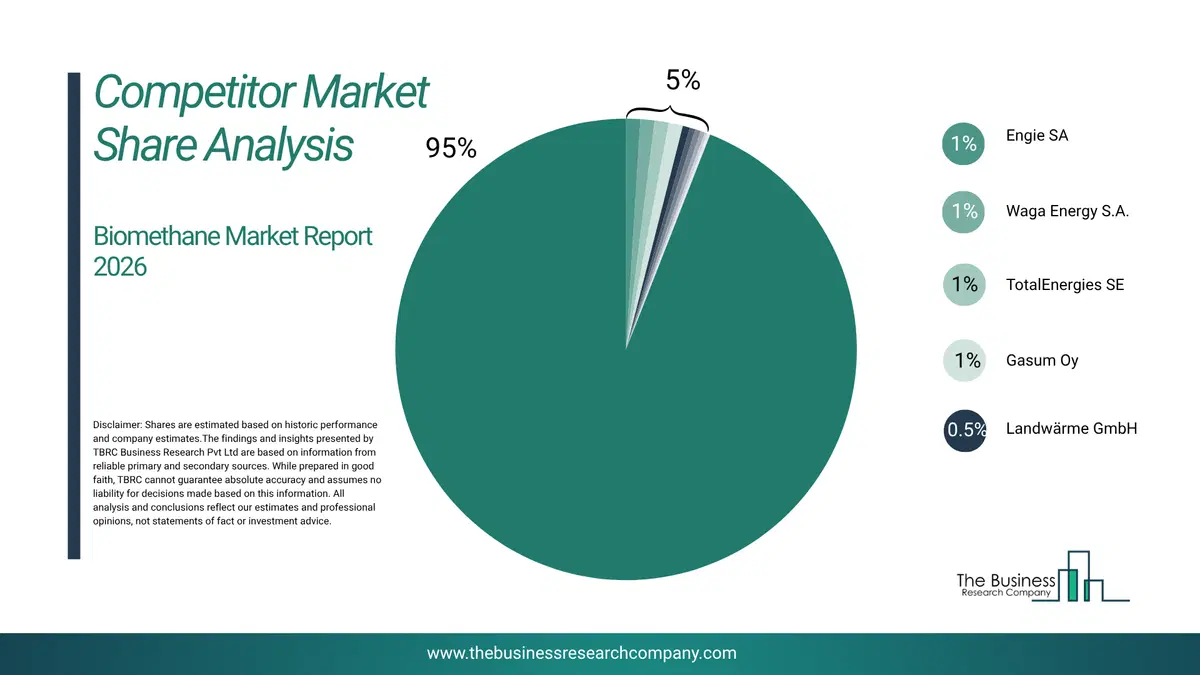
This chart is for illustrative purposes; the full report includes a detailed competitor analysis and comprehensive overview of the top 10 companies in the market.
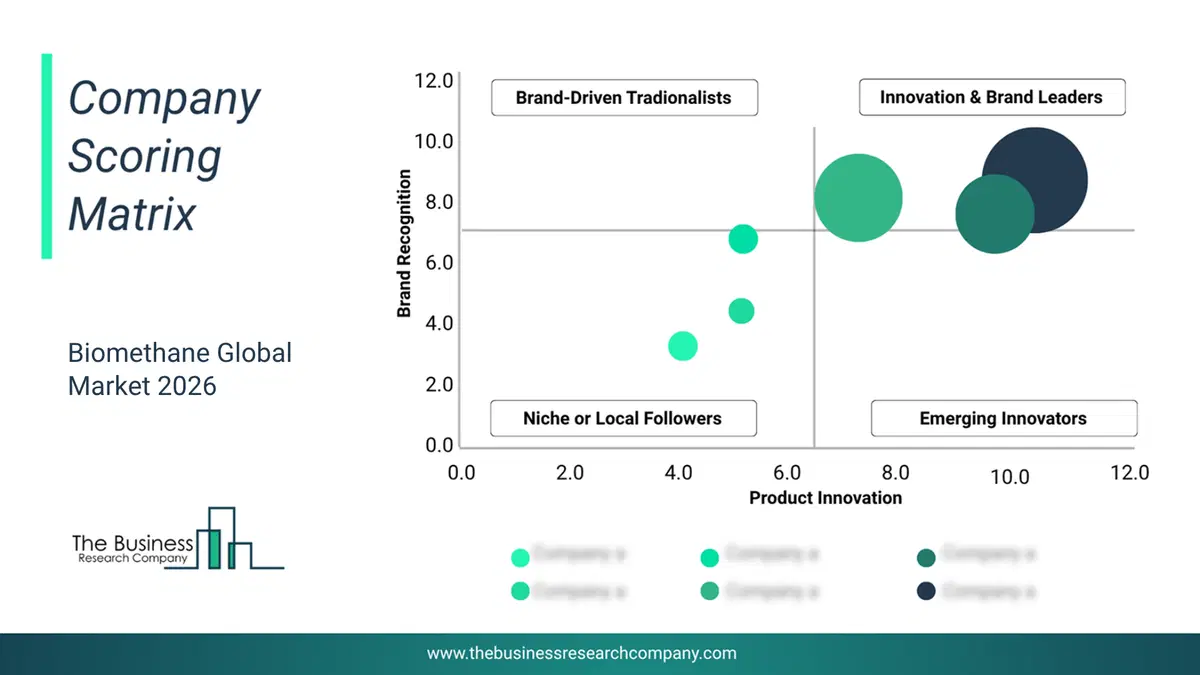
This chart maps companies by product innovation and brand strength, with bubble size indicating relative revenue, helping identify market leaders, challengers, and niche players. This is an illustrative chart; the full report provides a complete and accurate competitive analysis.
Global Biomethane Market Trends and Insights
Major companies operating in the biomethane market are increasing their focus on developing new biomethane production facilities to maximize their profitability in the market. Biomethane production facilities are installations designed for the generation of biomethane, a renewable natural gas derived from organic materials, through processes like anaerobic digestion or other biological means. For instance, in September 2023, CycleO Group Limited, a UK-based biomethane production company, launched the first biomethane plant with ammonia stripping in Spain. The plant will convert manure into sustainable ammonium nitrate and sulfate, which can be used as fertilizer. It has a maximum production capacity of 15,000 MWh per year and is CycleØ’s second operational installation in Spain and the company’s first fully developed, owned, built, and operated facility in the country. This plant will help reduce nitrate pollution and emissions on the local farm.What Are Latest Mergers And Acquisitions In The Biomethane Market?
In September 2023, Engie SA, a France-based utility company, acquired Ixora Energy Ltd. for an undisclosed amount. This acquisition strengthens ENGIE's biomethane presence in Europe and adds three new production units to its portfolio, which are located in Devon and Somerset, collectively generating approximately 160 GWh/y of biomethane. Ixora Energy Ltd. is a UK-based company that specializes in biomethane production.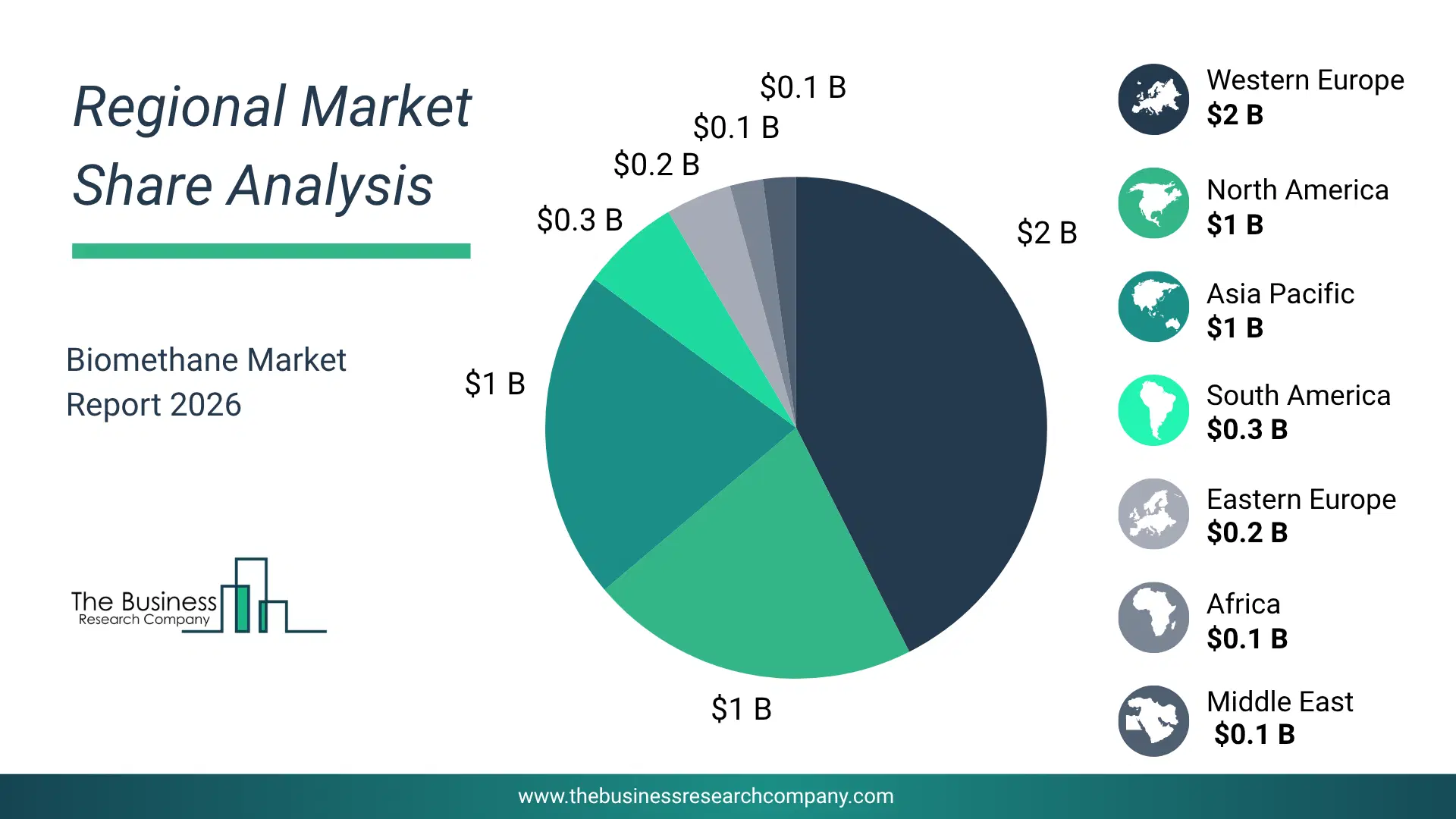
Regional Outlook
Europe was the largest region in the biomethane market in 2025. North America is expected to be the fastest-growing region in the forecast period. The regions covered in this market report are Asia-Pacific, South East Asia, Western Europe, Eastern Europe, North America, South America, Middle East, Africa. The countries covered in this market report are Australia, Brazil, China, France, Germany, India, Indonesia, Japan, Taiwan, Russia, South Korea, UK, USA, Canada, Italy, SpainWhat Defines the Biomethane Market?
The biomethane market consists of sales of biogasoline, bio-compressed natural gas (bio-CNG), and fertilizer. Values in this market are ‘factory gate’ values, that is the value of goods sold by the manufacturers or creators of the goods, whether to other entities (including downstream manufacturers, wholesalers, distributors and retailers) or directly to end customers. The value of goods in this market includes related services sold by the creators of the goods.How is Market Value Defined and Measured?
The market value is defined as the revenues that enterprises gain from the sale of goods and/or services within the specified market and geography through sales, grants, or donations in terms of the currency (in USD unless otherwise specified). The revenues for a specified geography are consumption values that are revenues generated by organizations in the specified geography within the market, irrespective of where they are produced. It does not include revenues from resales along the supply chain, either further along the supply chain or as part of other products.
This chart presents market attractiveness based on a quantitative evaluation of growth, competition, strategic alignment, and risk, offering a clear view of opportunity areas for decision-making. This chart is for illustrative purposes; the full report contains the complete analysis.

This chart highlights the Total Addressable Market (TAM) by estimating the maximum revenue opportunity using an assumption-driven approach, supporting strategic planning and opportunity sizing across markets. The chart is illustrative; the full report provides a more comprehensive analysis.
What Key Data and Analysis Are Included in the Biomethane Market Report 2026?
The biomethane market research report is one of a series of new reports from The Business Research Company that provides market statistics, including industry global market size, regional shares, competitors with the market share, detailed market segments, market trends and opportunities, and any further data you may need to thrive in the biomethane industry. The market research report delivers a complete perspective of everything you need, with an in-depth analysis of the current and future state of the industry.Biomethane Market Report Forecast Analysis
| Report Attribute | Details |
|---|---|
| Market Size Value In 2026 | $4.27 billion |
| Revenue Forecast In 2030 | $5.33 billion |
| Growth Rate | CAGR of 5.7% from 2026 to 2030 |
| Base Year For Estimation | 2025 |
| Actual Estimates/Historical Data | 2020-2025 |
| Forecast Period | 2026 - 2030 |
| Market Representation | Revenue in USD Billion and CAGR from 2026 to 2030 |
| Segments Covered | Feedstock, Production Method, End User |
| Regional Scope | Asia-Pacific, Western Europe, Eastern Europe, North America, South America, Middle East, Africa |
| Country Scope | The countries covered in the report are Australia, Brazil, China, France, Germany, India, Indonesia, Japan, Taiwan, Russia, South Korea, UK, USA, Canada, Italy, Spain. |
| Key Companies Profiled | E.ON SE, Air Liquide S.A, The Southern California Gas Company, VERBIO SE, Société Générale de Surveillance, Veolia Group, Envitec Biogas AG, Orbital Gas Systems, Future Biogas Ltd., Green Gas International, ETW Energietechnik GmbH, Biokraft International AB, Gasrec Ltd, PlanET Biogas Global GmbH, CNG Services Ltd., Biogas Products Ltd., Nature Energy, Landwärme GmbH, AB HOLDING SPA, ENVO Group, Cryon Purr, Schmack Carbotech GmbH |
| Customization Scope | Request for Customization |
| Pricing And Purchase Options | Explore Purchase Options |