
Bionic Contact Lenses Market Report 2026
Global Outlook – By Type (Vision Correction, Therapeutic, Augmented Reality (AR), Virtual Reality (VR)), By Application (Medical, Military, Other Applications), By Distribution Channel (Hospitals And Clinics, Retail Stores, Online Platforms) – Market Size, Trends, Strategies, and Forecast to 2030
Bionic Contact Lenses Market Overview
• Bionic Contact Lenses market size has reached to $0.32 billion in 2025 • Expected to grow to $0.53 billion in 2030 at a compound annual growth rate (CAGR) of 9.9% • Growth Driver: The Increasing Prevalence Of Vision Impairment Drives The Bionic Contact Lenses Market • Market Trend: Major Companies Focus on Soft-Electronic Smart Contact Lenses for Health Monitoring and AR • North America was the largest region in 2025.What Is Covered Under Bionic Contact Lenses Market?
Bionic contact lenses refer to advanced contact lenses embedded with microelectronics and sensors that can provide augmented reality displays, health monitoring, and vision correction. These lenses enhance visual experiences by overlaying digital information in the real world, tracking health metrics, such as glucose levels, and improving vision by correcting refractive errors. The main types of bionic contact lenses are vision correction, therapeutic, augmented reality (AR), and virtual reality (VR). Vision correction encompasses bionic contact lenses designed primarily to correct vision problems, such as near-sightedness, farsightedness, and astigmatism. These are used for several applications, including medical, military, and others, and are sold through various distribution channels, such as hospitals and clinics, retail stores, and online platforms.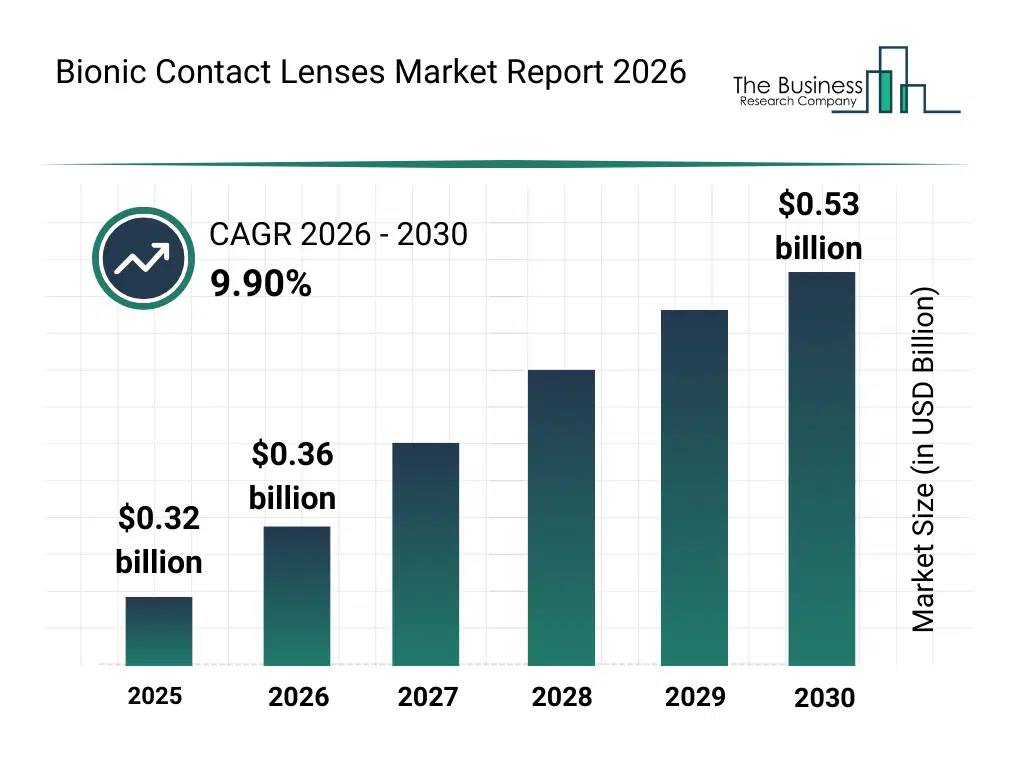
What Is The Bionic Contact Lenses Market Size and Share 2026?
The bionic contact lenses market size has grown rapidly in recent years. It will grow from $0.32 billion in 2025 to $0.36 billion in 2026 at a compound annual growth rate (CAGR) of 11.2%. The growth in the historic period can be attributed to advancement in microelectronic sensor miniaturization, early research initiatives in smart and therapeutic contact lenses, increasing focus on wearable biomedical monitoring solutions, development of multifunctional vision correction lenses, rising investment in ophthalmic technology innovation.What Is The Bionic Contact Lenses Market Growth Forecast?
The bionic contact lenses market size is expected to see strong growth in the next few years. It will grow to $0.53 billion in 2030 at a compound annual growth rate (CAGR) of 9.9%. The growth in the forecast period can be attributed to growing demand for augmented and mixed-reality visual enhancement, increasing interest in continuous health and glucose monitoring lenses, wider adoption across military and professional training applications, rising commercialization of therapeutic and drug-delivery lenses, expanding consumer acceptance of smart wearable eye-care devices. Major trends in the forecast period include increasing development of bionic lenses for vision correction and eye health, rising adoption of smart contact lenses for health and physiological monitoring, growing interest in non-invasive glucose and biomarker tracking through lenses, expansion of bionic contact lenses in military, training, and specialized fields, focus on enhancing user comfort, safety, and wearable lens biocompatibility.
Global Bionic Contact Lenses Market Segmentation
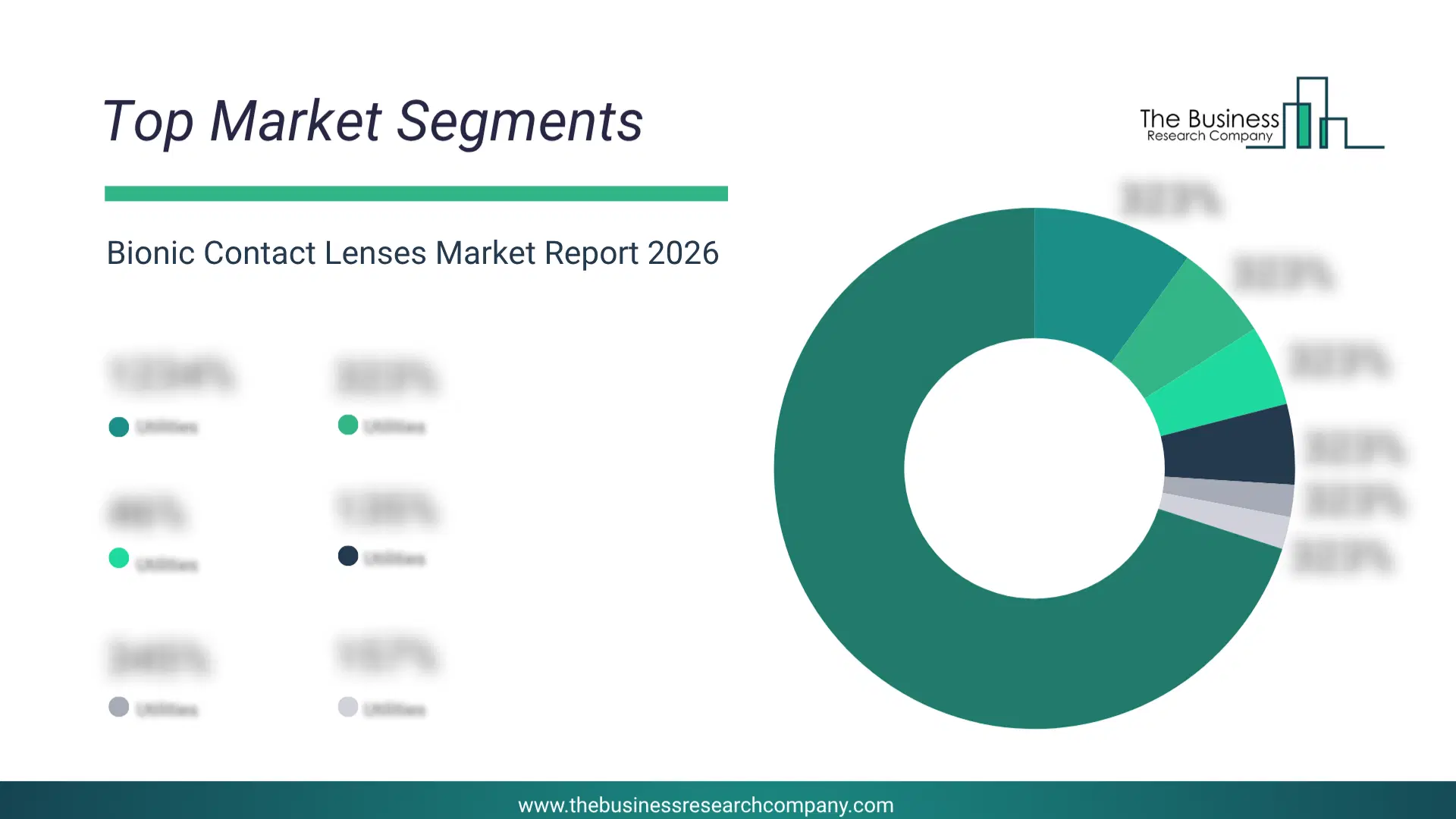
1) By Type: Vision Correction, Therapeutic, Augmented Reality (AR), Virtual Reality (VR) 2) By Application: Medical, Military, Other Applications 3) By Distribution Channel: Hospitals And Clinics, Retail Stores, Online Platforms Subsegments: 1) By Vision Correction: Myopia Correction, Hyperopia Correction, Astigmatism Correction, Presbyopia Correction 2) By Therapeutic: Drug Delivery Lenses, Corneal Healing Lenses, UV Protection Lenses 3) By Augmented Reality (AR): Navigation Assistance, Real-Time Information Display, Facial Recognition 4) By Virtual Reality (VR): Immersive Gaming Lenses, Training Simulation Lenses, Entertainment And Media LensesWhat Is The Driver Of The Bionic Contact Lenses Market?
The increasing prevalence of vision impairments is expected to drive the bionic contact lenses market going forward. Vision impairments refer to conditions that hinder an individual's ability to see clearly, ranging from refractive errors like myopia and hyperopia to severe issues such as cataracts or age-related macular degeneration. Factors contributing to the increasing prevalence of these impairments include aging populations, prolonged screen time, and lifestyle changes. Bionic contact lenses help to reduce the increasing prevalence of vision impairments by offering advanced vision correction and additional functionalities, such as augmented reality, providing individuals with effective solutions to address their visual impairments and improve their quality of life. For instance, in December 2023, according to the National Institutes of Health (NIH), a US-based government agency responsible for conducting and supporting medical research, Ukraine recorded 19,551 individuals diagnosed with vision impairments in 2022, while over 19,000 new cases were reported in just the first seven months of 2023, indicating a continuing high incidence of vision-related conditions. Therefore, the increasing prevalence of vision impairments drives the bionic contact lens market.Key Players In The Global Bionic Contact Lenses Market
Major companies operating in the bionic contact lenses market are Samsung Electronics, Sony Corporation, Alcon Inc., BostonSight, Hoya Corporation, Bausch & Lomb, Santen Pharmaceutical, Johnson & Johnson Vision Care, Verily Life Sciences, OrCam Technologies, Eyenovia Inc., Innovega INC, AlphaMicron Inc., Nano Retina Ltd, SwissLens AG, Bionic Vision Technologies, Inwith Corp., Medella Health, Ocumetrics Bionic Lens, Optobionics Corporation, Sensimed AG, SmartLens Inc., Pixium Vision S.A, Mojo Vision, Fraunhofer IAP, iBionics, Nidek Co Ltd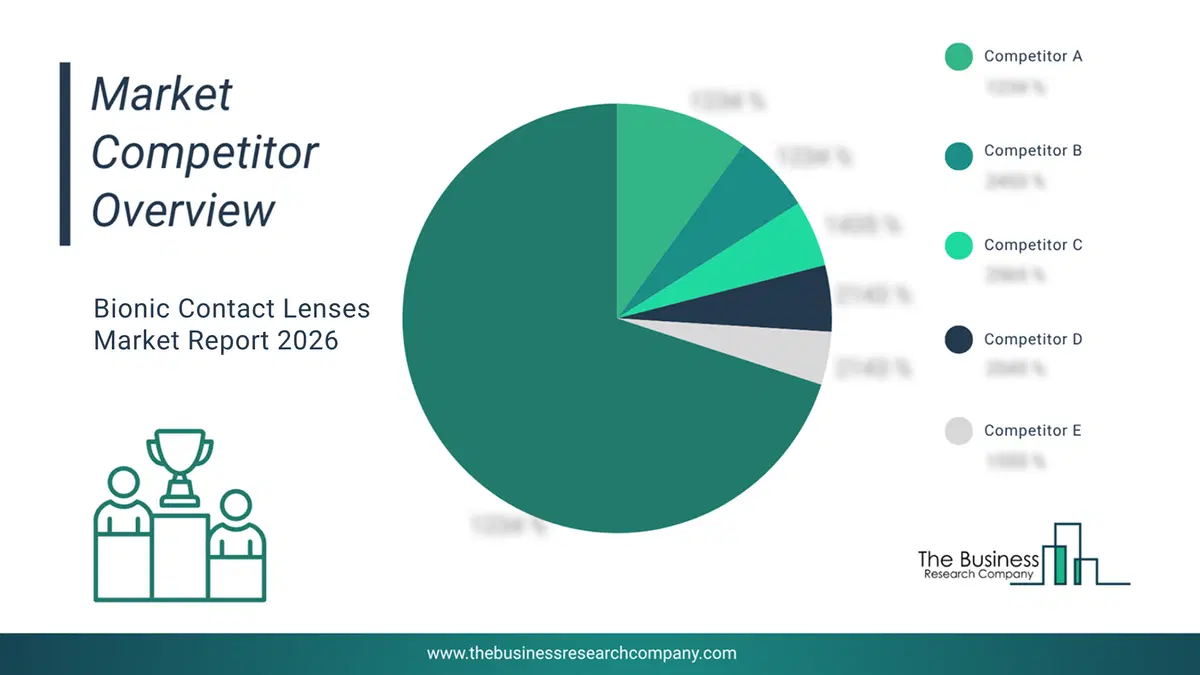
This chart is for illustrative purposes; the full report includes a detailed competitor analysis and comprehensive overview of the top 10 companies in the market.
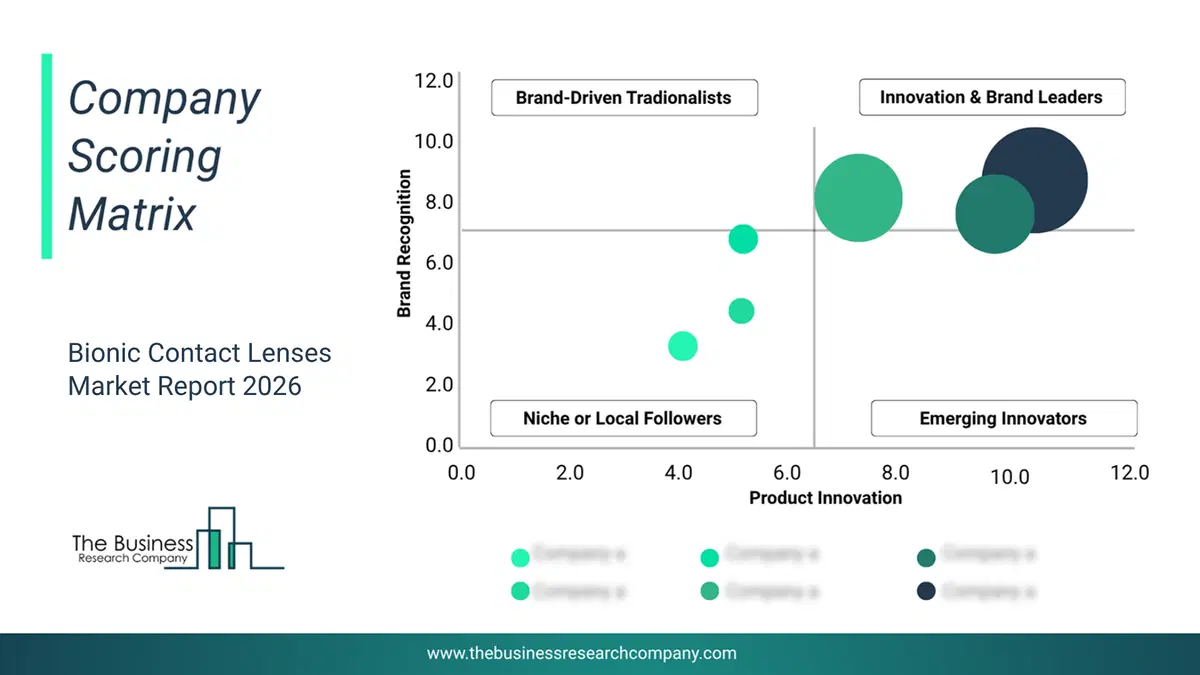
This chart maps companies by product innovation and brand strength, with bubble size indicating relative revenue, helping identify market leaders, challengers, and niche players. This is an illustrative chart; the full report provides a complete and accurate competitive analysis.
Global Bionic Contact Lenses Market Trends and Insights
Major companies operating in the bionic contact lenses market are focusing on the development of soft‑electronic smart contact lenses, such as flexible, sensor-embedded lenses capable of health monitoring and augmented reality (AR) displays, combining comfort with advanced functionality. For instance, in March 2025, XPANCEO, a Dubai‑based deep‑tech company, introduced three new smart contact lens prototypes, a lens with a wireless powering companion (offering fully remote power transfer with twice the range of prior solutions), a biosensing lens that monitors biomarkers in tear fluid (such as glucose, hormones, and vitamins), and a lens with an intraocular pressure (IOP) sensor that uses an AI‑powered app to detect glaucoma in real time.What Are Latest Mergers And Acquisitions In The Bionic Contact Lenses Market?
In September 2024, XPANCEO, a United Arab Emirates–based deep-tech company developing AR smart contact lenses as a next-generation computing platform, entered into a strategic partnership with Jade Bird Display (JBD) to co-develop integrated micro-LED displays for XPANCEO’s smart contact lens platform. With this partnership, the strategic objective is to embed JBD’s ultra-low-power, high-brightness MicroLED microdisplays directly into XPANCEO’s lenses to create augmented-reality bionic contact lenses that can project high-quality images while maintaining sub-millimeter lens thickness and microwatt-level power consumption, enabling all-day wearable AR contact lenses for applications across extended reality, healthcare, and personalized information display. Jade Bird Display is a China-based micro-LED display technology company.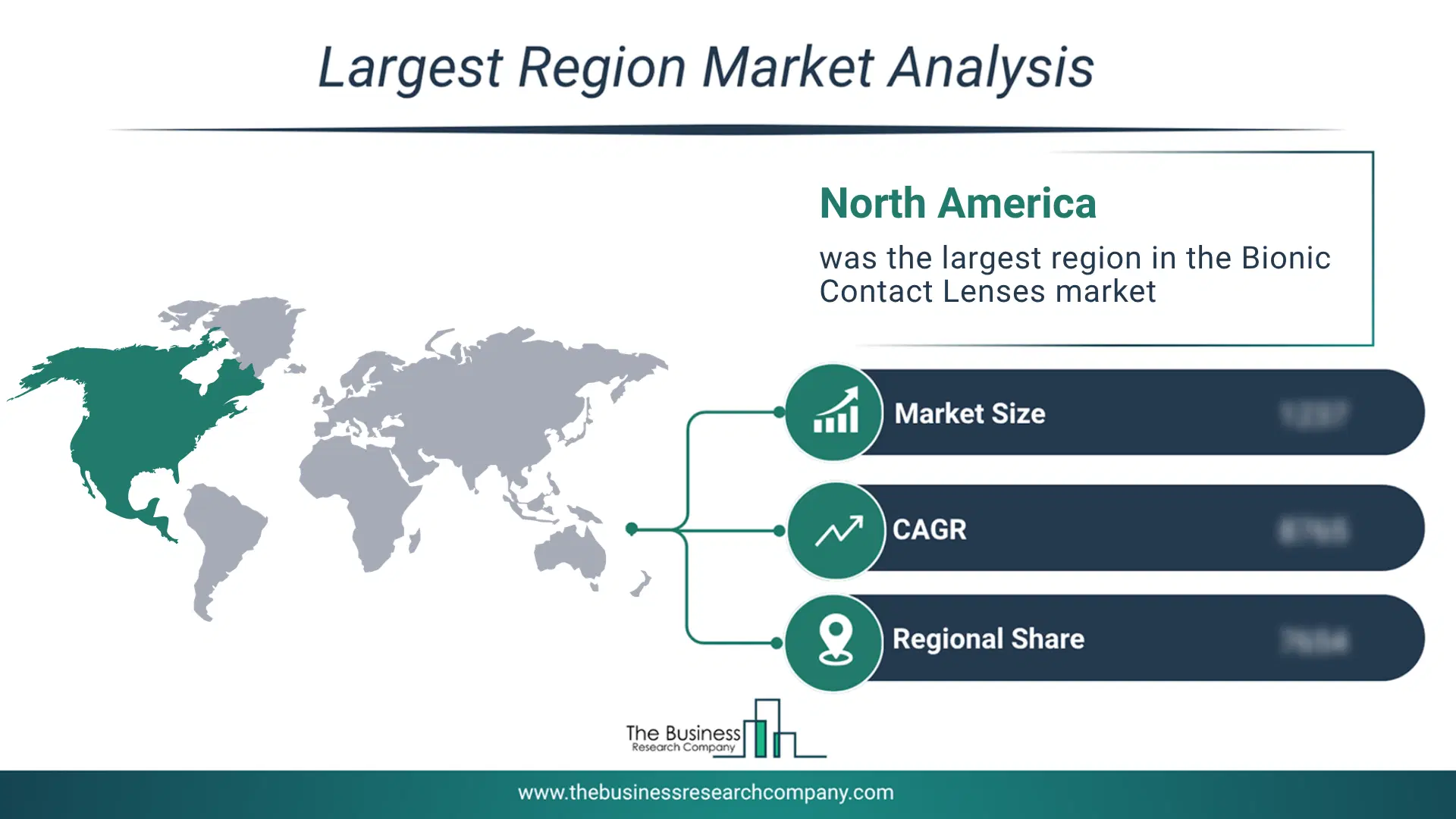
Regional Outlook
North America was the largest region in the bionic contact lenses market in 2025. The regions covered in this market report are Asia-Pacific, South East Asia, Western Europe, Eastern Europe, North America, South America, Middle East, Africa. The countries covered in this market report are Australia, Brazil, China, France, Germany, India, Indonesia, Japan, Taiwan, Russia, South Korea, UK, USA, Canada, Italy, SpainWhat Defines the Bionic Contact Lenses Market?
The bionic contact lenses market consists of revenues earned by entities by providing services, such as ophthalmic consultations, fitting and customization services, aftercare and maintenance services, telehealth support, software updates for augmented reality (AR) integration, and data analytics services. The market value includes the value of related goods sold by the service provider or included within the service offering. The bionic contact lenses market also includes sales of products, such as biometric lenses, UV protection lenses, night vision-enhancing lenses, color blindness lenses, sports performance enhancement lenses, and lenses with integrated communication capabilities. Values in this market are ‘factory gate’ values, that is the value of goods sold by the manufacturers or creators of the goods, whether to other entities (including downstream manufacturers, wholesalers, distributors and retailers) or directly to end customers. The value of goods in this market includes related services sold by the creators of the goods.How is Market Value Defined and Measured?
The market value is defined as the revenues that enterprises gain from the sale of goods and/or services within the specified market and geography through sales, grants, or donations in terms of the currency (in USD unless otherwise specified). The revenues for a specified geography are consumption values that are revenues generated by organizations in the specified geography within the market, irrespective of where they are produced. It does not include revenues from resales along the supply chain, either further along the supply chain or as part of other products.
This chart presents market attractiveness based on a quantitative evaluation of growth, competition, strategic alignment, and risk, offering a clear view of opportunity areas for decision-making. This chart is for illustrative purposes; the full report contains the complete analysis.

This chart highlights the Total Addressable Market (TAM) by estimating the maximum revenue opportunity using an assumption-driven approach, supporting strategic planning and opportunity sizing across markets. The chart is illustrative; the full report provides a more comprehensive analysis.
What Key Data and Analysis Are Included in the Bionic Contact Lenses Market Report 2026?
The bionic contact lenses market research report is one of a series of new reports from The Business Research Company that provides market statistics, including industry global market size, regional shares, competitors with the market share, detailed market segments, market trends and opportunities, and any further data you may need to thrive in the bionic contact lenses industry. The market research report delivers a complete perspective of everything you need, with an in-depth analysis of the current and future state of the industry.Bionic Contact Lenses Market Report Forecast Analysis
| Report Attribute | Details |
|---|---|
| Market Size Value In 2026 | $0.36 billion |
| Revenue Forecast In 2030 | $0.53 billion |
| Growth Rate | CAGR of 9.9% from 2026 to 2030 |
| Base Year For Estimation | 2025 |
| Actual Estimates/Historical Data | 2020-2025 |
| Forecast Period | 2026 - 2030 |
| Market Representation | Revenue in USD Billion and CAGR from 2026 to 2030 |
| Segments Covered | Type, Application, Distribution Channel |
| Regional Scope | Asia-Pacific, Western Europe, Eastern Europe, North America, South America, Middle East, Africa |
| Country Scope | The countries covered in the report are Australia, Brazil, China, France, Germany, India, Indonesia, Japan, Taiwan, Russia, South Korea, UK, USA, Canada, Italy, Spain. |
| Key Companies Profiled | Samsung Electronics, Sony Corporation, Alcon Inc., BostonSight, Hoya Corporation, Bausch & Lomb, Santen Pharmaceutical, Johnson & Johnson Vision Care, Verily Life Sciences, OrCam Technologies, Eyenovia Inc., Innovega INC, AlphaMicron Inc., Nano Retina Ltd, SwissLens AG, Bionic Vision Technologies, Inwith Corp., Medella Health, Ocumetrics Bionic Lens, Optobionics Corporation, Sensimed AG, SmartLens Inc., Pixium Vision S.A, Mojo Vision, Fraunhofer IAP, iBionics, Nidek Co Ltd |
| Customization Scope | Request for Customization |
| Pricing And Purchase Options | Explore Purchase Options |