
Biopharmaceutical Lab Equipment Market Report 2026
Global Outlook – By Product Type (Chromatography Systems, Mass Spectrometers, Polymerase Chain Reaction (PCR) Equipment, Cell Culture Systems, Microscopes, Other Product Types), By Technology (Single-Use Technology, Continuous Processing Technology, Cell Culture Technology, Filtration Technology, High-Throughput Screening Technology), By Size Of Lab (Small Scale Labs, Medium Scale Labs, Large Scale Labs), By Application (Drug Discovery, Clinical Diagnostics, Research And Development, Quality Control, Other Applications), By End-User (Pharmaceutical Companies, Biotechnology Companies, Academic And Research Institutes, Other End-Users) – Market Size, Trends, Strategies, and Forecast to 2035
Biopharmaceutical Lab Equipment Market Overview
• Biopharmaceutical Lab Equipment market size has reached to $17.77 billion in 2025 • Expected to grow to $25.72 billion in 2030 at a compound annual growth rate (CAGR) of 7.6% • Growth Driver: The Increasing Emphasis On Personalized Medicine Is Driving The Growth Of The Market Due To Advances In Genomic Sequencing And Targeted Therapies • Market Trend: Advancements In High-Resolution Mass Analysis For Enhanced Laboratory Efficiency And Precision Research • North America was the largest region in 2025 and Asia-Pacific is the fastest growing region.What Is Covered Under Biopharmaceutical Lab Equipment Market?
Biopharmaceutical lab equipment refers to instruments and devices designed to support the development, testing, and analysis of biopharmaceutical products. It enables precise measurement, control, and manipulation of biological and chemical processes. Biopharmaceutical lab equipment enhances experimental accuracy and reproducibility, ensuring reliable results. Its core function revolves around facilitating efficient and high-quality research in biopharmaceutical sciences. The main product types of biopharmaceutical lab equipment are chromatography systems, mass spectrometers, polymerase chain reaction (PCR) equipment, cell culture systems, microscopes, and others. Chromatography systems are used to separate, identify, and purify components in complex biological mixtures, enabling precise analysis and production in biopharmaceutical laboratories. The technologies include single-use technology, continuous processing technology, cell culture technology, filtration technology, and high-throughput screening technology, and labs are categorized by size into small-scale labs, medium-scale labs, and large-scale labs. It is applied in various applications encompassing drug discovery, clinical diagnostics, research and development, quality control, and others, and is used by several end-users, including pharmaceutical companies, biotechnology companies, academic and research institutes, and others.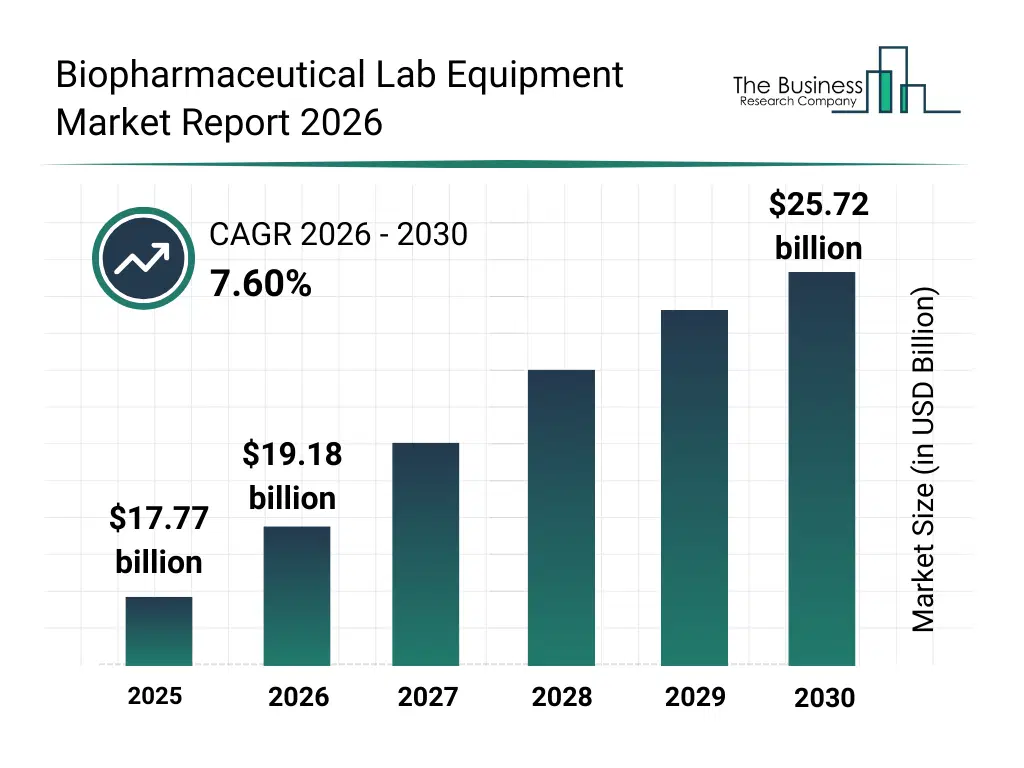
What Is The Biopharmaceutical Lab Equipment Market Size and Share 2026?
The biopharmaceutical lab equipment market size has grown strongly in recent years. It will grow from $17.77 billion in 2025 to $19.18 billion in 2026 at a compound annual growth rate (CAGR) of 7.9%. The growth in the historic period can be attributed to expansion of biopharmaceutical research pipelines, increased laboratory automation adoption, growing investment in life sciences infrastructure, reliance on chromatography and pcr technologies, standardization of quality control processes.What Is The Biopharmaceutical Lab Equipment Market Growth Forecast?
The biopharmaceutical lab equipment market size is expected to see strong growth in the next few years. It will grow to $25.72 billion in 2030 at a compound annual growth rate (CAGR) of 7.6%. The growth in the forecast period can be attributed to growing biologics and cell therapy development, rising demand for continuous processing technologies, expansion of large-scale biopharma labs, increased integration of ai-driven analytics, growing focus on operational efficiency in laboratories. Major trends in the forecast period include increasing adoption of single-use lab equipment, rising deployment of automated analytical instruments, growing demand for high-throughput testing systems, expansion of advanced cell culture platforms, enhanced focus on data integrity and reproducibility.
Global Biopharmaceutical Lab Equipment Market Segmentation
1) By Product Type: Chromatography Systems, Mass Spectrometers, Polymerase Chain Reaction (PCR) Equipment, Cell Culture Systems, Microscopes, Other Product Types 2) By Technology: Single-Use Technology, Continuous Processing Technology, Cell Culture Technology, Filtration Technology, High-Throughput Screening Technology 3) By Size Of Lab: Small Scale Labs, Medium Scale Labs, Large Scale Labs 4) By Application: Drug Discovery, Clinical Diagnostics, Research And Development, Quality Control, Other Applications 5) By End-User: Pharmaceutical Companies, Biotechnology Companies, Academic And Research Institutes, Other End-Users Subsegments: 1) By Chromatography Systems: High-Performance Liquid Chromatography (HPLC), Gas Chromatography (GC), Ion Exchange Chromatography, Affinity Chromatography, Size Exclusion Chromatography (SEC), Thin Layer Chromatography (TLC) 2) By Mass Spectrometers: Time-Of-Flight Mass Spectrometer (TOF-MS), Quadrupole Mass Spectrometer, Ion Trap Mass Spectrometer, Fourier Transform Ion Cyclotron Resonance (FT-ICR) Mass Spectrometer, Orbitrap Mass Spectrometer 3) By Polymerase Chain Reaction (PCR) Equipment: Real-Time Polymerase Chain Reaction (qPCR) Machines, Digital Polymerase Chain Reaction (dPCR) Systems, Conventional Thermocyclers, Polymerase Chain Reaction (PCR) Workstations 4) By Cell Culture Systems: Bioreactors, Incubators, Laminar Flow Cabinets, Automated Cell Culture Systems, CO2 Incubators 5) By Microscopes: Optical Microscopes, Electron Microscopes, Fluorescence Microscopes, Confocal Microscopes 6) By Other Product Types: Spectrophotometers, Microplate Readers, Autoclaves, Centrifuges, Freeze DryersWhat Is The Driver Of The Biopharmaceutical Lab Equipment Market?
The increasing emphasis on personalized medicine is expected to propel the growth of the biopharmaceutical lab equipment market going forward. Personalized medicine is an approach to patient care that tailors treatment and prevention strategies based on individual differences in patients' genes, environments, and lifestyles. The growing adoption of personalized medicine is driven by advances in genomic sequencing technologies and data analytics, which enable healthcare providers to develop more precise diagnostic tools and targeted therapies for individual patients. This shift toward precision-based healthcare requires sophisticated laboratory equipment capable of analyzing genetic information, developing targeted therapies, and supporting clinical research for individualized treatments. For instance, in February 2024, according to the Personalized Medicine Coalition, a US-based hospital and health care organization, in 2023, the FDA approved 16 new personalized treatments for rare disease patients, up from six in 2022. Therefore, the increasing emphasis on personalized medicine is driving the growth of the biopharmaceutical lab equipment industry.Key Players In The Global Biopharmaceutical Lab Equipment Market
Major companies operating in the biopharmaceutical lab equipment market are Thermo Fisher Scientific Inc., Danaher Corporation, Merck KGaA, GE HealthCare Technologies Inc., Agilent Technologies Inc., Hitachi High-Tech Corporation, Illumina Inc., Mettler-Toledo International Inc., Shimadzu Corporation, Bruker Corporation, Waters Corporation, Horiba Ltd., Eppendorf SE, Tecan Group Ltd., Hamilton Company, Oxford Instruments plc, Telstar SA, Advanced Instruments LLC, PBS Biotech Inc., Logos Biosystems Inc., Napro Scientific Inc., Accumax Lab Devices Pvt. Ltd.Global Biopharmaceutical Lab Equipment Market Trends and Insights
Major companies operating in the biopharmaceutical lab equipment market are focusing on developing innovative products, such as high-resolution mass analysis systems to enhance testing accuracy, streamline workflows, and improve overall laboratory efficiency. A high-resolution mass analysis system is an advanced instrument that accurately measures the mass-to-charge ratio of ions to identify and quantify complex molecules with high sensitivity and resolution for applications in proteomics, pharmaceuticals, and chemical analysis. For instance, in June 2025, Thermo Fisher Scientific, a US-based life sciences company, launched next-generation mass spectrometry instruments featuring Thermo Scientific OptiSpray technology. These instruments deliver exceptional speed and sensitivity for detecting proteins, metabolites, and other biomolecules, facilitating advanced precision medicine research. Its key features include high-resolution mass analysis, streamlined workflows for multiomics studies, intuitive software for data processing, robust automation for sample handling, and flexible integration with environmental and food safety research applications, enabling researchers to generate reproducible and high-quality data while accelerating discovery in complex disease studies.What Are Latest Mergers And Acquisitions In The Biopharmaceutical Lab Equipment Market?
In July 2025, Advanced Instruments LLC, a US-based manufacturing company, acquired Nova Biomedical Corporation for an undisclosed amount. Through this acquisition, Advanced Instruments aims to create a global life science platform under the Nova Biomedical name that combines complementary technologies, expands global reach, accelerates innovation, and delivers customer value in biopharmaceutical and clinical markets to improve patient care and drive long-term profitable growth. Nova Biomedical Corporation is a US-based technology company that offers biopharmaceutical lab equipment.Regional Insights
North America was the largest region in the biopharmaceutical lab equipment market in 2025. Asia-Pacific is expected to be the fastest-growing region in the forecast period. The regions covered in this market report are Asia-Pacific, South East Asia, Western Europe, Eastern Europe, North America, South America, Middle East, Africa. The countries covered in this market report are Australia, Brazil, China, France, Germany, India, Indonesia, Japan, Taiwan, Russia, South Korea, UK, USA, Canada, Italy, Spain.What Defines the Biopharmaceutical Lab Equipment Market?
The biopharmaceutical lab equipment market consists of sales of centrifuges, bioreactors, incubators, autoclaves, spectrophotometers, freezers, pipettes, microplate readers, liquid handling robots, analytical balances, and biosafety cabinets. Values in this market are ‘factory gate’ values, that is, the value of goods sold by the manufacturers or creators of the goods, whether to other entities (including downstream manufacturers, wholesalers, distributors, and retailers) or directly to end customers. The value of goods in this market includes related services sold by the creators of the goods.How is Market Value Defined and Measured?
The market value is defined as the revenues that enterprises gain from the sale of goods and/or services within the specified market and geography through sales, grants, or donations in terms of the currency (in USD unless otherwise specified). The revenues for a specified geography are consumption values that are revenues generated by organizations in the specified geography within the market, irrespective of where they are produced. It does not include revenues from resales along the supply chain, either further along the supply chain or as part of other products.What Key Data and Analysis Are Included in the Biopharmaceutical Lab Equipment Market Report 2026?
The biopharmaceutical lab equipment market research report is one of a series of new reports from The Business Research Company that provides market statistics, including industry global market size, regional shares, competitors with the market share, detailed market segments, market trends and opportunities, and any further data you may need to thrive in the biopharmaceutical lab equipment industry. The market research report delivers a complete perspective of everything you need, with an in-depth analysis of the current and future state of the industry.Biopharmaceutical Lab Equipment Market Report Forecast Analysis
| Report Attribute | Details |
|---|---|
| Market Size Value In 2026 | $19.18 billion |
| Revenue Forecast In 2035 | $25.72 billion |
| Growth Rate | CAGR of 7.9% from 2026 to 2035 |
| Base Year For Estimation | 2025 |
| Actual Estimates/Historical Data | 2020-2025 |
| Forecast Period | 2026 - 2030 - 2035 |
| Market Representation | Revenue in USD Billion and CAGR from 2026 to 2035 |
| Segments Covered | Product Type, Technology, Size Of Lab, Application, End-User |
| Regional Scope | Asia-Pacific, Western Europe, Eastern Europe, North America, South America, Middle East, Africa |
| Country Scope | The countries covered in the report are Australia, Brazil, China, France, Germany, India, ... |
| Key Companies Profiled | Thermo Fisher Scientific Inc., Danaher Corporation, Merck KGaA, GE HealthCare Technologies Inc., Agilent Technologies Inc., Hitachi High-Tech Corporation, Illumina Inc., Mettler-Toledo International Inc., Shimadzu Corporation, Bruker Corporation, Waters Corporation, Horiba Ltd., Eppendorf SE, Tecan Group Ltd., Hamilton Company, Oxford Instruments plc, Telstar SA, Advanced Instruments LLC, PBS Biotech Inc., Logos Biosystems Inc., Napro Scientific Inc., Accumax Lab Devices Pvt. Ltd. |
| Customization Scope | Request for Customization |
| Pricing And Purchase Options | Explore Purchase Options |