
Biopolymers Market Report 2026
Global Outlook – By Product (Polylactic Acid (PLA), Polyhydroxyalkanoates (PHA), Biodegradable Polyesters, Biodegradable Starch-Based Polymers, Protein-Based Biopolymers, Cellulose-Based Biopolymers), By Application (Films and Sheets, Rigid Packaging Products, Fibers and Textiles, Agricultural Applications, Medical Applications (Implants, Sutures, Drug Delivery), Consumer Goods, Other Applications), By End-Use Industry (Packaging, Agriculture, Healthcare and Medical, Consumer Goods, Textiles, Other End-Use Industries) – Market Size, Trends, Strategies, and Forecast to 2030
Biopolymers Market Overview
• Biopolymers market size has reached to $19.52 billion in 2025 • Expected to grow to $36.42 billion in 2030 at a compound annual growth rate (CAGR) of 13.3% • Growth Driver: Rising Awareness Of Plastic Pollution Fuels Growth In The Biopolymer Market • Market Trend: Advancements In Biopolymer Technology • Asia-Pacific was the largest region and fastest growing region.What Is Covered Under Biopolymers Market?
A biopolymer is a natural polymer produced by living organisms, such as proteins, nucleic acids, or polysaccharides. It is biodegradable and environmentally friendly, often used in packaging, agriculture, and medical applications. Biopolymers offer a sustainable alternative to synthetic polymers, reducing plastic waste and reliance on fossil fuels. The main products of biopolymers are biopolyethylene terephthalate, biopolyethylene, biodegradable polyesters, biodegradable starch blends, polylactic acid, polytrimethylene terephthalate, polyhydroxyalkanoates, and others. Bio-polyethylene terephthalate (Bio-PET) is a biopolymer derived from renewable resources such as sugarcane. The various applications include films, bottles, fibers, seed coating, vehicle components, medical implants, and others for varying end-uses such as packaging, consumer goods, automotive, textiles, agriculture, and others.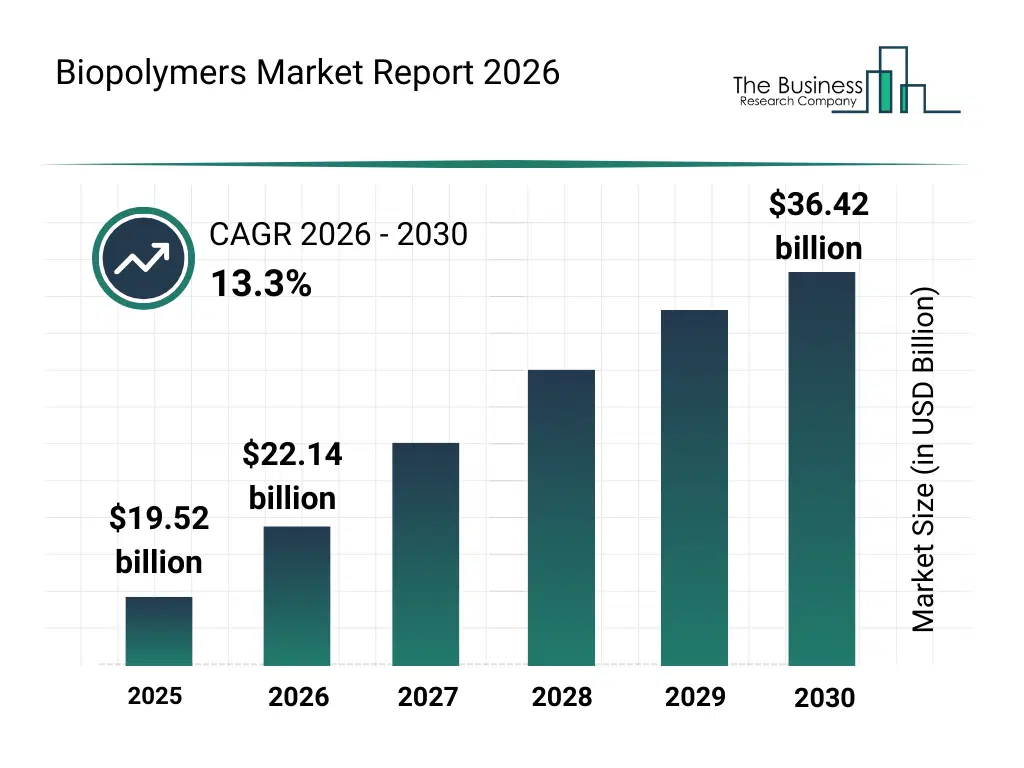
What Is The Biopolymers Market Size and Share 2026?
The biopolymers market size has grown rapidly in recent years. It will grow from $19.52 billion in 2025 to $22.14 billion in 2026 at a compound annual growth rate (CAGR) of 13.4%. The growth in the historic period can be attributed to regulatory pressure on plastic waste, volatility in fossil fuel prices, early adoption in packaging industry, government funding for bio materials research, consumer awareness of environmental impact.What Is The Biopolymers Market Growth Forecast?
The biopolymers market size is expected to see rapid growth in the next few years. It will grow to $36.42 billion in 2030 at a compound annual growth rate (CAGR) of 13.3%. The growth in the forecast period can be attributed to stringent single use plastic bans, scale up of biopolymer production capacity, cost reduction through feedstock innovation, growing demand from automotive lightweighting, increased investment in bio based circular economy. Major trends in the forecast period include increasing adoption of biodegradable packaging materials, rising use of biopolymers in agricultural films and seed coatings, growing demand for bio based medical implants, expansion of compostable consumer goods, improved material performance through polymer blending.
Global Biopolymers Market Segmentation
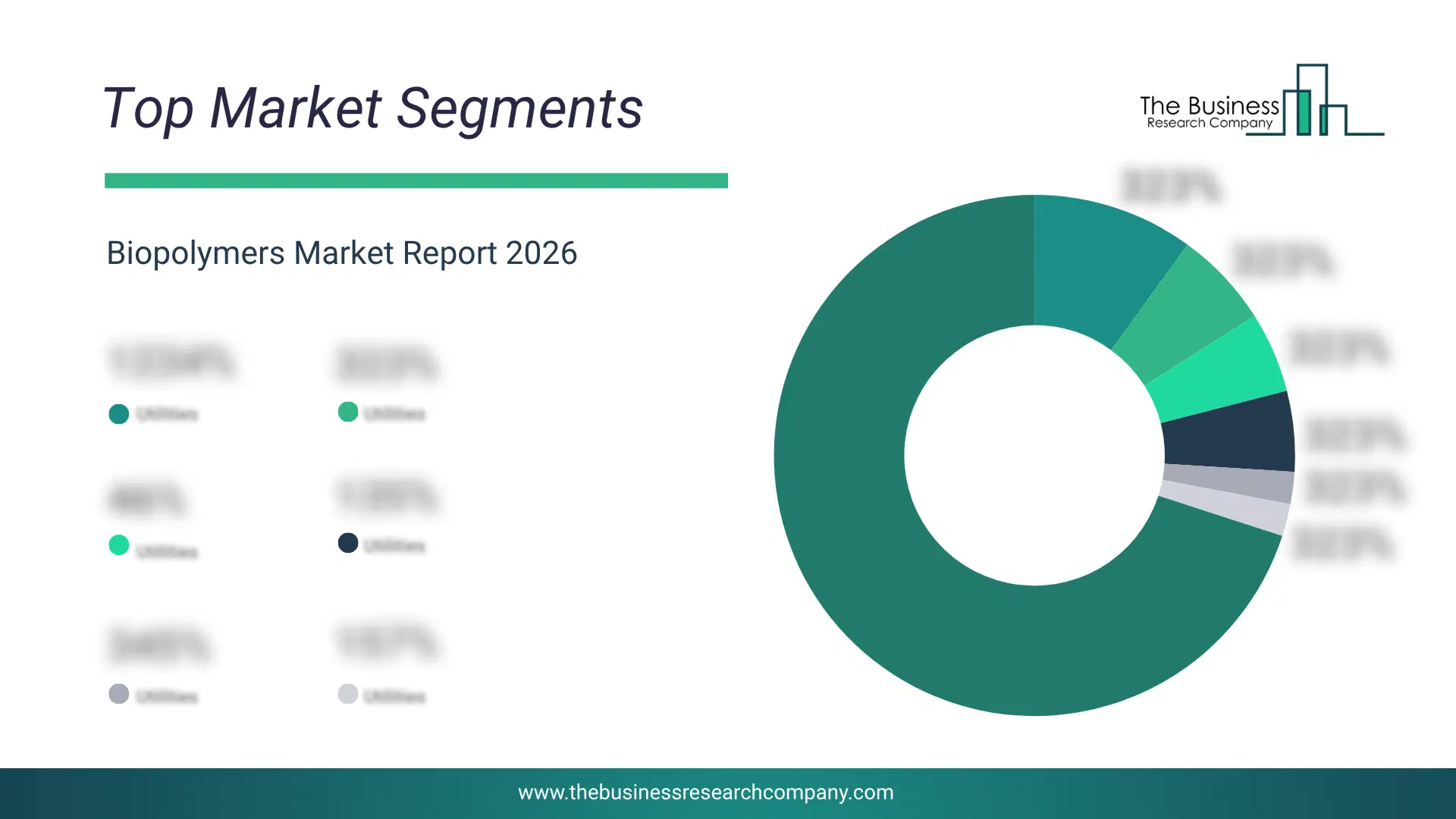
1) By Product: Polylactic Acid (PLA), Polyhydroxyalkanoates (PHA), Biodegradable Polyesters, Biodegradable Starch-Based Polymers, Protein-Based Biopolymers, Cellulose-Based Biopolymers 2) By Application: Films and Sheets, Rigid Packaging Products, Fibers and Textiles, Agricultural Applications, Medical Applications (Implants, Sutures, Drug Delivery), Consumer Goods, Other Applications 3) By End-Use Industry: Packaging, Agriculture, Healthcare and Medical, Consumer Goods, Textiles, Other End-Use Industries Subsegments: 1) By Polylactic Acid (PLA): Injection-Molded PLA Products, PLA Films and Sheets 2) By Polyhydroxyalkanoates (PHA): Short-Chain-Length PHA, Medium-Chain-Length PHA 3) By Biodegradable Polyesters: Polybutylene Succinate (PBS), Polycaprolactone (PCL), Polybutylene Adipate Terephthalate (PBAT) 4) By Biodegradable Starch-Based Polymers: Thermoplastic Starch (TPS), Starch-Based Polymer Blends 5) By Protein-Based Biopolymers: Silk-Based Biopolymers, Collagen-Based Biopolymers, Gelatin-Based Biopolymers 6) By Cellulose-Based Biopolymers: Cellulose Acetate, Regenerated Cellulose FilmsWhat Is The Driver Of The Biopolymers Market?
The rising awareness of plastic pollution is driving the growth of the biopolymer market going forward. Plastic pollution refers to the accumulation of plastic waste in the environment, causing harm to ecosystems, wildlife, and human health. The rising awareness of plastic pollution is driven by factors such as environmental campaigns, media coverage, scientific research on its long-term impacts, and government regulations. Biopolymers play a role in raising awareness of plastic pollution by offering eco-friendly alternatives and highlighting the need for sustainable solutions to reduce plastic waste. For instance, in June 2024, according to the European Parliament, a European-based government body, the EU adopted new rules to target the issue of plastic marine litter. It includes a 25% target for recycled content in plastic bottles by 2025 and 30% by 2030. Therefore, rising awareness of plastic pollution is driving the growth of the biopolymer industry.Key Players In The Global Biopolymers Market
Major companies operating in the biopolymers market are BASF SE, NatureWorks LLC, Danimer Scientific Inc., Avantium N.V., Novamont S.p.A., Corbion N.V., TotalEnergies Corbion, Mitsubishi Chemical Corporation, Toray Industries Inc., Kuraray Co. Ltd., Teijin Limited, Braskem S.A., Arkema S.A., Solvay S.A., DSM-Firmenich, Evonik Industries AG, PTT Global Chemical Public Company Limited, CJ CheilJedang Corporation, Kaneka Corporation, Rodenburg Biopolymers BV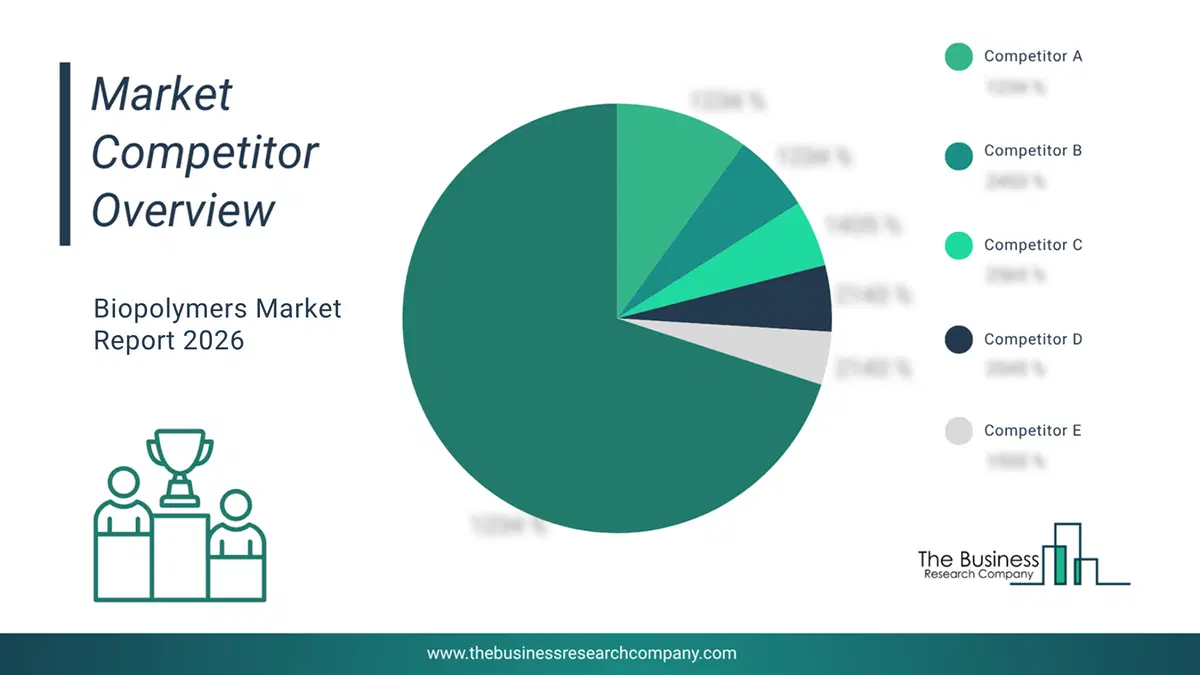
This chart is for illustrative purposes; the full report includes a detailed competitor analysis and comprehensive overview of the top 10 companies in the market.
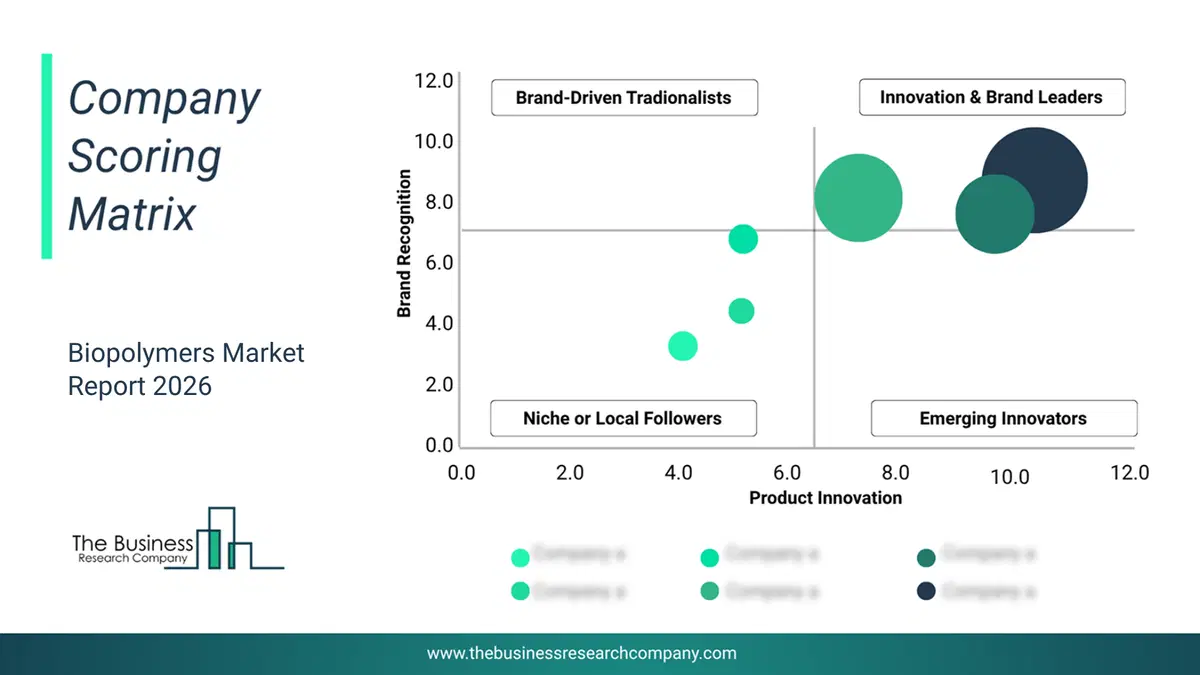
This chart maps companies by product innovation and brand strength, with bubble size indicating relative revenue, helping identify market leaders, challengers, and niche players. This is an illustrative chart; the full report provides a complete and accurate competitive analysis.
Global Biopolymers Market Trends and Insights
Major companies operating in the biopolymer market are developing semi-crystalline polyhydroxyalkanoate (PHA) biopolymers, to improve performance and biodegradability for sustainable applications. A semi-crystalline polyhydroxyalkanoate (PHA) biopolymer is a biodegradable plastic made from natural resources, offering higher heat stability and rigidity compared to its amorphous counterparts. It is used in applications where higher thermal resistance and structural strength are required, such as in packaging, agricultural films, and durable goods. For instance, in May 2024, CJ Biomaterials, a US-based biotechnology company, launched a PHACT S1000P (scPHA). It is a semi-crystalline PHA biopolymer tailored for applications that require high heat stability, offering a more rigid option compared to the company’s previous amorphous PHA (aPHA) products. This combines eco-friendliness with performance, being a bio-based material that is TÜV OK-certified for home and industrial composting, as well as marine and soil biodegradability. It offers a significant step in offering versatile, sustainable solutions for packaging, including food-contact materials.What Are Latest Mergers And Acquisitions In The Biopolymers Market?
In October 2023, Versalis SpA, an Italy-based chemical company, acquired Novamont for an undisclosed amount. Through the acquisition, Versalis aims to accelerate its strategy by integrating a unique and complementary technological platform. This will help decarbonize its product portfolio and support the growth of high-value, multi-product supply chains. Novamont is an Italy-based company focusing on the production of biopolymers and bioplastics.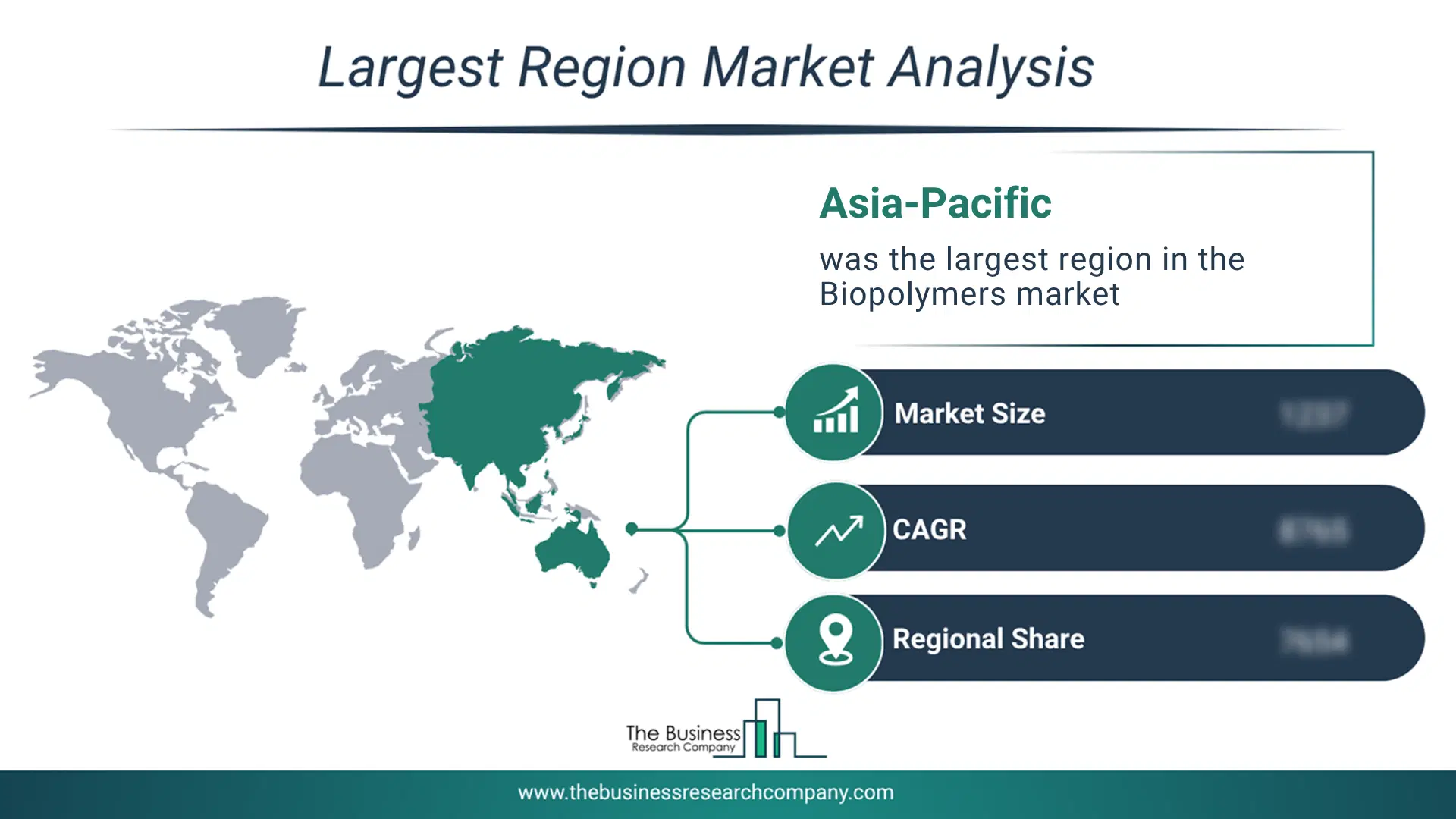
Regional Insights
Asia-Pacific was the largest region in the biopolymer market in 2025, and is expected to be the fastest-growing region in the forecast period. The regions covered in this market report are Asia-Pacific, South East Asia, Western Europe, Eastern Europe, North America, South America, Middle East, Africa The countries covered in this market report are Australia, Brazil, China, France, Germany, India, Indonesia, Japan, Taiwan, Russia, South Korea, UK, USA, Canada, Italy, SpainWhat Defines the Biopolymers Market?
The biopolymer market consists of sales of chitosan, cellulose-biopolymers, and polycaprolactone (PCL). Values in this market are ‘factory gate’ values, that is, the value of goods sold by the manufacturers or creators of the goods, whether to other entities (including downstream manufacturers, wholesalers, distributors, and retailers) or directly to end customers. The value of goods in this market includes related services sold by the creators of the goods.How is Market Value Defined and Measured?
The market value is defined as the revenues that enterprises gain from the sale of goods and/or services within the specified market and geography through sales, grants, or donations in terms of the currency (in USD unless otherwise specified). The revenues for a specified geography are consumption values that are revenues generated by organizations in the specified geography within the market, irrespective of where they are produced. It does not include revenues from resales along the supply chain, either further along the supply chain or as part of other products.
This chart presents market attractiveness based on a quantitative evaluation of growth, competition, strategic alignment, and risk, offering a clear view of opportunity areas for decision-making. This chart is for illustrative purposes; the full report contains the complete analysis.

This chart highlights the Total Addressable Market (TAM) by estimating the maximum revenue opportunity using an assumption-driven approach, supporting strategic planning and opportunity sizing across markets. The chart is illustrative; the full report provides a more comprehensive analysis.
What Key Data and Analysis Are Included in the Biopolymers Market Report 2026?
The biopolymers market research report is one of a series of new reports from The Business Research Company that provides market statistics, including industry global market size, regional shares, competitors with the market share, detailed market segments, market trends and opportunities, and any further data you may need to thrive in the biopolymers industry. The market research report delivers a complete perspective of everything you need, with an in-depth analysis of the current and future state of the industry.Biopolymers Market Report Forecast Analysis
| Report Attribute | Details |
|---|---|
| Market Size Value In 2026 | $22.14 billion |
| Revenue Forecast In 2030 | $36.42 billion |
| Growth Rate | CAGR of 13.4% from 2026 to 2030 |
| Base Year For Estimation | 2025 |
| Actual Estimates/Historical Data | 2020-2025 |
| Forecast Period | 2026 - 2030 |
| Market Representation | Revenue in USD Billion and CAGR from 2026 to 2030 |
| Segments Covered | Product, Application, End-Use Industry |
| Regional Scope | Asia-Pacific, Western Europe, Eastern Europe, North America, South America, Middle East, Africa |
| Country Scope | The countries covered in this market report are Australia, Brazil, China, France, Germany, India, Indonesia, Japan, Taiwan, Russia, South Korea, UK, USA, Canada, Italy, Spain |
| Key Companies Profiled | BASF SE, NatureWorks LLC, Danimer Scientific Inc., Avantium N.V., Novamont S.p.A., Corbion N.V., TotalEnergies Corbion, Mitsubishi Chemical Corporation, Toray Industries Inc., Kuraray Co. Ltd., Teijin Limited, Braskem S.A., Arkema S.A., Solvay S.A., DSM-Firmenich, Evonik Industries AG, PTT Global Chemical Public Company Limited, CJ CheilJedang Corporation, Kaneka Corporation, Rodenburg Biopolymers BV |
| Customization Scope | Request for Customization |
| Pricing And Purchase Options | Explore Purchase Options |