

Bioprocessing Monitoring Market Report 2026
Global Outlook – By Process Type (Upstream Bioprocess Monitoring, Downstream Bioprocess Monitoring), By Monitoring Parameter (pH, Oxygen, Temperature, Conductivity, Turbidity, Glucose, Lactate, Amino Acids), By Sensor Type (Optical, Electrochemical, Thermal, Acoustic, Electromagnetic, Biosensors), By Monitoring Method (Online, Offline), By End User (Biopharmaceutical Companies, Food And Beverage Companies, Research Institutes, Environmental Monitoring Agencies) – Market Size, Trends, Strategies, and Forecast to 2030
Bioprocessing Monitoring Market Overview
• Bioprocessing Monitoring market size has reached to $11.55 billion in 2025 • Expected to grow to $18.63 billion in 2030 at a compound annual growth rate (CAGR) of 10% • Growth Driver: Growing Adoption Of Personalized Medicine Driving The Market Growth Due To Rising Demand For Precise, Patient-Specific Biologics Production • Market Trend: Advancements In Cloud-Based Real-Time Bioprocess Analytics Enabling AI-Driven Optimization • North America was the largest region in 2025 and Asia-Pacific is the fastest growing region.What Is Covered Under Bioprocessing Monitoring Market?
Bioprocess monitoring is the continuous measurement and analysis of key biological, chemical, and physical parameters during a bioprocess. It helps maintain optimal process conditions by ensuring stability, consistency, and control throughout the biological production cycle. It enables early detection of deviations to support timely adjustments and improved process reliability. The main process types of bioprocessing monitoring include upstream bioprocess monitoring and downstream bioprocess monitoring. Upstream bioprocess monitoring refers to the monitoring of biological processes during cell culture and fermentation stages to ensure optimal production conditions. These systems monitor parameters such as pH, oxygen, temperature, conductivity, turbidity, glucose, lactate, and amino acids and use sensor types including optical, electrochemical, thermal, acoustic, electromagnetic, and biosensors. They are deployed through online and offline monitoring methods and are used by several end users such as biopharmaceutical companies, food and beverage companies, research institutes, and environmental monitoring agencies.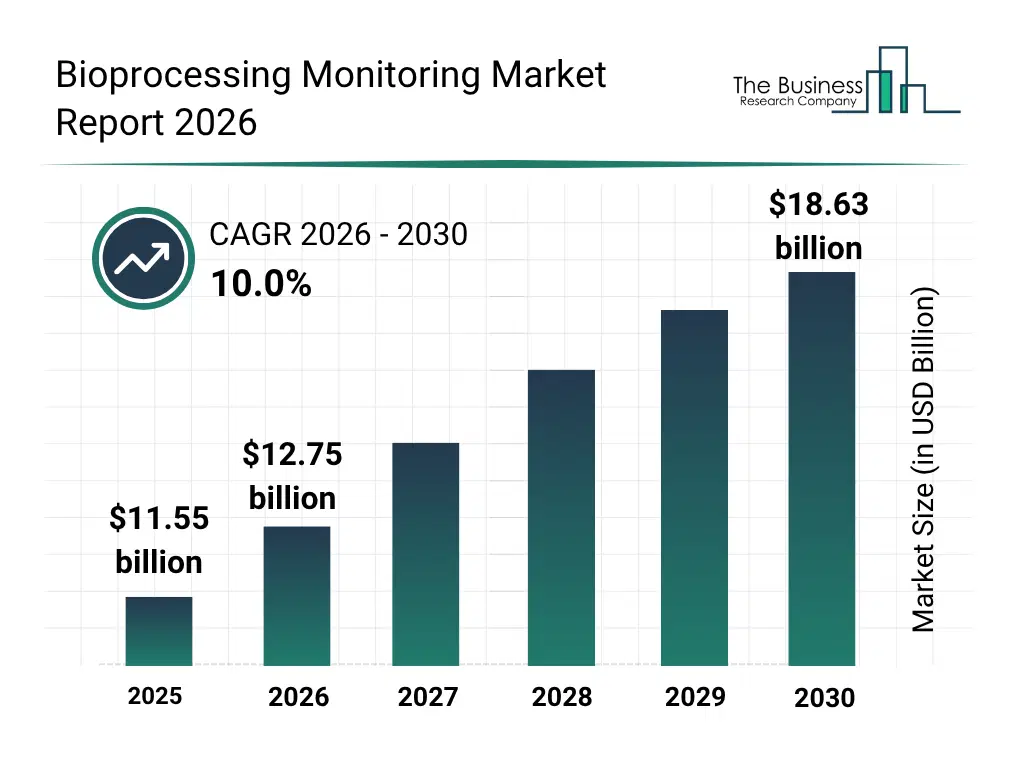
What Is The Bioprocessing Monitoring Market Size and Share 2026?
The bioprocessing monitoring market size has grown rapidly in recent years. It will grow from $11.55 billion in 2025 to $12.75 billion in 2026 at a compound annual growth rate (CAGR) of 10.4%. The growth in the historic period can be attributed to rise in biologics manufacturing demand driving need for process control, increasing regulatory emphasis on gmp compliant production monitoring, expansion of industrial fermentation in pharmaceuticals and food sectors, growing adoption of automated bioreactors in research labs, need for improved batch consistency and yield optimization in traditional bioprocessing.What Is The Bioprocessing Monitoring Market Growth Forecast?
The bioprocessing monitoring market size is expected to see strong growth in the next few years. It will grow to $18.63 billion in 2030 at a compound annual growth rate (CAGR) of 10.0%. The growth in the forecast period can be attributed to increasing demand for personalized biologics and advanced therapeutics production, expansion of cell and gene therapy manufacturing pipelines, rising focus on continuous bioprocessing and real time quality assurance, growing investments in sustainable and efficient biomanufacturing systems, increasing integration of advanced sensor fusion for predictive process control. Major trends in the forecast period include real time bioreactor parameter tracking for improved yield consistency, adoption of advanced process analytical technology (pat) for inline quality assurance in bioprocessing, increasing use of single use sensor based monitoring systems in flexible manufacturing setups, expansion of aseptic monitoring techniques to enhance contamination control in biologics production, growing integration of high resolution spectroscopy based monitoring for enhanced metabolite and nutrient tracking.
Global Bioprocessing Monitoring Market Segmentation
1) By Process Type: Upstream Bioprocess Monitoring; Downstream Bioprocess Monitoring 2) By Monitoring Parameter: pH; Oxygen; Temperature; Conductivity; Turbidity; Glucose; Lactate; Amino Acids 3) By Sensor Type: Optical; Electrochemical; Thermal; Acoustic; Electromagnetic; Biosensors 4) By Monitoring Method: Online; Offline 5) By End User: Biopharmaceutical Companies; Food And Beverage Companies; Research Institutes; Environmental Monitoring Agencies Subsegments: 1) By Upstream Bioprocess Monitoring: Cell Culture Monitoring; Fermentation Monitoring; Media Preparation Monitoring; Inoculum Development Monitoring; Bioreactor Monitoring; Process Parameter Monitoring; Microbial Growth Monitoring; Nutrient And Metabolite Monitoring; Gas Analysis Monitoring; Sterility Monitoring 2) By Downstream Bioprocess Monitoring: Filtration Monitoring; Centrifugation Monitoring; Chromatography Monitoring; Harvest Monitoring; Purification Monitoring; Buffer Preparation Monitoring; Concentration And Diafiltration Monitoring; Viral Clearance Monitoring; Fill-Finish Monitoring; Quality Control MonitoringWhat Is The Driver Of The Bioprocessing Monitoring Market?
The growing adoption of personalized medicine is expected to propel the growth of the bioprocess monitoring market going forward. Personalized medicine is a medical approach that uses individual genetic and personal data to tailor treatment and improve patient outcomes. Personalized medicine is growing due to advances in genomic sequencing, which enable faster and more affordable analysis of individual genetic profiles for targeted and more effective treatments. Bioprocess monitoring helps personalized medicine by enabling precise control and real-time tracking of biological production processes, ensuring that patient-specific therapies such as biologics and cell-based treatments are consistently safe, effective, and tailored to individual needs. For instance, in February 2024, according to the Personalized Medicine Coalition, a US-based nonprofit organization, in 2023, the FDA approved 16 new personalized treatments for rare disease patients, up from six in 2022, including the newly approved personalized treatments for 2023, which also include seven cancer drugs and three for other diseases and conditions. Therefore, the growing adoption of personalized medicine is driving the growth of the bioprocess monitoring market.Key Players In The Global Bioprocessing Monitoring Market
Major companies operating in the bioprocessing monitoring market are Thermo Fisher Scientific Inc.; Danaher Corporation; Honeywell International Inc.; Emerson Electric Co.; Merck KGaA; Sartorius AG; Agilent Technologies Inc.; Yokogawa Electric Corp.; Waters Corporation; Shimadzu Corporation; Bruker Corporation; Bio-Rad Laboratories Inc.; Endress+Hauser Group Services AG; Repligen Corporation; Eppendorf SE; Nova Biomedical Corporation; Aber Instruments Ltd.; ArgusEye; Adson Biotech; Holloid; Infera; LatchBioGlobal Bioprocessing Monitoring Market Trends and Insights
Major companies operating in the bioprocess monitoring market are focusing on developing innovative solutions such as cloud-based bioprocess analytics platforms to enable real-time process monitoring, centralized data integration, and predictive optimization of biomanufacturing operations. A cloud-based bioprocess analytics platform is a cloud-hosted system that collects and analyzes bioprocess data in real time to improve monitoring, control, and efficiency in biomanufacturing. For instance, in July 2024, Eppendorf AG, a Germany-based life science company, launched BioNsight Cloud, a cloud-based digital platform designed to collect, integrate, and analyze bioprocess data in real time from laboratory and biomanufacturing systems. It enables real-time remote process monitoring, multi-user collaboration, and seamless integration with DataHowLab for advanced, AI-driven analytics to accelerate process understanding and optimization.What Are Latest Mergers And Acquisitions In The Bioprocessing Monitoring Market?
In March 2025, Repligen Corporation, a US-based life sciences company, acquired the Bioprocessing Analytics Portfolio from 908 Devices Inc. for an undisclosed amount. With this acquisition, Repligen aimed to strengthen its bioprocessing analytics portfolio by expanding its process analytical technology capabilities for real-time monitoring and optimization of biologics manufacturing. 908 Devices Inc. is a US-based technology company that offers bioprocess monitoring and develops bioprocess monitoring/PAT solutions.Regional Outlook
North America was the largest region in the bioprocessing monitoring market in 2025. Asia-Pacific is expected to be the fastest-growing region in the forecast period. The regions covered in this market report are Asia-Pacific, South East Asia, Western Europe, Eastern Europe, North America, South America, Middle East, Africa. The countries covered in this market report are Australia, Brazil, China, France, Germany, India, Indonesia, Japan, Taiwan, Russia, South Korea, UK, USA, Canada, Italy, Spain.What Defines the Bioprocessing Monitoring Market?
The bioprocess monitoring market consists of revenues earned by entities by providing services such as data acquisition and process data logging, contamination detection and control monitoring, and bioreactor performance monitoring and optimization. The market value includes the value of related goods sold by the service provider or included within the service offering. The bioprocess monitoring market also includes sales of biomass sensors, carbon dioxide (CO₂) sensors, and flow rate sensors. Values in this market are ‘factory gate’ values, that is, the value of goods sold by the manufacturers or creators of the goods, whether to other entities (including downstream manufacturers, wholesalers, distributors, and retailers) or directly to end customers. The value of goods in this market includes related services sold by the creators of the goods.How is Market Value Defined and Measured?
The market value is defined as the revenues that enterprises gain from the sale of goods and/or services within the specified market and geography through sales, grants, or donations in terms of the currency (in USD unless otherwise specified). The revenues for a specified geography are consumption values that are revenues generated by organizations in the specified geography within the market, irrespective of where they are produced. It does not include revenues from resales along the supply chain, either further along the supply chain or as part of other products.What Key Data and Analysis Are Included in the Bioprocessing Monitoring Market Report 2026?
The bioprocessing monitoring market research report is one of a series of new reports from The Business Research Company that provides market statistics, including industry global market size, regional shares, competitors with the market share, detailed market segments, market trends and opportunities, and any further data you may need to thrive in the bioprocessing monitoring industry. The market research report delivers a complete perspective of everything you need, with an in-depth analysis of the current and future state of the industry.Bioprocessing Monitoring Market Report Forecast Analysis
| Report Attribute | Details |
|---|---|
| Market Size Value In 2026 | $12.75 billion |
| Revenue Forecast In 2030 | $18.63 billion |
| Growth Rate | CAGR of 10% from 2026 to 2030 |
| Base Year For Estimation | 2025 |
| Actual Estimates/Historical Data | 2020-2025 |
| Forecast Period | 2026 - 2030 |
| Market Representation | Revenue in USD Billion and CAGR from 2026 to 2030 |
| Segments Covered | Process Type, Monitoring Parameter, Sensor Type, Monitoring Method, End User |
| Regional Scope | Asia-Pacific, Western Europe, Eastern Europe, North America, South America, Middle East, Africa |
| Country Scope | The countries covered in the report are Australia, Brazil, China, France, Germany, India, ... |
| Key Companies Profiled | Thermo Fisher Scientific Inc.; Danaher Corporation; Honeywell International Inc.; Emerson Electric Co.; Merck KGaA; Sartorius AG; Agilent Technologies Inc.; Yokogawa Electric Corp.; Waters Corporation; Shimadzu Corporation; Bruker Corporation; Bio-Rad Laboratories Inc.; Endress+Hauser Group Services AG; Repligen Corporation; Eppendorf SE; Nova Biomedical Corporation; Aber Instruments Ltd.; ArgusEye; Adson Biotech; Holloid; Infera; LatchBio |
| Customization Scope | Request for Customization |
| Pricing And Purchase Options | Explore Purchase Options |