

Biosecurity Market 2025
By Product Type (Biocides And Disinfectants, Personal Protective Equipment, Detection And Monitoring Equipment, Decontamination Systems, Other Product Types), By Distribution Channel (Direct Sales, Distributors And Dealers, Online Retail Or E-Commerce, Specialty Stores, Government Procurement Channels), By End-User (Government And Regulatory Bodies, Healthcare Institutions, Agriculture Sector, Research And Academia, Private And Commercial Sectors), And By Region, Opportunities And Strategies – Global Forecast To 2035
Biosecurity Market Definition
Biosecurity refers to a comprehensive set of measures, products and practices designed to prevent the introduction and spread of harmful biological agents among humans, animals and plants. It is a multidisciplinary field that intersects healthcare, agriculture, environmental science and public safety, aiming to reduce risks associated with biological threats whether naturally occurring, accidental, or intentional. This also includes defense against bioterrorism, where biological agents are deliberately used to cause harm or disruption, making biosecurity an essential element of national security and emergency preparedness. The biosecurity market consists of sales, by entities (organizations, sole traders, or partnerships), of biosecurity products and services that plays a critical role in safeguarding public health, ensuring the safety of food and water supplies, protecting ecosystems and maintaining economic stability in sectors such as farming and healthcare. Its importance has grown significantly in recent years due to increasing globalization, climate change and emerging infectious diseases.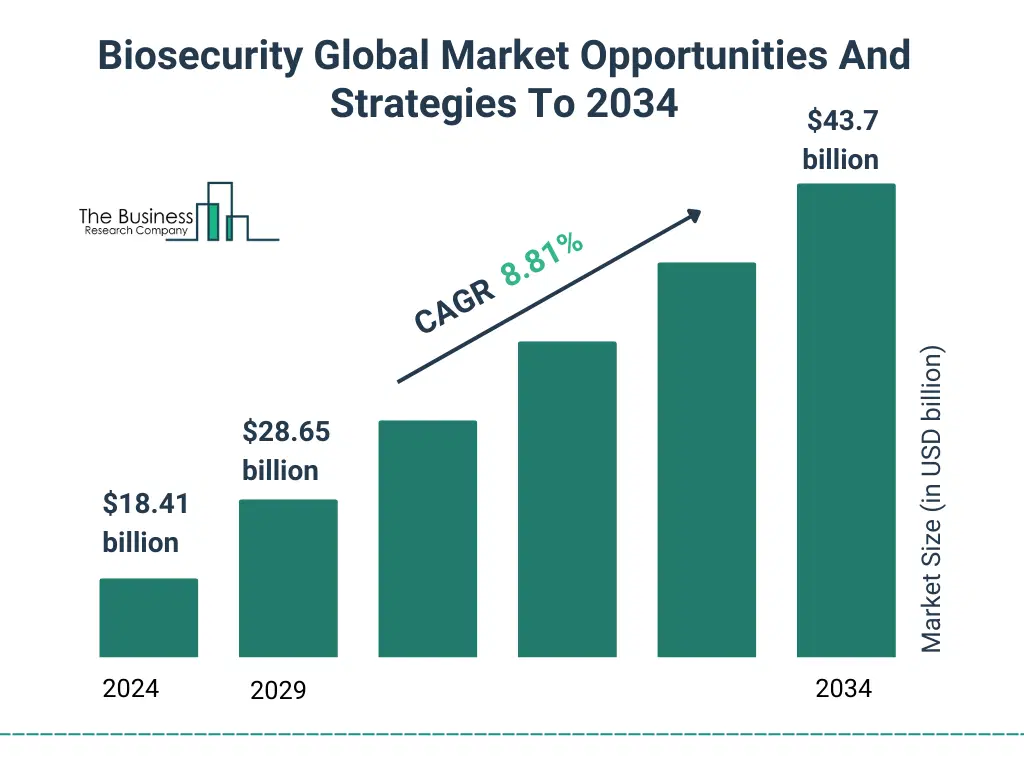
Biosecurity Market Size
The global biosecurity market reached a value of nearly $18,412.51 million in 2024, having grown at a compound annual growth rate (CAGR) of 11.01% since 2019. The market is expected to grow from $18,412.51 million in 2024 to $28,649.07 million in 2029 at a rate of 9.24%. The market is then expected to grow at a CAGR of 8.81% from 2029 and reach $43,698.38 million in 2034. Growth in the historic period resulted from the increasing concerns over food security, increasing infectious diseases, food safety regulations and stricter import controls and rising animal trade and wildlife trafficking. Factors that negatively affected growth in the historic period were high cost of advanced biosecurity technologies and unpredictability of emerging diseases. Going forward, expansion of international travel and tourism, rising demand for livestock production, climate change and shifting disease vectors and growing risk of zoonotic disease transmission will drive the growth. Factors that could hinder the growth of the biosecurity market in the future include challenges in monitoring and compliance, limited funding in public health and agricultural sectors and impact of trade war and tariff.Biosecurity Market Drivers
The key drivers of the biosecurity market include: Expansion Of International Travel And Tourism During forecast period, the expansion of international travel and tourism is expected to propel the growth of the biosecurity market. As cross-border movement raises the risk of the spread of infectious diseases, pests and contaminants, prompting governments, airports and travel-related industries to adopt stringent biosecurity measures. Enhanced regulatory frameworks, coupled with rising awareness among travelers and organizations about health and safety, are further accelerating the demand for effective biosecurity solutions. Consequently, companies offering advanced disinfectants, monitoring systems and pathogen control services are likely to witness significant market opportunities. The expansion of international travel and tourism contribution during the forecast period in 2024 is 1.50%.Biosecurity Market Restraints
The key restraints on the biosecurity market include: Challenges In Monitoring And Compliance Challenges in monitoring and compliance is expected to hinder the growth of the biosecurity market in forecast period. Ensuring adherence to strict biosecurity regulations across farms, transportation systems and healthcare facilities can be complex and resource-intensive. Variations in regional standards, limited technological infrastructure and insufficient trained personnel further complicate effective implementation. These obstacles can delay the adoption of advanced biosecurity measures and increase operational costs for organizations. As a result, despite rising awareness of disease prevention and pathogen control, the market may experience slower growth in regions facing significant compliance and monitoring challenges. Growth affected by challenges in monitoring and compliance during the forecast period in 2024 is -1.96%.Biosecurity Market Trends
Major trends shaping the biosecurity market include: Advancements In Long-Lasting Antimicrobial Solutions For Animal Health Companies operating in the biosecurity market are innovating antimicrobial solutions, forming strategic partnerships and expanding distribution networks to enhance pathogen control, improve animal health and ensure long-lasting protection across diverse animal care environments. For instance, in April 2025, MSD Animal Health, a US-based pharmaceutical company, partnered with Good Salt Life LLC, a US-based wellness company to launch ARMATREX, a spray-on antimicrobial solution outside US and Canada. It is U.S. Environmental Protection Agency (EPA)-registered solution and made with silane quaternary ammonium salt, ARMATREX is odorless, colorless, non-toxic and provides up to 90 days of protection against bacteria, fungi, mold and algae. Designed for livestock farms, veterinary clinics and shelters, it complements traditional cleaning methods and requires no mixing, applying evenly with induction-charged technology. Importantly, it prevents microbial adaptation or resistance. Available in 1-, 5- and 55-gallon containers, the product reflects Merck’s commitment to biosecurity, pathogen control and enhancing animal health outcomes globally. Next-Generation Protective Systems Enhancing Healthcare Safety And Comfort Major companies operating in the biosecurity market are focusing on advancing personal protective equipment (PPE) with improved ergonomics, visibility, comfort and high-level microbial barrier protection to enhance user safety, support healthcare professionals and strengthen infection prevention measures. For instance, in March 2025, Stryker Corporation, a US-based medical technology company, launched the Steri-Shield 8 personal protection system, its latest innovation in personal protective equipment (PPE) designed to improve safety, comfort and usability for healthcare professionals. The system features an ergonomically designed helmet with three secure points for adjustable fit, a ponytail path and enhanced visibility with a brighter light and 22% wider field of vision compared to earlier models. A redesigned fan improves airflow for user comfort, while a sleeker battery and efficient charging station boost convenience. Additionally, three toga styles provide Association for the Advancement of Medical Instrumentation (AAMI) level 4 protection, ensuring the highest standard of fluid and microbial barrier performance.Opportunities And Recommendations In The Biosecurity Market
Opportunities – The top opportunities in the biosecurity markets segmented by product type will arise in the personal protective equipment segment, which will gain $3,733.06 million of global annual sales by 2029. The top opportunities in the biosecurity markets segmented by distribution channel will arise in the government procurement channels segment, which will gain $3,600.31 million of global annual sales by 2029. The top opportunities in the biosecurity markets segmented by end user will arise in the agriculture sector segment, which will gain $3,581.82 million of global annual sales by 2029. The biosecurity market size will gain the most in the USA at $3,488.18 million. Recommendations- To take advantage of the opportunities, The Business Research Company recommends the biosecurity companies to focus on strategic partnerships and product innovation to strengthen market position, focus on enhancing ppe design and functionality to improve safety and market growth, focus on integrating autonomous robotics to advance hygiene and sustainability, focus on strengthening research, training, and partnerships to enhance biosecurity resilience, focus on advancing real-time threat management to strengthen disease preparedness and food security, focus on expanding digital platforms to improve on-farm biosecurity and disease preparedness, focus on advancing dual-action disinfectants and integrated pathogen control programs, focus on expanding ai-driven pathogen monitoring and global early-warning networks, focus on advancing real-time diagnostics and cloud-based monitoring to strengthen biosecurity compliance, focus on automating sanitation with autonomous disinfection systems, focus on personal protective equipment for growth, expand in emerging markets, focus on expanding distribution channels for biosecurity solutions, focus on optimizing pricing strategies for biosecurity solutions, focus on strengthening awareness through targeted communication, focus on driving adoption through incentive-based promotion, focus on online retail for biosecurity sales growth, focus on the agriculture sector for biosecurity expansion.
Biosecurity Market Segmentation
The man-made cellulosic fibers market is segmented by product type, by distribution channel, and by end-user.By Product Type –
The biosecurity market is segmented by product type into:
- a) Biocides And Disinfectants
- b) Personal Protective Equipment
- c) Detection And Monitoring Equipment
- d) Decontamination Systems
- e) Other Product Types
By Distribution Channel –
The biosecurity market is segmented by distribution channel into:
- a) Direct Sales
- b) Distributors And Dealers
- c) Online Retail Or E-commerce
- d) Specialty Stores
- d) Government Procurement Channels
By End-User –
The biosecurity market is segmented by end-user into:
- a) Government And Regulatory Bodies
- b) Healthcare Institutions
- c) Agriculture Sector
- c) Research And Academia
- c) Private And Commercial Sectors
By Geography - The biosecurity market is segmented by geography into:
- • China
- • India
- • Japan
- • Australia
- • Indonesia
- • South Korea
- • USA
- • Canada
- • Brazil
- • France
- • Germany
- • UK
- • Italy
- • Spain
- • Russia
-
o Asia Pacific
o Africa